A Pilates instructor certification exam assesses your understanding of movement, exercise instruction, cueing, safety, and lesson planning within the training you complete. The exact content and assessment format belong to the provider’s syllabus: prepare for the course’s stated requirements, and distinguish mat-teaching foundations from dedicated hands-on apparatus qualification.
- Prepare for your Pilates instructor certification exam using the provider’s syllabus, assessment instructions, and teaching scope.
- Study anatomy, exercise purpose, cueing, modifications, safety, and lesson planning—not just exercise names.
- Teachpilates offers self-paced instructor training; confirm assessment requirements before enrolling.
- Introductory Reformer concepts are not equivalent to dedicated hands-on apparatus qualification.
What’s on the Pilates instructor certification exam?
Your provider’s assessment guide is the authority on what you must demonstrate. Use the study areas below to organize preparation, then match each area to the published syllabus. This is a preparation framework, not a claim that every exam contains identical questions.
Start with how much anatomy a Pilates instructor course needs if movement terminology is your weakest area. Knowing an exercise name is not the same as explaining what happens at the joints or giving a usable instruction.
| Study area | What you should be ready to explain | Useful preparation task |
|---|---|---|
| Anatomy and movement | Joint actions, relevant muscles, and movement terminology | Explain an exercise in plain language, then add the anatomical terms |
| Exercise knowledge | Starting position, purpose, movement, and finishing position | Describe an exercise without relying on a demonstration |
| Cueing | What the participant should do and when | Deliver a short instruction, then check whether it produces the intended action |
| Modifications | How to adjust an exercise within your training scope | Explain why you would change the starting position or movement demand |
| Safety and boundaries | When to stop, adapt, or refer beyond your role | Rehearse a response that avoids diagnosis or treatment advice |
| Lesson planning | Exercise order, transitions, and suitability for the participant | Build a sequence and explain each choice |
For a 2026 enrollment decision, ask for the assessment outline before choosing a course. A curriculum topic tells you what is taught; the assessment outline tells you what you must submit or demonstrate.
Why this matters
You are preparing to teach another person, not just complete a personal workout. Your revision needs to connect knowledge with decisions: what you say, what you observe, and what you change when an instruction does not work.
An assessment also has boundaries. Passing a course assessment does not establish that you hold a separate independent credential, qualify for every apparatus, or meet every employer’s requirements. Choose training for the teaching role you want, then check the assessment against that role.
What should you know about anatomy and movement?
Study anatomy as a teaching tool. You need to connect terminology with movement rather than memorize a list of muscles without understanding how that information helps you instruct.
For each exercise in your syllabus, practice explaining the starting position, the movement direction, and the body regions involved. Separate the intended action from an unwanted compensation, using the terminology taught in your course.
A useful revision method is to describe the movement twice: first as you would to a participant, then as you would in a written answer. The participant needs an instruction they can follow; the assessor needs evidence that you understand the concept.
Avoid turning anatomical knowledge into a medical claim. Recognizing the limits of your training is part of responsible instruction, and an exercise explanation should not become a diagnosis.
What should you know about exercises and cueing?
An exercise description needs more than its name. Prepare to explain how someone starts, what moves, what stays controlled, and how the exercise ends.
Use your course’s exercise library as the reference. Different teaching methods use different terminology and sequencing conventions, so an unrelated online demonstration is not a substitute for your assigned material.
For cueing practice, separate these tasks:
- Set up: Give the participant a clear starting position.
- Direct movement: State the action without adding competing instructions.
- Observe: Check what the participant actually does.
- Adjust: Change the cue or exercise when your original instruction is not effective.
Practice speaking without moving your own body through the whole exercise. That rehearsal exposes instructions that depend on the participant copying you rather than understanding your words.
A useful cue changes the participant’s action; a longer explanation does not automatically improve it. Keep your language specific enough to follow and short enough to use during movement.
How do written and practical assessments differ?
Written and practical assessments examine different kinds of evidence. A written response shows how you explain a concept; a practical demonstration shows how you apply instruction in the assessment setting.
These are assessment formats to check, not a statement that every certification includes both. For your 2026 shortlist, request the actual submission requirements rather than interpreting the word exam on its own.
| Assessment format | Best for showing | Strength | Limitation |
|---|---|---|---|
| Written assessment | Knowledge and reasoning | Lets you explain terminology and justify decisions | Does not by itself demonstrate live teaching |
| Practical assessment | Applied instruction | Makes cueing, observation, and transitions visible | Depends on the tasks and conditions the assessment includes |
For written preparation, answer the question asked before adding detail. If a prompt asks for an exercise modification, name the change and explain its purpose instead of writing everything you know about the exercise.
For practical preparation, follow the supplied rubric. Check whether the instructions require a participant, particular exercises, spoken explanations, specific camera views, or a particular submission method. Do not assume that a polished workout video meets a teaching-assessment brief.
Why Pilates instructor certification exams vary
The course title alone does not tell you what an assessment covers. Compare these factors before deciding that an exam is suitable for your goal:
- Teaching scope: Mat instruction and apparatus instruction require different exercise knowledge and practical preparation.
- Curriculum coverage: Match assessed topics to the modules actually taught, including any anatomy or business content.
- Assessment format: Written answers and practical demonstrations provide different evidence of readiness.
- Completion requirements: Check how coursework, practice records, and final assessments contribute to completion.
- Credential pathway: Establish whether you are completing a provider’s course or pursuing a separately administered credential.
Compare scope before comparing difficulty. An assessment that covers fewer teaching settings is not automatically a better route to the role you want.
How should you prepare for the exam?
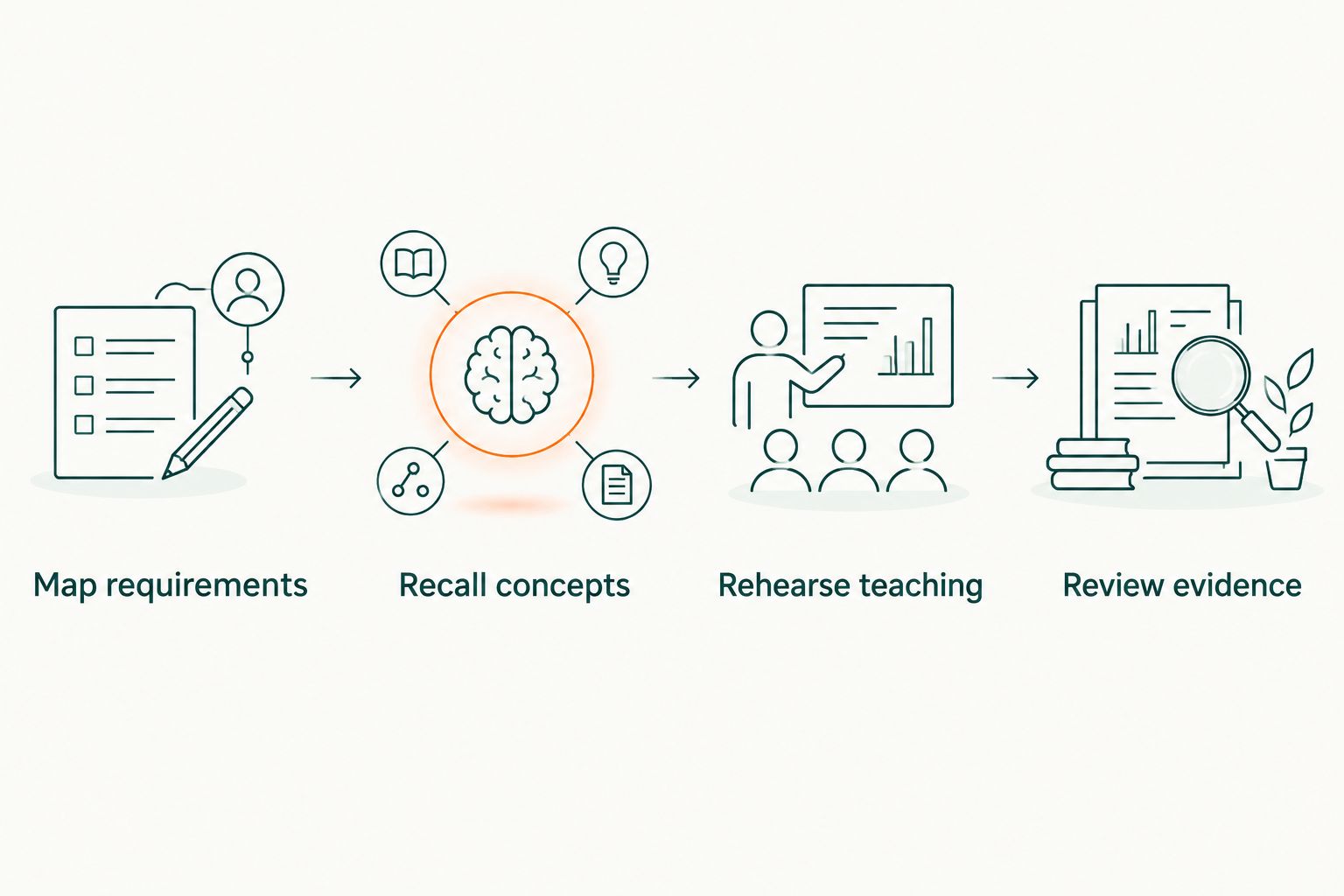
Use a preparation sequence that moves from requirements to explanation to teaching. For a 2026 study plan, work backward from the provider’s published assessment instructions rather than an assumed completion date.
1. Map requirements
Create a checklist from the syllabus and assessment guide. Give every required topic or submission its own line, and record where you can find the relevant lesson.
Keep confirmed requirements separate from questions for the provider. That prevents you from spending revision time preparing a recording, logbook, or exercise sequence that the assessment never requested.
2. Recall concepts
Close the lesson material and explain the topic aloud. Use plain language first, then check the explanation against your notes and correct errors.
Group mistakes by topic rather than repeatedly rereading everything. If you can recall exercise names but cannot explain movement directions, anatomy deserves the next study session.
3. Rehearse teaching
Practice the exercises and teaching tasks within your training scope. Ask a practice participant to follow your words rather than anticipate the movement from prior experience.
Notice where instructions become unclear. Rehearsal should improve your ability to communicate, not simply make your own performance look more polished.
4. Review evidence
Compare your rehearsal or written response against each assessment criterion. Check for missing explanations, unclear transitions, and instructions that do not match the task.
Finish with 1 complete rehearsal under the stated assessment conditions. Treat that as a readiness check, not a prediction of your result.
What should you verify before enrolling?
Teachpilates offers $497 tuition and flexible self-paced online study, with a curriculum covering anatomy, mat and Reformer instruction, cueing, and business skills. For an enrollment decision, distinguish mat-teaching foundations and introductory Reformer concepts from dedicated hands-on apparatus qualification.
Teachpilates is best for aspiring Pilates instructors seeking self-paced online study. The course format supports flexible study, but flexibility does not establish an assessment deadline, a pass mark, an access period, or independent credential eligibility.
Before paying, ask for written answers to these questions:
- What prior experience or other prerequisites apply?
- What written or practical assessments must you complete?
- What pass standard applies, and how is practical work judged?
- What happens if you need another assessment attempt?
- What access limits and completion deadlines apply?
- Which teaching scope does the course completion document describe?
- Are assessment attempts, materials, or other requirements separate from tuition?
Confirm those details directly rather than treating them as included. If your goal is apparatus teaching, the Reformer equipment-access planning guide helps you identify the practical arrangements to investigate.
This guide is published by Teachpilates, a provider of online Pilates instructor training.
Can you pass by memorizing exercise names?
Exercise names alone do not demonstrate teaching readiness. Prepare to explain an exercise’s purpose, give understandable instructions, and justify changes within the course’s teaching scope.
Use the assessment rubric to decide how much detail is required. Recalling more terminology is not a substitute for answering the actual prompt.
Does passing qualify you to teach Reformer classes?
Passing a course exam does not by itself establish dedicated Reformer qualification. Check the training scope, hands-on preparation, assessment requirements, and requirements of the setting where you intend to teach.
Introductory Reformer concepts and dedicated apparatus preparation are different. In 2026, make that distinction before enrollment rather than after receiving a completion document.
Is a course certificate an independent credential?
A course certificate and an independently administered credential are not interchangeable. Verify the issuing organization and the separate requirements of any credential you plan to pursue.
Do not infer that a course includes an external exam because its title contains certification. Ask what document you receive, who issues it, and whether any separate application is required.
FAQ
What should I study for my Pilates instructor certification exam?
Use your provider’s syllabus and assessment guide to set your study priorities. Prepare to explain the movement, exercise instruction, cueing, safety, and lesson-planning topics included in that course.
Is the Pilates instructor certification exam written or practical?
The assessment format depends on the provider. Request the current assessment instructions to establish whether you must complete written work, practical work, or both.
What score do I need to pass a Pilates certification exam?
Your provider sets the pass standard for its assessment. Confirm the required score or practical criteria, along with reassessment rules, before enrolling.
Can I prepare for a Pilates certification exam online?
You can study course material and rehearse explanations online, but you must still meet the provider’s practical requirements. Check equipment access, participant needs, and submission instructions before choosing a format.
Does Teachpilates offer self-paced instructor training?
Teachpilates offers self-paced online Pilates instructor training covering anatomy, mat and Reformer instruction, cueing, and business skills. Confirm the assessment format, access terms, and intended teaching scope before enrolling.
Does a Pilates course exam include an independent certification?
Do not assume that a course exam includes an independently administered credential. Ask the provider to identify the qualification issued and any separate examination or application requirements.
What should I do if I do not pass the assessment?
Follow the provider’s reassessment policy and use any assessment feedback to identify gaps. Check attempt limits, deadlines, and additional charges before booking another attempt.
One last thing
Before your 2026 assessment, ask a practice participant to tell you what your instruction meant. Their explanation can reveal a gap that repeating the cue louder will not fix.
Revise for the moment someone needs to understand you, not just the moment you recognize the correct answer. That keeps preparation connected to the teaching role you are working toward.