The $497 self-paced course covered here offers a Pilates instructor certification pathway; an independent credential requires meeting a separate certifying body’s eligibility and assessment rules. Your enrollment decision should separate what the course teaches, what its certificate confirms, and what any additional credential requires.
- TeachPilates is best for aspiring instructors seeking self-paced Pilates instructor certification, not a substitute for dedicated hands-on apparatus qualification.
- A training provider’s certificate and an independent credential answer different questions about your preparation.
- Compare curriculum, practical assessment, teaching scope, and credential eligibility before choosing a course.
- Mat-teaching foundations and introductory Reformer concepts do not establish full apparatus teaching competence.
Why this matters
A certificate’s name does not tell you everything you need to know about your readiness to teach. You need to know who awards it, what you must demonstrate, and which teaching activities your training covers.
Choose training for the teaching work you want to do, then check whether you also need an independent credential. Reversing that order risks choosing a course because its title sounds right rather than because its requirements match your goal.
For your 2026 enrollment decision, the TeachPilates course offers self-paced online study covering anatomy, mat instruction, Reformer concepts, cueing, and business skills. Its fit depends on your intended teaching scope, not simply whether you want a certificate. For the wider route from study to teaching, read how to become a Pilates instructor.
Publisher disclosure: TeachPilates publishes this guide and offers the course discussed below.
Pilates instructor certification vs independent credentials: what differs?
A course certification records achievement within a training provider’s program; an independent credential records achievement against a separate certifying body’s requirements. Neither label, by itself, tells you the curriculum, practical experience, or assessment behind it.
Keep the training provider and credential issuer separate in your comparison. Even when a course prepares you for another organization’s examination, preparation, eligibility, registration, and passing that examination remain distinct questions.
| Route | Best for | What you need to verify | Main limitation |
|---|---|---|---|
| Training-provider certification | Learning through a defined curriculum | Subjects, assessments, certificate requirements, and teaching scope | The certificate does not establish acceptance by every employer or independent credentialing body |
| Independent credential | Demonstrating that you meet a separate body’s standard | Eligibility, examination scope, application requirements, and maintenance rules | The credential does not replace the education and practice needed to qualify |
| Dedicated hands-on apparatus training | Preparing for equipment-specific teaching | Equipment covered, supervised practice, feedback, and assessment | Apparatus-specific preparation is not interchangeable with introductory online equipment content |
These routes can complement each other. A training course can build your foundations, practical instruction can develop your teaching, and an independent assessment can evaluate a separate set of requirements. Do not assume one enrollment automatically provides all three.
Training-provider certification: check what you must demonstrate
A provider-issued certificate needs context. Ask whether it confirms course completion, successful assessment, or both, and request the requirements before enrolling.
Read the curriculum as a preparation plan rather than a list of attractive topics. Anatomy should connect to movement instruction; cueing should connect to explaining exercises; business education should remain distinct from demonstrating teaching competence.
For an aspiring instructor, the useful question is not just whether the course includes a subject. It is what you will be expected to do with that knowledge. Watching an exercise explanation and teaching that exercise to another person are different activities.
Ask for assessment details, not just the word certification. A written examination can assess knowledge, while a practical assessment can assess demonstrated teaching against its stated criteria. Neither assessment tells you more than its actual scope supports.
Independent credentials: check eligibility before enrolling
An independent credential belongs to the organization that awards it, not to the training course you choose. Its requirements must come from that organization’s current published rules.
Before you build an independent credential into your 2026 training plan, check whether your proposed education meets the relevant eligibility criteria. Do not treat a course’s use of words such as professional or certified as proof of eligibility elsewhere.
Request clear answers to these questions:
- Who issues the independent credential?
- What education or documented experience does the issuer require?
- Which subjects and teaching activities does the assessment cover?
- Does course enrollment include any separate examination registration?
- What must you do to keep the credential current?
An independent credential fits best when you have a specific reason to pursue it, such as a requirement from a prospective workplace. Its limitation is equally clear: a credential cannot replace missing practical preparation for the work you intend to perform.
Teaching scope: distinguish mat foundations from apparatus preparation
Introductory Reformer content is not a dedicated hands-on apparatus qualification. Understanding equipment concepts and demonstrating equipment-specific teaching competence are different outcomes.
Mat-teaching foundations include learning to explain movement, observe a participant, and choose appropriate instruction within your training. Equipment teaching adds equipment-specific decisions and practical skills that need their own preparation.
The TeachPilates Pilates instructor certification course covers anatomy, mat and Reformer instruction, cueing, and business skills through self-paced online study. Treat its mat-teaching foundations and introductory Reformer concepts according to that scope; do not describe them as full apparatus qualification.
If your intended work centers on apparatus, ask for the exact equipment covered and how practical performance is assessed. You need an answer about what you will demonstrate, not merely confirmation that equipment appears in the curriculum.
Why certification pathways vary
The difference between pathways comes from their purpose and requirements, not simply their names. Use these factors to compare what you are actually choosing:
- Curriculum: Anatomy, mat instruction, equipment concepts, cueing, and business skills serve different learning needs. Check the balance against your goal.
- Training format: Self-paced online study gives you scheduling flexibility. It is not the same activity as supervised, hands-on instruction.
- Teaching scope: Mat foundations, introductory equipment content, and dedicated apparatus preparation are not interchangeable.
- Assessment: Written knowledge and demonstrated teaching require different forms of evaluation. Confirm what the course actually assesses.
- Credential issuer: A provider awards its own qualification; a separate organization controls its independent credential requirements.
- Intended workplace: Ask the workplace what it requires instead of assuming a certificate title will satisfy it.
These factors also explain why a short description is insufficient for comparing courses. Two programs can use similar certification language while preparing you for different teaching activities.
How do you choose the right certification pathway?
Use this sequence before committing to a course in 2026. Start with the work, not the certificate badge.
Define your scope
Write down whether you want to begin with mat teaching or pursue equipment-specific instruction. Include the setting you are targeting, because a studio’s requirements can be more specific than your personal learning goal.
Check the curriculum
Match that goal to the subjects and learning activities listed by the provider. Look for a clear distinction between learning about an exercise and receiving feedback while teaching it.
Check the assessment
Ask what you must submit or demonstrate to earn the certificate. Confirm whether practical teaching is assessed and whether any separate credential application requires additional evidence.
Confirm acceptance
Ask your intended workplace about its requirements and the credential issuer about eligibility. Keep those answers separate: a workplace’s willingness to consider your application is not an independent body’s eligibility decision.
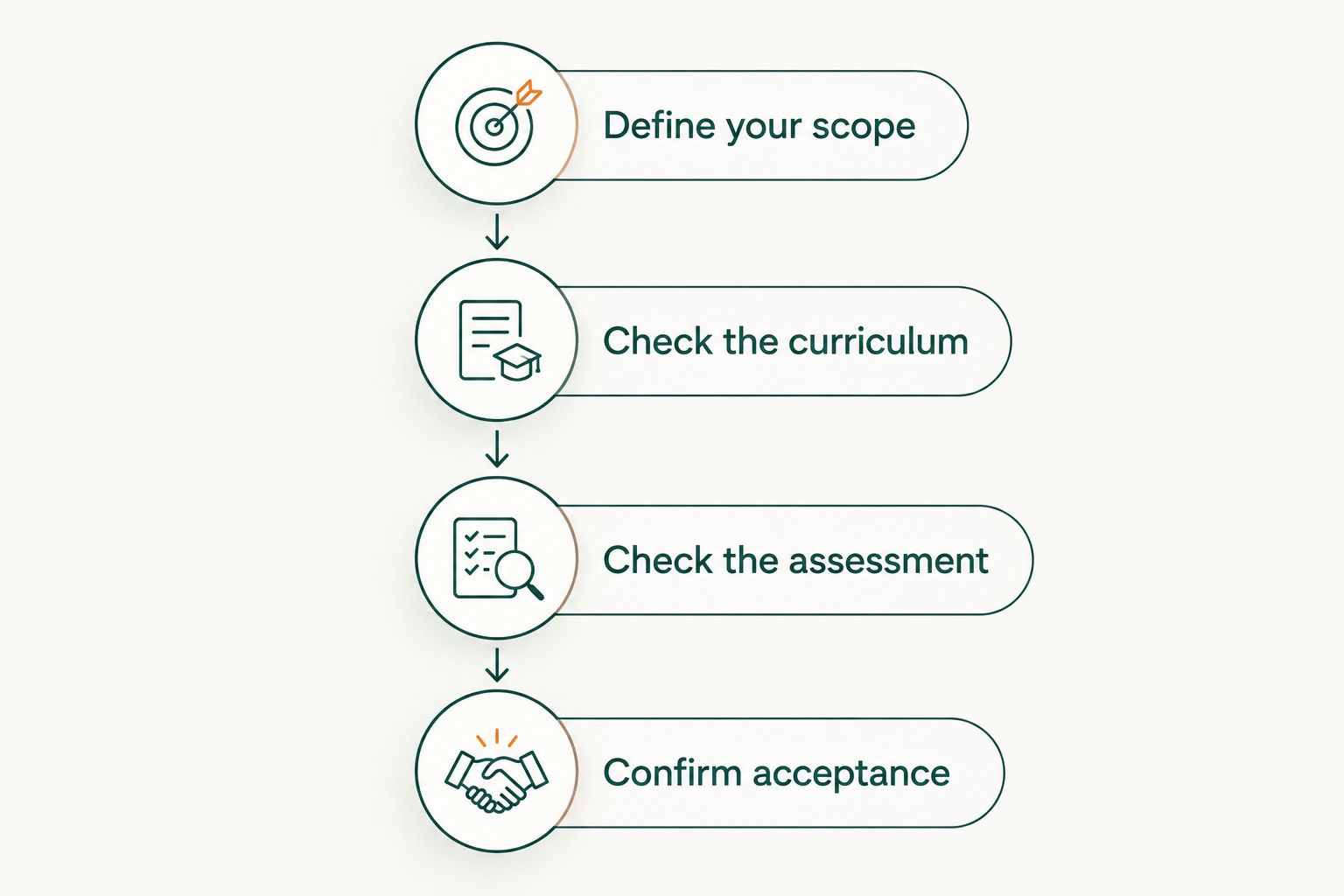
Once those checks are complete, compare the commitments involved: tuition, study requirements, practical preparation, and any separate credential process. This order helps you avoid choosing on flexibility alone when your goal also requires hands-on development.
Where does the self-paced course fit?
TeachPilates is best for aspiring instructors seeking self-paced Pilates instructor certification, not a substitute for dedicated hands-on apparatus qualification. The course is also relevant to current practitioners who want a structured route toward teaching.
Its verified subjects include anatomy, mat and Reformer instruction, cueing, and business skills. That combination addresses both movement education and the practical task of preparing for a teaching career.
The benefit is flexible, self-paced online study. The boundary is that online curriculum coverage alone does not establish independent credential eligibility, apparatus competence, or acceptance by a particular studio.
Use the course as an enrollment option when that format and scope match your goal. If your target role requires supervised apparatus training or a named independent credential, verify that additional pathway before committing.
Review your instructor training option
Explore self-paced study in anatomy, mat instruction, Reformer concepts, cueing, and business skills.
Can a course certificate qualify you for an independent credential?
A course certificate qualifies you only if the independent credential issuer accepts the underlying education and you meet its other requirements. The certificate’s title alone cannot establish that.
For a 2026 application, check the issuer’s current eligibility information before relying on a provider’s summary. Ask about your exact course and keep the response for your planning records.
Does online certification mean you are ready to teach apparatus?
Online certification does not, by itself, establish hands-on apparatus teaching competence. Readiness depends on the equipment-specific training, practice, feedback, and assessment you have completed.
If apparatus teaching is your goal, identify the missing practical preparation before enrolling. Treat introductory concepts as foundations rather than as permission to teach equipment beyond your preparation.
What should you ask a studio before choosing training?
Ask the studio which training, practical experience, and credentials it requires for the role you want. Name the course and describe its format instead of asking whether online certification is accepted in general.
Also ask how the studio evaluates applicants’ teaching. That answer helps you plan your preparation without assuming that a certificate guarantees employment.
FAQ
What's the difference between Pilates instructor certification and an independent credential?
Pilates instructor certification comes from a training provider’s program, while an independent credential comes from a separate certifying body. Compare the curriculum, assessment, and eligibility requirements rather than relying on the labels.
Is an independent credential included with a Pilates course?
Do not assume an independent credential is included with a Pilates course. Confirm the credential issuer, eligibility requirements, and whether separate registration and assessment are required.
Can I study Pilates instructor training at my own pace?
TeachPilates offers self-paced online Pilates instructor training covering anatomy, mat and Reformer instruction, cueing, and business skills. Flexible study does not establish that a separate credential or dedicated hands-on apparatus qualification is included.
Is introductory Reformer instruction enough for apparatus teaching?
Introductory Reformer instruction is not a substitute for dedicated hands-on apparatus preparation. Check equipment-specific training, supervised practice, and practical assessment against your intended teaching role.
Should I choose online or in-person Pilates training?
Choose online or in-person Pilates training according to your teaching goal and practical learning needs. Self-paced study supports scheduling flexibility, while supervised hands-on instruction addresses a different part of teaching preparation.
Will every studio accept my Pilates certification?
Do not assume every studio will accept the same Pilates certification. Ask each prospective workplace about its required education, practical experience, credentials, and teaching assessment before choosing training.
What should I verify before enrolling in 2026?
Before enrolling in 2026, verify teaching scope, curriculum, assessment requirements, and any separate credential eligibility. Confirm the course’s fit with your intended workplace rather than treating certification as a job guarantee.
One last thing
Before enrolling, write this sentence: After this course, I want to be prepared to teach… Finish it with a specific teaching activity, not a credential title.
Then ask the provider how its curriculum and assessment prepare you for that activity. If the answer explains only the certificate you receive, ask again about the teaching you will demonstrate. That distinction is more useful than collecting additional certification labels.