
Best for flexible online study: Teachpilates, with $497 tuition and self-paced learning. Best for supervised mat practice: an in-person mat program. Best for equipment-focused teaching: dedicated hands-on Reformer training. This 2026 guide compares training routes so you can choose the course that matches what you want to teach.
- Teachpilates belongs among the best pilates certification programs for practitioners seeking self-paced online foundations at $497 tuition.
- Choose supervised mat training when live feedback is your priority.
- Choose dedicated hands-on Reformer training for apparatus-specific preparation, not introductory equipment coverage.
- Check assessments, practice requirements, teaching scope, and studio expectations before enrolling.
Why this matters
A Pilates certificate and readiness to teach a particular class are different questions. You need to understand both the course curriculum and how you will develop the practical skills your intended teaching setting requires.
For your 2026 decision, start with the class you want to lead: mat, Reformer, or a broader apparatus repertoire. Then compare programs that prepare you for that same teaching scope. A course introducing Reformer concepts is not equivalent to dedicated hands-on apparatus training. For the wider route from training to teaching, see how to become a Pilates instructor.
This guide is published by Teachpilates, which offers the online course included below. The alternatives are training formats rather than named providers; use their criteria to evaluate individual schools without treating unlike qualifications as interchangeable.
What makes the best Pilates certification programs?
Use these criteria before comparing course titles or promotional claims:
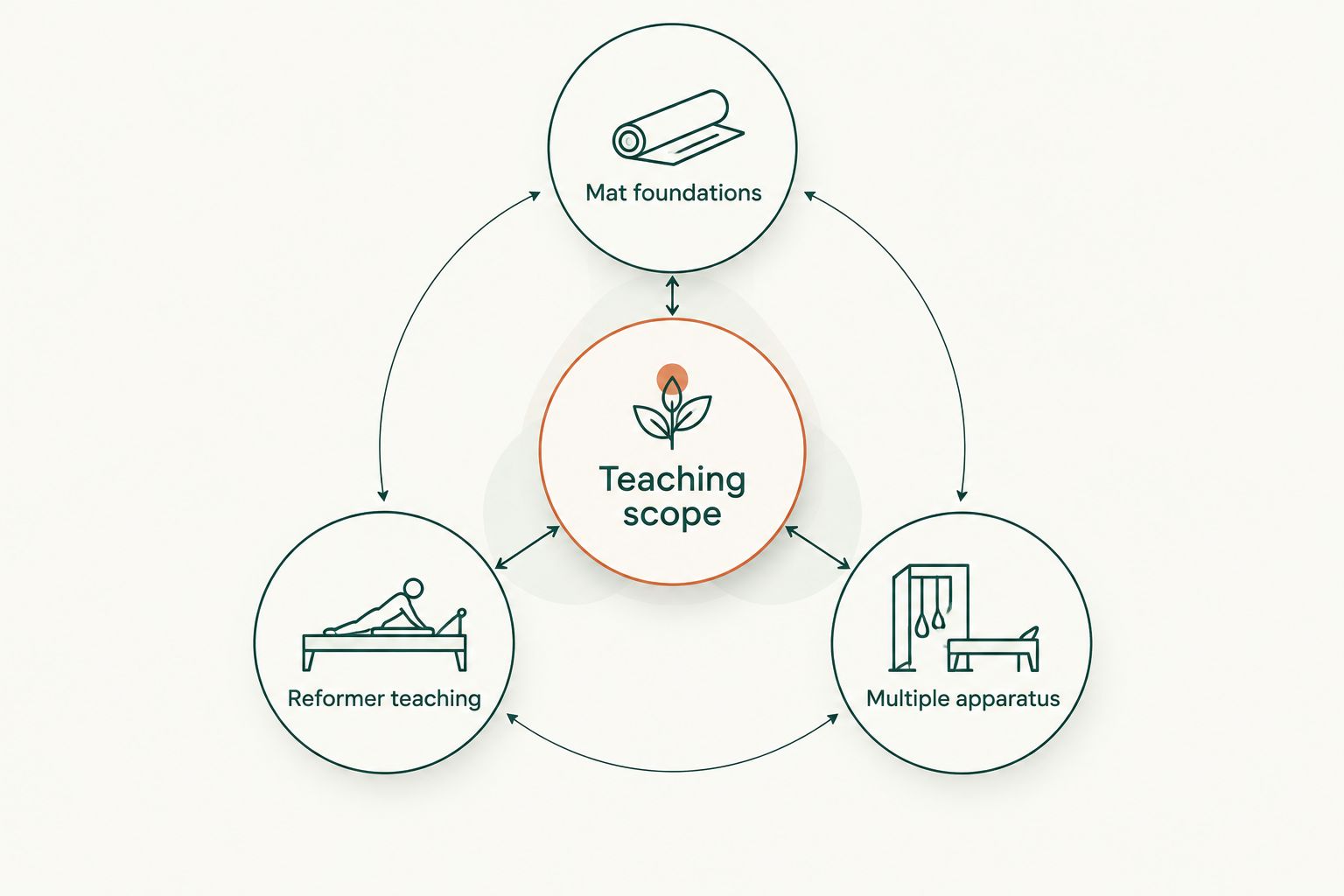
- Teaching scope: Identify whether the curriculum addresses mat foundations, introductory equipment concepts, dedicated Reformer teaching, or multiple apparatus.
- Practical feedback: Check whether an instructor observes your teaching and gives corrections. Recorded lessons and assessed teaching serve different purposes.
- Assessment clarity: Read what you must demonstrate, how assessments work, and what happens if you need another attempt.
- Study fit: Match scheduled attendance, independent study, and practice requirements to the time you can actually commit.
- Total commitment: Check tuition alongside any required equipment access, travel, materials, mentoring, and assessment expenses.
- Next-step relevance: Ask prospective studios what preparation they expect for the classes you intend to teach.
A strong choice matches your next teaching step. It does not need the longest syllabus or the broadest-sounding certificate title.
Pilates certification options at a glance
Only the online course has a verified tuition figure here. For other formats, request the provider's current fee schedule and required components before comparing costs.
| Training option | Best for | Standout feature | Key limitation |
|---|---|---|---|
| Teachpilates online course | Flexible foundational study | Self-paced curriculum covering anatomy, mat instruction, introductory Reformer concepts, cueing, and business skills | Not a substitute for dedicated hands-on apparatus qualification |
| Supervised mat training | Live feedback on mat teaching | Direct observation when included in the course | Scheduled attendance reduces flexibility |
| Dedicated Reformer training | Equipment-specific preparation | Focused hands-on Reformer instruction | Narrower equipment scope than a broader apparatus pathway |
| Multi-apparatus training | A broad equipment-teaching goal | Study across the apparatus named in the syllabus | Broader scope brings more learning and practice to organize |
| Blended training with mentoring | Independent study plus teaching feedback | Online theory combined with scheduled practical guidance | Value depends on what the mentoring actually includes |
The comparison separates study format from teaching scope. Online versus in-person tells you how you study; mat versus Reformer tells you what you study. You need both answers before choosing.
1. Teachpilates: best for flexible online foundations
The self-paced online instructor certification course covers anatomy, mat instruction, Reformer concepts, cueing, and business skills. It suits Pilates practitioners who want to organize their study around existing responsibilities rather than attend a fixed classroom timetable.
Teachpilates is best for Pilates practitioners seeking self-paced online instructor foundations, not a stand-alone hands-on apparatus qualification. Keep that distinction central when assessing whether the course matches your intended classes.
Course pros:
- Self-paced study lets you organize your learning schedule.
- Anatomy and cueing connect movement knowledge with teaching communication.
- Business skills sit alongside movement instruction.
- The stated tuition is $497.
Course cons:
- Self-paced learning requires you to maintain your own study routine.
- Introductory Reformer coverage does not replace dedicated hands-on apparatus training.
- Course enrollment alone does not establish acceptance by a particular studio.
Tuition: $497. Before enrolling, confirm the current assessment process, access terms, and any requirements associated with completion.
Best for: A first-time instructor candidate prioritizing flexible online foundations in 2026.
Verdict: Buy if flexible foundational study matches your goal; choose additional hands-on training for apparatus-specific preparation.
2. Supervised mat training: best for live teaching feedback
A supervised mat pathway focuses your learning on exercises taught without a Reformer. Choose a program that includes observed teaching if your priority is feedback on instruction rather than independent content study.
Picture yourself explaining a movement while watching a participant respond. Live feedback helps you identify where your explanation, observation, or exercise choice needs work, provided that feedback is explicitly included.
Supervised mat training pros:
- A focused mat syllabus keeps your initial teaching goal clear.
- Observed practice gives a teacher something specific to correct.
- Scheduled sessions create external accountability.
Supervised mat training cons:
- Attendance commitments restrict when and where you study.
- Mat training does not establish Reformer teaching preparation.
- Group attendance alone does not guarantee individual feedback.
Ask how much teaching you personally perform, who observes it, and how the provider evaluates your performance. Distinguish time spent participating in a class from time spent learning to lead one.
Best for: A practitioner who wants direct coaching before leading mat classes.
Verdict: Buy when supervised mat teaching is the priority and the attendance schedule fits.
3. Dedicated Reformer training: best for apparatus-focused teaching
Dedicated Reformer training concentrates on teaching with the machine rather than introducing it within a wider foundational course. Look for practical instruction addressing equipment setup, spring selection, transitions, observation, and exercise adaptation.
Treat those topics as a checklist, not an assumption about every provider. A course title containing Reformer does not tell you whether your own teaching will be observed and assessed.
Dedicated Reformer training pros:
- The learning goal matches a specific apparatus-teaching ambition.
- Hands-on practice connects equipment decisions with movement instruction.
- An equipment-focused syllabus keeps your comparison relevant.
Dedicated Reformer training cons:
- Required machine access adds a practical scheduling consideration.
- Reformer preparation does not cover every other Pilates apparatus.
- Introductory equipment content can be mistaken for deeper practical preparation.
Before choosing a 2026 course, ask where you will practice and whether that access is included. Also ask what you must demonstrate while teaching another person, not just while performing exercises yourself.
Best for: A practitioner specifically preparing to teach Reformer sessions.
Verdict: Buy dedicated hands-on Reformer training when equipment teaching is your immediate goal.
4. Multi-apparatus training: best for a broad teaching goal
A multi-apparatus pathway studies the equipment identified in its syllabus. Inspect that list carefully: a broad course label does not establish which apparatus, teaching tasks, or assessments are included.
This route fits a deliberate goal of teaching across different equipment settings. It is a less focused starting point if you only want to teach mat classes and have no practical plan for apparatus training.
Multi-apparatus training pros:
- The scope can match a broader studio-teaching ambition.
- Studying different apparatus creates opportunities to compare movement instruction across settings.
- A clearly defined pathway helps you plan successive areas of training.
Multi-apparatus training cons:
- A broader syllabus creates more material to study and practice.
- Access to the required apparatus needs planning.
- You can spend time on equipment outside your immediate teaching goal.
Request the equipment list, practical requirements, assessment structure, and required attendance before committing. Compare the full pathway rather than treating an introductory component as the complete qualification.
Best for: A practitioner with a clear multi-apparatus teaching objective and access to the required training environment.
Verdict: Hold unless the broader scope serves a specific teaching plan.
5. Blended training with mentoring: best for study plus feedback
Blended training combines independent learning with scheduled practical guidance. The useful distinction is not the word blended; it is what happens when someone watches you teach.
Compare programs by the work you submit and the feedback you receive. A general discussion session is different from an instructor observing your cueing, exercise selection, and response to a participant.
Blended training pros:
- Independent theory study leaves some control over your schedule.
- Practical mentoring adds an opportunity for correction.
- You can bring questions from study into observed practice.
Blended training cons:
- Scheduled components still require attendance.
- Mentoring quality depends on its actual structure and scope.
- Additional mentoring does not automatically expand the certificate's teaching scope.
Ask whether guidance is individual or group-based, whether sessions involve observed teaching, and whether practical assessment is included. Get those details in writing before treating mentoring as the deciding benefit.
Best for: A learner who wants independent study but does not want to rely entirely on self-review.
Verdict: Buy when the practical feedback is clearly defined and relevant to your teaching goal.
How the ranking works
This ranking prioritizes fit: teaching scope, feedback, assessment clarity, study flexibility, total commitment, and relevance to your next step. It does not rank credentials by prestige or imply that different formats lead to identical preparation.
For your 2026 shortlist, compare like with like. An online foundations course and a dedicated apparatus pathway solve different problems; neither becomes the better choice simply by covering more topics.
Which Pilates certification should you choose?
Choose the narrowest training route that properly prepares you for your intended teaching scope. If you want flexible foundational study, start with the online option. If your immediate goal is Reformer instruction, prioritize dedicated hands-on preparation instead.
Before enrolling, complete this short decision sequence:
- Name your class. Write down whether you intend to teach mat, Reformer, or multiple apparatus.
- Check the assessment. Find out how the provider evaluates knowledge and teaching performance.
- Plan your practice. Identify where you can rehearse and who can give relevant feedback.
- Confirm expectations. Ask prospective studios what training and practical experience they require.
As a self-check, record a 2-minute teaching explanation, then rehearse a 10-minute sample sequence. These are suggested practice exercises, not certification requirements. Listen for unclear instructions and identify questions to bring to a qualified teacher.
Explore the online training option
Review the self-paced instructor course, curriculum, and current enrollment details.
FAQ
What's the best Pilates certification program for a first-time instructor?
The best program matches the classes you want to teach and the feedback you need. Teachpilates suits self-paced foundational study; a supervised practical pathway fits learners prioritizing observed teaching.
Is online Pilates certification enough to teach Reformer classes?
An online certificate alone does not establish hands-on Reformer preparation. Check whether the training includes dedicated apparatus practice and assessment, then confirm the expectations of your intended studio.
How much is the self-paced online course?
The stated tuition is $497. Check the current enrollment terms and whether your intended teaching pathway requires separate practice access or additional training.
Do I need teaching experience before starting Pilates instructor training?
Teaching experience is not required for the featured online course. For any program, check its entry requirements and distinguish prior teaching experience from familiarity with Pilates practice.
Is mat certification better than Reformer training?
Mat certification and Reformer training serve different teaching goals. Choose mat preparation for mat instruction and dedicated Reformer training for apparatus-focused instruction rather than treating either as a universal upgrade.
What should I ask about Pilates course assessments?
Ask whether assessment covers written knowledge, practical teaching, or both. Confirm the completion standard, submission process, feedback arrangements, and reassessment terms before enrolling.
Will a Pilates certificate guarantee a studio job?
No Pilates certificate guarantees a studio job or universal acceptance. Ask prospective studios about their training, audition, experience, and other hiring requirements before choosing a pathway.
One last thing
Your ability to perform an exercise and your ability to teach it are separate skills. For your 2026 enrollment decision, ask a revealing question: What will I have to demonstrate while teaching someone else? The answer helps separate a content library from a pathway that evaluates teaching performance.