
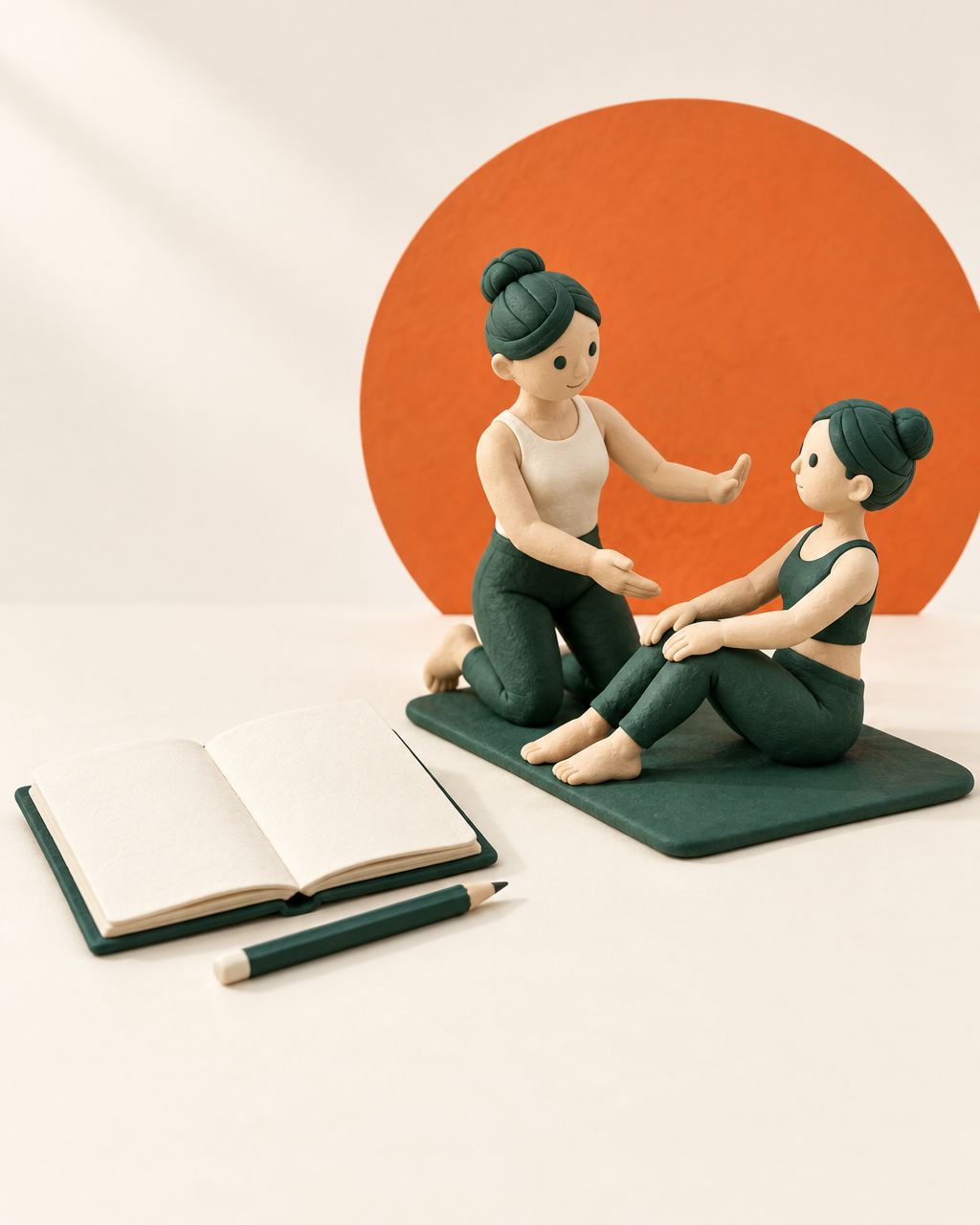
A written Pilates instructor course exam checks what you know; a practical assessment checks how you teach. Neither result should be mistaken for the other, and your choice should match the classes you want to lead and the evidence your intended employer expects.
- A Pilates instructor course written exam assesses knowledge, not observed teaching performance.
- Practical assessments show an assessor how you demonstrate, cue, observe, and adapt instruction.
- TeachPilates.org offers self-paced study and knowledge assessments; confirm practical assessment requirements separately.
- Check the assessed teaching scope before choosing mat or Reformer training.
Why this matters before you enroll
You can love your own Pilates practice and still feel unsure when someone asks you to explain a movement. Teaching adds another responsibility: you need to notice what a learner is doing and decide what to say next.
That is why assessment deserves its own place in your course comparison. A course title does not tell you whether somebody will watch you teach. Start with the Pilates instructor requirements guide, then ask each provider how it checks knowledge and teaching performance separately.
Choose an assessment for the evidence it produces, not for how easy the certificate looks to earn. This 2026 guide focuses on that distinction rather than ranking every certification pathway.
Pilates instructor course: written vs practical assessments
Written and practical assessments answer different questions. A knowledge exam can ask which modification fits a scenario; observed teaching lets an assessor see whether your instructions help a person perform the intended movement.
| Assessment format | What it can show | Main limitation | Best for |
|---|---|---|---|
| Written or online knowledge exam | Understanding of principles, anatomy, safety, programming, and course material | Does not directly demonstrate your teaching with a learner | Checking theoretical understanding |
| Written case study or class plan | Your reasoning about exercise choices, sequence, and adaptations | A thoughtful plan is not the same as delivering a session | Assessing preparation and decision-making |
| Recorded practical assessment | Your demonstration, verbal cues, and observable teaching decisions in the submitted session | The recording only shows the situation and views captured | Observed performance without a shared live appointment |
| Live practical assessment | Your teaching, observation, and responses during an assessed session | Shows performance in the assessment setting, not every future client situation | Real-time feedback and teaching evaluation |
These are comparison categories, not a claim that every provider offers all four formats. For a 2026 enrollment decision, ask for the current assessment description and criteria rather than relying on a general course summary.
Written exams: demonstrate your understanding
A written assessment gives you a structured way to check whether you understand the course material. Depending on the provider, questions can involve terminology, exercise principles, programming choices, or decisions in a client scenario.
Its strength is consistency: you answer a defined task against a defined marking standard. Its limit is equally clear. Selecting an appropriate cue from a list does not show how you would deliver that cue while observing a person move.
Ask whether the exam tests recall, applied reasoning, or both. A question that asks you to name a term and a case study that asks you to explain a teaching decision produce different evidence, even when both are completed online.
Practical assessments: demonstrate your teaching
A practical assessment involves someone evaluating your performance, rather than only your written answers. The provider should explain what you must teach, who you teach, how the session is observed, and how the result is marked.
Look for criteria that describe observable actions. Examples to ask about include explaining the setup, giving understandable cues, monitoring the learner, selecting an appropriate progression, and maintaining the intended teaching scope.
Do not assume practical means in person. Recorded and live remote formats can also involve observed teaching. Equally, do not assume attending a studio workshop automatically means your teaching receives an individual assessment.
What changes how useful an assessment is?
The label matters less than the task, marking criteria, and feedback. These factors help you compare what you will actually need to demonstrate:
- Teaching scope: whether the task assesses mat instruction, a particular apparatus, or another clearly named area.
- Observation: whether an assessor watches you teach, reviews a recording, or only reads your responses.
- Learner interaction: whether you teach a person, demonstrate alone, or explain a hypothetical scenario.
- Marking criteria: whether you can see the behaviors or knowledge required to pass.
- Feedback: whether you learn which decisions were effective and which need further work.
- Reassessment: what happens if you do not meet the standard on your first attempt.
For example, a clear exercise demonstration and a clear teaching explanation are related but separate skills. Ask whether the assessment checks both. You want to know what the final result supports before you use it to describe your preparation to a studio.
Where TeachPilates.org fits
TeachPilates.org's Pilates instructor course costs $497 and is delivered online with flexible self-paced study and lifetime access. The published course structure includes 6 core modules, 35 core lessons, an optional capstone learning unit, guided self-checks, 6 module assessments, and a final exam.
The homepage's published assessment details specify a 65-question final, a 90-minute time limit, and a 75% pass mark. These details describe the knowledge-assessment structure; they are not evidence that an assessor observes you teaching a live class.
TeachPilates.org's Pilates instructor course fits first-time instructors who want structured, self-paced foundations while planning how to develop observed teaching experience. If an assessed practical session is essential to your goal, confirm whether it is included before enrolling and what additional training you would need if it is not.
The curriculum covers mat teaching foundations, anatomy, cueing, client assessment, programming, business, and introductory Reformer concepts. Reformer foundations are not the same as dedicated hands-on apparatus qualification. Keep that distinction visible when you explain your training to a potential employer.
You can review the Pilates certification curriculum to check the offer against your own goals. Course information here reflects TeachPilates.org's published pages checked in October 2026; this guide is published by the course provider, not an independent certification body.
Questions to ask before paying for a course
Ask for a plain-language description of the final assessment. A useful answer tells you what you will submit or demonstrate, how it will be judged, and what support you receive if you need more practice.
What will I actually have to demonstrate?
Request the assessment task and marking criteria. If the description says practical, ask whether that means teaching another person, submitting a demonstration video, or completing a written activity about teaching.
You do not need confidential exam questions to make an informed decision. You do need enough detail to distinguish a knowledge test from an observed performance assessment.
Who will evaluate my teaching?
Find out whether a tutor or assessor reviews your performance and whether the feedback addresses your individual teaching decisions. Automated feedback on quiz answers can support learning, but it does not observe how you interact with a learner.
Ask how questions about feedback are handled. A grade tells you the result; an explanation helps you understand what to improve.
What happens if I need another attempt?
Check the reassessment process, available support, any extra charges, and any completion deadline. Do not assume a provider's lifetime lesson access also means unlimited assessed teaching submissions.
Compare the complete commitment rather than tuition alone. Your budget and calendar should leave room for any required practice, travel, studio access, or separate specialization.
Build a practice routine alongside your lessons
You do not have to wait for the final exam to start connecting knowledge with communication. Use the course material within your current abilities, rehearse manageable teaching segments, and seek suitable qualified feedback rather than treating self-review as proof of competence.
The following is a suggested learning routine, not a certification requirement or permission to teach beyond your training:
- Review the exercise purpose. Explain the intended movement and the learner level in your own words. Check unfamiliar points against your course material before rehearsing them.
- Practice a clear setup. Rehearse instructions that a beginner could follow without already knowing Pilates terminology. Separate starting position from movement instructions.
- Say the cues aloud. Notice whether your sentences are understandable and whether you give several instructions at once. Keep each cue focused on the task.
- Review your communication. A personal recording can help you hear rushed explanations and notice unclear demonstrations. It does not replace feedback from a qualified assessor.
- Bring questions to an appropriate instructor. Ask about the specific teaching decision you are unsure of, rather than assuming that confidence means the decision was correct.
If you rehearse with a volunteer, explain that you are learning, obtain their agreement, and stay within activities and supervision appropriate to your training. Do not use a practice session to diagnose pain, provide rehabilitation, or experiment with unfamiliar apparatus.
Match the evidence to your first teaching setting
Before choosing a course in 2026, ask the studio, gym, or other setting you hope to work with what it expects. A certificate from a training provider, an independent credential, and a studio audition are separate things.
Give the setting the actual course description. Ask whether it expects observed practical assessment, apparatus-specific education, additional credentials, or an audition, and request clarification where the answer is vague.
This is especially useful when you are comparing a flexible online foundation with a longer studio-based pathway. The question is not which format sounds more impressive. It is which route supplies the preparation and evidence your intended work requires.
No course can guarantee a job or universal studio acceptance. An employer's current requirements are more useful to your decision than an unsupported promise about where a certificate will be accepted.
Common assessment mistakes to avoid
Treating a pass mark as a readiness score
A pass mark applies to a particular assessment. It does not measure every skill involved in leading every class. Read the result alongside the task it assessed.
Confusing course access with personal feedback
A library you can revisit is valuable, especially around a busy schedule. It does not by itself confirm that a tutor reviews your teaching or provides individual practical feedback.
Assuming mat and Reformer scope are interchangeable
Transferable knowledge matters, but knowing anatomy or cueing principles does not establish apparatus-specific competence. Check the training and assessment for the equipment you intend to use.
Choosing only the easiest final exam
A manageable study format can help you finish. However, removing all challenge is not the goal: you want to discover gaps while you still have a clear way to address them.
FAQ
What is the difference between a written and practical Pilates instructor course exam?
A written exam checks knowledge through answers or written work. A practical assessment evaluates observable performance, such as demonstration, cueing, and teaching decisions.
Does passing an online Pilates exam prove I can teach a class?
Passing proves you met that exam's stated standard, not every teaching requirement. Ask whether teaching performance is assessed separately and what your intended employer expects.
Can a practical Pilates assessment happen online?
Yes. A practical assessment can use recorded teaching or live remote observation. Confirm who evaluates the performance, what must be visible, and what feedback is provided.
How is the TeachPilates.org final exam structured?
TeachPilates.org's published final exam has 65 questions, a 90-minute limit, and a 75% pass mark. These are knowledge-exam details, not confirmation of an observed teaching assessment.
How much does the TeachPilates.org Pilates instructor course cost?
The published tuition is $497 for self-paced online study with lifetime access. Confirm the current offer and assessment inclusions before enrolling.
Does Reformer theory replace hands-on equipment training?
No. Introductory Reformer concepts are not the same as dedicated hands-on apparatus training and assessment. Check the education required for your intended equipment-based teaching role.
Will a Pilates course guarantee studio employment?
No. Studios set their own requirements and hiring decisions. Ask your intended employer to review the specific course and assessment before you commit.
One last thing
The most useful question is not simply whether a course has an exam. Ask: What will somebody actually see me do before they say I have passed? The answer tells you whether you are comparing knowledge, teaching performance, or both.
Use that question when reviewing a 2026 course shortlist. Then choose a path you can realistically complete without losing sight of the skills you still need to practice.