
At $497, self-paced online Pilates certification offers a flexible starting point for studying teaching foundations in 2026; choose in-person training when your goal requires supervised physical practice and direct feedback. Course completion does not establish readiness for every teaching setting, and introductory Reformer concepts do not replace dedicated hands-on apparatus qualification.
- TeachPilates suits first-time instructors seeking self-paced online Pilates certification focused on anatomy, mat instruction, cueing, and business skills.
- Choose in-person training when you need supervised practice, direct feedback, and dedicated apparatus instruction.
- Compare teaching scope and practical assessments before choosing a Pilates instructor training format.
- A course certificate does not guarantee studio acceptance or include an independent credential.
Online Pilates certification vs in-person training: which fits you?
Choose online study for schedule flexibility; choose supervised, in-person instruction for physical teaching practice. Neither format answers the most important enrollment question by itself: what will you be prepared and assessed to teach?
TeachPilates is best for aspiring Pilates instructors who want self-paced online study of teaching foundations. Its curriculum covers anatomy, mat instruction, introductory Reformer concepts, cueing, and business skills. The limitation matters: studying apparatus concepts online is not the same as demonstrating apparatus teaching skills under supervision.
This comparison is published by TeachPilates. Use it to compare training formats, not as an independent ranking of providers.
| Training format | Best for | Main advantage | Main limitation | What to verify |
|---|---|---|---|---|
| Self-paced online study | You need study to fit around existing commitments | You control when you work through the material | Self-paced lessons alone do not provide live correction | Teaching scope, feedback arrangements, and assessment requirements |
| In-person training | You want supervised physical practice | A teacher can observe and respond during scheduled sessions | Attendance ties you to a place and timetable | Actual practice opportunities, class format, and apparatus coverage |
| Blended training | You want online study alongside supervised sessions | Theory study and physical practice can happen in different settings | You must coordinate both parts | Which sessions are required and how each part is assessed |
These are format differences, not promises about an individual course. An in-person course still needs a clear assessment process; an online course still needs a clear explanation of how teaching ability is evaluated.
Why this matters
Your enrollment decision in 2026 should start with your intended teaching role, not the appeal of studying from home or attending a studio. A course can match your schedule yet miss the skills your intended role requires. For the wider route from training to teaching, see how to become a Pilates instructor.
Picture yourself cueing a beginner through a mat exercise. You need more than the ability to perform it: you must explain the movement, observe the person, and decide whether your instruction is understandable. Reading about those tasks and practicing them are different activities.
Match the training to the teaching responsibility. If your goal involves apparatus, ask specifically about supervised equipment practice rather than treating the word certification as proof of apparatus readiness.
Self-paced online training: best for flexible foundations
Online study fits you when you can organize your learning independently and want to build teaching knowledge around work, family, or existing practice. You can plan study sessions without making every lesson a trip to a training location.
That flexibility is useful, but it creates a responsibility. You must distinguish time spent watching or reading from time spent practicing explanations, observing movement, and receiving feedback. A flexible timetable does not answer how those practical skills are developed.
What you gain
- Control over study scheduling: You can place independent learning around your existing commitments.
- A defined knowledge focus: Anatomy, movement instruction, cueing, and business topics can be studied as separate subjects.
- A starting point for a training decision: You can assess whether the stated scope matches the kind of instructor you want to become.
What you must check
Ask whether assessments are written, practical, recorded, live, or a combination. Then ask who evaluates your work and what happens when a submission needs improvement. Do not assume that online means there is no practical assessment, or that certification means there is one.
Also check access conditions before you enroll. Self-paced describes scheduling; it does not establish unlimited access, an absence of deadlines, or ongoing tutor support. Get those details in writing rather than interpreting them from a format label.
In-person training: best for supervised teaching practice
In-person training fits you when you want an instructor present while you practice physical teaching skills. Its strongest reason for consideration is the opportunity for observation and correction during a session—not simply being in the same room as other learners.
The trade-off is attendance. You need to accommodate the location and timetable, and you should understand what happens if you miss a required session. Travel and other attendance-related expenses belong in your enrollment decision when they apply.
What you gain
A supervised session gives an instructor an opportunity to hear your cues, watch your demonstrations, and respond to what happens. You can ask a question tied to a movement you have just practiced rather than trying to describe it later.
That opportunity has value only when the course actually allocates time to it. Ask how learners practice teaching and whether the instructor evaluates each learner. Attendance and individual teaching assessment are not interchangeable.
What you must check
Find out whether the course teaches mat work, Reformer work, other apparatus, or a defined combination. A physical training venue does not establish that every piece of equipment is included.
Check assessment standards as carefully as you would for an online program. You want to know what you must demonstrate, how feedback is delivered, and whether completing attendance requirements is separate from passing the course.
Blended training: best for combining study and supervision
Blended training fits you when you want independent study and scheduled opportunities to practice under supervision. Evaluate the parts separately: online lessons should have a clear purpose, and the in-person component should address skills that benefit from direct observation.
The benefit is the combination, not the label. A blended course still needs an explicit connection between what you study independently and what you practice with an instructor.
Its limitation is coordination. You must meet the requirements of both components, so confirm the timetable, attendance rules, assessment sequence, and any separate arrangements before enrolling. Do not assume the supervised portion includes every apparatus topic mentioned in the theory materials.
Why the right training format varies
The right choice depends on the teaching you intend to do and the support you need to reach that point. Use these factors to narrow your shortlist rather than comparing course labels alone.
- Teaching scope: Mat-teaching foundations and apparatus instruction require different preparation. Identify your intended scope before comparing formats.
- Feedback needs: If you need someone to observe your demonstrations and cues, check exactly how that observation happens.
- Schedule: Independent study and scheduled attendance place different demands on your week. Compare actual requirements, not just advertised flexibility.
- Assessment: Written knowledge checks and practical teaching assessments examine different skills. Ask what the course requires you to demonstrate.
- Total commitment: Include applicable travel, attendance, assessment, and additional training requirements alongside tuition. Verify each item rather than assuming it is included.
- Intended workplace: Ask a prospective studio what training and practical evidence it expects. Do not substitute a provider's certificate title for that conversation.
How do you choose a course before enrolling?
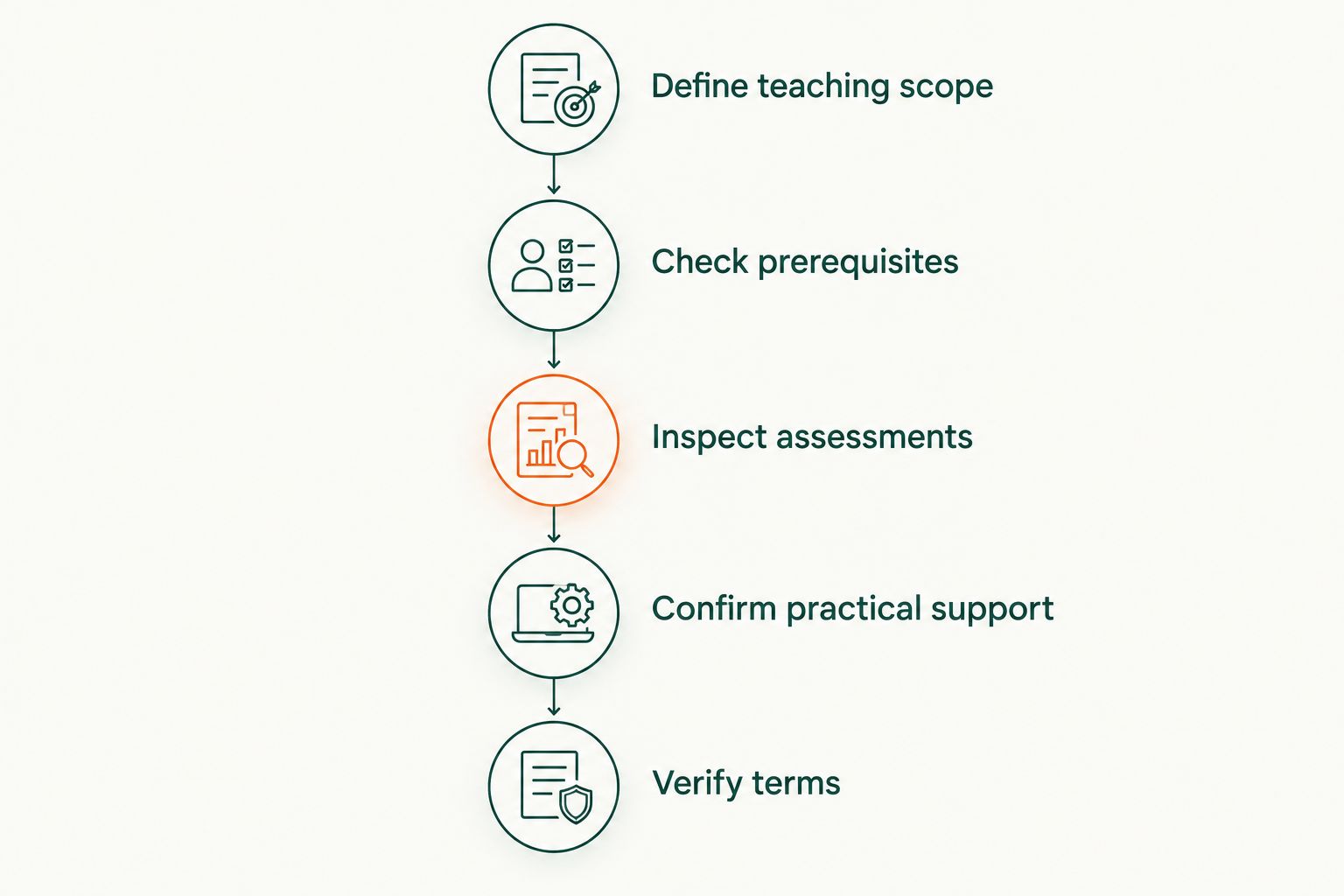
Use this sequence for your 2026 enrollment decision. It keeps the practical questions ahead of the checkout decision and gives you a clear basis for comparing courses.
Define teaching scope
Write down the work you want to prepare for: beginner mat instruction, Reformer instruction, or another clearly defined teaching role. Avoid a vague goal such as becoming fully qualified without specifying what you intend to teach.
Then compare that goal with the curriculum. If the description says introductory Reformer concepts, treat that as an introduction—not as evidence of dedicated hands-on apparatus qualification.
Check prerequisites
Ask what movement experience, prior study, or other entry requirements apply. TeachPilates does not require a teaching background, but that should not be read as a statement about another provider's requirements.
Your existing Pilates practice is relevant to your starting point, yet practicing and teaching are different responsibilities. Ask what preparation will help you follow the material and participate in any practical work.
Inspect assessments
Request the assessment requirements before enrolling. Ask what is tested, how it is submitted, what passing requires, and how feedback or reassessment works.
Do not fill gaps with assumptions. A written exam can assess knowledge; a practical assessment can examine teaching performance. The course should explain which evidence it requires and how that evidence relates to its stated teaching scope.
Confirm practical support
Identify where you will practice demonstrations, spoken cues, and observation. If the program includes supervised work, confirm its format; if you need separate hands-on preparation, plan that explicitly.
This is especially important for apparatus goals. Equipment familiarity, setup, and teaching practice need a clear place in your training plan rather than an assumption that theory lessons cover them all.
Verify terms
For a 2026 enrollment, check the current course description, access conditions, tuition inclusions, and assessment terms together. Save the information you use to make your decision so you can refer to the same terms later.
If a studio role is your goal, ask that studio about its expectations before paying. Neither a course title nor an online-versus-in-person label guarantees acceptance.
Is online Pilates certification enough to teach mat classes?
Online Pilates certification is not, by itself, proof that you are ready for every mat-teaching role. Check the curriculum, practical assessment, and expectations of the setting where you intend to teach.
For a first-time instructor, the useful question is what evidence shows you can teach—not simply what certificate you receive. Ask how you will demonstrate clear cueing, movement understanding, and the ability to guide someone through the material within the course's scope.
Can you learn Reformer instruction entirely online?
Online lessons can introduce Reformer concepts, but introductory study is not a substitute for dedicated hands-on apparatus qualification. If Reformer teaching is your goal, choose a training pathway that explicitly addresses supervised equipment practice and practical assessment.
Do not treat mat and Reformer preparation as interchangeable. Before committing to a course in 2026, ask what apparatus instruction is included and what further preparation remains outside it.
Does a course certificate include an independent credential?
A course certificate does not establish that a separate, independent credential is included. Treat those as different claims and ask for explicit documentation of any additional credential or examination pathway.
The same discipline applies to studio acceptance. Never assume that completing a course satisfies every employer's requirements; confirm the expectations of the particular setting where you want to teach.
FAQ
What's the best Pilates training format if I work full time?
Self-paced online study is the better fit when control over your study schedule is the priority. Check deadlines, assessment arrangements, and any scheduled requirements before enrolling.
Is online Pilates certification better than in-person training?
Online Pilates certification is better for flexible independent study; in-person training is better when you need supervised physical practice. Compare teaching scope and assessment requirements before choosing either format.
How much is the TeachPilates course?
TeachPilates tuition is $497, with self-paced online study. Check the current enrollment terms to confirm what tuition includes and whether your intended teaching goal requires separate training.
Do I need a teaching background before starting Pilates instructor training?
A teaching background is not required for the course described here. Other providers set their own prerequisites, so check the entry requirements for each program you consider.
Will an online Pilates certificate qualify me for every studio?
An online Pilates certificate does not guarantee acceptance at every studio. Ask your intended studio what training, teaching scope, and practical evidence it requires.
Can introductory Reformer lessons replace hands-on apparatus training?
Introductory Reformer lessons do not replace dedicated hands-on apparatus qualification. Match your training to the equipment and teaching responsibilities you intend to take on.
What should I ask about a Pilates certification exam?
Ask whether the assessment tests written knowledge, practical teaching, or both. Also confirm the passing requirements, feedback process, and reassessment terms before enrolling.
One last thing
Before enrolling, explain a familiar mat exercise aloud as though you were guiding someone who has never done it. Notice where your explanation becomes unclear or where you need feedback; use that observation to question a provider about its teaching practice and assessment process.
Choose the course that answers your teaching questions, not just your scheduling questions. Flexible study is valuable, but your training plan still needs a clear route from understanding an exercise to teaching it responsibly.