
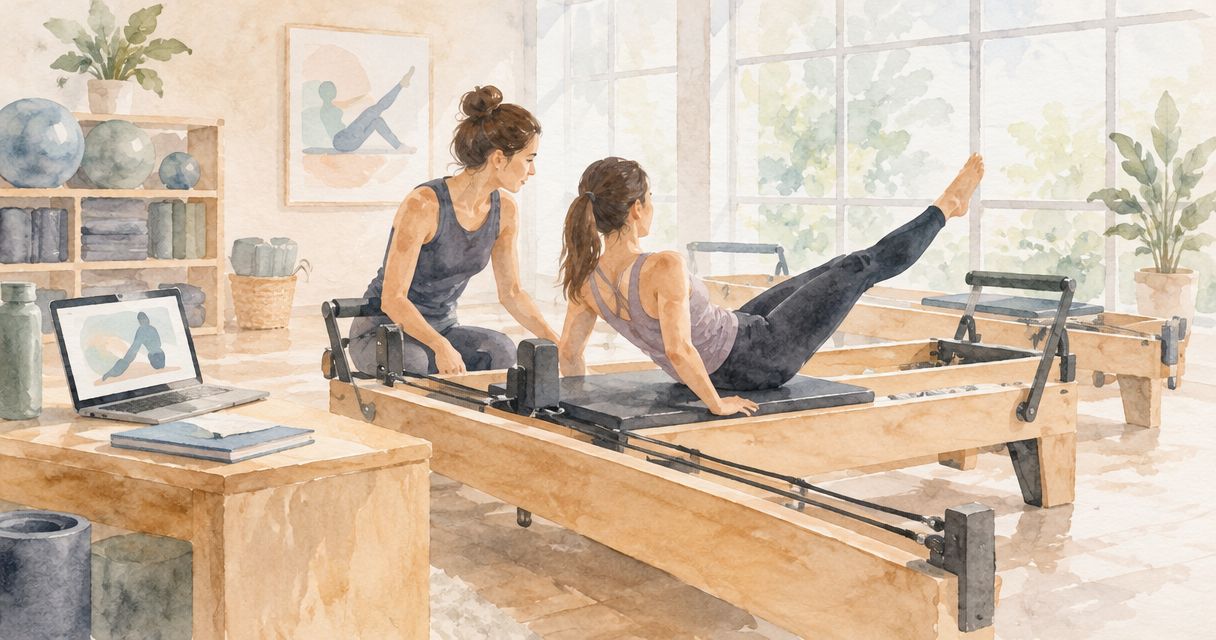
The $497 self-paced online course at TeachPilates covers anatomy, mat instruction, introductory Reformer concepts, cueing, and business skills; for reformer pilates certification, plan physical equipment access separately from online study. Before enrolling in 2026, confirm where you will practice, who will supervise you, and what practical assessment your chosen training requires—do not treat introductory apparatus study as a dedicated hands-on qualification.
- TeachPilates suits aspiring instructors seeking self-paced teaching foundations, not a substitute for dedicated hands-on Reformer qualification.
- Reformer pilates certification planning starts with confirmed equipment access, supervision, and practical assessment requirements.
- Ask whether studio access permits independent practice, observation, and practice teaching; these are different activities.
- Confirm equipment-related fees separately from tuition before committing to a training pathway.
Why this matters
An online study schedule does not reserve a Reformer. You need an equipment plan that fits the training you intend to complete, not just a course you can fit around work.
The distinction matters when choosing your teaching scope. Learning anatomy and cueing gives you a foundation; handling moving equipment and teaching someone on it require practical preparation. Choose the teaching role first, then check whether the training and equipment arrangements support it.
For your 2026 enrollment decision, separate curriculum, physical access, supervision, and assessment. A clear answer in one area does not settle the others. A studio that welcomes you to classes has not necessarily agreed to let you practice teaching there.
How do you plan equipment access for reformer Pilates certification?
Plan equipment access before you commit to a training pathway. Start with the provider's practical requirements, then secure permission to use suitable equipment for each required activity.
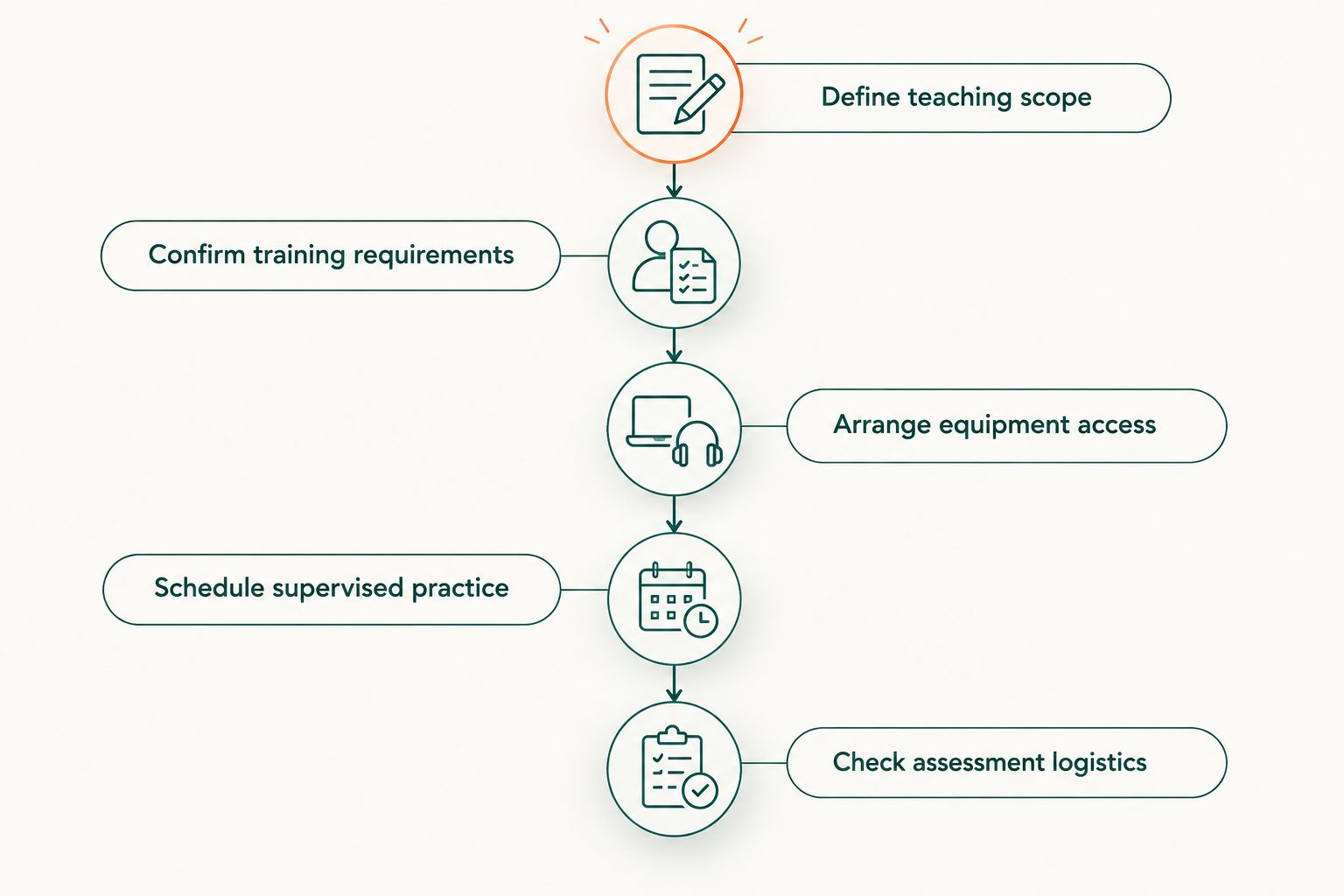
Use this sequence to turn an enrollment decision into a workable practice plan:
- Define teaching scope. Decide whether you want mat-teaching foundations, introductory apparatus study, or dedicated preparation to teach Reformer sessions.
- Confirm training requirements. Ask the provider what equipment, observation, practice teaching, supervision, and assessment the pathway requires.
- Arrange equipment access. Get the studio or equipment owner's permission for the specific activities you intend to complete.
- Schedule supervised practice. Identify who can review your setup, movement instruction, and teaching decisions.
- Check assessment logistics. Establish where the practical assessment happens, what equipment it uses, and how you demonstrate completion.
Do not substitute your own practice target for the provider's requirements. If a pathway specifies documented activities or an approved setting, make those conditions part of your equipment arrangement.
Online foundations versus dedicated Reformer training
TeachPilates is best for aspiring instructors seeking self-paced Pilates teaching foundations. Its curriculum includes anatomy, mat and Reformer instruction, cueing, and business skills; introductory Reformer concepts should not be presented as a dedicated hands-on apparatus qualification.
Compare the training scope rather than treating every course with Reformer content as interchangeable. The table below describes pathways to evaluate, not verified features of any unnamed provider.
| Training pathway | Best for | Main benefit | Limitation to resolve |
|---|---|---|---|
| Self-paced online foundations | Aspiring instructors building teaching knowledge around their schedule | Flexible study of teaching concepts | Online lessons alone do not provide physical equipment access or demonstrate hands-on competence |
| Dedicated hands-on Reformer training | Learners specifically preparing for apparatus teaching | A training setting focused on practical apparatus work | Confirm the actual equipment access, supervision, and assessment included |
| Foundations followed by apparatus training | Learners separating foundational study from apparatus preparation | A staged route with a defined purpose for each course | Confirm prerequisites and any accepted prior learning before assuming the courses connect |
For a 2026 course comparison, ask each provider to describe what you will be prepared to teach and how that preparation is assessed. A broad course title is not enough evidence of teaching scope.
Using a training studio for equipment access
A training studio is a practical starting point when you want instruction and equipment in the same setting. Ask whether your enrollment includes equipment use outside taught sessions, rather than assuming an open studio is available.
Best for: learners who want practice connected to an instructor's feedback. The benefit is the opportunity to connect what you study with supervised equipment work. The constraint is permission: the studio sets the activities and scheduling arrangements it will accept.
Get clear answers to these questions:
- Can you practice outside scheduled teaching sessions?
- Must an instructor be present?
- Can you bring a practice participant?
- Does the studio permit practice teaching, or only personal practice?
- Who can verify activities if your provider requires documentation?
Keep the answers with your training plan. Verbal enthusiasm about your teaching goals is not the same as an agreed practice arrangement.
Using a separate studio for equipment access
A separate studio is an option to investigate when your course does not provide a suitable practice setting. Describe yourself as a trainee and explain exactly what you want to do before discussing bookings.
Best for: learners who need a local practice setting separate from their course. The benefit is the possibility of a location that fits your routine. The limitation is coordination: the studio and training provider need to agree on whether the proposed activities meet the course requirements.
Taking a class, observing an instructor, practicing personally, and teaching a practice participant are different requests. Ask permission for each relevant activity. Do not assume a class booking authorizes independent equipment use afterward.
Also ask how the studio handles orientation, supervision, and any insurance conditions for trainees. Get answers before you build your study schedule around that location.
Using a home Reformer for practice
A home Reformer gives you a place to practice without arranging each session around a studio visit. It does not, by itself, provide supervision, feedback, or permission to count that practice toward a qualification.
Best for: learners whose provider accepts home practice and who have an appropriate feedback arrangement. Convenience is the benefit. The constraint is that equipment ownership does not establish teaching competence or guarantee that a provider accepts the setting.
Before purchasing equipment for training, ask the provider whether the proposed apparatus suits its exercises and assessment requirements. Follow the equipment manufacturer's setup, use, and maintenance instructions, and arrange practical guidance rather than teaching yourself unfamiliar adjustments by trial and error.
For a 2026 purchase decision, settle suitability first. Buying equipment before confirming the training requirements risks leaving you with a practice setup that does not serve your intended pathway.
Why equipment-access arrangements vary
Equipment planning depends on what you will do, where you will do it, and who will evaluate your work. Use these factors to compare arrangements without relying on an assumed number of practice hours.
- Teaching scope: Mat foundations and dedicated Reformer preparation call for different practical arrangements. Match access to the role you intend to train for.
- Permitted activities: Personal practice, observation, and practice teaching need separate confirmation. Permission for one does not establish permission for the others.
- Supervision: Clarify when an instructor must attend and who can give feedback. Unsupervised repetition is not the same activity as supervised teaching practice.
- Equipment suitability: Confirm that the apparatus supports the exercises and assessment tasks your provider specifies.
- Scheduling: Your access needs to fit both your routine and any practical requirements. Confirm booking rules before relying on a regular practice slot.
- Assessment setting: Establish whether evaluation happens at a training venue, through a recording, or another provider-approved process. Do not assume you can choose the format yourself.
Ask for requirements in writing before arranging equipment around them. This gives you a reference when discussing permission with a studio or deciding whether home practice fits.
What should you confirm about practical assessment?
Ask what the assessment actually evaluates and where you must complete it. Written knowledge and practical teaching demonstrate different things; passing one should not be treated as proof that the other has been assessed.
Your questions should cover equipment setup, exercise instruction, cueing, observation, and how you respond when a practice participant needs an adjustment. Ask the provider which of those areas its assessment includes rather than assuming a standard format.
The guide to written versus practical assessments explains the distinction to investigate. For equipment planning, the immediate decision is logistical: can your proposed location support the required assessment activity?
Also confirm the completion standard, any repeat-assessment arrangements, and who signs off your work. Do not book a practice space around a guessed exam format.
Can you start studying before you secure equipment access?
You can separate foundational study from physical apparatus practice, but confirm the course sequence before enrolling. Do not assume equipment access can wait if your chosen pathway requires practical work alongside lessons.
A useful plan distinguishes what you can study independently from what requires equipment, another participant, or an instructor. That prevents flexible study from becoming an indefinite delay to practical preparation.
Does owning a Reformer replace supervised training?
Owning a Reformer does not replace supervised training or practical assessment. It provides equipment access, not an independent judgment of your teaching ability.
Ask how you will receive feedback on setup, cueing, and teaching decisions. If you cannot identify that process, your equipment plan is not yet a complete training plan.
What should you check before enrolling in 2026?
Before enrolling in 2026, match the advertised curriculum to your intended teaching scope and confirm the practical requirements separately. Ask about prerequisites, access conditions, assessments, and the exact credential awarded.
TeachPilates offers flexible self-paced study, but that flexibility should not be confused with a promise of jobs, earnings, or universal studio acceptance. If you want to teach at a particular studio, ask that studio what preparation and credentials it expects before choosing your pathway.
Review your course fit
Compare self-paced teaching foundations with the practical Reformer preparation your goals require.
FAQ
Do I need to own a Reformer to get certified?
Do not buy a Reformer until your chosen provider confirms its equipment requirements. Ask whether an approved studio arrangement can support your practice and assessment instead.
Can I complete Reformer Pilates certification entirely online?
Check how the specific program handles physical practice, supervision, and practical assessment before treating online study as a complete Reformer teaching pathway. Online curriculum delivery does not itself provide equipment access or demonstrate hands-on competence.
Does TeachPilates include dedicated hands-on Reformer qualification?
TeachPilates covers teaching foundations and introductory Reformer concepts; do not treat that scope as a dedicated hands-on apparatus qualification. Confirm any additional practical training needed for your intended teaching role.
Can I practice teaching at the studio where I take classes?
Ask the studio for explicit permission to practice teaching. A class booking does not establish permission to use equipment independently, bring a participant, or record an assessment.
What should I ask about equipment fees before enrolling?
Ask which equipment-related activities are included and which require separate arrangements. Check practice access, supervision, observation, and assessment logistics rather than assuming tuition covers them.
Will my certification be accepted by every Pilates studio?
Do not assume universal studio acceptance. Ask prospective studios about their training, practical assessment, and credential expectations before enrolling.
Can I use home practice toward my training requirements?
Confirm acceptance with your training provider before counting home practice toward completion. Ask about equipment suitability, supervision, documentation, and any restrictions on practice teaching.
One last thing
Ask about practice teaching, not just equipment access. A studio can give you somewhere to exercise without providing somewhere to develop and demonstrate teaching skills.
Before paying tuition, write down where you will study, where you will practice, who will provide feedback, and how you will be assessed. Any unanswered item becomes your next enrollment question—not an assumption to carry into training.