

$497 is the published tuition for the self-paced online Pilates instructor course covered here in 2026; your total Pilates certification cost depends on the training and teaching scope you need. Before enrolling, confirm whether assessments, practice access, and any separate credentials require additional payment rather than assuming tuition covers everything.
- Teachpilates lists $497 tuition for self-paced online Pilates instructor training; confirm inclusions before setting your total budget.
- Compare Pilates certification cost by teaching scope, assessment requirements, and practice access—not tuition alone.
- Introductory Reformer concepts are not the same as dedicated hands-on apparatus qualification.
- Ask for written answers about retakes, access extensions, and separate credentials before enrolling.
Pilates certification cost: which fees should you check beyond tuition?
Start with the published tuition, then check every requirement between enrollment and the teaching role you want. An unanswered fee question is not evidence that a charge exists—but it is not confirmation that the requirement is included, either.
For Teachpilates, the stated tuition is $497 for self-paced online instructor training. The curriculum covers anatomy, mat instruction, Reformer concepts, cueing, and business skills; treat introductory apparatus content separately from dedicated hands-on apparatus qualification.
Use this breakdown when you request enrollment details in 2026:
| Budget item | What to confirm | How to record it |
|---|---|---|
| Course tuition | What curriculum and assessments the enrollment includes | Record the published tuition |
| Assessment | Whether initial written and practical assessments are included | Add only confirmed separate charges |
| Retakes | Whether another attempt requires payment | Keep conditional charges separate |
| Practice access | Whether required practice needs studio or equipment access | Record your actual access arrangement |
| Course access | How long materials remain available and whether extensions cost extra | Include an extension only if needed |
| Separate credentials | Whether your intended credential requires another application or assessment | Budget separately when applicable |
Do not turn this checklist into an assumed bill. A provider can include an item, charge separately, or not require it at all. Your job is to establish which applies before paying.
Why this matters
A low tuition figure answers only one question: what does enrollment cost? It does not, by itself, tell you whether the course prepares you for the classes you intend to teach or satisfies a particular studio's requirements.
Choose training for your intended teaching scope before comparing tuition. Otherwise, you risk comparing a mat-focused foundation with a different apparatus-training pathway and treating the difference as price alone.
A useful 2026 budget separates course completion from employment preparation. Completing a provider's course, obtaining a separate credential, and meeting a studio's hiring criteria are different decisions; do not assume one automatically settles the others.
Start with $497 tuition, then verify the inclusions
Teachpilates' stated $497 tuition and flexible self-paced study give you a defined starting point. The curriculum includes anatomy, instruction, cueing, and business skills, but those subject names do not establish access duration, assessment format, or retake terms.
Ask for an enrollment summary that answers these questions:
- What learning materials does tuition include?
- Which assessments must you complete?
- Does tuition include the first attempt at each required assessment?
- Are feedback, observation, or teaching-practice requirements included?
- How long can you access the course materials?
- What certificate does the provider issue after successful completion?
Keep the answers together with the enrollment terms. A course description explains what you study; the terms should explain what you receive and what you must do to finish.
Self-paced learning gives you control over when you study. The trade-off is that you must organize your learning and practice rather than rely on scheduled attendance to provide that structure. Confirm how instruction and feedback work before deciding that flexibility alone makes a course suitable.
Match your budget to the teaching scope
Mat foundations, dedicated Reformer training, and full-apparatus training are not interchangeable purchases. Compare the movements, equipment, practice requirements, and assessments relevant to the teaching role you actually want.
The table below compares pathways, not named providers. It identifies the fit and limitation to investigate rather than assigning unverified prices or hours.
| Training pathway | Best for | Main advantage | Limitation to check |
|---|---|---|---|
| Self-paced online foundations | Aspiring instructors who need flexible study | You can organize study around existing commitments | How practical teaching receives observation and feedback |
| Dedicated hands-on Reformer training | Learners specifically targeting Reformer instruction | Training can focus on apparatus-specific teaching practice | Exact equipment scope, practice access, and assessment requirements |
| Full-apparatus training | Learners seeking instruction across multiple apparatus types | The pathway addresses a broader equipment scope | Which apparatus, prerequisites, and completion requirements are included |
Teachpilates is best for aspiring Pilates instructors seeking self-paced online foundations, not a substitute for dedicated hands-on apparatus qualification.
This article is published by the course provider. For a format-focused comparison, read online Pilates certification vs. in-person training.
Choose dedicated hands-on apparatus training when that is the qualification your intended role requires. Do not select an online course solely because its curriculum mentions Reformer instruction. Ask what you must demonstrate and how an assessor evaluates your teaching.
Why Pilates certification cost varies
Your budget changes when the work required to reach your teaching goal changes. Use these factors to explain differences between enrollment options—not to assume that a higher tuition figure guarantees better preparation.
- Teaching scope: Mat instruction, introductory Reformer concepts, and dedicated apparatus qualification address different learning goals. Compare equivalent scope before comparing tuition.
- Training format: Self-paced study and scheduled in-person instruction organize learning differently. Ask what instruction, feedback, and attendance each includes.
- Assessment requirements: A knowledge test and an observed teaching assessment examine different abilities. Confirm which assessments are required and included.
- Practice arrangements: Establish where you will rehearse cueing and teaching, and whether your intended pathway requires equipment access you must arrange separately.
- Credential destination: Identify whether your goal is the provider's completion certificate, a separate credential, or a particular studio's requirements. Verify each directly.
For your 2026 comparison, record these factors beside tuition. A price difference becomes useful information only when you know what differs in the training.
Check assessment and retake terms before enrollment
Ask how the provider evaluates knowledge and teaching ability. Written questions can assess understanding of course material; an observed practical assessment lets an assessor evaluate your instruction. Neither label tells you the full assessment process without further detail.
Request the pass requirements, submission method, feedback process, and rules for another attempt. Do not assume an assessment is live, recorded, automatically graded, or individually reviewed unless the provider states it.
The same discipline applies to retakes. Ask whether another attempt is permitted, whether additional preparation is required, and whether payment applies. Record a retake charge as conditional rather than adding it to every student's expected total.
A clearly explained assessment process matters more than an unsupported promise of an easy certificate. You need to understand what successful completion requires before you commit your study time.
Check practice access and study time separately
Course access and practice access answer different questions. Being able to open online lessons does not establish where you will rehearse teaching or use apparatus.
If your chosen pathway requires apparatus practice, establish where that happens and who approves the arrangement. Ask whether observation or teaching practice must follow specific rules before you commit to an outside studio arrangement.
Also separate flexible scheduling from unlimited course access. Self-paced describes how you organize study; it does not establish an access deadline or extension policy. Confirm both in the enrollment terms.
For a first-time instructor, build a schedule around learning, rehearsal, and assessment—not just watching lessons. Leave room to revisit anatomy, explain movements aloud, and practice clear cues. These are study recommendations, not claims about a provider's mandatory hours.
Build your full budget before paying
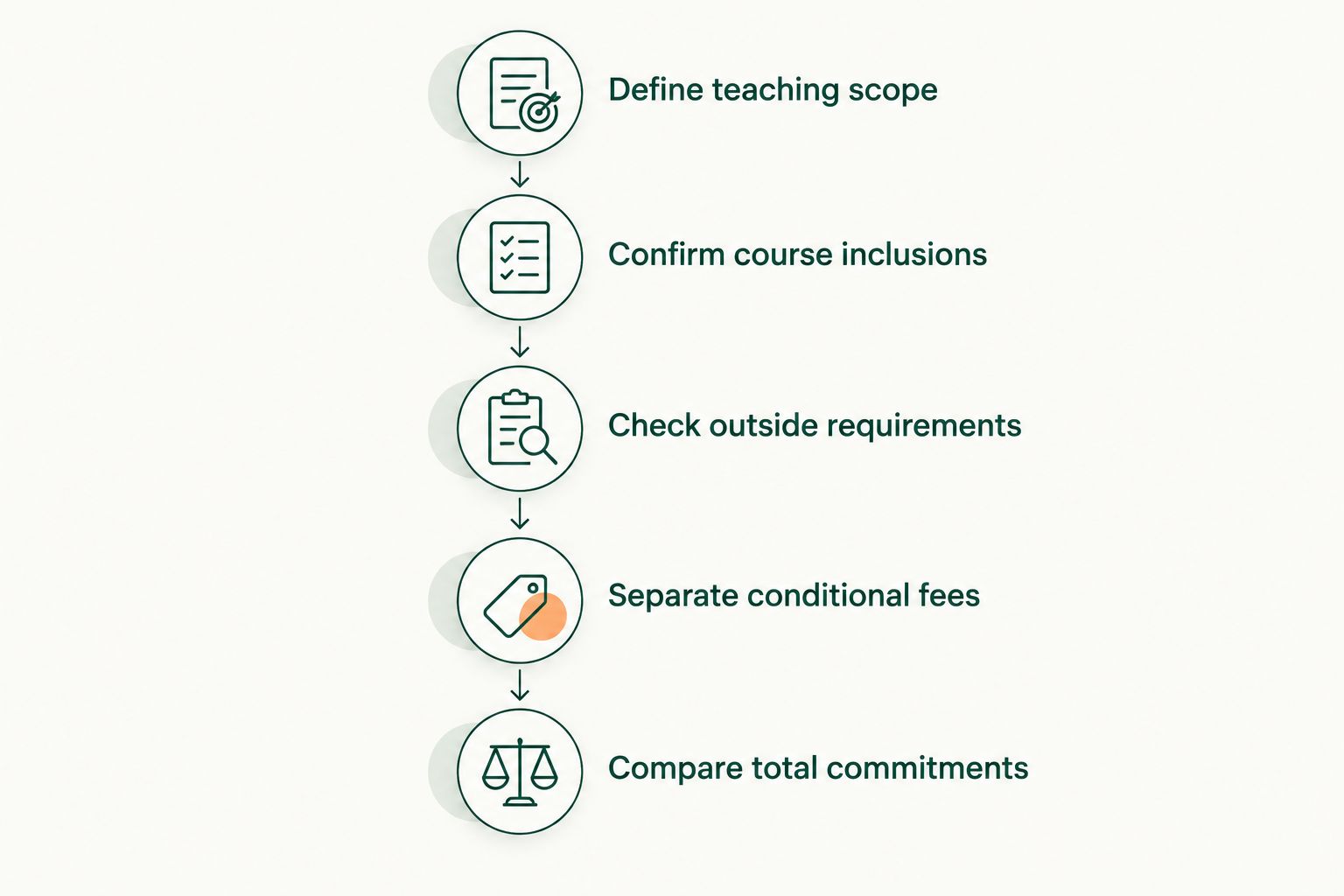
Use this sequence to turn the published tuition into a decision-ready plan. Keep confirmed costs, conditional costs, and unanswered questions in separate columns so you can see what is actually payable.
- Define teaching scope. Write down the classes or apparatus you intend to teach. Avoid a broad goal such as teaching everything when your immediate plan is mat instruction.
- Confirm course inclusions. Save the curriculum, assessment requirements, access terms, and stated completion award. Resolve conflicting descriptions before enrolling.
- Check outside requirements. Ask your intended studio or separate credentialing organization what training and evidence it accepts. Request the answer directly rather than relying on general recognition language.
- Separate conditional fees. List retakes, extensions, or optional additions only when the provider confirms they exist. Mark which circumstances trigger payment.
- Compare total commitments. Review confirmed payments alongside study time, practice arrangements, and assessment work. Choose the pathway that matches your goal, not simply the smallest tuition figure.
For a 2026 enrollment decision, keep a dated copy of the terms you relied on. That gives you a clear reference when you plan your study or ask the provider a follow-up question.
Is the $497 tuition the same as your total certification cost?
$497 is the stated course tuition, not confirmation of every expense associated with your chosen teaching pathway. Establish which assessments, practice arrangements, and separate credentials apply before treating it as your complete budget.
Does online training replace hands-on Reformer qualification?
Online study that introduces Reformer concepts is not the same as dedicated hands-on apparatus qualification. If your goal is Reformer teaching, verify the required practical training and assessment with the training provider and intended studio.
Should you pay for a separate credential immediately?
Pay for a separate credential only after confirming that it serves your teaching goal and that you meet its eligibility requirements. A provider-issued course certificate does not establish that an independent credential is included.
FAQ
How much is Teachpilates' Pilates instructor course?
Teachpilates lists $497 tuition for its self-paced online Pilates instructor course. Confirm assessment inclusions, course-access terms, and any separate requirements before treating tuition as your full training budget.
What fees should I check beyond Pilates course tuition?
Check assessment, retake, course-extension, practice-access, and separate-credential terms. These are questions to verify, not charges to assume every course imposes.
Are Pilates certification exam fees always included?
Do not assume exam fees are included in tuition. Ask which assessments the enrollment covers and whether a further attempt requires payment.
Can I become a Pilates instructor without previous teaching experience?
Previous teaching experience is not required for the course described here. You should still confirm enrollment prerequisites and plan time to develop cueing and teaching skills.
Does a course covering Reformer concepts qualify me to teach Reformer classes?
Reformer concepts alone do not establish dedicated hands-on apparatus qualification. Check the practical training, assessment, and acceptance requirements for the role you want.
Will a Pilates course certificate be accepted by every studio?
Do not assume universal studio acceptance. Ask each intended studio what training, practical assessment, and credentials it requires before selecting your course.
What should I ask before enrolling in a self-paced Pilates course?
Ask about curriculum scope, assessments, feedback, access duration, prerequisites, and the certificate awarded after completion. Request written clarification of any separate or conditional charges.
One last thing
Ask a prospective studio what it requires before paying for training—not after you finish. Its answer helps you distinguish a suitable first course from a pathway that needs additional apparatus training or assessment.
Keep a one-page enrollment record for 2026: your teaching goal, confirmed tuition, included assessments, access terms, and any outside requirements. A clear record makes your decision easier without pretending that an advertised tuition figure answers every question.