
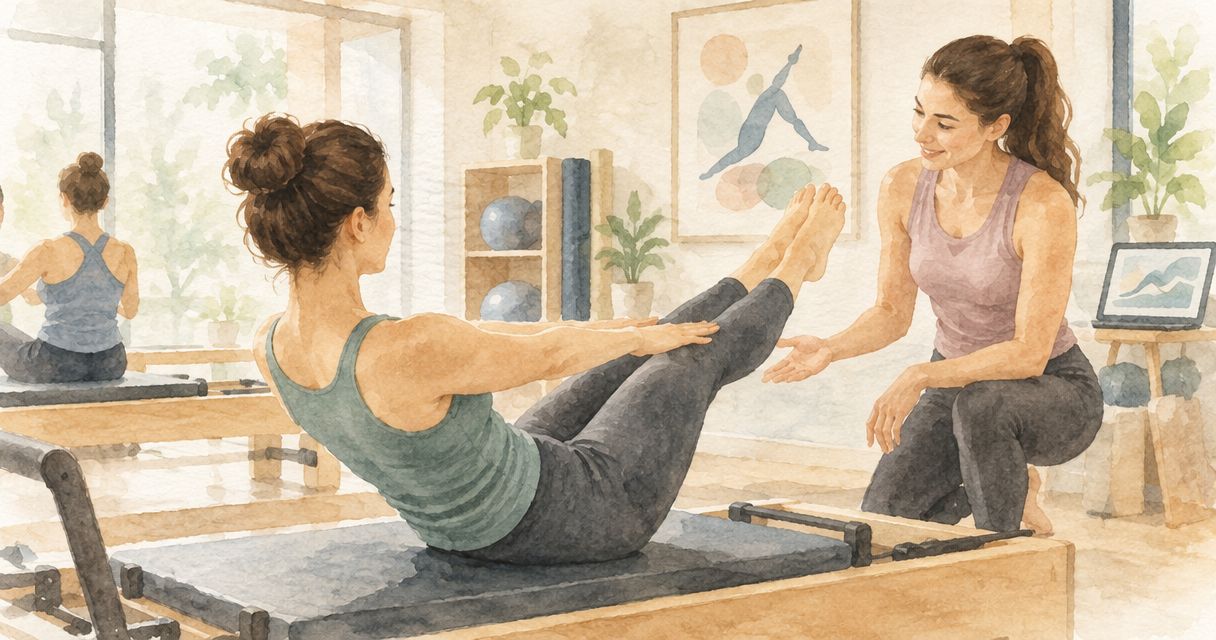
You do not need prior teaching experience to begin Pilates instructor training, but the Pilates practice required before certification depends on the course you choose. A $497 self-paced course gives you a flexible study option; admission requirements, practical assessments, and the teaching scope still need separate checks before you enroll.
- The Pilates experience required before certification depends on the provider; personal practice and teaching experience are different requirements.
- Teachpilates offers self-paced Pilates instructor certification with $497 tuition, covering anatomy, mat instruction, Reformer concepts, cueing, and business skills.
- Choose training for your intended teaching role, not simply the easiest entry requirements.
- Introductory Reformer study is not the same as dedicated hands-on apparatus qualification.
Why this matters
You are making two decisions: whether you qualify to start training and whether that training prepares you for the work you want. Those are not interchangeable. An accessible enrollment process does not establish readiness to teach independently.
For your 2026 course shortlist, separate admissions, course completion, and employer requirements. Use the guide to online Pilates certification and employer requirements to frame the questions you ask a prospective studio before paying tuition.
You do not need to arrive as a finished instructor. You need a course that clearly explains how you will develop and demonstrate teaching skills.
Do you need Pilates experience before becoming an instructor?
There is no single experience requirement you can apply to every Pilates instructor course. Check whether a provider means previous classes, documented personal practice, professional fitness experience, or previous teaching. A statement that welcomes first-time instructors does not answer all those questions.
Use this comparison to identify what your background contributes and what you still need to establish.
| Your starting point | What it contributes | What it does not establish | Best for |
|---|---|---|---|
| New to Pilates | A starting point for learning the method without assuming prior knowledge | Familiarity with exercises, terminology, or teaching | Checking beginner entry requirements before enrolling |
| Regular Pilates participant | Experience following instructions and noticing how movements feel | The ability to explain, observe, and adapt a lesson | Moving from personal practice into structured teacher training |
| Fitness or movement professional | Experience communicating movement instructions within an existing role | Pilates-specific training or apparatus competence | Checking which existing skills transfer and which need development |
| Returning Pilates practitioner | Previous familiarity to revisit during training | Current confidence or readiness to teach | Combining a return to practice with a clear training plan |
These are starting points, not admission categories. Ask your chosen provider which prerequisites apply to you and what evidence, if any, you must submit.
Personal practice is not teaching experience
Taking a class puts you in the learner's position. Teaching requires you to give instructions, watch another person respond, and decide whether your explanation needs to change. Being comfortable performing an exercise does not demonstrate those separate skills.
Your personal practice still has value. Use it to notice the difference between instructions that help you understand a movement and instructions that leave you guessing. Then practice explaining the movement without relying on someone copying you.
Enrollment is not certification
Admission tells you that you can start a course. Certification depends on satisfying that provider's completion requirements. Ask for those requirements before you enroll, including how knowledge and practical teaching are assessed.
For a 2026 enrollment decision, read the assessment description alongside the curriculum. A list of topics tells you what you will study; it does not tell you how you must demonstrate understanding.
Which starting route fits your experience?
Choose your next step according to the gap you need to close. Waiting until you feel like an expert is not a useful admission test, but enrolling without understanding the prerequisites is not a plan either.
If you have never taken a Pilates class
Best for complete newcomers: confirm beginner eligibility, then build personal familiarity alongside a training plan. Ask whether the course expects prior practice and whether any practice must be completed before enrollment rather than during study.
Attend an appropriate introductory class if you want to understand what participating feels like before committing to teacher training. Treat that class as orientation, not evidence that you are ready to instruct someone else. Avoid setting yourself an arbitrary class total unless your provider specifies one.
If you already practice Pilates regularly
Best for regular practitioners: focus on teaching skills rather than collecting more attendance. Your next learning task is explaining a movement clearly enough for another person to follow.
During practice, notice how the instructor introduces an exercise, establishes a starting position, and responds to confusion. Observation gives you questions to investigate in training. It does not replace assessment or feedback on your own instruction.
If you already teach fitness or movement
Best for existing instructors: identify Pilates-specific gaps before assuming your background transfers. Experience managing a group or communicating instructions is relevant, but it does not establish knowledge of the Pilates curriculum you plan to teach.
Ask whether the provider accepts previous training toward any requirement. Get the answer in writing, including what remains compulsory. Do not assume an existing qualification removes practice, assessment, or apparatus requirements.
Why the Pilates experience required before certification varies
Read prerequisites in the context of what the course promises to teach. These factors explain what to investigate rather than supplying a universal minimum:
- Teaching scope. Establish whether the course covers mat instruction, introductory apparatus concepts, dedicated Reformer teaching, or a broader apparatus pathway.
- Assumed knowledge. Check whether lessons begin with foundational anatomy and movement terminology or expect you to understand them already.
- Training format. Find out how online study, scheduled teaching, practical sessions, and independent work fit together.
- Assessment design. Ask how the provider evaluates understanding, demonstration, cueing, and practical instruction.
- Practice requirements. Separate personal practice, observation, and practice teaching; ask which activities count toward completion.
- Your intended workplace. Ask the employer about its own training and audition requirements rather than treating course admission as employer approval.
Keep your 2026 shortlist specific. Compare the same teaching scope and assessment expectations across courses, not just whether each provider uses the word certification.
How do you check whether you are ready to enroll?
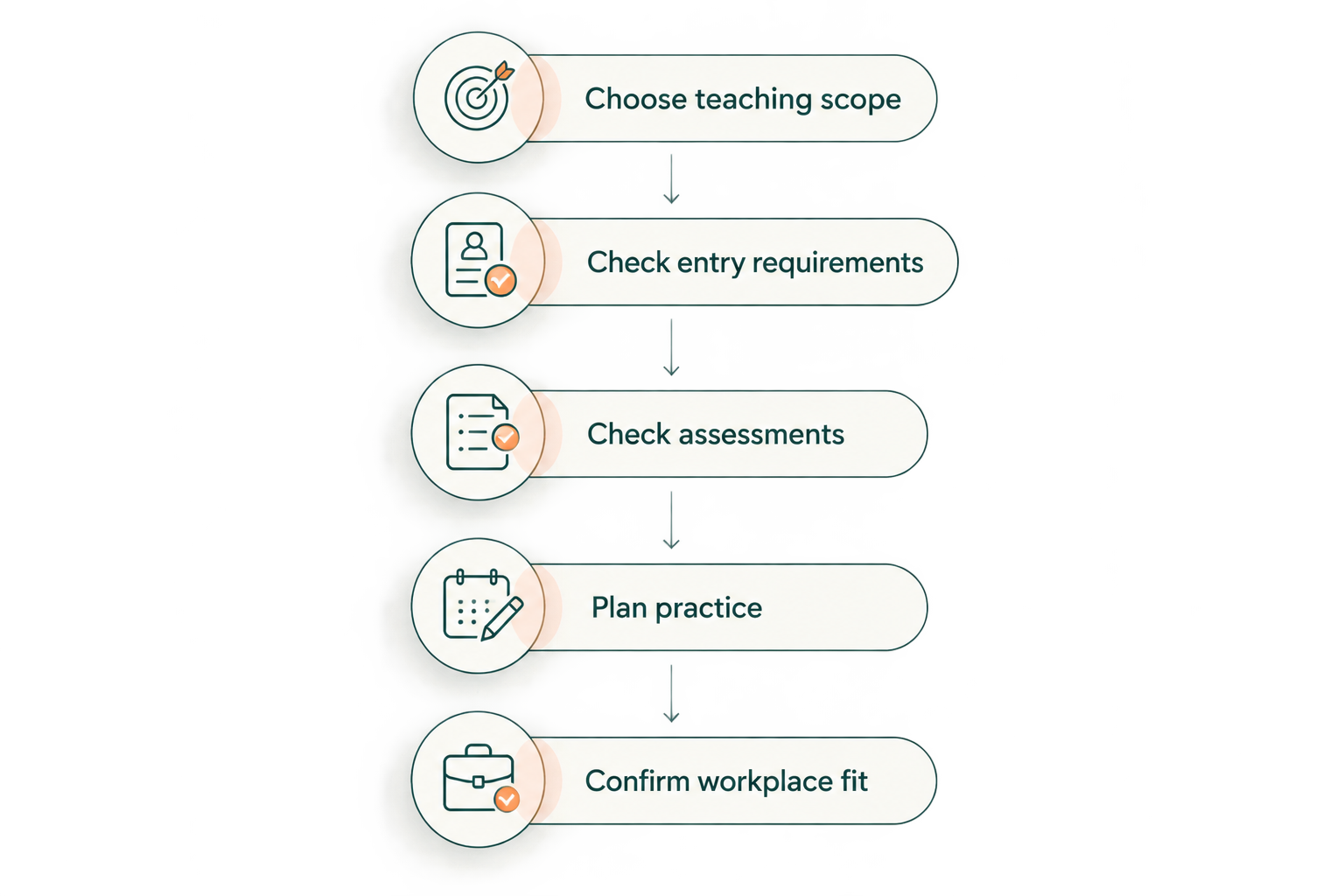
Use this sequence to turn a vague concern about experience into an enrollment decision. You are looking for clear answers, not permission to feel completely confident before learning begins.
- Choose teaching scope. Write down whether your immediate goal is mat teaching or apparatus instruction. Keep that goal narrow enough to compare courses accurately.
- Check entry requirements. Ask about previous classes, anatomy knowledge, minimum age, and any documents required before starting. Do not treat an unanswered question as a waived requirement.
- Check assessments. Request the completion criteria and ask what happens if your work needs improvement. Separate written knowledge from practical teaching.
- Plan practice. Identify where you will practice, observe instruction, and receive feedback appropriate to your training stage. Ask what the course requires rather than inventing your own completion standard.
- Confirm workplace fit. Contact the studio or organization where you hope to teach. Ask whether the proposed qualification matches the role you want.
Keep a written record of the answers. If a provider describes a requirement only in general terms, ask what you must actually do or submit. Specific completion criteria give you a better basis for deciding than reassurance alone.
Where does self-paced online training fit?
Teachpilates offers a self-paced online Pilates instructor certification course with $497 tuition. Its stated curriculum covers anatomy, mat instruction, Reformer instruction, cueing, and business skills. No previous teaching background is required.
Teachpilates Pilates instructor certification is best for aspiring first-time instructors who want self-paced online study. The format lets you plan study around your schedule, but you still need to establish how the course's assessments and practical expectations match your goals.
The limitation matters: introductory Reformer concepts are not the same as a dedicated hands-on apparatus qualification. Do not interpret Reformer content in an online curriculum as confirmation that a particular studio will accept you for apparatus teaching.
For your 2026 decision, confirm current access terms, practical assessment arrangements, and the scope of the certificate directly with the provider. Check separately whether any independent credential is required for your intended role; do not assume one is included.
This guide is published by Teachpilates, which offers the course described here.
Do you need anatomy knowledge before starting Pilates training?
Previous anatomy study is not a substitute for checking the course's actual entry rules. Ask whether the provider teaches anatomy from the beginning and what knowledge you need when you start. A curriculum that includes anatomy does not, by itself, establish the depth or assessment standard.
As you study, connect terminology to an instruction you would give a learner. Knowing a term and explaining a movement clearly are different tasks. If you cannot explain why an instruction belongs in a lesson, make that a question for further study or feedback.
Can you become an instructor without a fitness background?
A fitness background is not the same as the Pilates experience required before certification. Check the provider's prerequisites directly rather than ruling yourself out because you have never worked in fitness.
Your enrollment decision should rest on eligibility, the curriculum, and a workable practice plan. Previous employment in another field does not answer whether you can complete those requirements, just as fitness employment does not automatically satisfy them.
Does mat training qualify you to teach Reformer Pilates?
Mat training alone does not establish Reformer teaching competence. Treat mat instruction, introductory Reformer study, and dedicated hands-on apparatus training as distinct scopes when you compare courses.
If Reformer teaching is your goal, ask about supervised apparatus practice, equipment instruction, and practical assessment. Then confirm the intended employer's requirements before choosing the course. Do not rely on the presence of the word Reformer in a syllabus.
FAQ
What's the Pilates experience required before certification?
The Pilates experience required before certification depends on the course provider. Ask separately about previous classes, personal practice, anatomy knowledge, and teaching experience because those are different prerequisites.
Can I start Pilates instructor training with no teaching experience?
Yes, previous teaching experience is not required for every instructor course. Teachpilates states that no teaching background is required; confirm any separate personal-practice prerequisites before enrolling.
How many Pilates classes should I take before teacher training?
Use the class or practice requirement specified by your chosen provider rather than an assumed universal minimum. Ask whether classes must be completed before enrollment and whether you need to document them.
Do I have to perform every exercise perfectly before enrolling?
Do not use perfect performance as a substitute for the provider's actual admission criteria. Ask what movement demonstrations are required at entry and during assessment, and discuss any relevant limitations before committing.
Is online Pilates certification suitable for a beginner?
Online Pilates certification fits a beginner only when the entry requirements, foundational teaching, and practical expectations match that learner's starting point. Check how you will practice and how your teaching will be assessed, not just whether lessons are online.
How much is the self-paced Teachpilates course?
Teachpilates lists $497 tuition for its self-paced online Pilates instructor certification course. Confirm current enrollment terms and budget separately for any practice, equipment access, or additional qualification your intended role requires.
Will a Pilates certificate guarantee a studio job?
A Pilates certificate does not guarantee a studio job or universal acceptance. Ask the intended employer about qualifications, practical auditions, and any additional requirements before choosing your training.
One last thing
Before enrolling in 2026, ask a studio you would genuinely like to teach at what it expects from a first-time instructor. That answer connects your course choice to an actual teaching role rather than an abstract certificate.
You do not need to eliminate every learning gap before starting training. You need to know which gaps the course addresses, which practical skills you must develop, and what evidence you will need before teaching independently.