
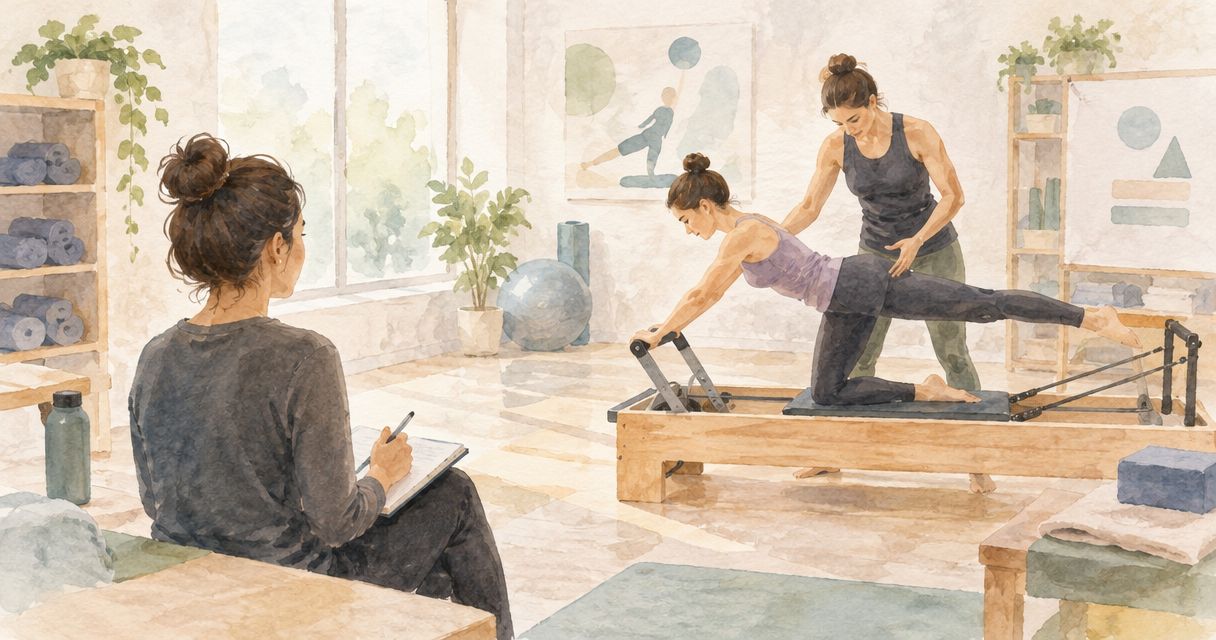
Teachpilates offers $497 tuition and flexible, self-paced study; when comparing Pilates certification programs, keep observation hours separate from practice-teaching hours. Observation means watching instruction, while practice teaching means giving instruction yourself. Neither replaces personal practice, and each provider's rules determine what counts toward course completion.
- Compare Pilates certification programs by observation, practice teaching, and personal practice—not total hours alone.
- Observation develops your eye; practice teaching develops your ability to give instructions and respond.
- Teachpilates suits aspiring instructors seeking self-paced online study; dedicated hands-on apparatus qualification requires separate scrutiny.
- Before enrolling, confirm which activities count, who verifies them, and how teaching ability is assessed.
Why this matters
A training schedule tells you how much time to set aside. It does not tell you what you will actually do during that time. Watching someone teach, performing an exercise, and helping another person perform it are different tasks.
For your 2026 enrollment decision, compare the work behind the hours before comparing headline totals. The distinction between online Pilates certification and in-person training also matters: study format and practical experience are separate questions, not competing labels for course quality.
Choose training that explains how you move from understanding exercises to teaching them. A large hour total without clear activity definitions gives you less useful information than a breakdown you can plan around.
How do observation and teaching hours differ in Pilates certification programs?
Observation hours involve watching another instructor teach and studying the decisions behind the session. Practice-teaching hours involve leading someone through exercises yourself. Personal practice involves performing the movements in your own body.
Keep 3 separate hour totals in your comparison notes: observation, practice teaching, and personal practice. Treat them as distinct unless a provider explicitly explains a different counting method.
| Activity | What you do | Best for | Strength | Limitation |
|---|---|---|---|---|
| Observation | Watch an instructor teach and examine the session | Studying cueing, sequencing, and responses | Lets you focus on teaching decisions without leading | Does not demonstrate your own teaching ability |
| Practice teaching | Give instructions and guide another person | Applying cueing and session-planning skills | Makes your instructions visible and available for feedback | Repeating sessions without feedback leaves errors unaddressed |
| Personal practice | Perform exercises yourself | Understanding movement from the participant's perspective | Gives you experience of the movements you explain | Does not show whether another person understands your cues |
The activities support each other, but they answer different questions. Observation asks what the instructor is doing. Personal practice asks what the movement feels like. Practice teaching asks whether you can help someone else understand it.
Do not read a combined training total as a practice-teaching total. Ask for the breakdown and the definitions together.
Observation hours: learn to see teaching decisions
Observation is more useful when you study the instructor's choices rather than simply follow the exercise sequence. Notice how the instructor introduces a movement, checks understanding, changes an explanation, and manages transitions.
You are watching a teaching process, not collecting exercise names. A familiar movement can still reveal an unfamiliar way of explaining setup or responding to confusion.
What should you record during observation?
Use notes that connect an instruction to what happened next:
- Setup: What did the instructor explain before movement began?
- Cueing: Which words helped clarify the task?
- Response: What did the instructor change when someone needed another explanation?
- Sequencing: How did the session move between exercises?
- Reflection: What would you try explaining in your own words?
Ask the provider whether live classes, recordings, or other observation formats qualify. Also confirm whether you need permission, a particular instructor, a signed record, or a written reflection.
Do not assume that watching course lessons automatically satisfies a separate observation requirement. Get that distinction in writing before building your study calendar.
Practice-teaching hours: learn to give usable instructions
Practice teaching puts you in the instructor's role. You explain the setup, give cues, observe the participant, and decide whether your next instruction needs to change.
This is where knowing an exercise and teaching an exercise separate. You can understand a movement yet still give an explanation that another person finds unclear.
What makes a teaching session useful?
Start with a defined purpose. You might work on explaining a starting position, giving a clear transition, or choosing fewer words when your instructions become crowded. These are practice goals, not substitutes for the provider's required tasks.
Feedback should address something you can change. Ask whether the reviewer identifies unclear cues, missed observations, or sequencing problems—and whether you can submit another attempt.
Before counting a session, confirm:
- Who you are allowed to teach.
- Whether the session must be supervised or recorded.
- Whether preparing a lesson plan counts separately from delivering it.
- What evidence you must submit.
- Who approves the completed work.
Teaching a session and having teaching competence assessed are not the same event. A log records an activity; an assessment evaluates performance against stated criteria.
Personal practice: understand movement without confusing it with teaching
Personal practice helps you connect exercise descriptions with your own movement experience. That experience gives you a starting point for explaining a position or recognizing when instructions need more clarity.
Its limit is equally important: your experience is not everyone else's experience. A cue that makes sense to you still needs to be tested through clear instruction and observation when you teach.
Keep personal-practice records separate from teaching records unless the course explicitly tells you otherwise. Attending a class as a participant does not establish that you led the class.
For 2026 course comparisons, ask whether personal practice means independent sessions, instructor-led classes, assigned exercise work, or a specified combination. The label alone does not settle the requirement.
Why hour requirements vary
Hour totals become useful only when you know what they include. These are the factors to check when two programs describe their training differently:
- Teaching scope: Establish whether the course covers mat teaching, introductory Reformer concepts, or dedicated apparatus instruction.
- Activity definitions: Check whether lessons, observation, personal practice, and teaching appear as separate categories.
- Accepted formats: Confirm whether live attendance, recordings, remote participation, or independent work qualify.
- Supervision: Identify which activities require an approved observer or reviewer.
- Assessment: Ask how written knowledge and practical teaching are evaluated.
- Completion rules: Confirm deadlines, required records, and the process for correcting incomplete work.
Avoid treating differences as evidence that one course is automatically better. First establish whether you are comparing the same teaching scope and the same activities.
A mat-focused pathway and a dedicated apparatus pathway should not be judged as interchangeable simply because both use the word certification. Match the training to what you intend to teach.
How should you check a program before enrolling?
Use these 5 questions to turn a course description into an enrollment decision. Keep the answers together so you can compare providers without relying on memory or headline claims.
- Define scope. What teaching activities does the curriculum prepare you for, and what falls outside it?
- Separate hours. Which activities count as observation, practice teaching, personal practice, and coursework?
- Check access. What people, classes, equipment, or recording arrangements must you organize yourself?
- Check assessment. What must you demonstrate, who reviews it, and what happens if you need another attempt?
- Confirm acceptance. Does the studio or organization you hope to work with accept that training for the role you want?
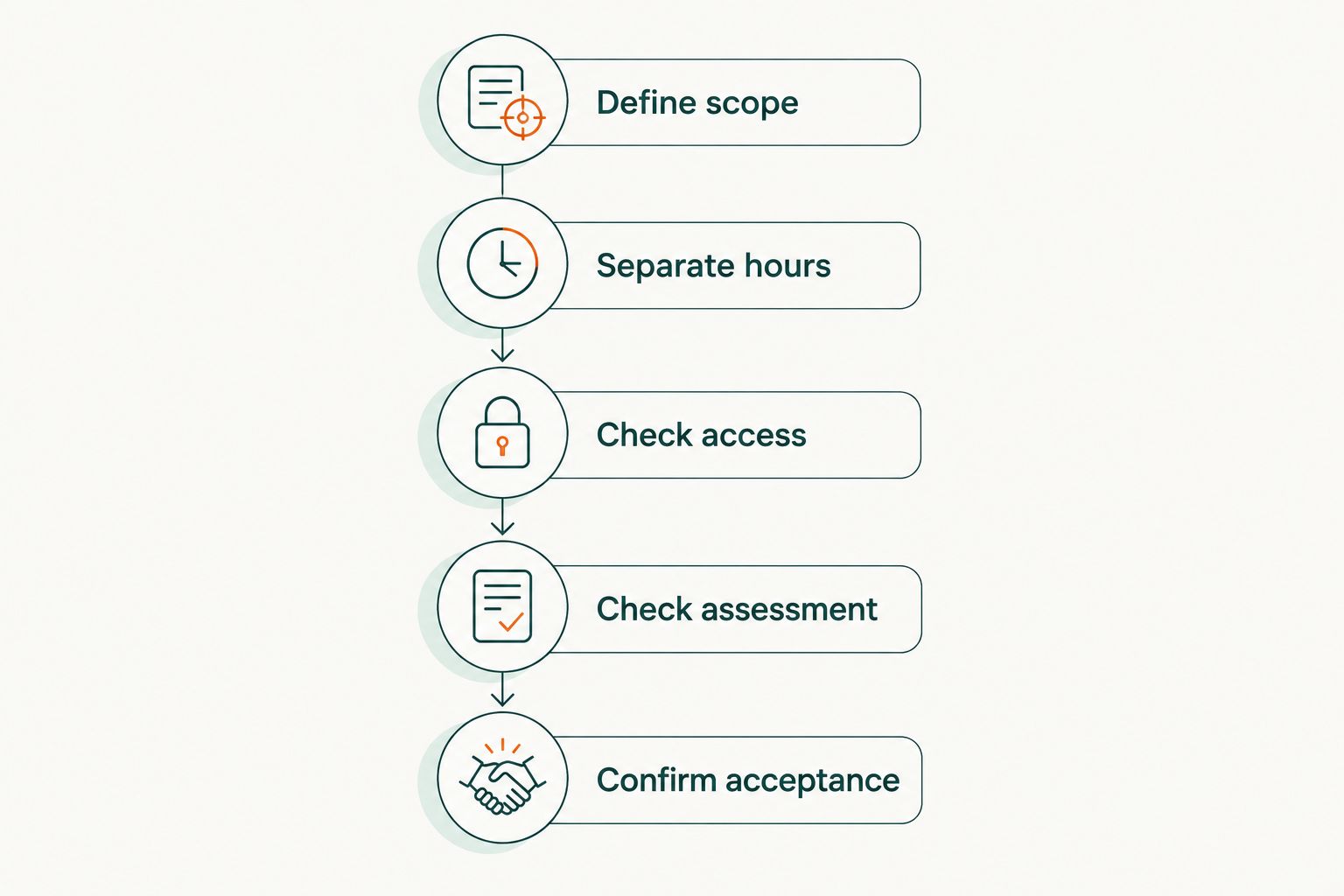
Save the provider's answers alongside the enrollment terms. Your 2026 plan should reflect the requirements that apply when you enroll, including any access limits or completion deadlines stated in those terms.
If an answer is vague, ask a narrower question. Instead of asking whether a course is practical, ask whether someone reviews you teaching another person and what criteria that reviewer uses.
Where does self-paced online study fit?
Teachpilates is best for aspiring Pilates instructors who want self-paced online study covering anatomy, mat instruction, cueing, business skills, and introductory Reformer concepts. The flexible format lets you arrange study around your schedule rather than a fixed classroom timetable.
Published by Teachpilates, this guide distinguishes course study from dedicated hands-on apparatus qualification. Introductory Reformer concepts are not the same as a dedicated hands-on Reformer qualification. Do not treat a course completion certificate as an independent credential unless that credential is explicitly included.
You can review the Teachpilates course with those boundaries in mind. Confirm the current observation rules, practice-teaching requirements, assessment process, and access terms before enrolling; curriculum coverage alone does not establish those details.
Self-paced study also needs a practical plan. Decide where you will study and how you will arrange any required observation or teaching activity. Flexibility removes a fixed classroom schedule; it does not remove your responsibility to complete the work.
Can observation hours count as teaching hours?
Observation hours and teaching hours represent different activities; count an activity according to the provider's written rules. Watching a session does not demonstrate that you delivered its instructions.
If a workshop includes both observation and participant teaching, ask how each portion is recorded. Do not enter the entire workshop into both categories unless the provider explicitly authorizes that method.
Can you complete practice teaching online?
Practice teaching can take place through a remote session, but only the provider can confirm whether that format satisfies its course requirements. Ask how the reviewer needs to see and hear the session and whether a recording is acceptable.
For a 2026 enrollment decision, separate the location of your lessons from the format of your practical assessment. An online course label does not, by itself, tell you how teaching work is submitted or evaluated.
Do more training hours mean better preparation?
More training hours do not, by themselves, establish better teaching preparation. You also need to know what you do during those hours, what feedback you receive, and what you must demonstrate to pass.
Compare like-for-like scope before comparing totals. Extra observation is not a direct substitute for reviewed teaching, and introductory apparatus content is not equivalent to dedicated hands-on apparatus training.
FAQ
What's the difference between observation and practice teaching in Pilates certification programs?
Observation means watching another instructor teach; practice teaching means giving instructions yourself. Keep the activities separate and follow the provider's rules for recording each one.
Can watching recorded Pilates classes count toward observation hours?
Recorded classes count only if the provider accepts them for its observation requirement. Confirm whether particular recordings, notes, permissions, or verification are required.
Does taking a Pilates class count as teaching practice?
Taking a Pilates class is personal practice, not evidence that you taught it. Record participant practice separately unless the provider gives explicit instructions for another method.
Do I need previous teaching experience to start training?
Previous teaching experience is not required to begin the Teachpilates course. Check other providers' entry requirements separately, including any expected Pilates experience or preparatory study.
Will an online course qualify me to teach every Pilates apparatus?
An online course does not establish qualification across every Pilates apparatus simply because it includes apparatus content. Distinguish introductory Reformer concepts from dedicated hands-on apparatus qualification and check the scope required for your intended role.
Is a course certificate the same as an independent Pilates credential?
A course certificate is not automatically an independent Pilates credential. Confirm the awarding organization, assessment requirements, and whether any separate credential is explicitly included.
What should I ask about a practical Pilates teaching assessment?
Ask what you must teach, how the session is reviewed, and which criteria determine a pass. Also confirm submission rules, feedback, and the process for another attempt before enrolling.
One last thing
Before choosing a course, write down what you want to be able to teach and where you want to teach it. Then ask the intended studio or organization what training and practical evidence it requires for that role.
Make that check before enrollment, not after certification. For your 2026 decision, the useful question is not simply how many hours a program lists. It is whether the course's teaching scope, practical work, and assessment match your next step.