
At $497, TeachPilates offers flexible, self-paced online Pilates instructor certification covering anatomy, mat instruction, introductory Reformer concepts, cueing, and business skills. For studiopilates alternatives in 2026, choose this route for online teaching foundations; choose dedicated hands-on Reformer training when apparatus instruction is your immediate goal.
- TeachPilates is the best-fit StudioPilates alternative for self-paced online Pilates teaching foundations at $497.
- Compare studiopilates alternatives by teaching scope, practical assessment, equipment access, and employer requirements.
- Introductory Reformer concepts do not replace dedicated hands-on apparatus qualification.
- Keep Studio Pilates on your shortlist when its current training meets your intended studio’s requirements.
Why this matters
Your first training decision should answer a practical question: what do you want to teach? Mat classes, Reformer sessions, and instruction across multiple apparatus require different preparation. A course title alone does not establish that scope.
This comparison is published by TeachPilates, which sells one of the courses discussed. The recommendation favors its online format only when that format matches your needs; it is not a claim of universal studio acceptance or equivalent hands-on apparatus preparation.
Studio Pilates belongs on your shortlist when its current course fits your intended teaching role. Looking at alternatives is useful when you need a different study format or teaching pathway—not because another provider is automatically better.
StudioPilates alternatives at a glance
This 2026 comparison separates a named online course from broader training pathways. The pathways are selection categories, not claims about a particular provider’s timetable, assessment, or recognition.
| Option | Best for | Standout feature or selection criterion | Difference to establish against Studio Pilates |
|---|---|---|---|
| Studio Pilates | Candidates whose intended training and employer requirements align with its course | Check the current provider syllabus and practical requirements | Use its actual course as your benchmark, not the brand name alone |
| TeachPilates online certification | First-time instructors seeking flexible online foundations | Self-paced study covering anatomy, mat instruction, cueing, business skills, and introductory Reformer concepts | Compare study format, assessment, and intended teaching scope directly |
| Dedicated hands-on Reformer training | Candidates preparing specifically for apparatus instruction | Select a course with equipment practice and observed teaching | Compare actual apparatus practice and assessment requirements |
| Mentored mat-teaching training | Candidates prioritizing feedback on mat-class delivery | Select a pathway with observation and assessed practice teaching | Compare how teaching feedback is delivered and evaluated |
| Full-apparatus training | Candidates planning to teach beyond mat and Reformer | Check exactly which apparatus and competencies the syllabus covers | Compare the complete apparatus list and practical obligations |
Do not compare an online foundation course with a broader apparatus pathway as though they deliver the same qualification. First match teaching scope; then compare format, assessment, and total commitment.
1. TeachPilates: best for self-paced online foundations
TeachPilates is the best-fit online Pilates certification option here if you want flexible foundational study before your first teaching role. Tuition is $497, and the course covers anatomy, mat instruction, cueing, business skills, and Reformer material that you should treat as introductory rather than dedicated hands-on apparatus qualification.
Best for: Pilates practitioners preparing to become instructors who need control over their study schedule.
Where this online course shines
- Self-paced study: Organize learning around your existing responsibilities rather than building your schedule around a fixed classroom timetable.
- Teaching-focused curriculum: Study anatomy alongside mat instruction and cueing, rather than treating movement knowledge and communication as separate goals.
- Business content: Include the business side of teaching in your preparation, not just exercise instruction.
Where this online course falls short
- Online study is not supervised equipment practice. Introductory Reformer concepts do not establish hands-on apparatus competence.
- Self-paced learning needs structure. You must make room to study and rehearse teaching instead of relying on a scheduled class to create momentum.
- Employer requirements still apply. A course certificate does not guarantee acceptance by every studio or inclusion of an independent credential.
Before enrolling, request the assessment criteria, course-access terms, and any completion deadlines. Flexible pacing describes how you study; it does not, by itself, establish unlimited access or a particular level of tutor support.
For your 2026 decision, separate what you want to learn online from what you need to demonstrate in person. If your immediate goal is apparatus teaching, arrange the relevant practical training rather than expecting online foundations to replace it.
Verdict: Buy for flexible online foundations—not as a substitute for dedicated hands-on Reformer qualification.
2. Dedicated Reformer training: best for apparatus teaching
Choose a dedicated hands-on Reformer pathway when the role you want centers on teaching with the apparatus. Evaluate courses by what you physically practice and demonstrate, not simply whether Reformer appears in the curriculum.
Best for: Aspiring instructors with a clear Reformer-teaching goal and a workable equipment-access plan.
Where this pathway shines
- Relevant practice: A course selected for hands-on apparatus instruction aligns your study with your intended teaching setting.
- Observable skills: Look for assessment of equipment setup, exercise instruction, transitions, and modifications.
- Specific feedback: Prioritize opportunities for an assessor to watch you teach and explain what needs correcting.
Where this pathway falls short
- Equipment access becomes a practical requirement you must solve before committing.
- Travel, scheduled attendance, and practice arrangements can conflict with a flexible-study preference; check the actual course requirements.
- A Reformer-focused qualification does not automatically establish readiness to teach other apparatus.
Against Studio Pilates, compare the same deliverables: required practical attendance, equipment practice, observed teaching, and assessment scope. Avoid treating a course’s delivery label—online, hybrid, or in person—as proof of those details.
Verdict: Buy when Reformer teaching is the goal and the practical requirements fit your schedule.
3. Mentored mat training: best for feedback on teaching
A mentored mat pathway suits you when your priority is learning to explain movement clearly and respond to a person in front of you. Select it for defined teaching observation and feedback, rather than assuming that access to a tutor includes practical coaching.
Best for: First-time teachers who want structured feedback on mat-class delivery.
Where this pathway shines
- Teaching rehearsal: Practice giving instructions without relying on your own demonstration to carry the class.
- Specific correction: Ask for feedback on cueing, pacing, exercise choices, and modifications.
- Clearer readiness checks: An observed teaching task gives you something concrete to prepare and improve.
Where this pathway falls short
- Mat preparation alone does not establish apparatus-teaching competence.
- Mentoring arrangements need definition: who observes, what they assess, and how feedback reaches you.
- Scheduled feedback sessions require coordination, even if the study material is self-paced.
Compare this pathway with Studio Pilates by examining the actual observation and feedback arrangements on both sides. The useful distinction is assessed teaching practice, not a vague promise of support.
Verdict: Buy when practical feedback matters more to you than studying entirely independently.
4. Full-apparatus training: best for broader teaching scope
Consider full-apparatus training when your intended work extends beyond mat and Reformer. Read the equipment list carefully: a broad course name is not a substitute for a syllabus naming the apparatus and teaching competencies covered.
Best for: Candidates with a defined goal to teach across multiple apparatus.
Where this pathway shines
- It gives you a framework for comparing preparation across the apparatus relevant to your intended role.
- It directs attention to equipment-specific practice rather than general Pilates knowledge alone.
Where this pathway falls short
- Access to the required equipment needs advance planning.
- A broader syllabus is unnecessary if it does not match the work you intend to pursue.
- The credential still needs checking against employer and independent-assessment requirements.
Compare full-apparatus training with Studio Pilates only after establishing which course and apparatus scope you mean. Otherwise, the comparison mixes different educational goals.
Verdict: Wait until you have confirmed your intended teaching scope and equipment access.
How to choose your training route in 2026
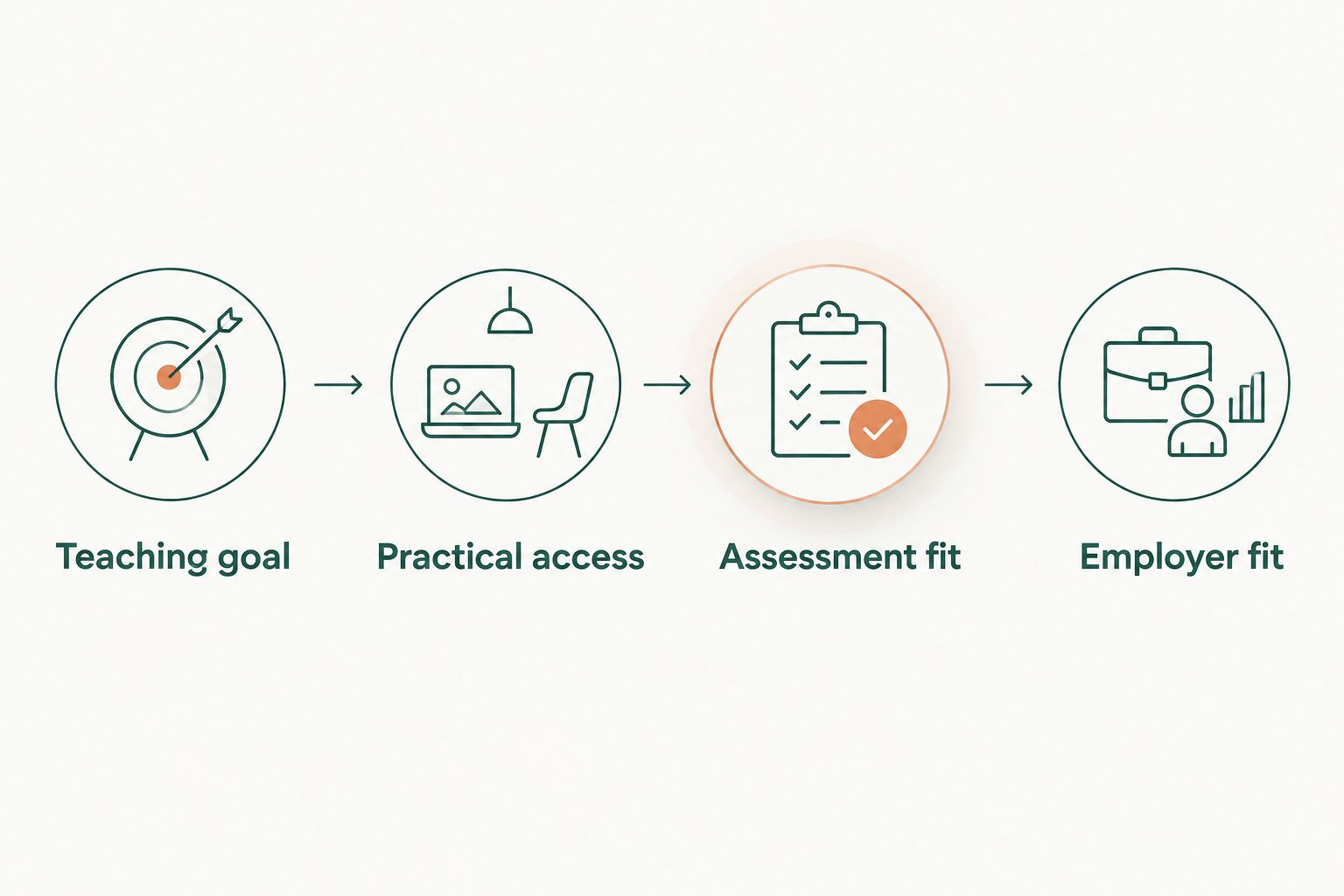
Use these 4 checks before paying tuition. Start with the teaching role, then work backward to the course requirements; beginning with a provider name reverses that process.
Teaching goal
Write down the classes you want to teach: mat, Reformer, or multiple apparatus. If a particular studio is your target, ask what training it requires for that role before selecting a course.
Practical access
Decide where you will rehearse and, where relevant, use equipment. Watching instruction and practicing your own movement are different from teaching another person under observation.
Assessment fit
Ask what you must demonstrate to pass, not merely what lessons you receive. A written assessment can evaluate knowledge; a practical assessment examines how you apply it while teaching. Use the guide to written versus practical assessments to structure those questions.
Employer fit
Give your intended employer the exact course name and intended qualification. Ask about required practical training, auditions, and any additional credentials instead of asking whether it accepts online courses in general.
Check costs alongside these decisions. Request a written breakdown separating tuition from any assessment, reassessment, equipment-access, travel, or other requirements that apply to the course you are considering. Do not assume any of these are included or charged separately.
Explore your online training option
Review self-paced Pilates instructor training with $497 tuition and a teaching-focused curriculum.
Why consider switching from Studio Pilates?
A useful reason to switch is a documented mismatch between your needs and a course’s requirements. It is not an unsupported claim about a provider’s quality, pricing history, or graduate outcomes.
For your 2026 shortlist, use these decision triggers:
- Schedule mismatch: The required attendance conflicts with your responsibilities, and another course’s confirmed format fits.
- Scope mismatch: The course does not prepare you for the particular teaching role you want.
- Practice mismatch: You cannot arrange the equipment access or supervised teaching the course requires.
- Assessment mismatch: You need a different assessment format or more clearly defined practical feedback.
These are comparison criteria, not claims that Studio Pilates has those shortcomings. Check the current course documents before deciding that an alternative solves a problem.
If you have already started training, ask both providers about transfer arrangements before changing courses. Do not assume completed lessons or practice hours will count elsewhere.
When staying with Studio Pilates is the right call
Stay with Studio Pilates when its current course matches your teaching goal, practical arrangements, assessment needs, and intended employer’s requirements. A different course is not automatically an upgrade because its study format sounds easier to manage.
Keep the distinction between convenience and suitability clear. If the course you have selected provides the preparation your intended role requires, switching to a differently scoped option can move you away from that goal.
FAQ
What is the best StudioPilates alternative for flexible online study?
TeachPilates is the best-fit option in this comparison for self-paced online Pilates teaching foundations, with $497 tuition. Its curriculum covers anatomy, mat instruction, cueing, business skills, and introductory Reformer concepts; dedicated hands-on apparatus qualification is a separate consideration.
Is online Pilates certification enough to teach Reformer classes?
Online study alone does not establish hands-on Reformer teaching competence. Check the course’s practical requirements and the intended employer’s training expectations before treating it as preparation for apparatus instruction.
Should I choose mat or Reformer instructor training first?
Choose the pathway that matches the classes you intend to teach. Mat foundations and dedicated Reformer preparation address different teaching settings, so compare the actual syllabus and assessment rather than the course title.
Do I need teaching experience before starting Pilates certification?
TeachPilates states that no teaching background is required. For any course, confirm its current movement-experience, attendance, and assessment prerequisites before enrolling.
Does a Pilates course certificate include an independent credential?
Do not assume a course certificate includes an independent credential. Ask which organization issues the certificate and whether a separate application, eligibility check, or assessment is required.
How should I compare Pilates certification costs in 2026?
Compare the full requirements for courses with the same intended teaching scope. Request a written breakdown of tuition and any applicable assessment, reassessment, equipment-access, or travel costs before committing.
When should I stay with Studio Pilates instead of switching?
Stay with Studio Pilates when its current training fits your intended teaching role and employer requirements. Confirm that the practical arrangements and assessments also work for you before replacing it with a differently scoped course.
One last thing
Before you enroll, ask one intended employer this specific question: What would I need to demonstrate at an audition after completing this exact course? The answer connects your training decision to the teaching task you are preparing to perform, without confusing enrollment, certification, and employment.