
Power Pilates offers classical Pilates teacher training; TeachPilates offers $497 tuition and flexible, self-paced online study for aspiring instructors. The deciding question is whether you need an online teaching foundation, supervised mat practice, or dedicated hands-on apparatus training. The best Power Pilates alternative in 2026 is TeachPilates if you need self-paced online foundations; a dedicated hands-on Reformer course fits better if apparatus teaching is your goal.
- TeachPilates leads these Power Pilates certification alternatives for self-paced online foundations at $497 tuition.
- Choose dedicated hands-on Reformer training when your goal is teaching apparatus sessions.
- Compare mat certification, practical assessment, and employer requirements before choosing a course.
- Stay with Power Pilates if its classical training pathway matches your intended teaching role.
Published by TeachPilates, the provider of the online course included in this comparison.
Why this matters
A Pilates certification decision starts with the class you want to teach, not the certificate you want to display. Teaching mat sessions and teaching clients on spring-loaded apparatus require different preparation. Course titles alone do not establish that preparation.
The TeachPilates online Pilates instructor certification course covers anatomy, mat instruction, introductory Reformer concepts, cueing, and business skills. Treat that as a teaching foundation, not a substitute for dedicated hands-on apparatus qualification. No teaching background is required, but learning to perform an exercise and learning to teach it are separate tasks.
For your 2026 shortlist, compare equivalent outcomes: mat with mat, Reformer with Reformer, and full-apparatus training with full-apparatus training. A broader course title does not settle whether its assessed teaching scope matches your plans.
Power Pilates alternatives at a glance
The alternatives below include a named online course and training formats. A format recommendation lets you choose the right kind of education without treating providers with different teaching scopes as interchangeable.
| Option | Best for | Defining feature | Difference from Power Pilates |
|---|---|---|---|
| Power Pilates | Students specifically seeking classical Pilates education | Classical teacher-training approach | The benchmark for this comparison; compare the particular pathway you intend to take |
| TeachPilates | First-time instructors needing self-paced online foundations | Online study covering anatomy, mat instruction, cueing, introductory Reformer concepts, and business skills | Prioritizes flexible independent study rather than choosing training around the Power Pilates pathway |
| In-person mat teacher training | Students prioritizing supervised mat-teaching practice | A format built around attending practical teaching sessions | Compare delivery and assessment, rather than assuming every alternative teaches a different method |
| Dedicated hands-on Reformer training | Students intending to teach Reformer sessions | Equipment-specific practical instruction | A focused apparatus choice rather than a general online foundation |
| Full-apparatus teacher training | Students seeking preparation across multiple apparatus | A broader equipment-training scope | Compare against an equivalent Power Pilates pathway, not an introductory mat course |
Choose teaching scope first and study format second. Otherwise, you risk comparing a convenient foundation course with a different kind of professional preparation.
1. TeachPilates: best for self-paced online foundations
TeachPilates is the strongest fit here if you want to begin instructor education independently and need study to fit around existing commitments. Tuition is $497, and the course is self-paced. Its curriculum combines movement instruction with anatomy, cueing, and business skills rather than treating exercise knowledge alone as teacher preparation.
Where the course shines
- Flexible study: You can work through online material at your own pace.
- First-time instructor focus: No previous teaching background is required.
- Teaching-related curriculum: Anatomy, mat instruction, and cueing address skills you need beyond performing the exercises yourself.
- Business education: Business skills sit alongside movement instruction.
Where the course falls short
- Self-paced study does not replace the experience of cueing someone in real time.
- Introductory Reformer concepts are not the same as dedicated hands-on apparatus qualification.
- Enrollment is not a promise of employment, earnings, or acceptance by every studio.
Best for: A Pilates practitioner preparing to become an instructor who needs an online foundation and accepts responsibility for organizing regular study and practice.
Online foundations versus a classical training pathway
| Decision | Online foundation course | Power Pilates |
|---|---|---|
| Main selection reason | Flexible, self-paced study | A specifically classical training pathway |
| Curriculum emphasis | Anatomy, mat instruction, cueing, introductory Reformer concepts, and business skills | Classical Pilates education within the selected pathway |
| Apparatus decision | Add dedicated hands-on qualification when apparatus teaching is your goal | Evaluate the apparatus scope of the particular pathway before enrolling |
Before choosing an online course in 2026, write down how you will practice explaining movements aloud. Reading a cue silently does not show whether another person understands it. Build practice teaching into your plan rather than waiting until the end to discover that gap.
Verdict: Buy if self-paced foundations match your goal; skip this route as a substitute for dedicated hands-on apparatus training.
2. In-person mat training: best for supervised teaching practice
An in-person mat pathway fits you when your priority is practicing instruction with other people present. Choose a course whose published schedule actually includes observed teaching and feedback. Attendance alone does not establish either.
This is a format alternative, not a claim that in-person education is always better than online education. The useful distinction is what you will do during the sessions and how your teaching will be assessed.
Where in-person mat training shines
- Scheduled sessions give your learning a defined structure.
- A course with supervised teaching lets you practice cues and receive feedback.
- A mat-focused scope keeps the decision tied to the classes you intend to teach.
Where in-person mat training falls short
- You must work around the provider's attendance schedule.
- Mat instruction does not establish qualification to teach Reformer or other apparatus sessions.
- A practical timetable still needs to distinguish demonstrations, personal practice, and assessed teaching.
Best for: An aspiring mat instructor who wants scheduled practical instruction and can attend the required sessions.
Ask how the course handles an unclear cue. Does a tutor watch you teach, explain what failed, and ask you to try again? That is a more useful enrollment question than whether a course describes itself as practical.
Verdict: Buy when supervised mat teaching is the priority and the assessment matches that promise.
3. Hands-on Reformer training: best for apparatus teaching goals
Choose dedicated hands-on Reformer training when you specifically intend to teach Reformer sessions. Learning introductory concepts online and learning to manage an apparatus session are different objectives. Your course decision should reflect that distinction from the start.
Where hands-on Reformer training shines
- Equipment-specific practice connects instruction to the apparatus you intend to teach.
- Supervised teaching creates an opportunity to assess setup, cueing, and exercise choices together.
- A focused scope makes it easier to ask exactly what your final assessment covers.
Where hands-on Reformer training falls short
- You need equipment access for the practical work the course requires.
- Reformer training is not automatically full-apparatus training.
- An equipment-focused course still needs adequate anatomy and teaching preparation.
Best for: A practitioner whose intended teaching role specifically involves the Reformer.
Before enrolling in 2026, map out your Reformer training and equipment access. Ask where you will practice, who will supervise you, and which activities count toward completion. A course schedule is not a practice-access plan.
Verdict: Buy for a Reformer teaching goal; skip an introductory overview as its replacement.
4. Full-apparatus training: best for broader equipment scope
Full-apparatus education belongs on your shortlist when your intended role extends beyond mat or Reformer alone. Compare the actual apparatus named in each syllabus and the teaching assessed on each one. Do not treat the word comprehensive as a complete description.
Where full-apparatus training shines
- It lets you plan education around a broader equipment-teaching goal.
- An explicit apparatus list makes scope easier to compare.
- Equipment-by-equipment assessment requirements give you concrete enrollment questions.
Where full-apparatus training falls short
- You must arrange access to the apparatus required for practice.
- A broader syllabus adds subjects you might not need for a mat-only goal.
- Breadth does not remove the need to check supervision and assessment quality.
Best for: Someone deliberately preparing for a role involving multiple apparatus, rather than seeking the simplest route into mat instruction.
Verdict: Buy for a defined full-apparatus goal; hold if you have not established the teaching scope you need.
Why people consider switching from Power Pilates
A different course makes sense when its format or scope better matches your needs. These are decision criteria, not claims about Power Pilates student behavior, completion rates, or satisfaction.
Your schedule requires independent study
If fixed attendance is the obstacle, prioritize a self-paced format. Then check access duration, assessment arrangements, and support before paying. Flexible study should solve a scheduling problem without leaving your practical preparation undefined.
Your immediate goal is mat teaching
If you want to teach mat classes, compare mat-level learning and assessment first. You do not need to select broader apparatus education merely because it appears more extensive. Choose the scope you intend to use.
Your goal requires apparatus practice
If you want to teach equipment sessions, prioritize hands-on preparation for that equipment. Moving from one general foundation course to another does not resolve an apparatus-training need.
You need a clearer assessment plan
Ask what you must demonstrate, who evaluates it, and what happens if you do not meet the standard. In 2026, a course comparison should separate 2 assessment formats: written assessment and practical teaching assessment. Neither label alone tells you how demanding the assessment is.
Check these details before enrolling
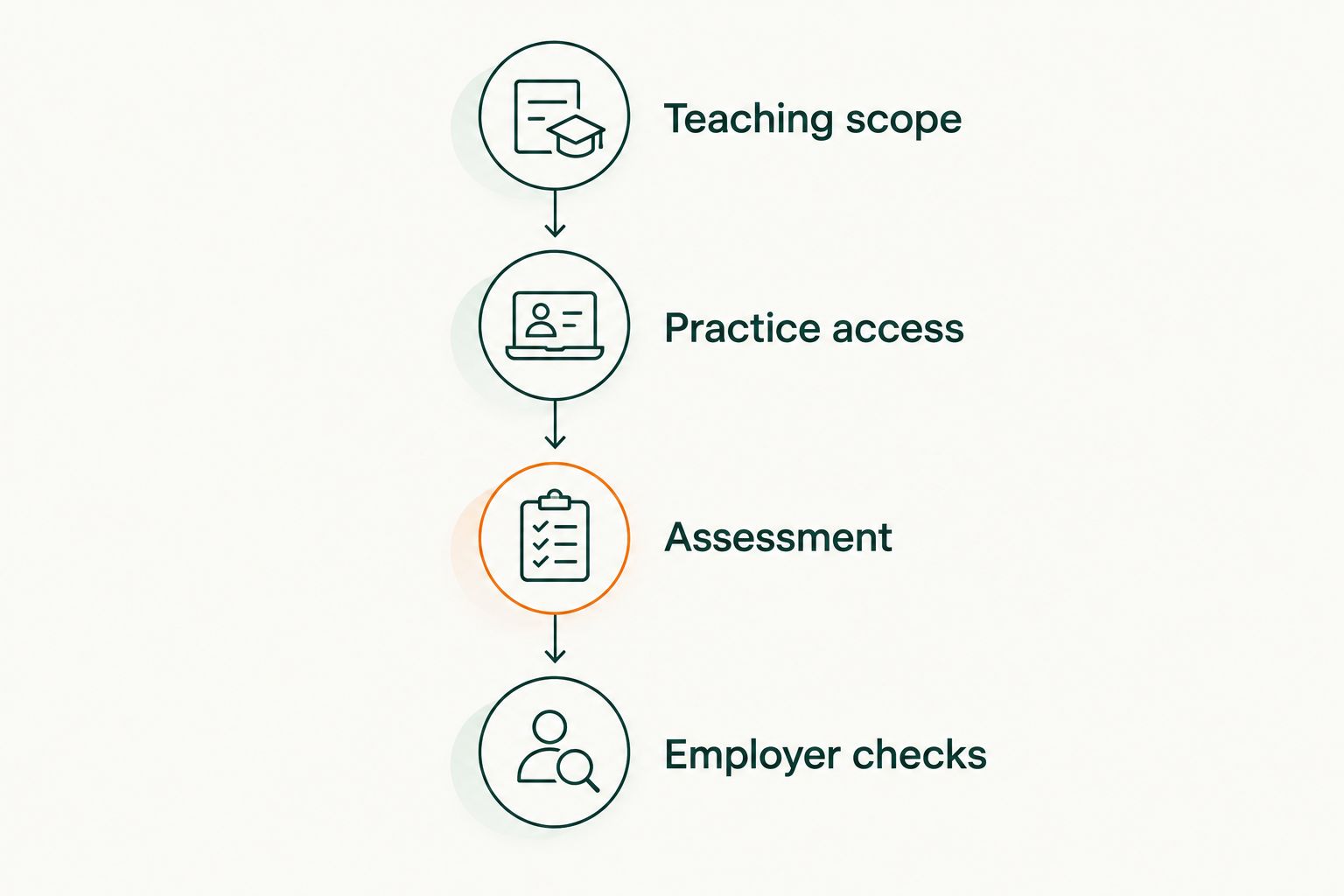
Use these steps with every provider, including the publisher of this article. Keep the answers in writing so you can compare the same questions across courses.
- Teaching scope: Name the classes and equipment you intend to teach. Ask whether the course assesses that exact scope.
- Practice access: Separate 3 practice activities: personal practice, observation, and practice teaching. Ask what each involves and where you will complete it.
- Assessment: Request the written and practical requirements, pass criteria, and reassessment terms. Do not assume watching lessons demonstrates teaching competence.
- Employer checks: Ask prospective studios what education, practical experience, and audition evidence they require. Their answer matters more than a general acceptance claim.
These checks connect your education purchase to a specific teaching plan. Complete them before letting convenience or a course title decide for you.
Also distinguish course certification from an independent credential. Do not assume a separate examination, registration, or professional designation is included unless the provider explicitly confirms it. The same discipline applies to access limits, refund terms, and support arrangements: check the terms attached to your enrollment.
Review your online training option
Explore self-paced instructor education covering anatomy, mat instruction, cueing, and business skills.
When staying with Power Pilates is the right call
Stay with Power Pilates if you specifically want classical Pilates education and its selected pathway matches your teaching goal. An alternative is not better simply because its study format is different.
Compare the actual pathway, required practice, and assessed scope before switching. If your target studio identifies a particular training requirement, use that requirement to guide the decision. A favorable online comparison cannot override an employer's hiring criteria.
FAQ
What's the best Power Pilates certification alternative in 2026?
TeachPilates is the best fit in this comparison for aspiring instructors seeking self-paced online foundations. Choose dedicated hands-on training instead when your goal requires apparatus qualification.
How much does the online course in this comparison cost?
TeachPilates tuition is $497. When comparing enrollment costs, also ask providers about assessments, required materials, practice access, and any separate credential expenses.
Is an online Pilates course enough to teach Reformer?
Introductory online Reformer concepts are not a substitute for dedicated hands-on apparatus qualification. Check the practical training and assessment required for the role you want.
Do I need teaching experience before starting?
No teaching background is required for the online course described here. You still need to develop cueing, observation, and practice-teaching skills as part of preparing to instruct others.
Should I choose mat training or full-apparatus training?
Choose the training scope that matches the classes you intend to teach. Mat preparation and full-apparatus preparation are different objectives, so compare their syllabuses and assessments separately.
Will every studio accept an online Pilates certificate?
Do not assume universal studio acceptance. Ask each prospective employer about required education, practical experience, insurance, and auditions before enrolling.
Does course certification include an independent credential?
Do not assume an independent credential is included. Ask whether a separate examination, application, or eligibility process applies to the credential you want.
One last thing
Before paying for any course, ask a studio where you would genuinely like to teach what it expects from a new instructor. Request specifics about assessed teaching, apparatus preparation, and auditions. Choose the course that prepares you for that conversation—not just the course with the most appealing title.