

Pilates instructor requirements depend on your teaching role: confirm your training scope, the studio’s CPR/AED rules, and insurance that covers your work. You can begin with $497 self-paced online training, but completing a course does not replace an employer’s emergency-care requirements or establish insurance coverage.
- Pilates instructor requirements include checking training scope, CPR/AED conditions, and insurance before accepting teaching work.
- TeachPilates offers $497 self-paced online instructor training; confirm each studio’s separate hiring requirements.
- Ask whether your teaching arrangement requires individual liability insurance, studio coverage, or both.
- Introductory Reformer concepts do not replace dedicated hands-on apparatus qualification.
What are the Pilates instructor requirements for CPR and insurance?
Check the requirements of the specific role before you enroll or accept a class. A training certificate, CPR/AED documentation, and insurance evidence answer different questions. Do not treat any one of them as proof that the others are satisfied.
For a practical starting point in 2026, work through these checks:
- Training scope: Identify whether you intend to teach mat classes or use apparatus, and match your preparation to that work.
- CPR/AED acceptance: Ask the hiring studio which course providers, assessment formats, and credentials it accepts.
- Insurance responsibility: Establish whether you need your own policy and whether the studio’s policy covers your activities.
- Document approval: Submit the requested evidence and get confirmation before your first class.
TeachPilates offers self-paced online instructor training covering anatomy, mat instruction, introductory Reformer concepts, cueing, and business skills. Use those curriculum areas to evaluate your starting point, then check the separate conditions attached to the work you want.
Why this matters
Training, emergency response, and insurance serve different purposes. Training develops your teaching knowledge; CPR/AED preparation addresses emergency response; insurance deals with covered claims under a policy’s terms.
Passing a course is not the same as being cleared to teach every class. A studio can ask for documents or practical demonstrations beyond your course certificate. An insurer can also place conditions on the activities it covers.
Before paying tuition in 2026, ask a prospective studio what it expects from a first-time instructor. You want a specific answer about qualifications, teaching scope, emergency-care documentation, and insurance—not simply reassurance that certification is desirable.
CPR and AED: check the accepted course before booking
CPR means cardiopulmonary resuscitation; AED means automated external defibrillator. Your task is to establish what the organization hiring you requires, rather than assuming every emergency-care certificate is interchangeable.
Ask the studio or facility:
- Does the role require CPR, AED training, first aid, or a combination?
- Which training providers and course titles are accepted?
- Is a hands-on skills assessment required?
- Is an entirely online course accepted for this role?
- Must the credential remain current throughout your teaching arrangement?
- Who receives the certificate and tracks its expiration?
Do not book a CPR course solely because its title sounds right. Send the course details to the hiring organization first. An online knowledge course and a course with a practical skills assessment are different formats; the employer’s acceptance criteria determine which fits the role.
Keep the completion document where you can retrieve it easily. Check the expiration date printed on your credential rather than relying on a general renewal interval from an unrelated article.
CPR training also does not replace a site-specific emergency plan. Before teaching, locate the AED if the facility has one, learn how staff contact emergency services, and identify who takes responsibility for assisting other participants. Knowing the building’s procedure is a separate preparation task from holding a certificate.
Insurance: verify your actual teaching arrangement
Ask what the policy covers, not just whether insurance exists. A studio having insurance does not answer whether you are insured for every activity, location, or contractual responsibility involved in your work.
Professional liability generally concerns claims arising from professional services or instruction. General liability generally concerns claims such as bodily injury or property damage connected with business operations. Policy wording, definitions, exclusions, and endorsements determine actual coverage.
Use this comparison to organize your questions; it is not a coverage determination.
| Insurance arrangement | Best for | Potential advantage | Limitation to check |
|---|---|---|---|
| Coverage through a studio | Instructors teaching within that studio’s approved arrangement | Coverage administration can sit with the studio | Confirm that you are covered and for which activities |
| Your own instructor policy | Instructors responsible for arranging individual coverage | You can discuss your own teaching activities directly with the insurer | Coverage still depends on policy terms and declared activities |
| Studio coverage plus an individual policy | Instructors whose work involves separate contractual obligations | Each policy can address a different responsibility | Do not assume overlapping policies automatically resolve a claim |
Tell the insurer whether you will teach as an employee, an independent contractor, or through your own business. Also describe the teaching itself: mat instruction, apparatus work, live online sessions, or recorded content, as applicable.
Ask about professional liability and general liability separately. If a venue requests a certificate of insurance or additional-insured status, send that request to the insurer for confirmation rather than promising that a standard document will satisfy it.
An insurance certificate is evidence to review, not a substitute for reading coverage terms. Keep the policy documents and relevant written answers with your teaching records.
Match your qualification to mat or apparatus teaching
Your qualification should match the class you intend to lead. Mat-teaching foundations and introductory Reformer concepts are not the same preparation as dedicated hands-on apparatus training.
TeachPilates is best for aspiring Pilates instructors seeking self-paced online foundations, not a substitute for dedicated hands-on apparatus qualification. Its $497 tuition gives you a defined course cost to evaluate alongside your learning needs. Check separate CPR, insurance, and any additional practical-training obligations before deciding your total budget.
For mat teaching, examine how the course addresses movement instruction, anatomy, cueing, modifications, and teaching decisions. Then ask the intended studio how it assesses readiness to lead its classes.
For Reformer or other apparatus teaching, ask what equipment-specific education and practical assessment the studio expects. Do not present introductory equipment concepts as proof that you are qualified for every apparatus class.
A certificate’s wording matters. Describe what you completed accurately on applications, instructor profiles, and insurance forms; avoid upgrading a course description into a broader qualification.
This article is published by TeachPilates, which offers the online course discussed here. That commercial relationship does not change the need to verify a hiring studio’s criteria or an insurer’s terms independently.
Why Pilates instructor requirements vary
There is no useful enrollment decision without knowing the work you are preparing for. In 2026, organize your checks around these factors:
- Teaching format: Mat instruction and apparatus instruction involve different teaching tasks and preparation.
- Hiring organization: A studio’s accepted qualifications and practical assessment can differ from a course provider’s graduation requirements.
- Emergency-care conditions: The required credential and accepted assessment format come from the organization setting the condition.
- Working relationship: Employee, contractor, and business-owner arrangements change the questions you need to ask about insurance responsibility.
- Delivery setting: In-person, live online, and recorded instruction should be described accurately when checking coverage.
- Contract terms: A venue can request specific insurance evidence or impose conditions that need separate review.
Use these factors to narrow your options, not to collect unrelated certificates. Start with the intended teaching role and work backward to the preparation and documents it requires.
How do you check assessments before enrolling?
Ask what you must demonstrate, not just what you will watch. A curriculum list tells you which subjects appear in a course; assessment details tell you how the provider evaluates your understanding and teaching ability.
Read the distinction between written and practical assessments, then request the current assessment requirements for the course you are considering. Confirm whether assessment involves written knowledge, observed teaching, submitted video, or another stated format.
Ask how feedback works and what happens if you do not meet the assessment standard. Check any stated resubmission conditions before enrolling. Do not assume that self-paced study means assessment-free completion or that practical assessment necessarily occurs in person.
For your 2026 enrollment decision, keep three questions separate: what the course teaches, what it assesses, and what your intended studio accepts. A satisfactory answer to one does not establish the others.
What should you do before accepting your first class?
Build a short approval sequence around the actual class assignment. Get the teaching scope and document requirements settled before agreeing to lead the session.
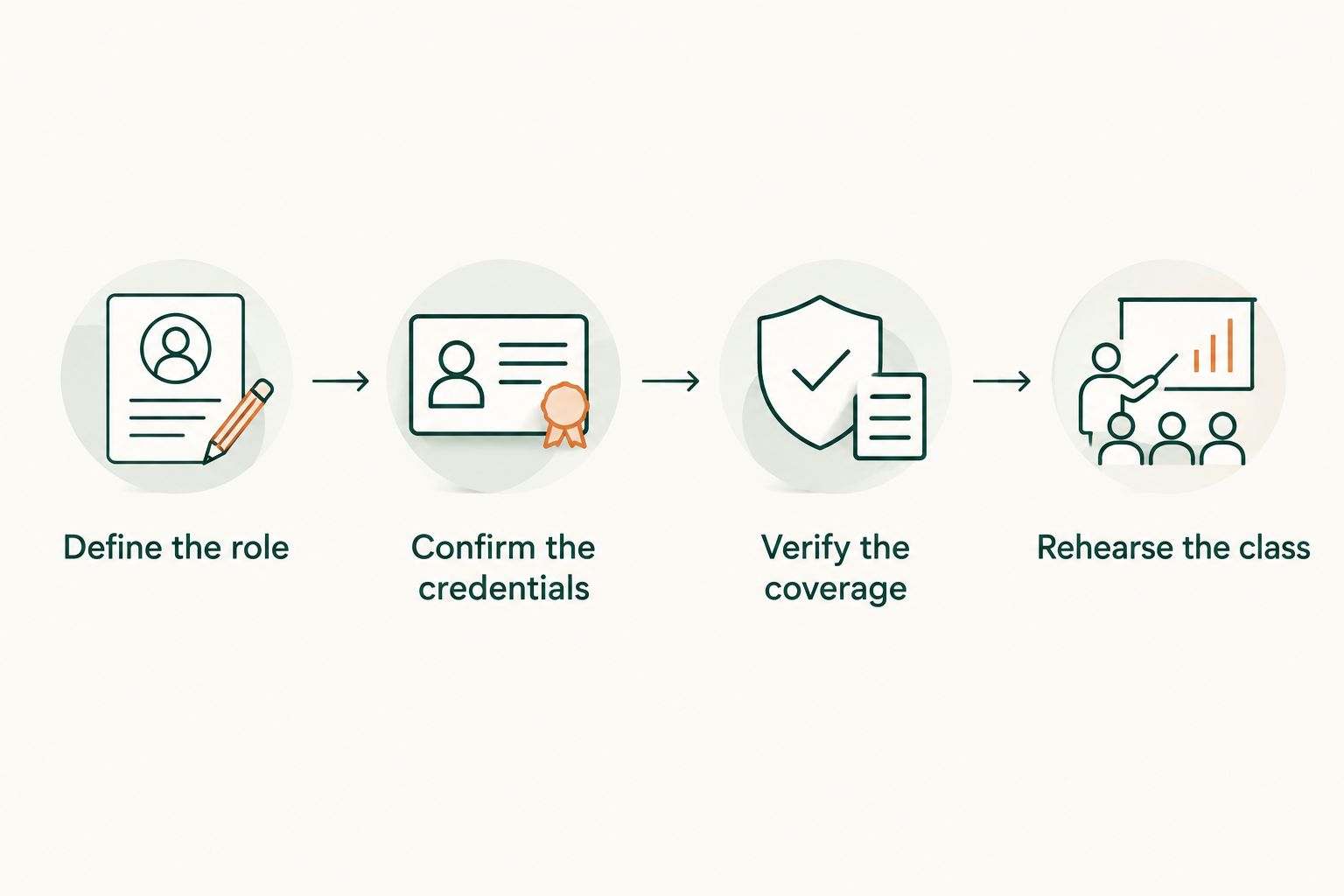
Define the role
Write down the class format, equipment, location, and working relationship. Include whether you will teach independently or under another instructor’s supervision. This description becomes the basis for your conversations with the studio and insurer.
Avoid vague descriptions such as general fitness instruction when the assignment is specifically apparatus teaching. Accurate details help the people reviewing your qualifications answer the right question.
Confirm the credentials
Send the studio your course details and ask what else it requires. Check CPR/AED acceptance before booking emergency-care training, and ask whether a teaching audition or practical evaluation forms part of hiring.
Save the response alongside your certificates. If the assignment changes, revisit the approval rather than assuming an earlier answer covers a different format.
Verify the coverage
Give the insurer an accurate description of your work and the venue’s insurance request. Ask for clarification of relevant exclusions and any activities that require separate approval.
Do not assume that a client waiver replaces liability insurance. A waiver and an insurance policy serve different functions, and neither should be treated as permission to teach beyond your preparation.
Rehearse the class
Practice the session within your training scope. Rehearse your setup instructions, movement explanations, transitions, and response when a participant needs a different option.
Also review the venue’s emergency procedure. A clear teaching plan and an accessible document folder solve different problems; prepare both.
Can you start training before you have CPR certification?
Check the course’s enrollment requirements separately from a studio’s hiring requirements. The point at which a studio expects CPR documentation does not establish when a training provider requires it. Confirm both before arranging your study and teaching schedule.
Does Pilates certification automatically include insurance?
Do not assume that course enrollment or certification includes insurance. Look for explicit policy documentation and coverage terms. If insurance is not expressly documented, arrange the required coverage separately before teaching.
Will a studio accept an online Pilates course?
Acceptance is the studio’s decision, not a guarantee attached to online study. Send the curriculum and assessment details to the intended employer, and ask about any additional practical preparation. This is more useful than judging a course by delivery format alone.
FAQ
What are the Pilates instructor requirements for CPR?
Confirm the CPR/AED credential, provider, and assessment format accepted by the organization hiring you. Check whether first aid is also required and keep the credential current under that organization’s conditions.
Do I need my own insurance if I teach at a studio?
Confirm whether the studio’s policy covers you and whether your contract requires individual insurance. Ask about the exact activities and working arrangement rather than relying on a general statement that the studio is insured.
Is online CPR training accepted for Pilates instructors?
Acceptance depends on the organization setting the requirement. Send the course details before booking and ask specifically whether a hands-on skills assessment is required.
Does TeachPilates tuition include CPR training or insurance?
Treat CPR training and insurance as separate checks rather than assuming they are included in the $497 tuition. Confirm any inclusion explicitly before enrolling or accepting teaching work.
Can introductory Reformer study qualify me for every apparatus class?
No. Introductory Reformer concepts do not replace dedicated hands-on apparatus qualification, and a hiring studio can set additional practical requirements.
What insurance details should I check before teaching online?
Describe live online or recorded instruction accurately to the insurer and ask whether the policy covers that activity. Also confirm any relevant restrictions on where you and your participants are located.
Does a Pilates course certificate include an independent credential?
Do not assume an independent credential is included with course completion. Check the credential issuer’s separate eligibility and assessment requirements before describing yourself as holding that credential.
One last thing
Ask for approval of the class you will actually teach, not approval of your certificate in isolation. A mat assignment, an apparatus assignment, and an online session create different questions about preparation and coverage. Keep that distinction at the center of your 2026 plan: enroll for the knowledge you need, then verify the conditions attached to your first teaching role.