
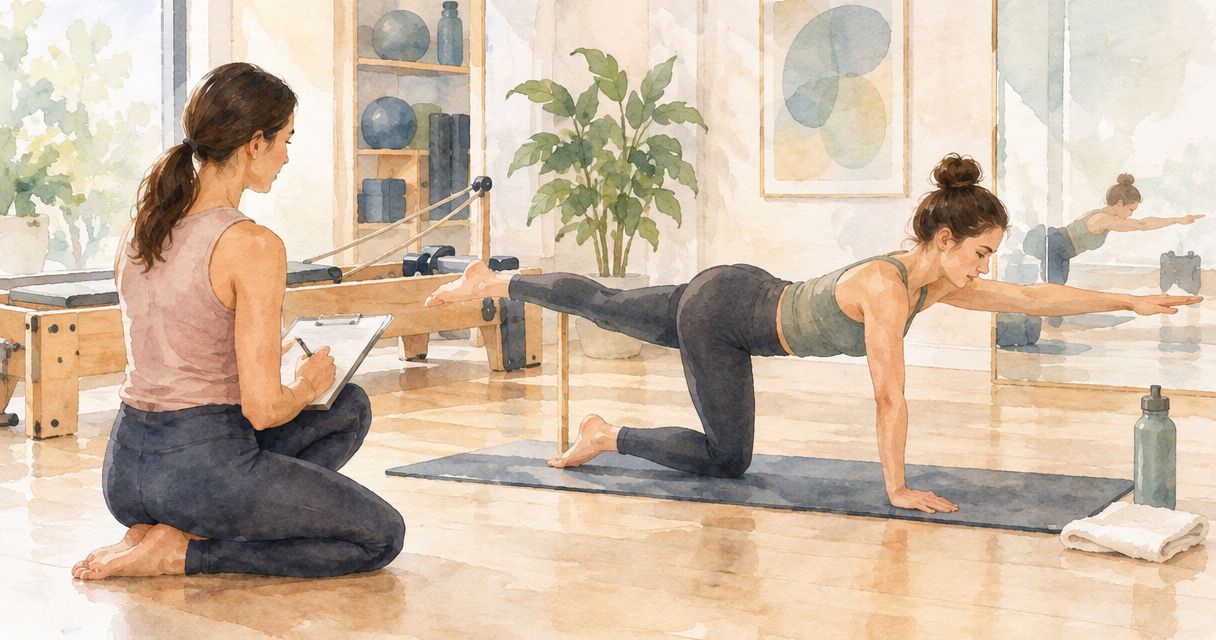
The $497 tuition for flexible, self-paced online study is a starting point; preparing a studio audition means turning your Pilates instructor certification coursework into a clear, scope-appropriate teaching demonstration. Confirm what the studio accepts, prepare for the exact class format, and rehearse giving instructions while someone else moves. Course completion does not guarantee studio acceptance or establish readiness to teach apparatus without dedicated hands-on preparation.
- TeachPilates offers self-paced Pilates instructor certification; pair coursework with deliberate practice teaching before a studio audition.
- Confirm the studio’s qualification requirements and audition format before preparing your demonstration.
- Mat-teaching foundations and introductory Reformer concepts are not interchangeable with dedicated hands-on apparatus qualification.
- Prepare clear cues, an accessible alternative, and a response when a participant cannot follow your instruction.
How do you prepare a Pilates instructor certification studio audition?
Prepare the teaching demonstration around the role you want, not around the hardest exercises you can perform. Use this sequence:
- Confirm the role. Ask whether the audition covers mat, Reformer, another apparatus, or a combination.
- Check acceptance. Send the studio your course details and ask whether its hiring requirements include additional credentials or practical training.
- Match your preparation. The TeachPilates online Pilates instructor certification covers anatomy, mat and Reformer instruction, cueing, and business skills; distinguish that curriculum from the hands-on qualification required for a particular apparatus role.
- Write a teaching outline. Include an opening, a coherent movement sequence, transitions, alternatives, and a closing.
- Practice with a participant. Check whether your instructions work when you stop demonstrating.
- Confirm logistics. Ask about the audition length, equipment, audience, and feedback process before attending.
A useful audition demonstrates what you can teach clearly, not everything you know. Keep your sequence within your preparation and the studio’s requested scope.
Why this matters
Your personal practice and your teaching demonstration answer different questions. Performing a movement shows what you can do; giving a usable instruction shows whether another person can follow you.
For a 2026 studio application, separate course completion, practical preparation, and employer acceptance. Treat each as something to verify rather than assuming one automatically establishes the others. That distinction helps you choose training and approach auditions without overstating your qualification.
Which teaching format should you prepare for?
Choose your audition format only after the studio confirms the role. These are preparation routes, not interchangeable qualifications.
| Preparation route | Best for | Advantage | Limitation to address |
|---|---|---|---|
| Mat-focused preparation | Applicants seeking a mat-teaching role | Lets you focus on movement instructions, observation, and class sequencing | Does not establish readiness to operate or teach apparatus |
| Dedicated hands-on Reformer preparation | Applicants seeking a Reformer-teaching role | Provides a setting to practice equipment use alongside teaching | Requires equipment access and practical preparation specific to the role |
| Combined mat and apparatus preparation | Applicants pursuing a role covering both formats | Connects preparation to a broader teaching brief | Requires you to verify readiness separately for each format |
Do not choose the broadest route simply because it sounds more impressive. Choose the route that matches the work you intend to do. A focused demonstration within your preparation is more defensible than an apparatus sequence you cannot confidently explain or manage.
Mat auditions: show that your instructions work
For a mat audition, prepare a sequence you understand well enough to teach without continuously demonstrating. Know the starting position, intended movement, breathing instruction where relevant, and the transition into the next exercise.
Include an accessible alternative you have learned to teach. Explain the change plainly rather than labeling a participant as weak or inflexible. Your objective is to make the instruction usable, not to show how many exercise variations you remember.
Reformer auditions: verify hands-on preparation first
For a Reformer audition, confirm the equipment and the studio’s expectations before planning the demonstration. Do not treat introductory Reformer concepts in an online curriculum as a substitute for dedicated hands-on apparatus qualification.
If your practical preparation does not match the audition brief, ask about a mat-only opportunity or the additional training required. Declining to demonstrate outside your preparation is a clear professional boundary, not something to disguise with confident language.
Build your audition plan around observable teaching
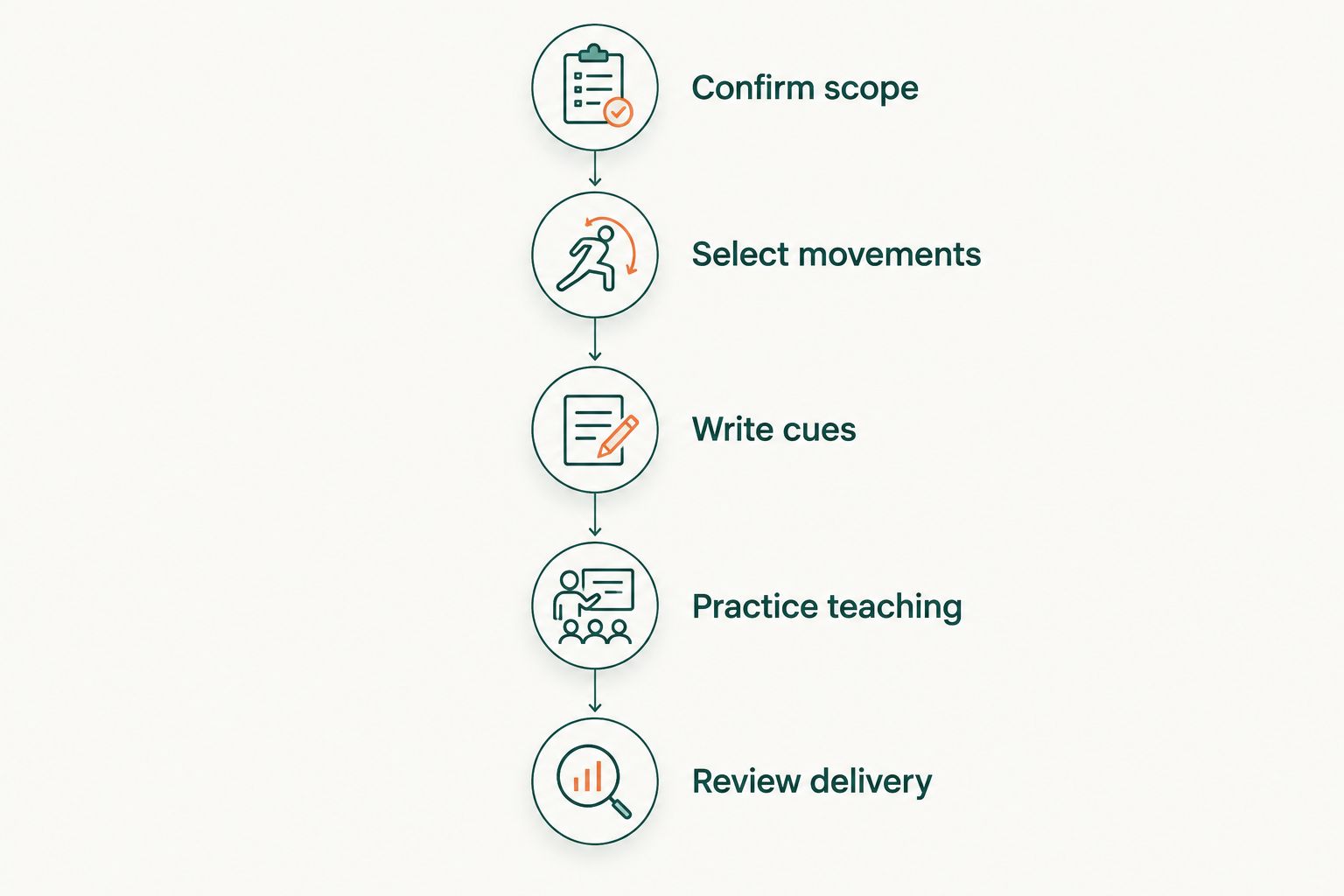
Write your 2026 audition plan so another instructor could understand its purpose without watching you perform it. Use the following sequence as a preparation exercise, not as a claimed studio assessment rubric.
1. Confirm scope
Ask the studio what you will teach, who will participate, and whether you should demonstrate continuously or primarily coach. Request the duration and any required exercises in writing so your preparation follows the actual brief.
Also ask what happens if the planned equipment is unavailable or the participant cannot perform an exercise. You are identifying decisions before the audition, rather than improvising beyond your training when the setting changes.
2. Select movements
Choose familiar movements with transitions you can explain. Give every exercise a reason for being in the sequence, such as introducing an action that appears again later or offering a manageable progression.
Remove an exercise if you cannot explain its setup or provide an appropriate alternative within your training. An audition is not the place to introduce a movement you have only watched and never practiced teaching.
3. Write cues
Write the initial setup instruction first, then the action instruction. Read both aloud and remove words that do not help the participant understand what to do.
Avoid stacking several corrections into the same sentence. Give an instruction, watch the response, and decide whether another cue is needed. If the movement does not change, try clearer wording rather than repeating the same phrase more loudly.
4. Practice teaching
Ask a willing practice participant to follow your instructions without copying your demonstration. Explain that this is practice teaching within your current preparation, not a treatment session or a substitute for individualized clinical advice.
Notice where you interrupt yourself, lose the sequence, or need to demonstrate because your words were unclear. Record those moments in your notes and revise the instruction before repeating the practice.
5. Review delivery
Review your rehearsal against the teaching brief. Check whether your introduction identifies the session’s purpose, your transitions are understandable, and your closing brings the session to a deliberate stop.
Listen for unnecessary apologies and unsupported claims about what an exercise fixes. Replace both with practical instructions. You can sound encouraging without promising a physical outcome or pretending to know why a participant finds something difficult.
Prepare for moments when the plan changes
A written sequence helps you prepare, but it should not force you to ignore the person in front of you. Rehearse how you will pause, clarify an instruction, or choose an alternative you are trained to teach.
When a participant cannot follow your cue
Stop adding instructions long enough to identify what was unclear. Restate the starting position or simplify the action, then observe again.
Do not assume the participant needs a more difficult explanation. The problem can be the wording or the amount of information you gave at once. Treat their response as feedback on the instruction.
When a participant reports pain
Do not coach someone to push through pain during your audition. Pause the exercise and follow the studio’s procedures within your training and scope.
Avoid diagnosing the cause or promising that another movement will resolve it. You can demonstrate judgment by acknowledging a limit and asking the supervising instructor how the studio handles that situation.
When you forget the sequence
Pause, reorient yourself, and return to a movement you prepared rather than inventing a progression. Keep a concise outline available if the studio permits notes.
Practice recovering during rehearsal instead of restarting every time you make a mistake. That gives you a way to continue when your delivery is imperfect without abandoning the participant’s needs.
Why studio audition requirements vary
Your preparation should reflect the specific teaching role. Ask about these factors rather than assuming every studio uses the same requirements:
- Class format: Mat and apparatus roles call for different preparation and demonstrations.
- Equipment: An apparatus audition requires clarity about the equipment you will use and your hands-on preparation.
- Participant brief: Ask whether you will teach an individual, a group, or the evaluating instructor.
- Qualification requirements: Confirm the accepted course, any separate credential, and practical-training expectations.
- Assessment format: Ask whether the studio wants a planned sequence, assigned exercises, discussion, or a combination.
- Administrative checks: Verify any CPR, insurance, or documentation requirements directly with the studio.
Use a dated checklist for each 2026 application. Keep the studio’s answers separate from course marketing so you can see exactly which requirements you meet and which need further preparation.
How should you choose training before booking an audition?
Start with the teaching role, then evaluate whether a course and your planned practice address it. TeachPilates is best for aspiring Pilates instructors seeking self-paced online study covering anatomy, mat instruction, introductory Reformer concepts, cueing, and business skills. Its flexible format supports independent study; it does not remove the need to verify employer acceptance or arrange appropriate hands-on preparation.
The stated tuition is $497. Before enrolling in 2026, confirm current access terms, assessment requirements, tutor support, and any additional expenses that apply to your intended pathway. Do not assume an independent credential or dedicated apparatus qualification is included.
For a role requiring supervised apparatus work, choose preparation that explicitly includes the relevant practical training. The better fit is the route that meets the role’s requirements, not necessarily the one with the most convenient study format.
What should you ask the studio before attending?
Ask the studio to confirm acceptance of your training before you invest in audition-specific preparation. The guide to checking employer requirements for online Pilates certification provides a related starting point.
Keep your message concise: identify your completed or current training, describe the teaching format you are pursuing, and request the audition brief. Ask which documents to bring and whether further practical training is required. Save the reply with your application notes.
Can you audition before finishing certification?
You can request an audition before completing certification, but the studio decides whether it accepts applicants still in training. State your status accurately and distinguish completed coursework from work still in progress.
If the studio offers an observation, trainee, or other arrangement, ask it to define the responsibilities and supervision. Do not describe yourself as certified before meeting your course’s completion requirements.
Does a successful audition replace certification?
A successful audition does not establish that you hold a course certificate or an independent credential. Treat the audition result and your qualification documents as separate records.
Likewise, holding a course certificate does not guarantee that a studio will offer you a role. For your 2026 applications, verify both the qualification requirements and the practical demonstration expected.
FAQ
How do I prepare for a Pilates instructor audition?
Confirm the studio’s teaching format, qualification requirements, and audition brief, then rehearse a sequence within your training. Practice giving cues while someone else moves, including how you will pause or offer an appropriate alternative.
Is online Pilates instructor certification enough for a studio audition?
Online Pilates instructor certification is enough only when it meets that studio’s requirements for the role. Verify acceptance directly and distinguish online coursework from any required hands-on apparatus preparation.
What does TeachPilates cost?
TeachPilates has stated tuition of $497 for its self-paced online Pilates instructor certification course. Confirm current enrollment terms and any additional preparation costs relevant to the role you want.
Can I teach Reformer after taking a course that includes Reformer concepts?
Introductory Reformer concepts alone do not establish dedicated hands-on apparatus qualification. Check the practical training required for the role before accepting a Reformer teaching audition.
What if I make a mistake during my Pilates audition?
Pause, clarify your instruction, and return to a prepared movement rather than inventing an unfamiliar progression. Rehearse recovery beforehand so you can continue without ignoring the participant.
Do I need to memorize a whole class for my audition?
Prepare the sequence the studio requests rather than assuming a full class is required. Ask about duration, assigned exercises, and whether you can refer to a short outline.
Does Pilates certification guarantee that a studio will hire me?
Pilates certification does not guarantee hiring or universal studio acceptance. Each studio’s qualification checks and audition process must be confirmed directly.
One last thing
Rehearse once without demonstrating the movements. That simple constraint exposes instructions that depend on someone copying you rather than understanding you.
Choose the shortest clear cue that produces the intended response. Then stop talking long enough to observe. Your audition preparation should make room for the participant, not just your planned script.