
The $497 tuition and flexible self-paced study let you organize your mat Pilates certification around your schedule; plan practice teaching alongside the coursework, not only after it. Confirm which activities count toward your course requirements, then build a repeatable cycle of preparation, teaching, feedback, and revision.
- Teachpilates offers self-paced online study; pair mat Pilates certification coursework with deliberate practice teaching.
- Separate personal practice, observation, and teaching in your training log.
- Confirm assessment rules before recording practice sessions or recruiting participants.
- Mat-teaching foundations and introductory Reformer concepts are not interchangeable with hands-on apparatus qualification.
How do you plan practice teaching for mat Pilates certification?
Start with your provider’s requirements, then schedule teaching sessions that let you practice the skills those requirements assess. Your plan needs a defined teaching goal, an appropriate participant, a way to collect feedback, and a record of what happened.
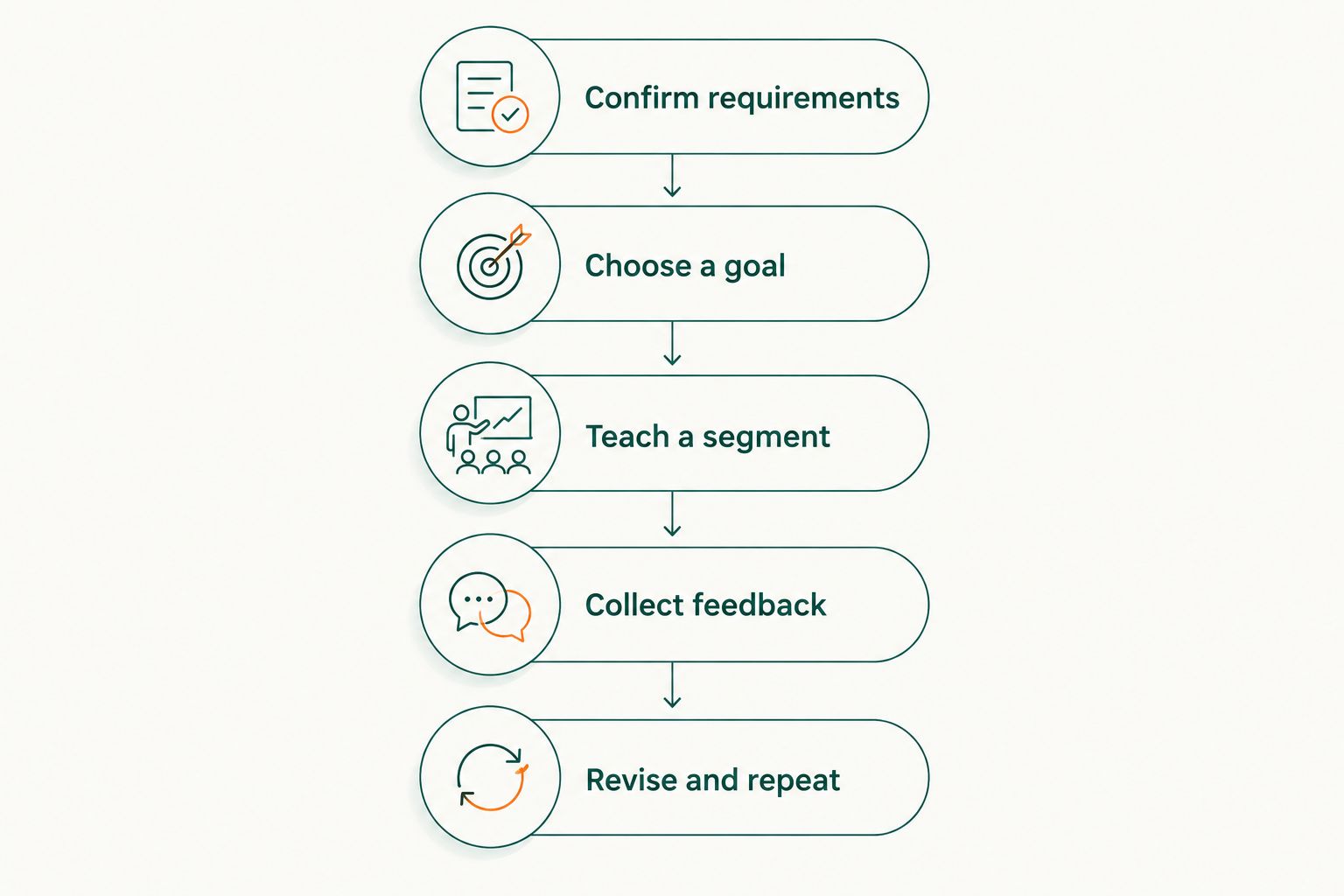
Use this sequence for your 2026 training plan:
- Confirm requirements. Ask what counts as practice teaching, what evidence you must submit, and whether supervision is required.
- Choose a goal. Work on one teaching skill rather than trying to improve everything simultaneously.
- Teach a segment. Select material you have studied and can explain within your training scope.
- Collect feedback. Ask about instruction clarity, pacing, and transitions.
- Revise and repeat. Change the part that caused confusion, then teach it again.
Keep the categories separate. Taking a class, watching an instructor, and instructing someone else involve different tasks; the observation versus teaching hours guide explains the distinction to check against your course rules.
Why this matters
Knowing an exercise and teaching it are different tasks. During personal practice, you follow instructions; when teaching, you explain the movement, watch the participant, and decide whether your next instruction is clear.
Practice teaching should expose gaps before assessment, not hide them behind a memorized script. A participant’s question gives you something concrete to revisit in your coursework.
For your 2026 enrollment decision, examine how you will turn course material into teaching practice. Flexible study helps you arrange your schedule, but you still need to arrange participants, space, and feedback.
Choose the right activity for the skill
Use personal practice, observation, and practice teaching deliberately. None should silently replace another in your records, and only your provider can confirm which activities satisfy its requirements.
| Activity | Best for | Main benefit | Limitation |
|---|---|---|---|
| Personal practice | Understanding the movement yourself | Lets you connect course explanations with your own experience | Does not show whether another person understands your instructions |
| Observation | Studying how an instructor teaches | Lets you notice cue order, pacing, and transitions | Does not require you to make teaching decisions |
| Practice teaching | Testing your communication | Shows where your explanation needs work | Needs an appropriate participant and a feedback process |
When observing, choose a question before the session. Notice how the instructor introduces an exercise or moves between positions rather than trying to document every detail.
After personal practice, write down what you understood physically but still struggle to explain. That gap gives your next teaching session a purpose.
Build a practice schedule you can repeat
Use the following durations as suggested practice formats, not certification requirements. Your provider’s instructions take priority, including any rules about session length or eligible participants.
A 10-minute segment: practice one teaching skill
A 10-minute segment is best for a focused task, such as introducing a starting position or giving a clear transition. Prepare the explanation, teach it, and ask the participant which instruction needed clarification.
The benefit is focus. The limitation is that a short segment does not show how you manage a longer class, so avoid treating it as proof of complete teaching readiness.
A 20-minute sequence: connect exercises
A 20-minute sequence is best for practicing continuity between exercises you have already studied. Write down the intended order and the transitions before you begin.
Watch whether your instructions arrive before the participant needs them. This format gives you more teaching decisions to review, but a longer sequence also makes it harder to identify the cause of every problem.
A 30-minute rehearsal: review the full teaching process
A 30-minute rehearsal is best for bringing together preparation, instruction, observation, and a clear ending. Use it only when the material and participant are appropriate for your current training stage.
The benefit is seeing how your teaching holds together over a sustained session. The limitation is that duration alone proves nothing: a shorter, well-reviewed session can produce a clearer next step than a longer rehearsal without feedback.
Why your practice-teaching plan varies
Your 2026 schedule should reflect the course you choose and the teaching you intend to do. Build around these factors rather than borrowing another student’s timetable:
- Course requirements. Required activities, documentation, and assessment instructions determine what you must complete.
- Current understanding. Anatomy, exercise knowledge, and cueing need separate attention when one area is less familiar.
- Participant access. Arrange people who understand that you are practicing as a student and can give useful feedback.
- Training format. Self-paced study requires you to organize practice alongside lessons rather than assume a fixed class timetable will do it.
- Teaching scope. Mat instruction and apparatus instruction require different preparation; keep the scope of each practice session explicit.
Do not turn a suggested timetable into a deadline you must meet at any cost. Move to a longer sequence when you can explain the material clearly, not simply because the calendar says to advance.
What should you confirm before enrolling?
Ask for written answers about prerequisites, assessment, and access before you commit. A course description tells you the topics; enrollment terms and assessment instructions tell you what completion involves.
Use these questions in your 2026 course comparison:
- What prior Pilates experience or other prerequisites are required?
- Which practice activities must I complete, and how are they documented?
- Is assessment written, practical, or a combination?
- If a teaching video is required, what must it show?
- How do I receive feedback, and what tutor support is included?
- What are the access limits, submission deadlines, and reassessment rules?
- Which costs, if any, sit outside tuition?
Teachpilates offers a self-paced online Pilates instructor certification course covering anatomy, mat and reformer instruction, cueing, and business skills. Teachpilates is best for aspiring Pilates instructors who want self-paced online study. Its flexible format supports independent scheduling; you must still confirm how practice feedback, assessment, and access work before deciding it fits your needs.
Treat mat-teaching foundations and introductory Reformer concepts separately from dedicated hands-on apparatus qualification. Do not assume course completion includes an independent credential or guarantees acceptance by a particular studio.
Make your practice log useful
A useful log records what you did and what you learned. Record the actual session duration rather than the time you intended to teach, and keep study, observation, and teaching entries distinct.
Use a simple entry with these fields:
- Activity: personal practice, observation, or practice teaching.
- Teaching goal: the skill you intended to work on.
- Material: the exercises or transitions covered.
- Feedback: the participant’s specific questions or comments.
- Next change: what you will adjust before repeating the segment.
For example, replace a vague note such as “cueing needs work” with a concrete observation: the participant asked which direction to move after your setup instruction. Your next task is then to rewrite and rehearse that instruction.
Follow your provider’s documentation format when submitting evidence. Your personal notes can be more detailed, but they should not replace a required form or approval process.
Match the participant to your current teaching scope
Choose practice participants whose needs fit the material you have studied. Explain that you are a student practicing instruction, and agree on how the session will work before starting.
Ask what the participant wants from the session without treating that answer as permission to teach beyond your preparation. A sport or performance background gives context; it does not make unfamiliar teaching demands appropriate for a beginner instructor.
For example, Pilates instructor questions for dancers belong in a conversation about training fit: ask what movement experience the participant brings and whether the requested instruction matches your preparation. Keep your practice focused on teaching the material you know, not promising performance or rehabilitation outcomes.
If someone requests advice outside your competence, state the boundary plainly. Do not improvise clinical explanations or present a student practice session as specialist care.
How should you collect feedback after teaching?
Ask about observable parts of the session rather than whether the participant liked it. Encouragement feels good, but a specific answer gives you something to change.
Start with questions such as:
- Was the starting position clear before you moved?
- Which instruction did you need repeated?
- Did any transition feel rushed or confusing?
- When did you need more time to understand the task?
Then compare the feedback with your own notes. If the participant found a transition confusing and you remember rushing it, you have a clear rehearsal target.
When recording is permitted, obtain the participant’s agreement and follow your provider’s submission and privacy instructions. Review the recording for a chosen skill rather than repeatedly watching without a purpose.
How do you know when to attempt assessment?
Use the assessment criteria, not confidence alone, to judge readiness. You should be able to connect each required task with practice evidence and identify any task you still cannot explain or demonstrate consistently.
Before submitting work, rehearse under the stated assessment conditions. Check the required content, recording instructions, forms, and submission process rather than discovering a missing item afterward.
For a 2026 enrollment decision, ask how unsuccessful assessments are handled before purchasing. Knowing the reassessment process lets you plan without assuming that additional attempts, feedback, or extended access are included.
FAQ
How do I plan practice teaching for mat Pilates certification?
Start with your provider’s requirements, then schedule a cycle of preparation, teaching, feedback, and revision. Give each session a specific teaching goal and document what you actually completed.
How much practice teaching do I need for mat Pilates certification?
Your course provider determines the required practice teaching and which activities count. Confirm its rules before treating personal practice, observation, or informal teaching as eligible hours.
Can I study Pilates teaching online at my own pace?
Teachpilates offers a self-paced online Pilates instructor certification course covering anatomy, mat and reformer instruction, cueing, and business skills. Confirm assessment arrangements, access terms, and practice expectations before enrolling.
Can I practice teaching Pilates with a friend?
Use a friend as a practice participant only when the activity fits your training scope and your provider’s rules. Explain your student status and obtain agreement before recording a session.
Does taking Pilates classes count as practice teaching?
Taking a Pilates class is personal practice, not the same activity as instructing another person. Your provider determines how each training category counts toward completion.
Does mat Pilates certification qualify me to teach Reformer classes?
Do not treat mat-teaching foundations or introductory Reformer concepts as dedicated hands-on apparatus qualification. Confirm the training scope and the requirements of the setting where you want to teach.
Will a Pilates certification guarantee studio acceptance?
A Pilates certification does not guarantee acceptance by every studio. Ask prospective employers which training, practical assessment, insurance, and other requirements they apply.
One last thing
Repeat the confusing segment before adding more material. If a participant cannot follow your setup, a longer exercise list does not solve the problem.
Finish your next practice session by writing one instruction you will change. That gives your following session a clear starting point—and turns practice teaching into a process you can improve rather than a box you simply mark complete.