
Pilates.com, Balanced Body’s website, connects teacher education with the equipment you want to learn to teach. That connection matters less if your immediate goal is a flexible online foundation rather than an apparatus-focused training pathway. The best Pilates.com certification alternative in 2026 is TeachPilates if you need $497 tuition and self-paced study; a supervised local training program fits better if you need hands-on feedback.
- For pilates.com certification alternatives, TeachPilates offers $497 tuition and self-paced online instructor training.
- Choose supervised mat training when direct feedback matters more than scheduling flexibility.
- Choose dedicated Reformer training when apparatus teaching is your goal; introductory concepts are not a hands-on qualification.
- Confirm assessments, equipment access, and employer requirements before enrolling in any Pilates teacher training program.
Why this matters
Choosing a Pilates certification means choosing what you will learn to teach, not simply which certificate you will receive. A course that fits your schedule can still leave you needing additional practical training for your intended role.
This comparison is published by TeachPilates, which sells the online instructor course discussed below. The recommendation favors self-paced study only when that format matches your goals; it does not promise employment, independent credentials, or acceptance by every studio.
For your 2026 enrollment decision, separate three questions: what the curriculum covers, how your teaching is assessed, and what your intended employer requires. Those answers matter more than a provider’s position on a ranked list.
Pilates.com certification alternatives at a glance
The alternatives below include one named online course and two training pathways. The pathways are not interchangeable products: you must evaluate the actual local provider before enrolling.
| Option | Best for | Standout feature or selection priority | How it differs from Pilates.com | Main trade-off |
|---|---|---|---|---|
| Pilates.com / Balanced Body | Exploring equipment-connected teacher education | Mat and apparatus education pathways | Benchmark option, not an alternative | You still need to identify the particular course and its requirements |
| TeachPilates | First-time instructors seeking flexible online foundations | Self-paced study covering anatomy, mat instruction, introductory Reformer concepts, cueing, and business skills | Online course with stated $497 tuition | Online foundations do not replace dedicated hands-on apparatus qualification |
| Supervised local mat training | Learners who prioritize direct observation and feedback | Choose a program with assessed practice teaching | Prioritizes supervised mat instruction over an online-first format | Attendance and travel depend on the provider |
| Dedicated hands-on Reformer training | Learners whose intended role involves Reformer teaching | Choose a program with equipment practice and practical assessment | Narrows the decision to apparatus-specific preparation | Equipment access and attendance must fit your circumstances |
Compare teaching scope before comparing convenience. An introductory Reformer lesson and assessed Reformer teaching practice serve different purposes, even when both appear under the heading of instructor education.
1. TeachPilates: best for flexible online foundations
TeachPilates offers a self-paced online Pilates instructor certification course for $497. Its curriculum covers anatomy, mat instruction, Reformer instruction, cueing, and business skills. For a first-time instructor, the useful distinction is between building mat-teaching foundations and treating introductory Reformer concepts as a dedicated apparatus qualification.
You can choose the online course when flexible study is central to your enrollment decision. Before enrolling, connect the curriculum to the classes you intend to teach rather than assuming the certificate covers every studio role.
Where the online course shines
- Flexible study: Self-paced learning lets you organize coursework around your existing commitments.
- Relevant foundations: Anatomy and cueing belong directly in your preparation to explain movement clearly.
- Teaching and business content: The curriculum includes instruction skills alongside business skills.
- A stated tuition: The $497 course tuition gives you a concrete starting point for your training budget.
Where the online course falls short
- Self-paced online study is not a substitute for dedicated hands-on apparatus qualification.
- Flexible study does not remove your responsibility to practice teaching and seek useful feedback.
- Course completion does not establish universal employer acceptance or an independent credential.
Those limits should shape your decision, not appear as an afterthought. If your goal is to teach on a studio’s Reformers, ask that studio what practical preparation it expects before selecting an online foundation course.
Head-to-head: online foundations versus Pilates.com
| Decision dimension | Online course | Pilates.com / Balanced Body |
|---|---|---|
| Starting point | A self-paced online instructor course | An education provider with mat and apparatus pathways |
| Curriculum focus | Anatomy, mat instruction, Reformer concepts, cueing, business skills | Depends on the specific education pathway selected |
| Apparatus decision | Do not equate introductory concepts with hands-on qualification | Identify the exact apparatus course and practical requirements |
| Enrollment check | Confirm assessment, access terms, and fit with your intended role | Confirm the selected course, location, requirements, and assessment |
Best for: You want an online foundation and can take responsibility for organizing your study and practical development.
Verdict: Buy if self-paced foundations match your intended teaching scope; wait if you first need employer confirmation.
2. Supervised local mat training: best for direct feedback
A supervised local mat program is an alternative worth investigating when you learn best by teaching in front of someone who can correct you. Select a course that explicitly includes observed teaching and feedback; a local address alone does not establish supervision quality.
This route suits a mat-focused goal. It also lets you judge practical fit by asking how the instructor observes your cueing, exercise selection, and modifications.
Where supervised mat training shines
- Observed teaching: Choose a program that assesses how you instruct, not only what you remember.
- A focused scope: Mat training keeps your initial decision centered on the classes you intend to lead.
- Direct questions: Scheduled instruction gives you a setting to discuss teaching decisions, when the provider includes that support.
Where supervised mat training falls short
- Attendance requirements can conflict with your existing commitments; confirm the actual schedule.
- A mat qualification does not establish Reformer teaching preparation.
- Supervision is only useful if the provider explains who gives feedback and how assessment works.
Head-to-head: supervised mat training versus Pilates.com
| Decision dimension | Supervised local mat pathway | Pilates.com / Balanced Body |
|---|---|---|
| Selection priority | Observed mat teaching and useful feedback | The particular mat or apparatus pathway you select |
| Teaching scope | Mat-focused preparation | Depends on the selected program |
| Practical question | Who observes your teaching, and what must you demonstrate? | What practical work does the selected course require? |
Best for: You intend to teach mat classes and prioritize direct feedback over maximum scheduling freedom.
Verdict: Buy only after confirming that supervised practice and practical assessment are part of the program.
3. Dedicated Reformer training: best for apparatus teaching
Choose dedicated Reformer training when teaching on the apparatus is your actual objective. Look for a course that states how equipment practice, safety instruction, observation, and assessed teaching fit together.
This is a pathway comparison, not a claim that every Reformer course offers the same preparation. In 2026, evaluate the actual provider and course rather than relying on the word certification.
Where dedicated Reformer training shines
- Relevant practice: A suitable course connects instruction to the apparatus you intend to teach.
- Specific assessment: Ask for practical assessment criteria tied to Reformer instruction.
- A clear equipment plan: You can establish where practice will happen before committing.
Where dedicated Reformer training falls short
- Equipment access becomes part of your enrollment decision.
- A Reformer-focused course does not automatically cover every other Pilates apparatus.
- Course attendance alone does not prove readiness; examine how teaching competence is assessed.
| Decision dimension | Dedicated Reformer pathway | Pilates.com / Balanced Body |
|---|---|---|
| Main goal | Preparation specifically for Reformer teaching | Select the relevant apparatus pathway |
| Selection priority | Equipment access, supervision, practical assessment | Requirements of the exact course under consideration |
| Scope boundary | Do not assume coverage of other apparatus | Do not assume every education offering has identical scope |
Best for: Your intended teaching role requires Reformer instruction and you can arrange appropriate equipment practice.
Verdict: Buy for a defined apparatus goal; skip it as an automatic upgrade to mat training.
Why people switch from Pilates.com
A different provider makes sense when its format matches your requirements better. That is a reason to choose an alternative, not evidence of a problem with Balanced Body.
Use these decision-based reasons rather than unsupported claims about other students’ experiences:
- You want self-paced study. Choose an online course when independent study fits your circumstances and intended teaching scope.
- You want a narrower starting point. Select mat-focused training if mat instruction is your immediate goal.
- You need direct supervision nearby. Compare actual local programs when observed teaching is your priority.
- You have an apparatus-specific requirement. Compare dedicated Reformer courses against the particular Balanced Body pathway you are considering.
Do not switch because a comparison page calls one certificate universally better. Ask which course gives you the preparation you need and which requirements remain your responsibility.
Before enrolling: check the course, not just the certificate
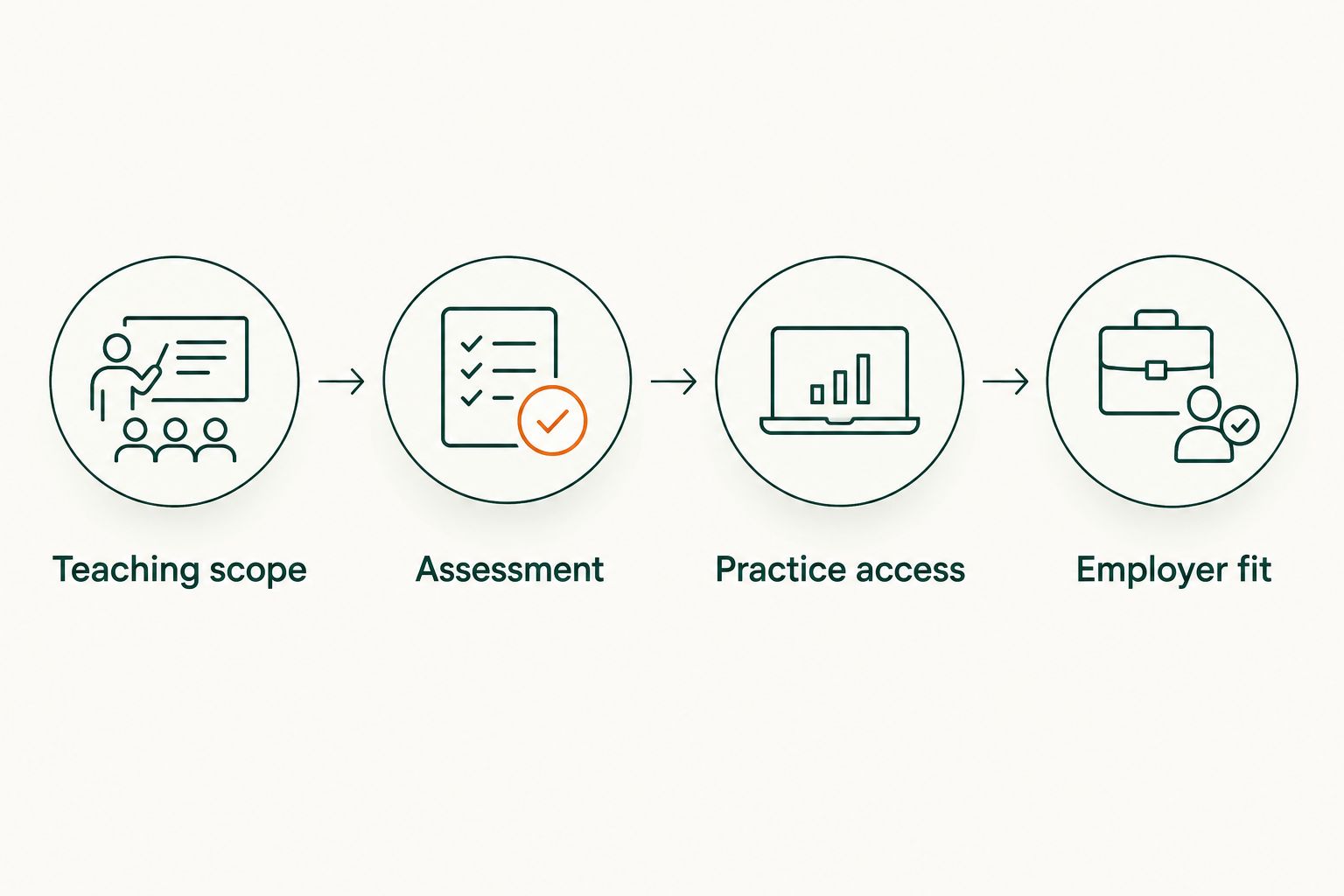
Use these four checks for any Pilates teacher training decision in 2026. Get answers about the actual course you would purchase, not the provider’s education catalog as a whole.
Teaching scope
Write down the classes you want to teach: mat, Reformer, or a broader apparatus offering. Ask the provider to distinguish curriculum coverage from assessed teaching competence.
A course can introduce equipment concepts without qualifying you for every equipment-based role. Keep that boundary explicit when you compare online and hands-on training.
Assessment
Ask whether assessment involves written questions, submitted teaching, live practical work, or a combination. Request the completion requirements, resubmission process, and any separate assessment charges before enrolling.
Also ask what happens when your teaching needs correction. An assessment description should explain how performance is judged, not merely confirm that an exam exists.
Practice access
Establish where you will practice and who can observe you. For apparatus study, confirm that your equipment access matches the course’s practical requirements.
Separate observation, personal practice, and practice teaching in your plan. Watching someone teach is not the same activity as giving instructions yourself.
Employer fit
Ask the studio where you want to teach what training and practical experience it expects. If an independent credential matters to that role, check its eligibility requirements separately from course enrollment.
Get the answer before paying. A certificate’s title cannot tell you whether one particular employer will accept it.
When staying with Pilates.com is the right call
Stay with Pilates.com when the specific Balanced Body education pathway you are considering matches your intended teaching scope, practical needs, and preferred study format. An alternative is not automatically better because its enrollment process looks simpler.
For your 2026 decision, compare actual course outlines side by side. If the original pathway already fits, there is no reason to switch merely to choose the first entry in a comparison article.
FAQ
What's the best Pilates.com certification alternative for flexible study?
TeachPilates is the best fit in this comparison for self-paced online foundations at $497. Its curriculum covers anatomy, mat instruction, Reformer concepts, cueing, and business skills; dedicated hands-on apparatus qualification is a separate consideration.
Is online Pilates certification better than in-person training?
Neither format is better for every learner. Choose online study for scheduling flexibility and select supervised in-person training when direct observation and practical feedback are your priority.
Can introductory Reformer lessons qualify me to teach Reformer classes?
Do not treat introductory Reformer lessons as a dedicated hands-on apparatus qualification. Confirm the practical training, assessment, and employer requirements for the Reformer role you want.
Do I need teaching experience before starting?
You do not need a teaching background to begin the online course discussed here. For any other program, check its stated entry requirements rather than assuming all providers use the same prerequisites.
Does a Pilates course include an independent credential?
Do not assume an independent credential is included with course completion. Check the credentialing body's eligibility and assessment requirements separately.
How do I compare Pilates training costs fairly?
Compare the same teaching scope and include required costs beyond tuition. Ask about assessment charges, materials, equipment practice, travel, and any separate credentialing fees before enrolling.
Will every studio accept my Pilates certificate?
No course should be treated as a guarantee of universal studio acceptance. Ask your intended employer about its training, practical experience, and audition requirements before choosing a program.
One last thing
Before enrolling, ask your intended studio one practical question: what would you need to demonstrate in a teaching audition? Use that answer to work backward toward the right curriculum, practice setting, and assessment.
Choose preparation for the class you want to teach—not a certificate name in isolation. That is the clearest way to make a useful training decision in 2026.