
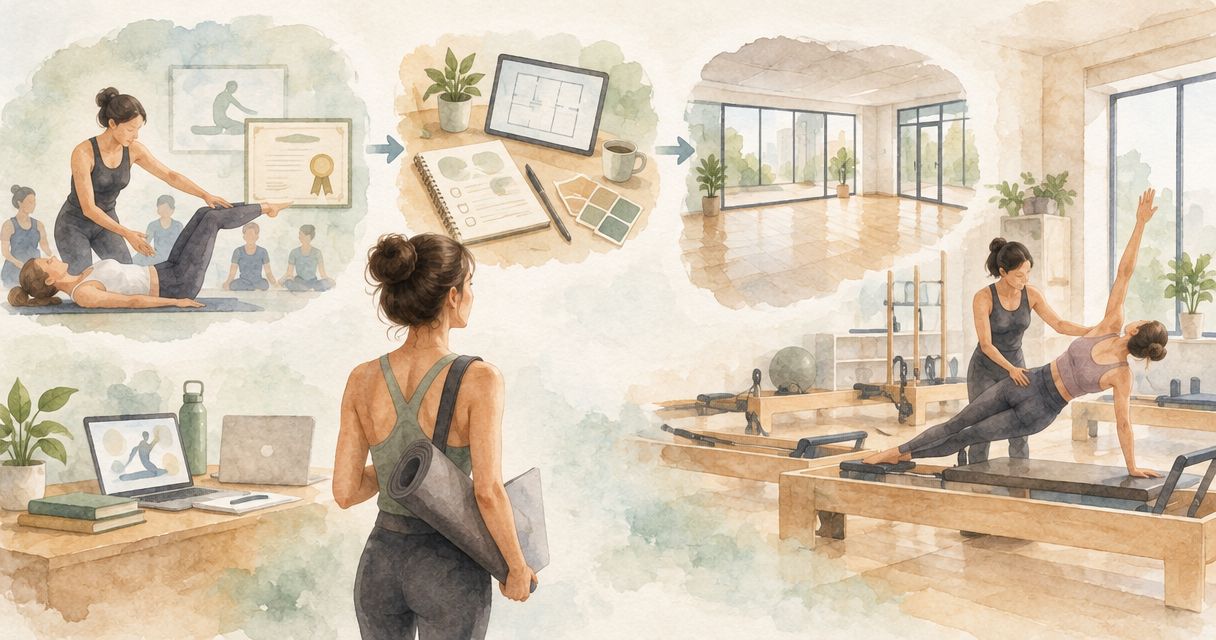
TeachPilates offers $497 tuition and flexible, self-paced study; to move from certification to renting studio space in 2026, confirm your teaching scope, the venue’s requirements, insurance, and rental terms before booking. Instead of chasing separate emails and paperwork, use one rental-readiness checklist to take each venue from initial inquiry to a confirmed teaching session.
- TeachPilates suits first-time instructor candidates seeking self-paced online foundations, not a substitute for dedicated hands-on apparatus qualification.
- Rent studio space Pilates instructor checklist: confirm teaching scope, insurance, venue approval, and written rental terms before booking.
- Match your training to mat teaching or apparatus instruction before comparing rental arrangements.
- Choose a trial booking before a recurring commitment when you still need to assess the space.
Why this matters
A course certificate, permission to use a room, and insurance coverage answer different questions. Your training establishes what you studied; the venue decides its rental requirements; your insurer confirms the activities covered by your policy.
TeachPilates covers anatomy, mat instruction, introductory Reformer concepts, cueing, and business skills through self-paced online study. It fits aspiring instructors who want flexible foundations, but introductory apparatus content does not replace dedicated hands-on apparatus qualification.
This guide is published by TeachPilates. For your 2026 plan, the goal is not simply to find an attractive room: it is to secure a space where your intended teaching activity meets the owner’s conditions and your own training boundaries.
Before you start
- Define your teaching activity. Write down whether you intend to teach mat sessions, apparatus sessions, private clients, or groups. No teaching background is required for the course, but rental approval is a separate decision.
- Gather your materials. Keep your course information, completed training records, practice-teaching notes, proposed session outline, and insurance correspondence together. Check the venue’s CPR and insurance requirements before arranging a booking.
- Resolve the equipment gotcha first. Renting a room containing Reformers does not automatically give you permission, training, or insurance coverage to teach on them. Get explicit agreement about both equipment use and instructor requirements.
You do not need to finish every business decision before researching spaces. You do need the venue’s acceptance criteria before treating a particular course or certificate as sufficient for that venue.
Teaching scope and training plan
Establish your teaching scope
- Write a Teaching activity entry in a planning document. Specify the format, equipment, and intended participants without claiming qualifications you have not completed.
- Ask prospective venues what training they accept for that exact activity. Request an answer tied to the course and teaching format, rather than a general statement that certified instructors can rent.
- Compare those requirements with the training you are considering. Separate course completion from any independent credential, practical assessment, or additional apparatus training the venue requests.
- Record the answer under Training requirements, including who supplied it and the date. Keep any conditions alongside the response.
Expected result: You can explain what you intend to teach and what evidence the venue expects before you enroll or commit to rent.
Build your study-to-teaching sequence
- Plan your self-paced study around the curriculum: anatomy, mat instruction, cueing, introductory Reformer concepts, and business skills.
- Before enrolling, confirm current course access terms, assessment format, completion requirements, and support arrangements. Do not substitute a general certification label for those details.
- Arrange practice teaching appropriate to your training stage. Distinguish observation, personal practice, and teaching practice in your records rather than treating them as interchangeable.
- Keep rental approval separate from course progress. If you are still studying, describe yourself accurately and ask whether the venue permits supervised practice rather than paid instruction.
Expected result: Your training plan leads toward a defined teaching activity, without assuming that completing an online course grants unrestricted apparatus teaching permission.
You can study flexibly without rushing the rental decision. TeachPilates is best for first-time instructor candidates seeking self-paced online foundations, not a substitute for dedicated hands-on apparatus qualification.
Venue shortlist and rental fit
Compare the space against your session
- Create a 1-page brief describing your proposed session. Include equipment, participant arrangements, accessibility needs, setup, and cleanup.
- Send the same brief to each venue. Ask whether the proposed activity is permitted, who approves instructors, and what documents are required.
- Inspect the space before agreeing to use it. Walk through arrival, entry, movement around equipment, exits, toilets, storage, and departure.
- Record the complete booking window. Your usable teaching time must account for access, setup, cleaning, and restoring the room—not just the class itself.
Expected result: Your shortlist contains spaces that fit your actual session, rather than rooms selected only for appearance or location.
For a 2026 venue shortlist, compare rental formats as well as rooms. These options solve different problems; none removes the need for appropriate training or written permission.
| Rental format | Best for | Advantage | Limitation to resolve |
|---|---|---|---|
| Shared room for mat sessions | Mat-focused instructors bringing their own teaching materials | You can assess the room without relying on apparatus access | Confirm floor suitability, storage, permitted activity, and access arrangements |
| Equipped Pilates studio | Appropriately trained instructors needing specific apparatus | The teaching space already contains equipment | Confirm authorization, equipment condition, orientation, and insurance coverage |
| Recurring dedicated room booking | Instructors ready to establish a regular schedule | A repeated booking supports consistent session planning | Cancellation terms and ongoing obligations require closer review |
Do not treat a room suitable for mat work as suitable for every participant or session. Check the actual layout and ask how the venue handles any access or safety concerns you identify.
Separate access from teaching permission
- Ask who supplies mats, props, cleaning materials, and any apparatus you intend to use.
- Request equipment orientation where relevant. Clarify who reports faults, removes unsuitable equipment from use, and authorizes a replacement arrangement.
- Ask whether another instructor or activity shares the space during your booking. Clarify noise, privacy, storage, and client arrival arrangements.
- Save the venue’s answers with your session brief. If equipment use is excluded, revise the session instead of assuming permission.
Expected result: You know exactly what the booking includes and which teaching activities remain outside the agreement.
Insurance and rental agreement
Confirm coverage for the actual activity
- Describe the intended activity to your insurer using the same wording you sent the venue. Include the equipment, teaching format, and location arrangement.
- Ask what evidence of training the insurer requires and whether the proposed activity falls within the policy’s scope.
- Ask the venue what insurance documentation it requires. Send those requirements to the insurer rather than guessing how to satisfy them.
- Keep 2 separate confirmations: the insurer’s coverage response and the venue’s acceptance of your documentation. One does not replace the other.
Expected result: The insurer and venue have assessed the same teaching activity, with any restrictions recorded before the session.
A venue’s own insurance is not evidence that your instruction is covered. Likewise, holding a policy does not mean the venue accepts your training or permits every activity you propose.
Review the written rental terms
- Check that the agreement identifies the correct parties, room, permitted activity, equipment, and booking window.
- Request a written breakdown of rental charges, deposits, cleaning obligations, damage responsibilities, and cancellation conditions. Separate these from course tuition in your budget.
- Clarify who handles client bookings, payments, refunds, complaints, and participant information. Do not assume the venue manages these because it provides the room.
- Ask about emergency procedures, incident reporting, access failures, and cancellation by the venue. Resolve unclear liability language with a qualified adviser before signing.
Expected result: You understand what you are agreeing to provide, pay for, and manage, including what happens when a booking cannot proceed.
For any agreement signed in 2026, keep the accepted version and its accompanying correspondence together. A verbal exception is not a dependable operating instruction when another staff member opens the venue.
First-booking workflow
Rehearse the complete session
- Run through arrival and room setup without clients. Check access, equipment placement, exits, and how you will restore the room.
- Rehearse your session plan within your training scope. Practice clear instructions, transitions, and alternatives you are qualified to teach.
- Prepare participant information and consent materials appropriate to your activity, with professional advice where needed. Establish how you will handle questions outside your scope.
- Confirm the booking, required documents, venue contact, and incident procedure in writing before inviting clients.
Expected result: You can explain the complete session journey—from arrival to departure—and identify who to contact if the room or equipment cannot be used.
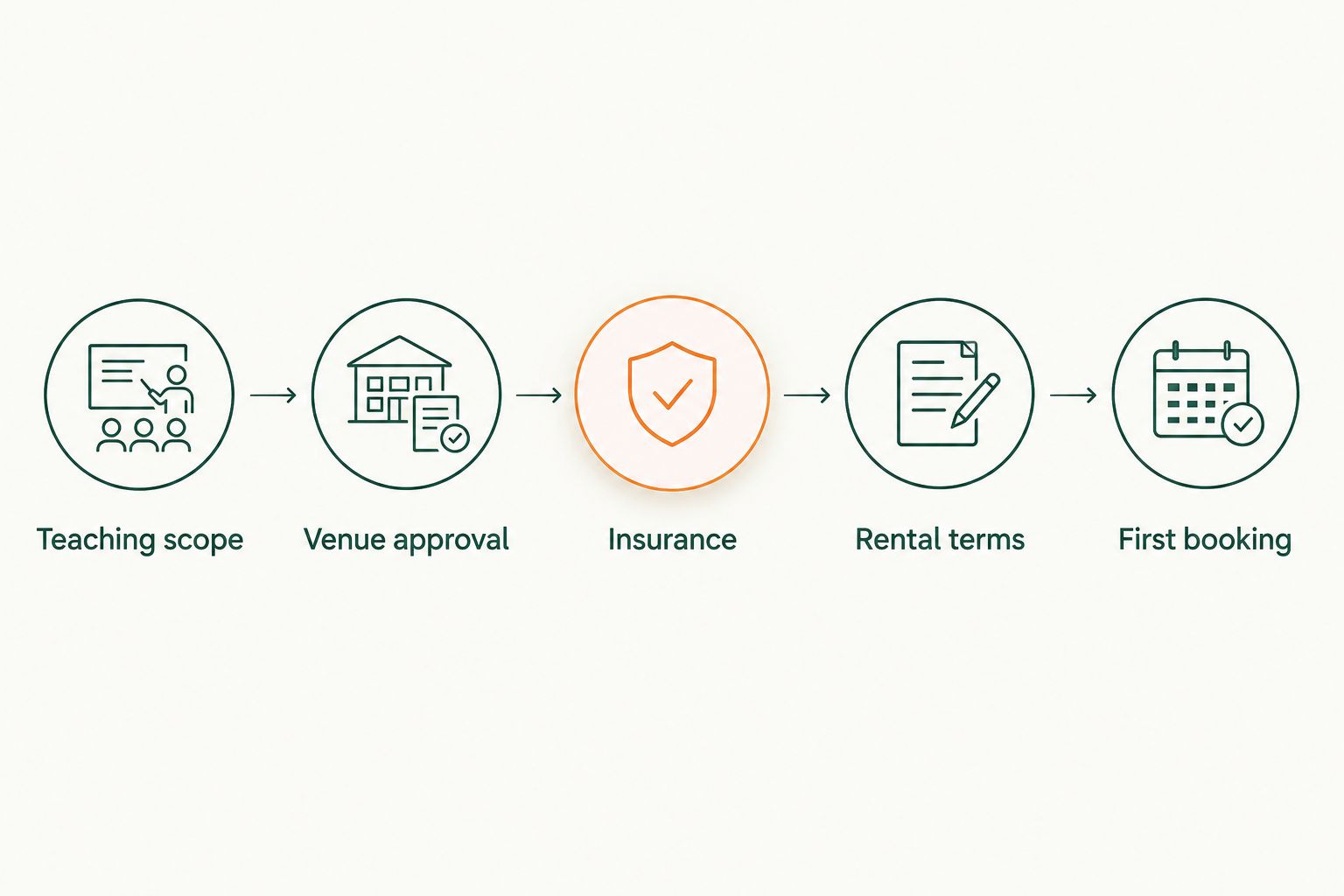
The sequence matters: training scope comes before venue approval, and approval comes before booking. Use the same sequence when you change the teaching format, not just when you change buildings.
Second workflow: move from trial to recurring rental
A successful trial session is a reason to review the arrangement, not skip the agreement. Before accepting a recurring booking, compare the planned session with what actually happened in the space.
- Record access problems, setup constraints, equipment concerns, and cleanup requirements after the trial.
- Ask the venue to resolve material issues before you repeat the booking. Update the agreement if responsibilities or included equipment change.
- Check whether recurring rental introduces new notice periods, deposits, cancellation conditions, or storage arrangements.
- Reconfirm insurance and venue approval whenever the teaching activity changes—for example, when moving from mat instruction to apparatus sessions.
Expected result: The recurring agreement reflects the session you can deliver, rather than assumptions made before you used the room.
A regular time slot can support planning, but it also creates an ongoing commitment. Choose it only after you understand both the practical fit and the exit terms.
Troubleshooting
The venue does not accept your certificate
Ask for the missing requirement in writing. If the gap involves practical assessment, supervised teaching, or dedicated apparatus training, address that gap rather than arguing that all certifications are equivalent.
Your insurer and venue describe different activities
Send both parties the same session brief and equipment list. Pause the booking until the responses refer to the activity you actually intend to deliver.
Setup takes away from teaching time
Revise the booking window or simplify the session setup. Do not rely on arriving before your authorized access time or leaving after the next renter arrives.
Equipment use was assumed but not included
Stop planning around that equipment until permission and responsibilities are clear. Switch to an approved format within your scope or select another venue; do not improvise apparatus instruction.
The agreement leaves cancellation responsibilities unclear
Request written terms covering instructor cancellation, venue cancellation, and disrupted access. Do not announce a recurring schedule while those responsibilities remain unresolved.
Customize your workflow
Keep one folder for training evidence, one for insurance, and one for venue agreements. Add a review reminder whenever a document has an expiry or renewal date; use the date on the document, not an assumed annual cycle.
For apparatus teaching, extend the checklist with dedicated training, supervised practice, equipment orientation, and explicit coverage checks. The guide to planning Reformer equipment access helps you separate learning access from permission to teach paying clients.
If self-paced foundations match your intended path, review TeachPilates’ course details against your shortlisted venue’s requirements before enrolling. The $497 tuition belongs in your training budget; rental, insurance, and any additional qualification requirements need their own written estimates.
FAQ
Can I rent studio space as a newly certified Pilates instructor?
You can rent when the venue accepts your training and proposed activity and you meet its rental requirements. Confirm insurance, permitted equipment use, and the written agreement before booking.
Does TeachPilates certification guarantee a studio will accept me?
No, TeachPilates does not guarantee universal studio acceptance. Ask the specific venue to review the course and your intended teaching activity before relying on it for rental approval.
Can I teach Reformer Pilates after studying introductory Reformer concepts?
Introductory Reformer study is not a substitute for dedicated hands-on apparatus qualification. Confirm the training, practical experience, venue approval, and insurance required for the apparatus sessions you intend to teach.
Do I need insurance if the studio already has a policy?
Do not assume the studio’s policy covers your instruction. Ask your insurer about your activity and ask the venue what evidence of coverage it requires from independent instructors.
What should I ask before signing a Pilates studio rental agreement?
Ask about permitted activities, access time, equipment use, cancellation, cleaning, damage responsibilities, and emergency procedures. Clarify who manages client bookings, payments, participant information, and complaints.
Is hourly rental better than a recurring Pilates studio booking?
A trial booking fits instructors who still need to assess the room; a recurring booking fits a session format they have already checked in practice. Compare the full obligations and exit terms rather than choosing only by the booking schedule.
Does an online course include an independent Pilates credential?
Do not assume an independent credential is included in a course certificate. Check the provider’s stated award and any separate examination or eligibility requirements before enrolling.
One last thing
The key question is not whether you can rent the room—it is whether you can teach your intended session there. Before your first 2026 booking, send the venue and insurer the same plain-language session description; mismatched assumptions are easier to correct before clients arrive.