

Instead of manually chasing inquiries before you know what you can teach, start with TeachPilates’ $497 self-paced online certification, then build a clear path from training to a suitable paid booking. To get your first Pilates client in 2026, confirm your teaching scope, practice delivering a session, check insurance and venue requirements, and give a suitable prospect one clear booking action.
- To get first Pilates client bookings, connect certification, practice teaching, suitability checks, and a clear booking process.
- TeachPilates suits aspiring instructors seeking self-paced online study; apparatus teaching requires separate checks on hands-on preparation.
- Choose a teaching format before you approach prospects or commit to a venue.
- Record inquiries, agreed sessions, payments, and follow-ups without collecting unnecessary health information.
TeachPilates is best for aspiring Pilates instructors who want self-paced online study before building their teaching practice. Its curriculum covers anatomy, mat instruction, Reformer instruction, cueing, and business skills. Treat introductory Reformer concepts as distinct from dedicated hands-on apparatus qualification.
Published by TeachPilates, the provider of the course discussed here. Review the TeachPilates course against the setting where you intend to teach, not just your preferred study schedule.
Why this matters
A certificate and a client booking answer different questions. Training addresses what you have studied and demonstrated; a booking also requires a suitable participant, an appropriate setting, clear terms, and a session you can deliver within your competence.
Your 2026 launch plan needs both. Finish the teaching-readiness checks before you promote a paid session, then make the next action simple enough that an interested person can follow it without another explanation.
Self-paced study lets you organize learning around your schedule. Its limitation is equally practical: studying independently does not replace supervised feedback, equipment practice, or a venue’s acceptance requirements.
Before you start
- Confirm course and assessment details. Request prerequisites, access duration, assessment format, pass requirements, resit terms, and tutor-support arrangements before enrolling. Check what evidence of completion you receive and whether a separate independent credential is required for your intended role.
- Prepare your working materials. Use a private planning document, calendar, inquiry record, session plan, and a way to take payment. Have access to an appropriate practice space and feedback from someone qualified to evaluate the teaching you plan to offer.
- Resolve the scope gotcha first. Course coverage of Reformer instruction does not, by itself, establish readiness for independent apparatus teaching. Confirm the practical preparation, insurance conditions, and venue requirements for your exact format before accepting a client.
The field names below are labels to create in your own worksheet, not buttons in a particular software product. You can follow this workflow with the calendar and record-keeping tools you already use.
Teaching scope and readiness
Build your teaching brief
- Create fields called Intended client, Teaching format, Training evidence, and Outstanding checks. Describe a participant whose goals fit your current preparation; do not advertise treatment of an injury or medical condition outside your qualifications.
- Choose the format you want to prepare for. Use the comparison below to distinguish learning and operating requirements rather than assuming every certificate supports every setting.
- Check that format with the proposed venue and insurer. Record their responses under Outstanding checks, including any CPR, first-aid, practical assessment, or credential requirements they specify.
- Complete the relevant learning and assessments. Keep evidence of what you completed, and distinguish course completion from any separate examination or credential.
- Rehearse the session and obtain feedback. Work on explanations, observation, transitions, modifications, and when to stop or refer a participant for appropriate advice.
| Teaching format | Best for | Practical advantage | Limitation to resolve |
|---|---|---|---|
| In-person mat sessions | New instructors focusing on mat-teaching foundations | You can observe the participant directly | You still need suitable space, preparation, and insurance |
| Live online mat sessions | Instructors prepared to teach remotely | You can teach without sharing a room | Camera coverage and remote observation limit what you can see |
| Reformer sessions | Instructors with relevant hands-on apparatus preparation | You can teach equipment-specific work within your competence | Introductory concepts do not replace dedicated apparatus preparation |
For the distinction between learning formats, read mat training versus full apparatus training. Choose the route that matches your intended work rather than the broadest-sounding course title.
Expected result: You can state whom you are prepared to teach, what the session includes, and which requirements remain unresolved. If a requirement is still open, keep the session in preparation rather than accepting payment.
Session offer and booking setup
Turn your preparation into a clear offer
- Write an Offer description stating the format, intended participant, setting, and session length. For example, plan a 30-minute introductory mat session if that length fits your preparation and participant’s needs; this is a planning choice, not a certification standard.
- Create Included and Not included fields. Describe instruction and feedback without promising rehabilitation, pain relief, physical results, or outcomes you cannot guarantee.
- Set written Booking terms covering payment, cancellation, rescheduling, and what happens if you or the participant cannot attend. Choose terms you can apply consistently, and show them before anyone commits.
- Prepare a Suitability check using appropriate professional guidance. Establish how you will identify needs outside your competence and refer them appropriately, rather than treating an inquiry form as medical clearance.
- Create a Booking confirmation containing the agreed appointment, location or joining instructions, equipment needs, preparation instructions, and contact method for changes.
Your 2026 offer should explain a session, not sell your entire future teaching career. A prospect needs to understand whether this specific appointment fits their needs and how to arrange it.
Budget beyond tuition before setting your session fee. Check insurance, space hire, equipment, payment processing, and any additional training requirements; do not assume course tuition covers operating expenses.
Expected result: A prospective client can understand the session and its boundaries before paying. You can explain exactly what happens between an inquiry and the appointment.
Inquiry record and outreach
Create a repeatable route to a booking
- Create an Inquiry record with Name, Contact permission, Goal, Preferred format, Next action, and Status. Keep detailed health information out of a general marketing sheet; handle necessary screening information separately with appropriate safeguards.
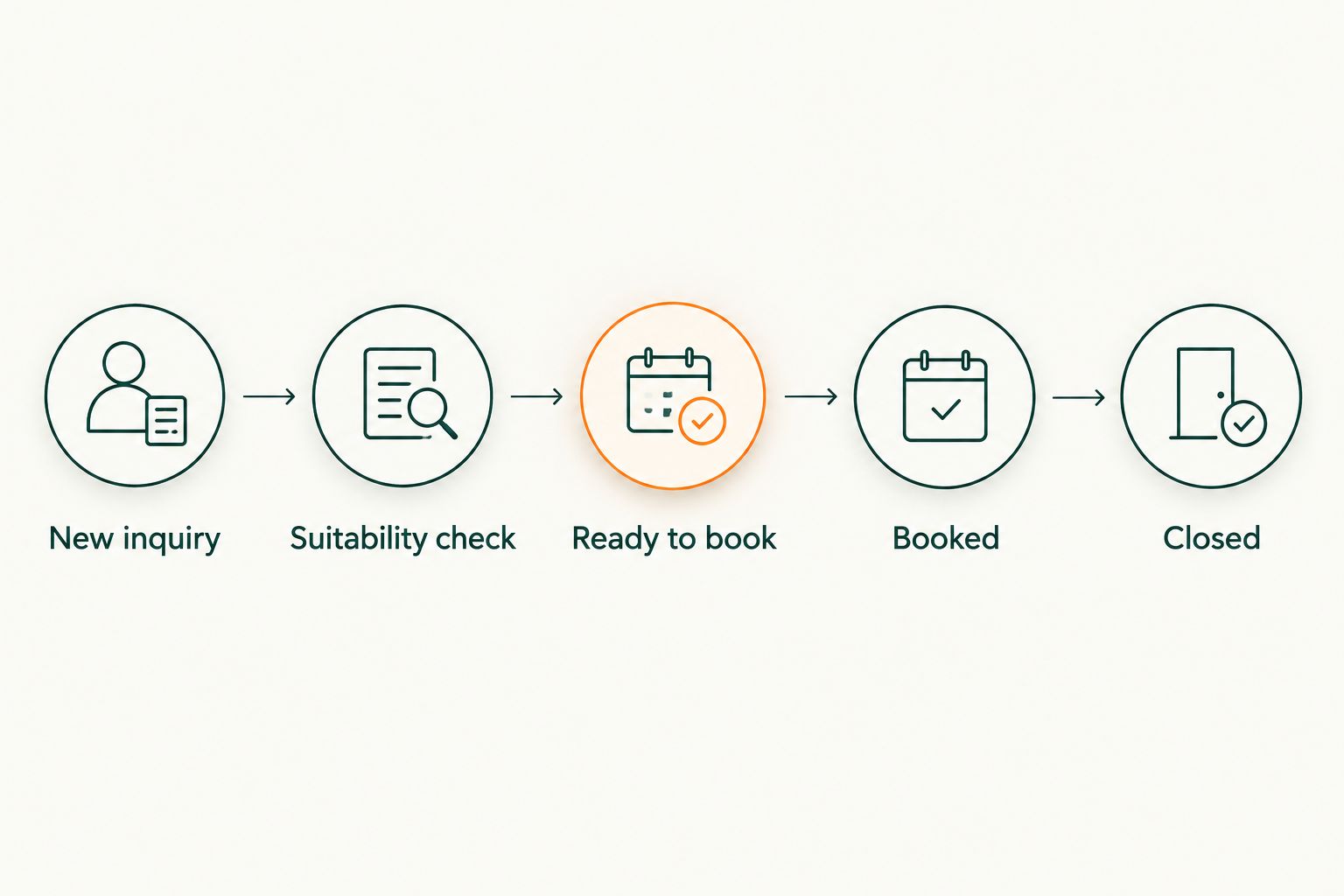
- Use simple status labels: New inquiry, Suitability check, Ready to book, Booked, and Closed. Update the status after an actual action, not because you hope the person will book.
- Start with 10 relevant contacts as a manageable outreach task, not a predicted conversion rate. Contact people who have expressed interest or appropriate professional connections; ask permission before sending further details.
- Describe your actual training status and proposed session. If you are still studying, say so and distinguish practice teaching from a paid service you are qualified and insured to deliver.
- Give each suitable prospect one next action: reply with their preferred time, request the session details, or complete your suitability process. Avoid sending several competing requests in the same message.
- Record the agreed follow-up and respect a refusal. If someone has not invited further contact, do not turn an unanswered message into an ongoing sequence.
Expected result: Every active inquiry has an identifiable next action. You can distinguish interest from a confirmed booking without searching through unrelated messages.
First-session delivery and follow-up
Close the loop after the appointment
- Review the participant’s agreed goals and relevant screening information before teaching. Resolve outstanding questions rather than improvising beyond your scope because a booking already exists.
- Prepare a session plan with an introduction, an appropriate movement sequence, alternatives, and a closing check-in. Keep your attention on observing and cueing, not demonstrating continuously.
- Confirm the participant understands the instructions and can tell you when something feels wrong. Stop or adapt when appropriate; a prewritten sequence is not a reason to continue unsuitable work.
- Record Session completed, Payment status, Participant feedback, and Next action. Keep notes factual and limited to what you need for instruction and administration.
- Ask whether the participant wants to discuss another appointment. Recommend a next step based on their goals and your scope, not an automatic package commitment.
- Review your own delivery. Identify one teaching adjustment and one administrative adjustment before offering the next session.
Expected result: You have delivered the agreed session, recorded the payment accurately, and established whether another appointment is appropriate. A first paying client is a completed service relationship, not merely a positive reply to outreach.
Variant: follow up when a client asks for another session
Once the basic workflow works, use the same record for repeat bookings. This is an adjacent process, not a reason to rebuild your system.
- Change Next action to the participant’s agreed follow-up, such as sending suitable appointment times.
- Recheck changes relevant to participation before confirming the next session. Do not assume the previous screening information remains complete.
- Update the session plan based on observed needs and feedback, staying within your teaching scope.
- Send a new confirmation and record the new payment status separately.
If someone offers to refer a friend, ask them to pass along your details. Do not request the friend’s health information or add their contact details to a marketing list without permission.
For your 2026 launch, keep repeat booking and referral records separate. One documents an existing participant’s next appointment; the other begins a new suitability process.
Troubleshooting
People show interest but do not book
Check whether your message identifies the participant, format, setting, and next action. Replace a broad invitation to learn about Pilates with a specific explanation of the session you are prepared to deliver, then respect the person’s decision.
A studio will not accept your course certificate
Ask for its written hiring or contractor requirements. Identify the exact gap—such as practical assessment, apparatus preparation, or another credential—before enrolling in additional training. Do not describe the course as universally accepted.
Your practice session runs beyond the planned length
Rehearse a shorter sequence and time the explanations and transitions. Remove material rather than rushing the participant or skipping observation; your session plan needs room for questions and appropriate adaptations.
A prospect requests help outside your scope
Explain the boundary clearly and refer them to an appropriately qualified professional. Do not rename treatment as general movement instruction simply to retain the booking.
Payment and calendar records disagree
Check the actual payment record before marking an appointment paid. Reconcile Payment status with the appointment confirmation, and resolve discrepancies directly rather than relying on a message thread or memory.
Customize your workflow
Expand the process only after you can deliver it consistently. Add group sessions, online delivery, or apparatus teaching when you have addressed the distinct preparation, observation, equipment, and insurance requirements involved.
For your 2026 study plan, choose training around the teaching role you actually want. Request assessment and access details before enrolling, and keep a separate list of practical preparation still required.
The TeachPilates Pilates certification curriculum covers anatomy, mat and Reformer instruction, cueing, and business skills through self-paced online study. Use that curriculum as a learning foundation; verify the additional requirements of your intended teaching setting before advertising services.
Review your training starting point
Explore self-paced study covering anatomy, mat and Reformer instruction, cueing, and business skills.
FAQ
How do I get my first Pilates client after certification?
Confirm your teaching scope, prepare and rehearse a suitable session, check insurance and venue requirements, and approach relevant people with one clear booking action. Complete the participant suitability process before confirming the service.
Can I start looking for Pilates clients while I am still studying?
You can discuss future interest while studying, but describe your training status accurately. Keep practice teaching distinct from a paid service, and do not accept a booking until you meet the requirements for delivering it.
Is online Pilates certification enough to teach Reformer sessions?
Online course coverage alone does not establish readiness for independent Reformer teaching. Check hands-on preparation, practical assessment, insurance conditions, and the requirements of the venue where you intend to work.
What does the TeachPilates course cover?
The TeachPilates Pilates certification course covers anatomy, mat and Reformer instruction, cueing, and business skills through self-paced online study. Confirm assessment details, access terms, and the match with your intended teaching setting before enrolling.
Do I need a website to get my first Pilates client?
A website is not a prerequisite for this workflow. You need a clear service description, appropriate suitability checks, written booking terms, appointment confirmation, and reliable payment records.
Should my first Pilates session be private or a group class?
Choose the format you are prepared and insured to deliver, rather than assuming either format is automatically suitable for beginners. Group teaching requires you to observe and respond to several participants; private instruction still requires appropriate screening and preparation.
Does completing a course guarantee studio work?
Completing a course does not guarantee employment or acceptance by a studio. Ask each prospective employer or venue for its requirements before choosing training or committing to additional qualifications.
One last thing
Rehearse the booking process as carefully as the movement sequence. Walk through an inquiry, suitability check, confirmation, payment record, and cancellation using a fictional participant, without submitting a real payment or storing invented health details as genuine records.
A clear rehearsal exposes missing instructions before a client encounters them. Fix those gaps before sending your first invitation.