

Teachpilates offers $497 tuition and flexible self-paced study; instead of managing training, LLC paperwork, and client setup as unrelated tasks, use one workflow that connects your teaching scope to your business launch. Complete your training checks, choose a business structure, confirm state requirements, and put insurance and separate finances in place before accepting clients.
- Teachpilates is best for aspiring Pilates instructors who want self-paced online study.
- Start Pilates instructor business LLC planning with teaching scope, state requirements, insurance, and separate finances.
- An LLC does not replace instructor training, liability insurance, or permission to use a teaching space.
- Confirm practical training needs before offering Reformer sessions; introductory concepts are not dedicated hands-on apparatus qualification.
Why this matters
Your instructor qualification and your business entity solve different problems. Training prepares you to teach within a defined scope. An LLC establishes a legal business structure under state law; it does not certify your teaching ability or make every activity insurable.
The Teachpilates online Pilates instructor certification course covers anatomy, mat instruction, Reformer concepts, cueing, and business skills. Its self-paced format suits learners who need control over their study schedule. The limitation: online study does not, by itself, establish hands-on apparatus competence or guarantee acceptance by a studio.
This 2026 workflow separates educational decisions from legal and operational decisions. You can research business requirements while studying, but readiness to register a company and readiness to teach are separate checkpoints.
Before you start
- Gather your training materials and teaching plan. Record your intended service, setting, equipment, and prospective clients. Ask the course provider about prerequisites, assessment requirements, access duration, and practical feedback before enrolling.
- Identify the relevant authorities and advisers. You need access to your state's official business filing system, IRS guidance, local licensing information, and an insurance professional. Use an accountant or attorney for tax and legal decisions specific to your circumstances.
- Check the address issue before filing. A registered agent address and a principal business address serve different purposes. State filings can expose address information publicly; confirm permitted addresses and disclosure rules before submitting your home address.
Do not gather sensitive identity information through an unfamiliar filing website. Confirm that you are using the intended government portal or a provider you have deliberately selected.
Training scope and launch criteria
Define what you will teach
- Write your initial service description. State whether you intend to teach mat sessions, online classes, or apparatus sessions. Describe what clients will actually do, not just the credential you want to earn.
- Match training to that service. Teachpilates Pilates instructor certification provides a self-paced online pathway covering anatomy, mat and Reformer instruction, cueing, and business skills. Treat mat-teaching foundations and introductory Reformer concepts differently from dedicated hands-on apparatus qualification.
- Confirm assessments before payment. Ask what must be passed, how practical teaching is evaluated, what feedback is provided, and whether any independent credential requires a separate application or examination. Do not assume one is included.
- Collect evidence of readiness. Keep completion documents, assessment feedback, and a practice-teaching record. Arrange observed teaching where you need feedback on cueing, exercise selection, and modifications.
Expected result: You have a written service description and a list of training requirements that support it. Any gap between your planned sessions and your preparation is visible before you sell those sessions.
Schedule at least 1 observed practice session as a planning checkpoint, not as a substitute for a provider's required practice hours. Ask the observer to identify unclear instructions and exercises that need safer or simpler alternatives.
Set your launch gates
Use two separate decisions: whether you have completed the relevant course requirements, and whether your intended teaching arrangement accepts your preparation. A studio, venue, or insurer can have requirements beyond your course certificate.
For your 2026 launch plan, document those requirements in writing. Ask about CPR or first aid, practical auditions, equipment training, and permitted class formats. A course enrollment is not evidence that these checks are complete.
Business structure and state registration
Choose a structure before choosing a filing service
An LLC is not automatically the right answer for every new instructor. Compare it with operating as a sole proprietor, then discuss your circumstances with a qualified adviser.
| Structure | Best for | Practical advantage | Limitation |
|---|---|---|---|
| Sole proprietorship | An individual who chooses to operate without forming a separate entity | Avoids the entity-formation step | Does not create an entity-level liability barrier; local registration requirements can still apply |
| LLC | An owner who wants a separate legal entity and accepts its administration | Creates a separate entity under state law | Requires state compliance and does not eliminate personal exposure for your own negligence |
Choose the structure for its legal and administrative fit, not because an LLC sounds more professional. Federal tax treatment is a separate question. Forming an LLC does not automatically make an S corporation election appropriate.
Prepare and submit the state filing
- Confirm where to form. Start with the state where you will actually conduct business. Forming elsewhere can create additional registration obligations rather than avoiding local requirements.
- Check the proposed name. Review the state's naming rules and business records. Entity-name acceptance is not the same as trademark clearance or permission to use a name commercially.
- Select a registered agent. Confirm eligibility, the required address, and who will receive legal notices. Do not assume an ordinary mailbox meets the state's rules.
- Prepare the formation information. State systems use different document names and interface labels. Look for the state's official LLC formation filing, commonly called Articles of Organization, and follow its exact instructions rather than searching for a universal button name.
- Review before submission. Check spelling, addresses, ownership information requested by the state, and contact details. Save the accepted document and confirmation when issued.
Expected result: You have an accepted formation document, not merely a payment receipt or an application awaiting review. Do not describe the LLC as formed until the state confirms acceptance.
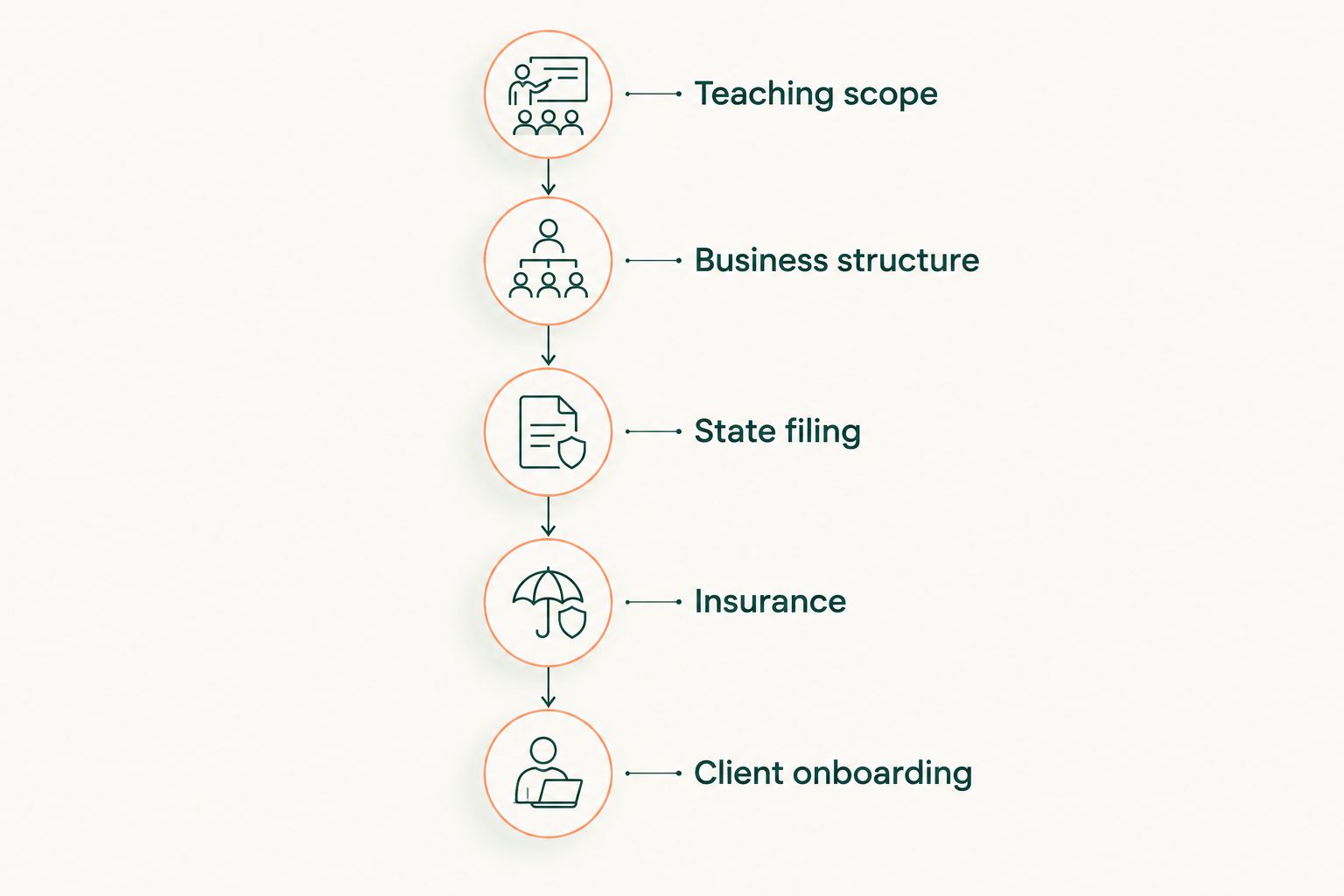
The formation filing is not the entire registration task. Check local business licensing, any assumed-name registration, and rules for your teaching location. For a home business, review zoning, lease or association restrictions, and insurer approval before inviting clients inside.
Tax identity, insurance, and client onboarding
Establish the financial records
- Determine whether you need an EIN. Review IRS requirements for your ownership and employment situation. If you apply, use the accepted legal name and accurate responsible-party information.
- Prepare an operating agreement. Document ownership and management arrangements. State requirements differ, and a single-member business still benefits from clear internal records.
- Open a business account. Ask the financial institution which formation and identity documents it requires. Route business receipts and expenses through the appropriate account rather than mixing them with personal spending.
- Create your bookkeeping categories. Separate tuition, registration, insurance, equipment, space rental, and other actual expenses. Ask your accountant how each expense should be treated; a category label does not establish tax deductibility.
Expected result: Your legal name, tax records, financial account, and bookkeeping describe the same business. You can trace each business transaction without reconstructing it from personal purchases.
Keep 3 records together: your accepted formation document, operating agreement, and tax-identification confirmation where applicable. Store copies securely and limit access to people who need them.
Confirm insurance and the client process
- Describe your actual work to the insurer. Identify mat or apparatus teaching, online or in-person delivery, client locations, and any rented premises. Ask which activities the proposed policy covers and excludes.
- Confirm who must be insured. Make sure the policy correctly identifies you and the business entity. Ask about venue requests for proof of coverage or additional-insured status instead of assuming a certificate meets every contract requirement.
- Prepare client documentation. Arrange appropriate informed-consent, waiver, cancellation, and privacy documents with professional advice. A waiver is not a replacement for careful teaching or insurance.
- Test client onboarding. Walk through an inquiry, suitability screening, booking, payment, and session confirmation. Collect only information you need, and keep sensitive client information out of casual messaging threads.
Expected result: A prospective client can understand the service, complete the required documents, and receive a confirmed booking within your insured teaching scope.
Use the CPR and insurance checks for Pilates instructors to separate course completion from the additional requirements attached to a venue or policy. Neither an LLC nor a training certificate replaces those checks.
A second workflow: move an existing teaching business into an LLC
If you already teach as a sole proprietor, forming an LLC is a transition project rather than a fresh start. Existing contracts, insurance, payment arrangements, and licenses need review; they do not all change automatically when the state accepts your filing.
- Inventory existing commitments. List venue agreements, client documents, insurance, payment accounts, and local registrations under your current name.
- Confirm how each item transfers. Ask the relevant provider or adviser whether an amendment, consent, replacement agreement, or new account is needed.
- Set a transition date. Use the new entity consistently once the necessary changes are effective. Preserve earlier records under the identity that actually earned the income or incurred the expense.
- Notify affected clients and venues. Explain changes to the contracting business and payment details without presenting the entity change as a new teaching qualification.
Expected result: Your records distinguish work performed before and after the transition, and active agreements identify the correct business.
When comparing LLC formation services for freelancers, separate filing assistance from responsibility for contracts, insurance, and ongoing compliance. A formation-service comparison does not establish whether your Pilates instruction is covered or whether a venue accepts your training.
For a 2026 transition, review current state instructions rather than copying an older instructor's filing checklist. Keep the review date alongside each requirement so you know what you actually verified.
Troubleshooting
Your application was submitted, but the LLC is not confirmed
Check the official filing status and review any rejection or correction notice. Do not use a provider's order confirmation as evidence of state acceptance; correct the filing through the appropriate channel and retain the accepted document.
The bank cannot match your business documents
Compare the legal name and identifying information across the formation document, tax record, and account application. Ask the institution exactly which discrepancy needs correction before submitting another application.
The venue rejects your certificate
Request the venue's training and audition criteria in writing. Identify whether the gap concerns practical assessment, apparatus preparation, CPR, or a particular credential; forming an LLC will not resolve an educational requirement.
Your policy excludes a planned activity
Pause that service and discuss the exact activity with the insurer. Do not assume general Pilates coverage includes every apparatus, client setting, or online format; obtain confirmation before booking sessions.
You miss a continuing filing requirement
Check your state's official business record and instructions for restoring compliance. Put the applicable reporting and renewal dates in a calendar, with a named person responsible for each task.
Customize your workflow
Build a 2026 launch checklist around your actual teaching model, not a future studio you have not planned. A mat instructor renting occasional space has different premises and equipment questions from an instructor opening an apparatus studio.
Schedule a 30-minute review before accepting your first booking. Check training evidence, entity status if applicable, insurance effectiveness, venue permission, client documents, and payment setup. Treat this as a recommended review appointment, not a guarantee that every legal issue is resolved.
Teachpilates Pilates instructor certification is best for aspiring instructors who want self-paced online study. Its curriculum provides a starting point for educational planning; you still need to confirm assessment details, practical preparation, and acceptance for your intended teaching arrangement.
Review your training starting point
Explore the self-paced course covering anatomy, mat instruction, cueing, and business skills.
FAQ
Do I need an LLC to start teaching Pilates?
An LLC is not automatically required to teach Pilates. Choose your business structure separately from checking local registrations, training requirements, insurance, and venue rules.
Should I finish Pilates certification before forming an LLC?
You can research or form a business while studying, but entity formation does not make you ready to teach. Complete the training and practical preparation required for your intended service before accepting clients.
Does an LLC protect me if a Pilates client gets injured?
An LLC does not eliminate personal exposure for your own negligent instruction. Discuss entity protection with an attorney and obtain insurance appropriate to your actual teaching activities.
Can I teach Reformer Pilates after an online course?
Do not treat introductory Reformer concepts as dedicated hands-on apparatus qualification. Confirm practical preparation, assessment, insurer coverage, and the requirements of any studio where you intend to teach.
What does Teachpilates tuition cover?
Teachpilates offers a self-paced online Pilates instructor certification course for $497 covering anatomy, mat and Reformer instruction, cueing, and business skills. Confirm assessment arrangements and access terms before enrolling; do not assume an independent credential is included.
Can I use my home address when opening a Pilates LLC?
Whether you can use a home address depends on the filing requirement and applicable state rules. Check public disclosure, registered-agent requirements, and local restrictions before filing or hosting clients.
What should I check before my first paid Pilates session?
Confirm your teaching preparation, insurance, venue permission, client documents, and payment process. If you formed an LLC, also verify state acceptance and use the correct business identity in your records.
One last thing
The most consequential launch mismatch is selling a service your training or policy does not cover. Before your first 2026 booking, compare the exact session description on your booking page with your training evidence and insurance terms. Fix any mismatch before collecting payment.
This article provides general educational information, not individualized legal, tax, or insurance advice. Use qualified professionals and current official requirements for your circumstances.