

TeachPilates offers $497 tuition and flexible, self-paced study; turning that training into an insured teaching practice requires a separate insurance application. Instead of repeatedly chasing certificates, studio requirements, and policy documents, use a single workflow to match your training, teaching activities, and Pilates instructor liability insurance before you lead a class.
- Pilates instructor liability insurance must match your actual teaching activities, locations, and training.
- TeachPilates is best for aspiring instructors seeking self-paced online Pilates instructor training.
- Mat teaching foundations and introductory Reformer concepts are not the same as dedicated hands-on apparatus qualification.
- Get written confirmation of coverage and verify the effective date before teaching.
Why this matters
A course certificate documents training. An insurance policy sets out coverage, exclusions, and conditions. Neither document guarantees that a particular studio will accept you or that every activity you teach is covered.
Treat training, employer acceptance, and insurance as separate checks. For your 2026 teaching plans, start with the classes you intend to deliver, then verify that your education and policy fit those activities.
This guide is published by TeachPilates, which offers online Pilates instructor certification. The enrollment recommendation concerns its training format, not an insurer's acceptance decision or a promise of employment.
Before you start
- Prepare your training materials: Gather your course outline, assessment information, certificates already earned, and any practice-teaching records. If you are still studying, describe yourself as a student rather than a qualified instructor.
- Get the teaching requirements: Ask the intended studio or venue for its qualification, insurance, CPR, and first-aid requirements. You also need access to your insurer's application and policy documents, plus a reliable way to store correspondence.
- Catch the scope mismatch early: An online course covering Reformer concepts does not establish dedicated hands-on apparatus qualification. Ask the insurer and intended employer what evidence they require for each activity before committing to that teaching format.
You do not need an automated connection between a course platform and an insurance portal. You need consistent information across your training records, application, and policy. Application labels differ by insurer, so the steps below identify the information to enter rather than inventing universal buttons or field names.
Training scope
Define the work before choosing the paperwork
- Write your teaching description. State whether you intend to teach mat classes, apparatus sessions, private lessons, groups, or online sessions. Include the setting: a studio, rented venue, client home, or your own premises.
- Match each activity to your education. Record the relevant curriculum, assessment, and practical preparation. Separate completed training from planned training; do not describe an unfinished course as a completed credential.
- Confirm the intended employer's requirements. Ask for its accepted training, assessment, practical experience, and credential requirements in writing. Use the questions in checking employer requirements for online Pilates certification before enrolling solely to qualify for a specific role.
- Resolve gaps before expanding your scope. If the role requires supervised apparatus practice or another credential, plan that separately. Do not assume a broad course description satisfies a narrow hiring requirement.
Expected result: You have a written teaching description supported by evidence, with unfinished requirements clearly marked.
Choose training for the role you actually want
TeachPilates' $497 self-paced online course covers anatomy, mat and Reformer instruction, cueing, and business skills. That format suits aspiring instructors who want to organize study around existing commitments.
Its limitation matters just as much: online curriculum coverage should not be presented as proof of dedicated hands-on apparatus qualification. Verify practical assessment requirements, course access terms, and the teaching scope relevant to your goal before enrolling. Do not assume an independent credential is included.
For a 2026 enrollment decision, separate tuition from the wider preparation budget. Insurance, any required CPR training, practical instruction, and venue arrangements are distinct items to investigate; the course tuition does not establish their costs or inclusion.
Coverage application
Describe the activities you want insured
- Use your actual teaching description. Enter your business identity and teaching activities accurately. Include all intended locations and delivery methods rather than selecting a broad category and assuming everything fits.
- Disclose your training status. Supply the documents requested by the insurer. Ask whether the policy accepts your particular course and whether student practice teaching requires different arrangements.
- Separate the liability questions. Ask about claims arising from instruction and claims arising from ordinary business activities. A policy's title alone does not establish that both are covered.
- Request written answers to scope questions. Identify mat teaching, apparatus work, live online instruction, recordings, and home visits individually when relevant. Keep the insurer's response with your application.
Expected result: Your application describes the work you will actually do, and unresolved coverage questions are visible before purchase.
Understand what each arrangement does
These categories answer different questions. The table is a starting point for discussion with an insurer, not a substitute for the policy wording.
| Arrangement | Best for | Main benefit | Limitation to check |
|---|---|---|---|
| Professional liability coverage | Claims alleging negligent instruction or professional services | Addresses the instructional side of your work, subject to policy terms | Covered activities, exclusions, defense provisions, and training requirements |
| General liability coverage | Third-party bodily injury or property damage arising from covered business activities | Addresses business liability beyond the instruction itself | Professional-services exclusions and treatment of rented premises |
| Studio or employer policy | Teaching specifically included under that organization's arrangements | Can form part of the protection attached to a covered role | Whether you are insured, in what capacity, and for which activities |
Do not treat a studio's insurance as proof that your independent work is insured. Ask whether the arrangement includes you as an employee, contractor, or another insured party, and whether it extends to work outside that studio.
When comparing applications in 2026, keep the activity description identical. Otherwise, differences between quotes can reflect different assumptions rather than equivalent protection.
Policy verification
Check the contract before the first class
- Verify the insured identity. Check your name or business name against the party delivering the instruction. Resolve discrepancies with the insurer rather than editing the certificate yourself.
- Read the policy documents together. Review the declarations or schedule, coverage wording, exclusions, and endorsements. A certificate of insurance summarizes information; it does not replace the policy.
- Check dates, limits, and obligations. Confirm the effective date, expiration date, applicable limits, deductible or retention, and incident-reporting conditions. Compare these with any venue contract requirements.
- Obtain required venue documentation. If the venue requests additional-insured status, ask the insurer whether the required endorsement is available and appropriate. Sending a certificate alone does not establish that an endorsement has been added.
- Close every open question. Get clarification before teaching an activity whose coverage is uncertain. Store the response alongside the policy version it concerns.
Expected result: You hold issued policy documents, the relevant dates fit your teaching schedule, and the venue has received the documentation it requires.
Build your verification sequence around the documents, not an application confirmation screen. A submitted application or a quote does not establish that coverage is in force.
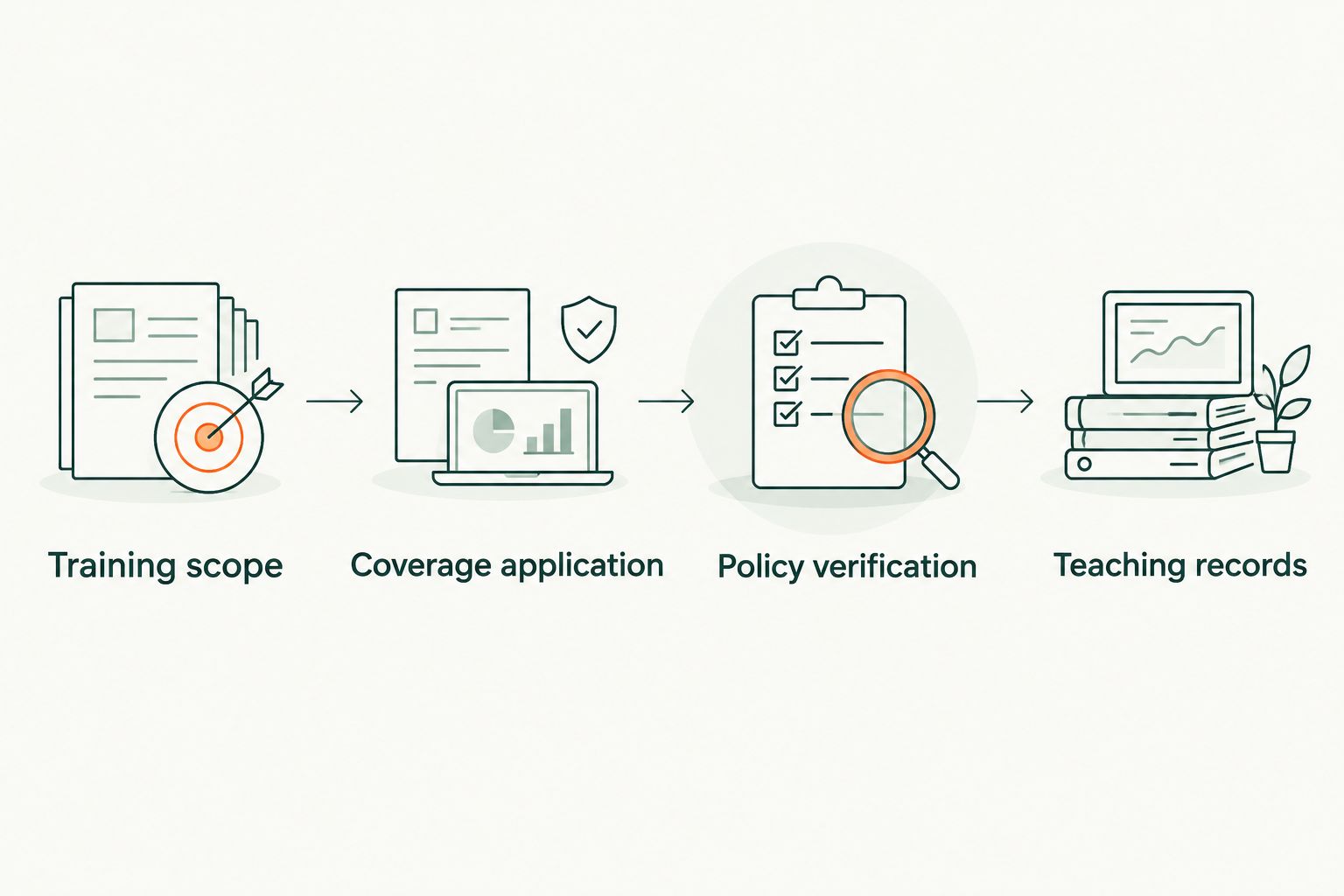
Teaching records
Keep your teaching practice consistent with the application
- Create a secure teaching file. Store qualification evidence, insurer correspondence, policy documents, venue agreements, and relevant emergency procedures. Restrict access to personal information.
- Prepare the class process. Establish an appropriate intake process, explain the session, and teach within your training. Consent forms and waivers do not replace insurance or safe instruction.
- Document incidents factually. Record what happened without speculation, preserve relevant information, and follow the policy's reporting instructions. Do not wait for a formal complaint if the policy requires earlier notification.
- Set change reminders. Review coverage before renewal and before changing activities, venues, equipment, or delivery methods. A calendar reminder supports the process; it does not renew or amend a policy.
Expected result: Your records support the teaching you deliver, and changes trigger a coverage review rather than an assumption.
Keep a dated 2026 review record showing which documents you checked and which activities were confirmed. If your practice changes later, preserve the earlier record rather than replacing it without a history.
Add home-based or online teaching
A move from studio classes to home-based or online instruction creates a second workflow: update the teaching description, ask the insurer about the new activity, obtain any required policy change, and verify the revised documents before starting.
For home-based teaching, ask about business visitors, premises-related exclusions, equipment, and any separate property considerations. Check local requirements and venue permissions separately; liability insurance is not permission to operate a business from a property.
For a Texas teaching business, general liability insurance in Texas addresses a different coverage question from professional liability for Pilates instruction. Ask about both, and confirm how the proposed policy treats business visitors, rented teaching space, and professional services.
For online teaching, distinguish live sessions from recorded content. Tell the insurer where you teach from and where clients participate, then ask about territorial restrictions, covered delivery methods, and exclusions. Do not assume that coverage for an in-person class automatically extends to every online format.
The change is complete only when the required coverage is confirmed. Updating your website, booking system, or class description does not update your policy.
Troubleshooting
The insurer asks for training hours you cannot document
Provide the course outline and the records you actually have. Ask the course provider for clarification of its documented requirements, then ask the insurer what evidence it accepts. Do not convert lesson counts into training hours without a stated basis.
The studio rejects your certificate
Ask which requirement is unmet: curriculum, practical assessment, teaching experience, apparatus training, or a separate credential. Address that specific gap before paying for another program. Insurance approval and employer acceptance are separate decisions.
You have a certificate of insurance but no clear answer on Reformer work
Read the policy and relevant endorsements, then ask the insurer to identify how apparatus instruction is treated. Describe the equipment and your preparation accurately. Do not teach the disputed activity until the question is resolved.
The venue asks to be added to your insurance
Request the venue's exact legal name and contractual wording. Send those requirements to the insurer and ask what endorsement is needed. Do not assume that listing the venue as a certificate holder makes it an additional insured.
Your teaching date arrives before coverage starts
Move the session or arrange an earlier effective date with the insurer and obtain confirmation. A future-dated policy does not cover an earlier class merely because you have already received documents.
Customize your workflow
Use the same file structure for each teaching arrangement, but keep venue requirements distinct. A studio contract, home-based practice, and online class can raise different questions even when you teach the same exercises.
Before choosing training, write down your intended teaching scope and the employer's acceptance criteria. Then decide whether self-paced online study meets your immediate goal or whether supervised practical preparation needs to come first.
Review your training starting point
Explore self-paced study covering anatomy, mat instruction, introductory Reformer concepts, cueing, and business skills.
FAQ
Do I need Pilates instructor liability insurance before my first class?
Arrange the required coverage before teaching and verify that its effective date includes your first class. Ask your venue and insurer which activities and teaching arrangements must be covered.
Does Pilates certification include liability insurance?
Do not assume that a Pilates course includes insurance. Confirm any stated inclusion with the course provider and obtain the actual coverage documents before relying on it.
Is general liability enough for a Pilates instructor?
General liability alone does not establish coverage for claims arising from Pilates instruction. Ask about professional liability and read the policy's professional-services exclusions and covered-activity definitions.
Will a studio's insurance cover me as a contractor?
A studio's insurance covers you only to the extent its policy includes your role and activities. Request written confirmation rather than assuming contractor work or classes elsewhere are included.
Can I get insured while I am still completing certification?
Ask the insurer whether it offers coverage for your specific student or practice-teaching arrangement. Disclose that your training is unfinished and confirm any supervision requirements before teaching.
Does online Pilates training qualify me to teach Reformer classes?
Online curriculum coverage does not by itself establish dedicated hands-on Reformer qualification. Verify practical training, assessment, insurer acceptance, and employer requirements separately.
What should I compare when choosing Pilates instructor liability insurance in 2026?
Compare covered activities, exclusions, insured identity, locations, limits, deductibles, effective dates, and reporting conditions. Keep the teaching description consistent so each proposal addresses the same work.
One last thing
Save the teaching description you submitted with your insurance application. Compare it with your actual class offering before adding a new service; that simple check exposes scope changes that a renewal reminder alone will miss.