
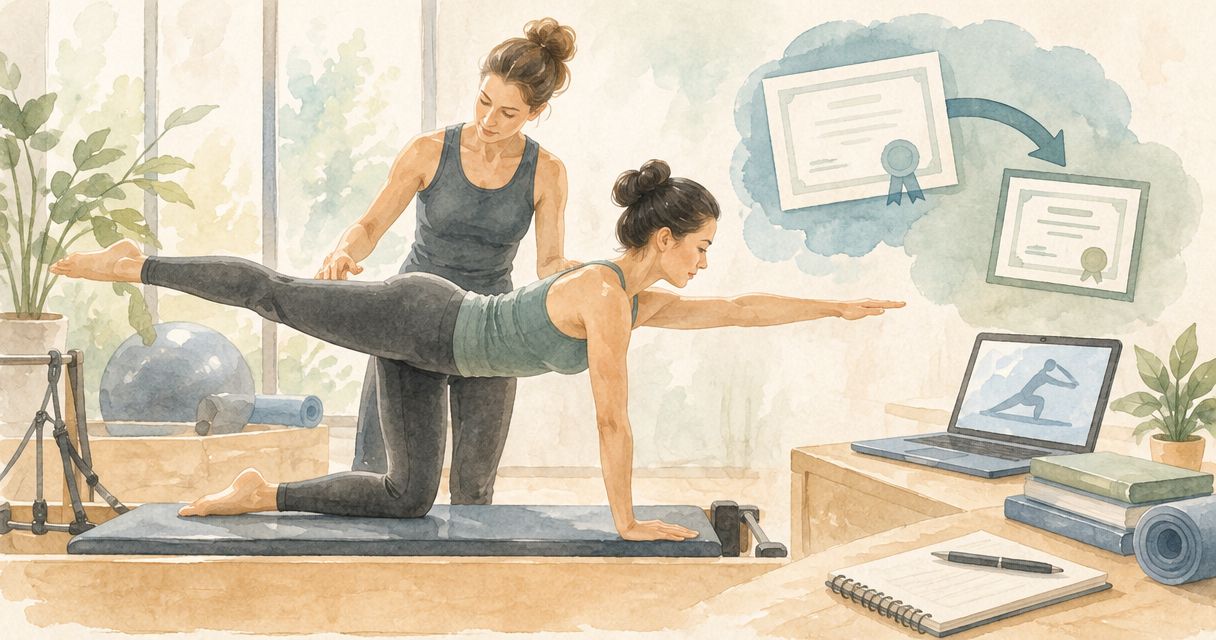
TeachPilates offers flexible, self-paced online Pilates instructor training for $497; to transfer prior training between Pilates certification programs, request a written review of your coursework before enrolling. Separate permission to enroll from permission to skip lessons, practice requirements, or assessments, and ask whether any approved exemption changes your tuition or teaching scope.
- Compare Pilates certification programs by written transfer decisions, not assumptions about overlapping anatomy or mat coursework.
- TeachPilates offers self-paced online instructor training for $497; confirm transfer arrangements before enrolling.
- Personal practice, teacher training, and assessed teaching are different evidence categories.
- Introductory Reformer concepts do not replace dedicated hands-on apparatus qualification.
Why this matters
Your earlier training can help you understand Pilates without necessarily replacing a new course requirement. Treat familiarity with the material and formal credit as separate questions. That distinction protects your enrollment decision from an expensive assumption.
For your 2026 course shortlist, start with the teaching role you want, then check which requirements your existing evidence addresses. The TeachPilates course covers anatomy, mat instruction, introductory Reformer concepts, cueing, and business skills through self-paced online study. Compare that curriculum with your intended teaching scope rather than treating every certificate as interchangeable.
The useful transfer decision names exactly what you can skip, what you must complete, and what qualification you receive. A general welcome to experienced applicants does not answer those questions.
Can you transfer prior training between Pilates certification programs?
Ask the receiving provider to assess your previous training against its current requirements. Do not plan around an exemption until the provider identifies it in writing. Submit evidence that shows what you studied, how you practiced, and how your competence was assessed.
Use this comparison to organize your request. These are evidence categories, not promises that a provider will accept them.
| Prior training or experience | Best for demonstrating | Strength of the evidence | Limitation to address |
|---|---|---|---|
| Pilates practitioner classes | Familiarity with exercises and class participation | Shows your experience as a participant | Does not itself document instructor training or assessed teaching |
| Previous mat teacher training | Overlap in mat repertoire, cueing, and teaching preparation | Can identify specific curriculum matches | Does not establish Reformer or full-apparatus competence |
| Personal training or yoga education | Related anatomy knowledge and teaching experience | Helps explain your existing foundation | Does not establish Pilates-specific teaching competence |
| Previous apparatus teacher training | Training on the equipment named in your records | Gives the provider specific material to review | Acceptance still depends on the receiving provider's decision |
| An unfinished Pilates course | Completed learning and any assessed components | Can support a targeted review rather than a vague request | Enrollment alone does not prove completion |
Your request should identify the outcome you want: admission, exemption from specified content, recognition of practice, or permission to take an assessment. Those are different requests. Ask for a separate answer to each one that affects your enrollment.
Build a transfer evidence pack
Prepare these 5 document categories where they apply to your previous training:
- Completion records: certificates, transcripts, or records identifying completed components.
- Curriculum details: syllabi, learning objectives, exercise lists, and equipment covered.
- Training records: documented study, observation, personal practice, and teaching practice, kept separate.
- Assessment evidence: results, practical feedback, or the criteria used to assess your teaching.
- Course conditions: any documented limits on the training or qualification you completed.
Use the records you actually have. Do not relabel ordinary class attendance as supervised teaching or estimate undocumented practice to strengthen the application.
What should your transfer decision say?
A useful response should let you plan your remaining work without interpreting vague language. Ask the provider to name the requirement being waived and the requirement that replaces it, if any.
For example, permission to bypass an introductory lesson is not permission to bypass the final assessment. Likewise, acceptance of an anatomy qualification does not establish competence in exercise selection, cueing, or apparatus setup.
Before you enroll in 2026, get clear answers to these questions:
- Which specific course components, if any, are exempted?
- Which lessons and practice requirements remain compulsory?
- Which assessments must you complete?
- Does the decision change tuition or any other charges?
- What qualification will you receive after completing the remaining requirements?
- Does the decision have conditions or an expiry date?
Keep the written decision with your enrollment agreement. If the answer only says your experience is relevant, ask whether it changes any actual requirement.
Why transfer decisions need a detailed review
Build your comparison around these 5 factors. Each helps you ask a more precise question without assuming that similarly named courses teach or assess the same things.
- Curriculum match: Compare learning objectives and teaching content, not just module titles. An anatomy heading alone does not show which topics were covered.
- Teaching scope: Identify whether your evidence concerns mat teaching, introductory apparatus concepts, or dedicated apparatus training.
- Practice evidence: Separate participation, observation, self-practice, and teaching practice. Tell the provider exactly what each record represents.
- Assessment evidence: Show whether you completed written work, demonstrated teaching, or received practical feedback. Attendance and assessment answer different questions.
- Remaining requirements: Ask which current course requirements still apply after the review. Do not infer exemptions from admission approval.
Use these factors to compare decisions, not to predict acceptance. A provider's written response is the basis for your plan; the apparent similarity of course names is not.
How do you choose your next training step?
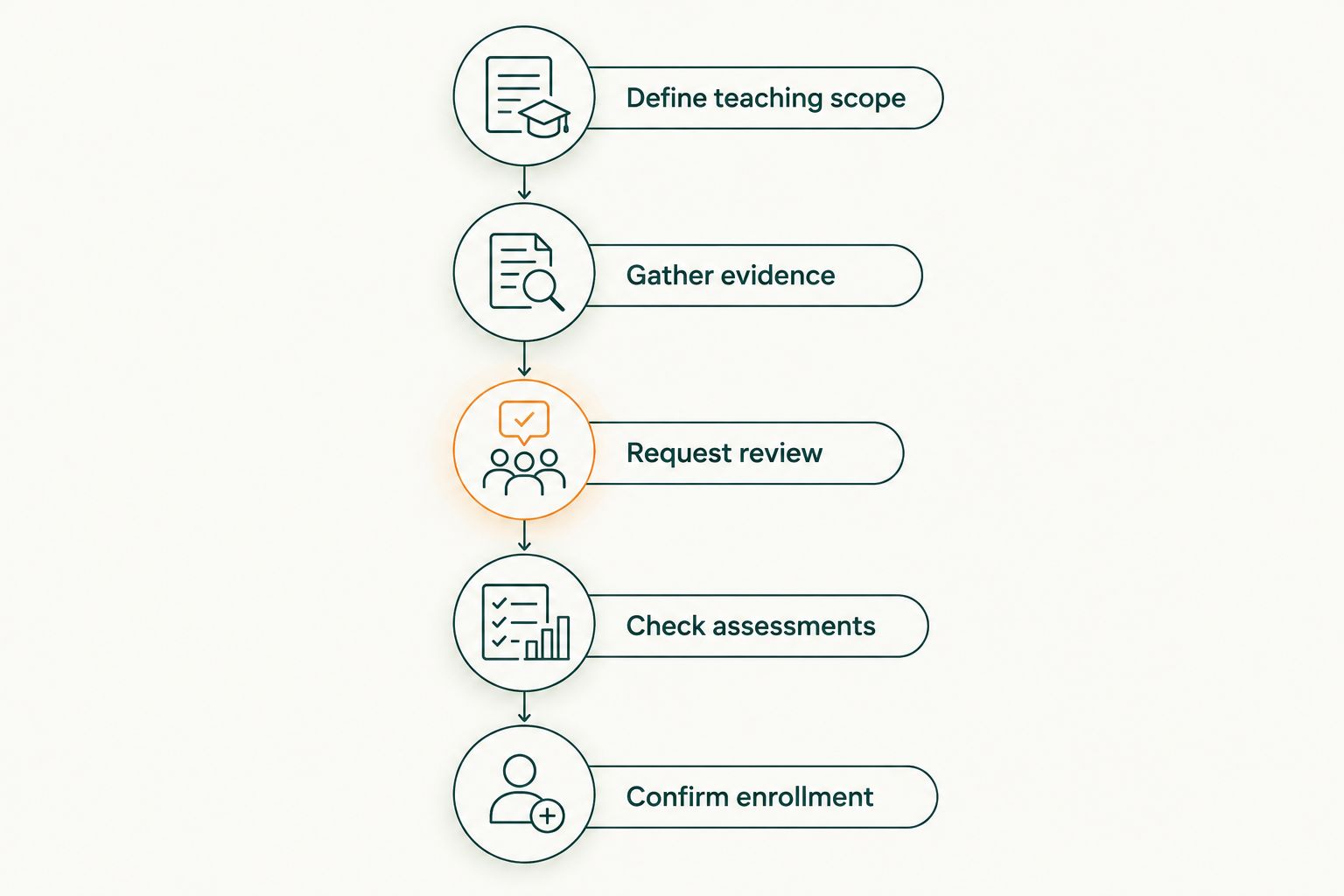
Follow this sequence before paying for another course. It keeps your previous investment relevant without letting it dictate a qualification that does not fit your goal.
- Define teaching scope. Write down whether you want to teach mat classes, work toward Reformer instruction, or pursue broader apparatus training.
- Gather evidence. Assemble the records that show completed learning and assessed skills, not just course enrollment.
- Request review. Ask the receiving provider to identify accepted evidence and remaining requirements in writing.
- Check assessments. Confirm how you must demonstrate teaching competence after any exemptions.
- Confirm enrollment. Review tuition, access conditions, and the qualification awarded before committing.
Your 2026 training plan should also separate study convenience from practical preparation. Online access answers where you can study; it does not, by itself, answer how your teaching is assessed or how you prepare to use apparatus.
For a closer look at that distinction, read about written versus practical assessments. Use the assessment requirements to identify what evidence you need to produce, rather than choosing solely by the amount of content you can skip.
Where does self-paced online training fit?
TeachPilates is best for aspiring instructors seeking self-paced online Pilates education, not a substitute for dedicated hands-on apparatus qualification. Its stated curriculum includes anatomy, mat teaching, introductory Reformer concepts, cueing, and business skills.
The practical advantage is control over your study schedule. The boundary is teaching scope: learning introductory Reformer concepts is not the same claim as completing dedicated hands-on apparatus training. If apparatus instruction is your goal, make equipment practice and assessment part of your enrollment questions.
For TeachPilates Pilates instructor training, the stated tuition is $497. Ask about prerequisites, assessment requirements, course-access conditions, and any proposed recognition of prior learning before deciding whether the course fits your next step.
Do not assume that course completion includes a separate independent credential or guarantees acceptance by a particular studio. Check the requirements of the studio, employer, or independent credential you intend to pursue directly.
Review your training fit
Explore self-paced online study, then confirm the requirements that apply to your prior training.
Does previous mat training count toward Reformer certification?
Previous mat training should be presented as evidence of mat preparation, not proof of Reformer teaching competence. Ask the receiving provider which foundations overlap and which apparatus-specific requirements remain.
Make the equipment distinction explicit. A record of mat cueing does not document your ability to set up a Reformer, select its resistance, or teach exercises on it. Submit separate evidence for any apparatus training you have actually completed.
For your 2026 decision, compare the teaching scope you want with the scope you can document. Choose the remaining training around the skills you need to demonstrate, not around the certificate title you hope to obtain.
Can personal training or yoga education replace Pilates teacher training?
Personal training or yoga education gives you related experience to submit for review; it does not establish Pilates-specific teaching competence by itself. Identify the anatomy, instruction, and assessment content you completed, then ask which requirements it addresses.
Avoid describing your background only through job titles. A syllabus and assessment record give the receiving provider more specific evidence than the statement that you already teach fitness.
Your existing experience still matters when no formal exemption follows. Use it to identify familiar material, then give your attention to Pilates-specific repertoire, cueing, and teaching practice rather than assuming those skills transfer unchanged.
Will transferring prior training reduce your tuition?
Do not assume that an approved exemption reduces tuition. Ask the provider to confirm the financial effect separately from the academic decision, including whether any review or assessment carries an additional charge.
For your 2026 comparison, distinguish 3 outcomes: less repeated study, fewer remaining requirements, and lower tuition. Ask which outcomes the written decision actually provides. They are not interchangeable.
Also check whether access deadlines still apply after a transfer review. A shorter list of remaining lessons is only useful if the course conditions let you complete the work and assessments you still need.
FAQ
Can I transfer an unfinished Pilates course to another provider?
Request a review of the components you actually completed before enrolling elsewhere. Submit completion records, curriculum details, and assessment evidence, then ask which remaining requirements apply.
Will my Pilates classes count as teacher-training practice?
Do not count participant classes as teacher-training practice unless the receiving provider explicitly accepts them for that requirement. Keep personal practice, observation, and teaching records separate.
Do I need to repeat anatomy if I already studied it?
Ask the receiving provider to review your anatomy syllabus and assessment evidence. Familiarity with anatomy does not itself confirm an exemption from the provider's course or assessment requirements.
Can I skip a practical assessment if I already have a certificate?
Do not skip a practical assessment without a written exemption from the receiving provider. Submit the evidence of your previous assessment and ask whether it satisfies the current requirement.
Does online Pilates certification qualify me to teach every apparatus?
Do not treat online course completion as proof of competence on every apparatus. Check the equipment covered, the practical training required, and the teaching skills assessed.
What should I ask before paying for another Pilates course?
Ask for the remaining curriculum, required assessments, total charges, access conditions, and qualification awarded. If you want prior learning recognized, get that decision in writing before enrolling.
Will a Pilates course certificate guarantee studio acceptance?
Do not treat a course certificate as a guarantee of studio acceptance. Ask the studio which training, practical experience, credentials, and other requirements it expects for the role you want.
One last thing
An exemption is useful only when it leaves you prepared for the teaching you intend to do. Before requesting the shortest route, write down the skills you still need someone to assess. That list gives you a better enrollment question than asking how much training you can avoid.
Ask the provider to describe your remaining route from enrollment to assessment in one written response. You should be able to identify every required step without combining promises from separate messages.