
Wellness coordinators’ Pilates certification is instructor training aimed at preparing you to teach Pilates within a workplace or community wellness program. TeachPilates offers flexible, self-paced online study for $497; your enrollment decision should also account for employer requirements, practical assessment, and whether you need mat foundations or dedicated hands-on apparatus training.
- TeachPilates Pilates certification suits wellness coordinators seeking self-paced foundations, not a substitute for dedicated hands-on apparatus qualification.
- Choose pilates certification for wellness coordinators around your intended classes, employer requirements, and opportunities to practice teaching.
- Compare anatomy, cueing, assessments, access terms, and teaching scope before enrolling in online Pilates instructor training.
- Confirm workplace approval before treating any course certificate as permission to lead employee sessions.
Why Pilates certification matters for wellness coordinators
Coordinating a wellness calendar and teaching movement are different responsibilities. You can organize attendance, book instructors, and manage communications without being prepared to explain an exercise, recognize a struggling participant, or change a class plan.
Choose training for the class you will teach, not the job title you already hold. For your 2026 enrollment decision, define the proposed session, the participants, and the environment before comparing certificates.
A workplace mat session requires different preparation from teaching on a Reformer. A general employee class also differs from clinical rehabilitation: an instructor course does not itself authorize you to diagnose conditions or provide treatment.
Your first decision is therefore straightforward: do you want to coordinate Pilates sessions, teach them yourself, or do both? Only the teaching role creates the need to develop and demonstrate Pilates instruction skills.
How to choose training and prepare to teach
1. Define your teaching assignment
Start with a written brief, not a course purchase. Describe what your organization wants you to deliver and what you are prepared to take responsibility for.
Be specific about format. A live mat class, a recorded movement session, and an equipment-based appointment have different supervision and preparation needs. Do not assume a general wellness remit covers every setting.
Keep the initial assignment narrow enough to evaluate. A beginner mat class is a clearer training target than a promise to offer Pilates for every employee and every physical concern.
- Identify whether you will coordinate, teach, or combine both roles.
- Name the intended setting: workplace, community venue, or online.
- Specify mat instruction or apparatus instruction.
- Describe the participants without making assumptions about their ability.
- Write down activities outside your intended teaching scope.
2. Confirm prerequisites and workplace approval
Ask your employer what evidence is required before you enroll. Get the answer in writing so you can compare the course against an actual requirement rather than an informal expression of interest.
No teaching background is required for the TeachPilates course, but admission and workplace approval are separate decisions. Ask about personal practice expectations, assessment participation, and any prerequisites attached to your intended role.
For a 2026 launch, resolve these questions before announcing a class date. Course completion, workplace authorization, and insurance acceptance should not be treated as interchangeable.
- Request the employer’s accepted training criteria.
- Ask whether a practical demonstration or audition is required.
- Confirm CPR and first-aid expectations for the setting.
- Check insurance requirements with the relevant insurer or administrator.
- Ask the course provider to explain prerequisites and completion requirements.
3. Match the curriculum to your first classes
Make a curriculum checklist yourself before speaking with a provider. Include anatomy, movement instruction, cueing, exercise selection, and the ability to adapt a lesson when someone cannot follow the original plan.
TeachPilates Pilates certification covers anatomy, mat and Reformer instruction, cueing, and business skills through self-paced online study. That format suits coordinators who need to organize study around existing responsibilities. Its limitation is equally important: introductory Reformer concepts are not a substitute for dedicated hands-on apparatus qualification.
Match curriculum coverage to demonstrated teaching ability. A topic appearing in a syllabus does not tell you how much supervised practice or individual feedback accompanies it.
- Ask how anatomy connects to exercise selection and instruction.
- Check how cueing and modifications are taught and assessed.
- Distinguish mat-teaching foundations from introductory Reformer content.
- Ask what practical feedback you receive and from whom.
- Review whether business lessons address responsibilities relevant to your role.
4. Build a study plan around your work calendar
Map your available time on a calendar before choosing a completion target. Self-paced study lets you organize your learning, but it does not replace the time needed to practice explaining movement aloud.
As a planning example, reserve 2 study sessions per week, each lasting 30 minutes, and add a separate rehearsal. These are suggested calendar blocks, not course requirements or a claim about how quickly you will qualify.
For your 2026 schedule, include room for assessment preparation, questions, and repeated practice. Confirm access limits and deadlines directly; self-paced does not automatically mean lifetime access or unlimited assessment attempts.
- Separate reading or video study from movement practice.
- Schedule cueing rehearsals rather than only watching lessons.
- Leave time to revisit topics you cannot explain clearly.
- Confirm course-access terms before setting your calendar.
- Keep the proposed workplace launch date provisional until requirements are met.
5. Check how assessments measure teaching
Ask for the assessment requirements before paying. A written test can assess terminology and principles; practical assessment examines how you apply instruction. Neither should be assumed from the word certification alone.
Request the actual format, pass criteria, submission process, and feedback arrangements. Do not infer an exam pass mark, assessment count, or independent credential from a course title.
For a self-check, record a 10-minute rehearsal of a beginner lesson segment. Watch whether your directions explain the starting position, movement, and next transition without relying on participants to copy you.
- Confirm whether assessments are written, practical, or both.
- Ask whether teaching submissions receive individual feedback.
- Request pass criteria and reassessment terms.
- Check whether observation and practice teaching are required.
- Distinguish the provider’s certificate from any separate independent credential.
6. Arrange practice and participant safeguards
Begin with a lesson outline and rehearse before scheduling an employee class. Practice with a willing adult who understands that the session is rehearsal, and stay within the exercises and decisions you have been prepared to teach.
Workplace familiarity is not a substitute for clear boundaries. Colleagues need a way to decline participation or raise a concern without discussing private health information in front of the group.
Use your organization’s established procedures for health information and incident reporting. Do not create a clinical screening process yourself or present a general Pilates lesson as treatment.
- Rehearse opening instructions and transitions aloud.
- Identify how participants can stop or ask for an alternative.
- Confirm the venue’s emergency procedures.
- Agree on a private route for participant concerns.
- Arrange qualified feedback before expanding your teaching scope.
7. Confirm total commitments before enrolling
Create a comparison sheet with tuition, access, assessments, practical requirements, and employer acceptance. Keep confirmed facts separate from questions awaiting an answer.
The stated TeachPilates tuition is $497. Before enrolling, verify what the enrollment includes and whether your intended pathway requires separate practical instruction, equipment access, insurance, or other commitments. Do not assume those items are included or required without checking.
For a 2026 decision, save the current enrollment terms and the employer’s approval together. You need a documented fit between the course and your role, not simply a certificate with Pilates in its name.
- Confirm the current enrollment terms and included materials.
- Ask about assessment and reassessment arrangements.
- Record access limits and support arrangements.
- Identify any separate apparatus-training needs.
- Keep written confirmation of workplace requirements.
Training options for wellness coordinators
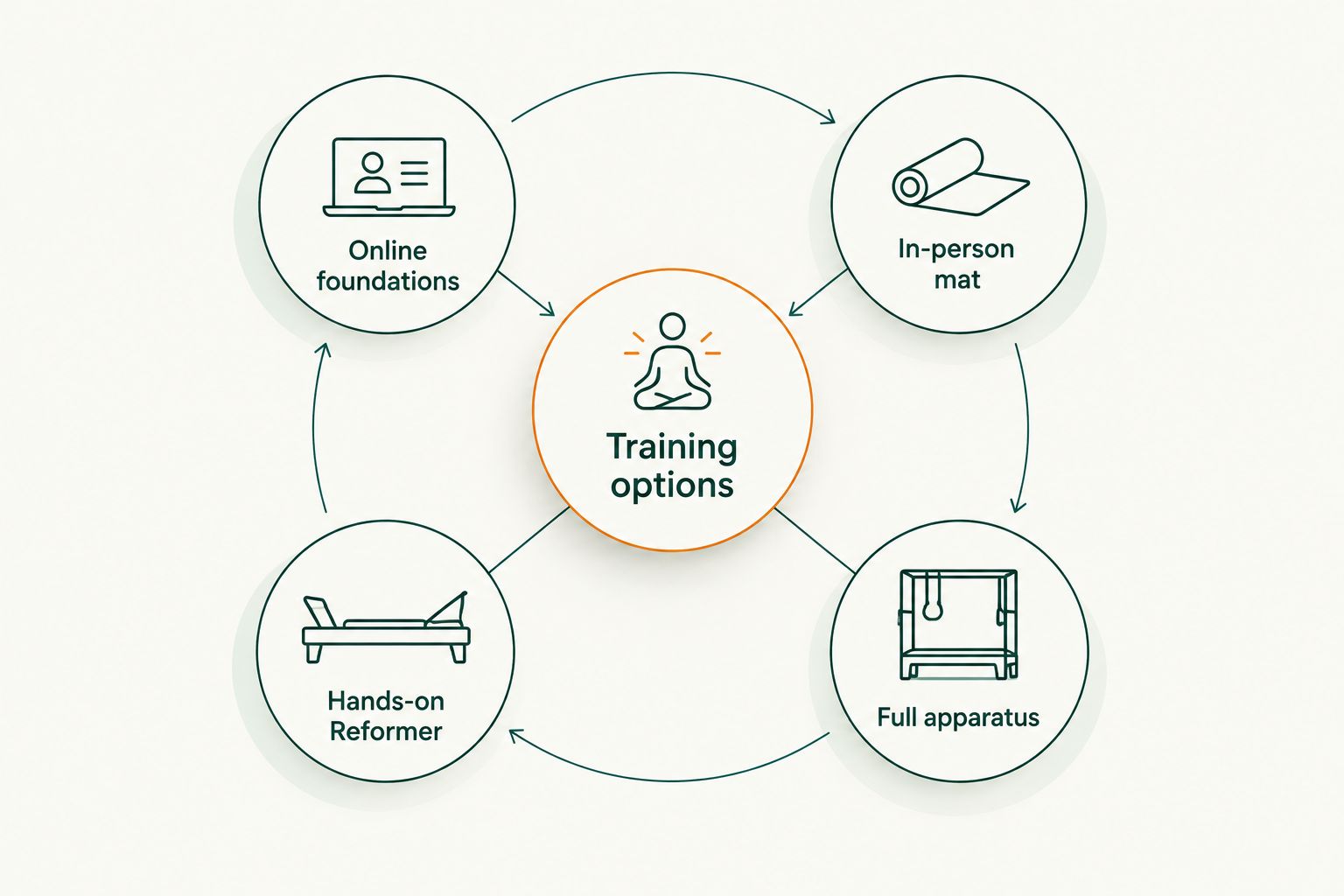
Choose the format that closes your teaching gap. Online foundations address a different need from supervised equipment instruction; neither should be evaluated as though it automatically includes the other.
This guide is published by TeachPilates. The comparison below describes training formats rather than making unverified claims about named competitors. The tuition shown is the amount supplied for this course, not an estimate for other providers.
| Option | Best for | Stated tuition | Main advantage | Key limitation |
|---|---|---|---|---|
| Online foundations: TeachPilates | Coordinators seeking flexible study in anatomy, mat foundations, cueing, and business skills | $497 | Self-paced online learning around existing responsibilities | Does not replace dedicated hands-on apparatus qualification; confirm assessment and access details |
| In-person mat | Coordinators prioritizing live mat-instruction practice | Confirm with provider | Lets you assess opportunities for direct observation and feedback | Attendance and feedback arrangements depend on the program |
| Hands-on Reformer | Coordinators specifically preparing for equipment-based teaching | Confirm with provider | Focuses the training decision on apparatus use and supervised practice | Requires suitable equipment access; verify the exact teaching scope |
| Full apparatus | Coordinators whose intended role includes broader apparatus instruction | Confirm with provider | Can align training with a wider equipment-based role | Broader scope is unnecessary if your assignment is mat-only; verify what is included |
The categories below are alternatives to evaluate, not a required progression. Start with the format that matches your assignment, and add another only when your teaching role calls for it.
Common mistakes wellness coordinators make
Treating employer interest as approval
An enthusiastic manager has not necessarily checked insurance, venue procedures, or instructor requirements. Get the approval criteria before enrollment, then confirm that the chosen pathway meets them.
Keep the approval tied to a defined assignment. Permission to teach a beginner mat class does not establish permission to teach apparatus sessions or provide rehabilitation.
Choosing training from a class benefit alone
A wellness calendar might group classes for flexibility and strength together, but those shared goals do not establish that every class uses the same method or requires the same instructor preparation. Choose Pilates training because you intend to teach Pilates, not because a broad outcome sounds attractive.
Separate employee interest from your competence. A request for more challenging sessions is a reason to review training and scope, not to add unfamiliar exercises immediately.
Confusing Reformer content with apparatus qualification
A syllabus can introduce Reformer principles without providing dedicated hands-on qualification. Ask what equipment practice, supervision, and practical assessment are included rather than interpreting the topic name as proof of readiness.
This distinction matters even when you only plan to offer mat classes initially. Describe your completed training accurately when communicating with employers and participants.
Measuring readiness by course completion alone
Completing lessons is not the same task as leading a group. You still need to give clear directions, watch participants, manage transitions, and recognize when a request falls outside your scope.
Use practical feedback to identify the next step. If your intended class requires skills your course has not assessed, arrange appropriate additional preparation before teaching it.
FAQ
What’s the best Pilates certification for wellness coordinators?
The best fit is training that matches your intended teaching scope and your employer’s requirements. Choose mat foundations for a mat-focused assignment and dedicated hands-on apparatus training when your role includes equipment instruction.
How much is the TeachPilates course?
TeachPilates lists tuition of $497 for its self-paced online Pilates instructor certification course. Confirm current enrollment terms and what is included before paying, then check any separate requirements attached to your workplace role.
Can I study for Pilates certification while working full time?
Self-paced online study lets you arrange learning around your work schedule. Reserve separate time for practice teaching and assessment preparation, and confirm access limits before choosing a completion date.
Do wellness coordinators need previous teaching experience?
No teaching background is required for the course described here. Your employer can set separate requirements for leading workplace sessions, so confirm both course admission and workplace approval before enrolling.
Does online Pilates certification qualify me to teach Reformer?
Do not treat online course completion as proof of dedicated hands-on Reformer qualification. Check equipment practice, supervision, practical assessment, and the requirements of the organization where you intend to teach.
Can I use Pilates certification to provide rehabilitation at work?
A Pilates instructor certificate does not itself authorize diagnosis or clinical rehabilitation. Keep workplace sessions within your training and role, and direct clinical concerns to an appropriately licensed professional.
Will every workplace accept the same Pilates certificate?
Do not assume universal workplace acceptance. Send the course details to the person responsible for instructor approval and request written confirmation before committing to a teaching assignment.
One last thing
Ask your employer to approve the proposed class before asking the employer to approve a course. A clear class brief makes the training decision easier: you can compare instruction, assessment, and practice against a real assignment.
For your 2026 plan, make the first deliverable a written teaching scope. Enrollment should prepare you for that scope, not leave you guessing what your certificate permits.