
Military veterans’ Pilates certification is instructor training aimed at preparing former service members to teach within a defined scope; TeachPilates offers a $497 self-paced online course covering anatomy, mat instruction, introductory Reformer concepts, cueing, and business skills. This 2026 guide explains how to match training to your intended teaching role, check military education funding, and separate course completion from employer requirements.
- TeachPilates suits military veterans seeking $497 self-paced Pilates instructor training with mat foundations and introductory Reformer concepts.
- Choose Pilates certification for military veterans by teaching scope, assessment requirements, practical experience, and employer acceptance.
- Confirm military education funding for the exact course before enrolling; veteran status alone does not establish coverage.
- Online study does not replace dedicated hands-on apparatus qualification or guarantee studio employment.
Why Pilates certification matters for military veterans
Choose your intended teaching role before choosing your certificate. Teaching mat classes and teaching clients on apparatus require different preparation. A course title alone does not establish what you can competently teach or what a studio will accept.
For a veteran changing careers, the practical questions include how training fits your current commitments, whether previous experience counts, and whether education benefits cover the exact program. None of those answers follows automatically from military service.
Military instruction experience can give you examples to discuss during an application or audition. It does not replace learning Pilates technique, anatomy, exercise selection, or modifications. Likewise, personal Pilates experience and teaching readiness are different things.
This guide is published by TeachPilates, which offers the course discussed here. TeachPilates is best for military veterans seeking self-paced online Pilates instructor training focused on mat foundations rather than dedicated hands-on apparatus qualification.
How to choose Pilates certification for military veterans
1. Define the teaching role you want
Start with a written description of the work you want to do. Name the setting, equipment, and participants rather than writing only that you want to become certified. A beginner mat class, a Reformer session, and exercise instruction in a clinical setting are not interchangeable roles.
Next, contact a prospective employer or venue directly. Ask which qualifications it accepts in 2026, whether it requires a practical audition, and what additional documentation instructors need. Get a written response before paying tuition.
If you intend to teach fellow veterans, describe the proposed class accurately. Shared military experience does not establish competence in rehabilitation, trauma treatment, or clinical exercise prescription. Keep the role within your training and professional scope.
- Write down whether you want to teach mat, Reformer, or other apparatus.
- Name the kind of venue where you want to teach.
- Ask that venue which training and assessments it accepts.
- Record any CPR, insurance, audition, or experience requirements.
- Separate general exercise instruction from clinical services.
2. Check prerequisites and practical requirements
Review the course entry requirements yourself before speaking with admissions. No teaching background is required for the TeachPilates course, but entry eligibility is only the starting point. You still need to understand what you must demonstrate to complete training.
Ask how the provider evaluates anatomy knowledge, exercise instruction, cueing, and modifications. A written assessment checks different abilities from a practical teaching assessment. Request the actual completion requirements, including any observation, personal practice, or practice-teaching components.
Do not assume military training counts toward course requirements. Ask whether prior learning receives credit and what evidence the provider needs. A verbal suggestion that your background will help is not a documented exemption.
Use the same scrutiny for access. Self-paced describes scheduling flexibility; it does not, by itself, establish lifetime access, unlimited assessment attempts, or personal tutor support.
- Request the prerequisites and completion requirements in writing.
- Check whether assessments include written and practical components.
- Ask how instructors evaluate cueing and exercise modifications.
- Confirm access duration, extension terms, and assessment deadlines.
- Verify any prior-learning credit before relying on it.
3. Match the training format to your commitments
Build a study plan using your existing calendar first. Mark work, family, appointments, travel, and any continuing service obligations that apply to you. Then identify repeatable study periods and separate opportunities to practice teaching aloud.
The TeachPilates course offers self-paced online study covering anatomy, mat and Reformer instruction, cueing, and business skills. Its fit is flexible foundational study, not a promise that online lessons alone prepare you for every apparatus-based teaching role.
For your 2026 plan, distinguish material you can study independently from skills that need observation, feedback, or equipment access. If Reformer teaching is your goal, investigate dedicated hands-on apparatus training before treating introductory concepts as sufficient preparation.
As a scheduling exercise, reserve two 30-minute study sessions and one 20-minute cueing rehearsal in your weekly calendar. These are suggested planning blocks, not course requirements or a completion estimate. Adjust them to the provider’s actual workload.
- Protect recurring study time instead of relying on spare time.
- Schedule spoken cueing practice separately from reading.
- Identify where you can obtain appropriate practical feedback.
- Check equipment access before selecting apparatus training.
- Compare tutor support and practical assessment arrangements.
4. Verify tuition and military education funding
Start with a written budget that separates tuition from other expenses. TeachPilates tuition is $497. Confirm what enrollment includes and ask about any separate assessment, extension, equipment, or practical-training charges before making your decision.
Do not treat veteran status as confirmation that a course receives military education funding. GI Bill coverage depends on eligibility and approval of the relevant program. Ask the provider and the Department of Veterans Affairs about the exact course rather than assuming approval from a school name or a military-friendly description.
If you are pursuing Veteran Readiness and Employment support, discuss the proposed training with your VA counselor before making a financial commitment. Approval for one education benefit does not establish approval for another.
For a 2026 enrollment, keep written confirmation of the course identity, funding decision, and expenses you remain responsible for. Until coverage is confirmed, do not count it as money available for tuition.
- Request an itemized statement of what tuition includes.
- Ask whether the exact program has relevant VA approval.
- Verify your own eligibility through the appropriate VA process.
- Discuss proposed training with your counselor when applicable.
- Budget separately for required items outside tuition.
5. Build teaching practice into your training plan
Use a notebook or simple document to record practice before purchasing extra planning tools. Track what you taught, the cues you used, where participants needed clarification, and what you will change next time. Reflection makes practice more deliberate than repeating a sequence unchanged.
Practice explaining exercises aloud, but do not mistake confidence for competence. Seek qualified feedback on exercise selection, positioning, pacing, and modifications. Follow the course’s requirements and stay within the activities you have been trained to teach.
When teaching people with different experience levels, ask for feedback rather than assuming everyone understands a familiar instruction. Military terminology that worked in one setting is not automatically clear or appropriate in a Pilates class.
The goal is instruction participants can understand and follow—not a performance of authority. Be precise, leave room for questions, and avoid diagnosing pain or promising treatment.
- Keep a log of personal practice, observation, and teaching separately.
- Rehearse instructions without relying on specialist jargon.
- Ask a qualified teacher to review your cueing.
- Practice explaining options without pressuring participants.
- Record feedback and revise your next teaching session.
6. Confirm your next step before enrolling
Return to the employer or venue you identified at the start. Show the course description and assessment information, then ask whether that preparation meets its requirements for the specific role. Broad approval of online learning is less useful than an answer about your actual course.
Use this guide to checking employer requirements to organize the conversation. Ask about auditions, documented teaching experience, insurance, and any additional credentials rather than assuming the certificate resolves everything.
A provider-issued certificate and an independent credential are separate. Do not assume an independent examination, registration, or professional designation is included unless the provider explicitly confirms it.
Make your enrollment decision from the complete pathway: course, assessment, practical preparation, and venue requirements. If your goal requires dedicated apparatus instruction, include that training in the plan before deciding that the online course alone meets your needs.
- Obtain an answer about the specific course and intended role.
- Confirm whether a practical audition is required.
- Ask which documents you must supply before teaching.
- Distinguish provider certification from independent credentials.
- Write down the remaining steps after course completion.
Review your instructor training option
Explore the $497 self-paced course, then confirm its fit with your teaching goal and employer requirements.
Compare training options for your teaching goal
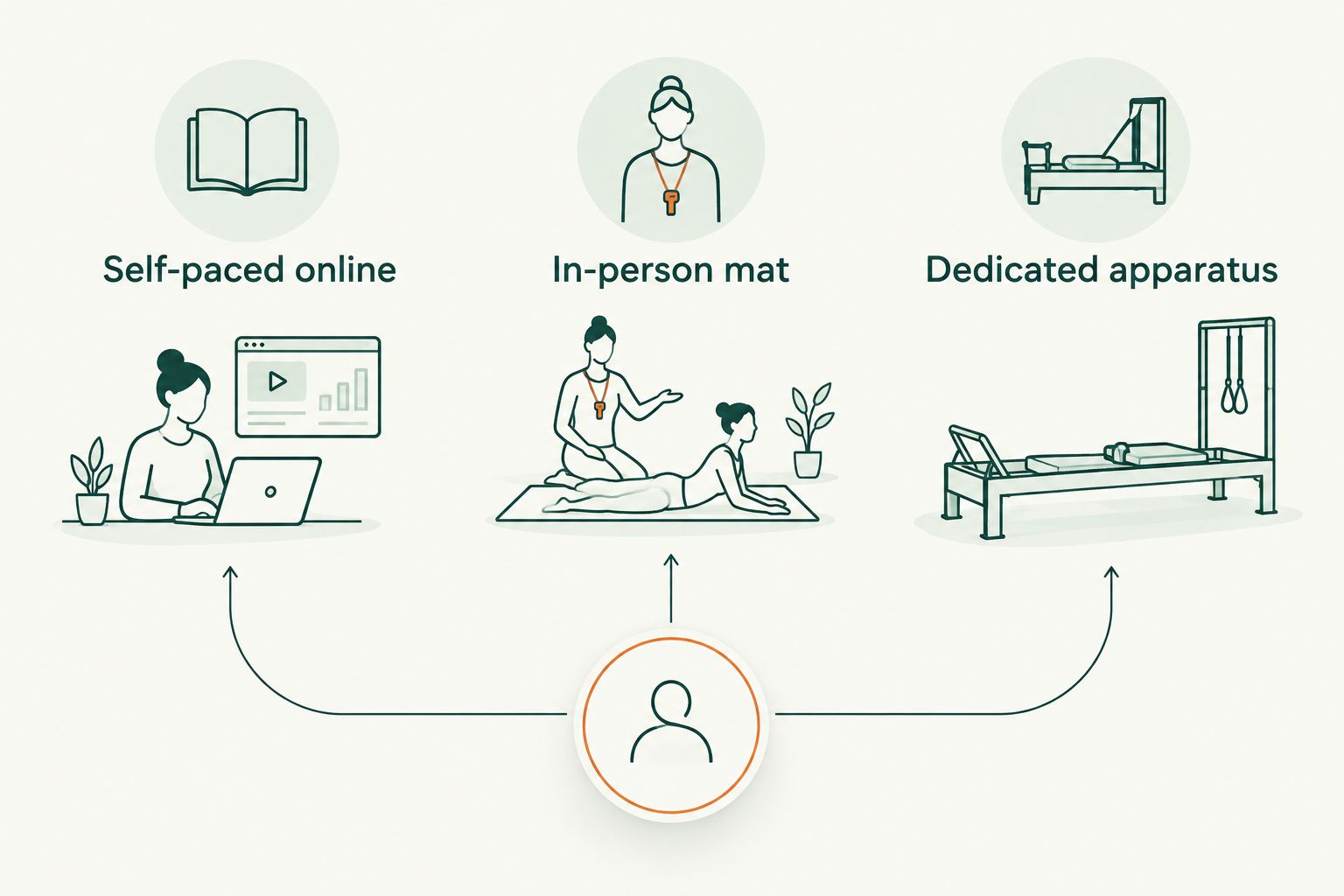
This comparison separates training formats, not competing providers. Only one course’s tuition is established here; obtain a current written total for any alternative you consider. Compare the same teaching scope before comparing the commitment involved.
| Option | Best for | Tuition information | Main advantage | Key limitation |
|---|---|---|---|---|
| Self-paced online: TeachPilates | Veterans seeking flexible study and mat-teaching foundations | $497 tuition | Online study covering anatomy, mat instruction, introductory Reformer concepts, cueing, and business skills | Not a substitute for dedicated hands-on apparatus qualification; confirm employer acceptance |
| In-person mat | Veterans prioritizing scheduled, face-to-face mat instruction | Request the provider’s current total | Offers an in-person learning setting | Fixed attendance commitments; confirm feedback and assessment arrangements |
| Dedicated apparatus | Veterans whose intended role requires Reformer or other apparatus teaching | Request the provider’s current total | Focuses training on the equipment-based role | Requires suitable equipment access; verify the apparatus and practical work included |
Choose the format that matches the teaching role, then check the delivery details. In-person mat training fits better when scheduled face-to-face instruction is your priority. Dedicated apparatus training fits better when equipment-based teaching is your immediate goal.
Common mistakes military veterans make when choosing training
Treating military experience as a qualification exemption
Your service record can explain your background, but it does not document Pilates teaching competence. Submit prior-learning evidence only through the provider’s stated process. Do not omit required training based on an informal conversation.
Assuming military education benefits cover enrollment
A provider’s reference to veterans is not a funding decision. Verify the exact program and your eligibility before committing benefit funds or paying expenses you expect to recover.
Choosing Reformer work without planning equipment access
Online anatomy and movement study do not resolve the practical question of where you will learn apparatus setup and teaching. Confirm access and instruction before enrolling in a pathway intended to lead to apparatus-based work.
Confusing service to veterans with clinical treatment
You can want to support fellow veterans without presenting Pilates instruction as rehabilitation or treatment. Describe the exercise service accurately and refer clinical questions to an appropriately qualified healthcare professional.
FAQ
What is the best Pilates certification for military veterans?
The best Pilates certification for military veterans matches your intended teaching scope, study schedule, and employer requirements. TeachPilates fits veterans seeking $497 self-paced online foundations; dedicated hands-on apparatus training fits an immediate apparatus-teaching goal better.
Can I use the GI Bill for Pilates instructor training?
GI Bill coverage depends on your eligibility and approval of the exact program. Confirm both with the provider and VA before enrolling; do not assume the course discussed here is covered.
Do I need teaching experience before starting Pilates certification?
No teaching background is required for the course discussed here. You still need to meet its completion requirements and develop the practical teaching skills required for your intended role.
Does military fitness instruction count toward Pilates certification?
Military fitness instruction counts toward course requirements only if the provider formally accepts it as prior learning. Ask what documentation is required and obtain confirmation before planning around an exemption.
Can I teach Reformer Pilates after an online course?
Introductory online Reformer concepts are not a substitute for dedicated hands-on apparatus qualification. Confirm the practical training, assessment, and employer requirements for the Reformer role you want.
How long will Pilates certification take while I work?
Completion time depends on the course requirements and the study and practice time you can sustain. Ask about access limits and assessments, then build a schedule; self-paced does not establish a fixed completion timeline.
Will certification guarantee a studio job in 2026?
Certification does not guarantee a studio job in 2026. Ask prospective employers about accepted training, practical auditions, experience, and any additional requirements before choosing your course.
One last thing
Before enrolling, ask a prospective employer this exact question: Would this course, together with its stated assessments and practice requirements, meet your requirements for the role I want? A specific written answer is more useful than a general assurance that Pilates instructors are welcome.
For your 2026 decision, keep that answer beside the course syllabus and your funding confirmation. Enroll when the training scope, practical plan, and financial commitment all match—not simply when the course title sounds right.