
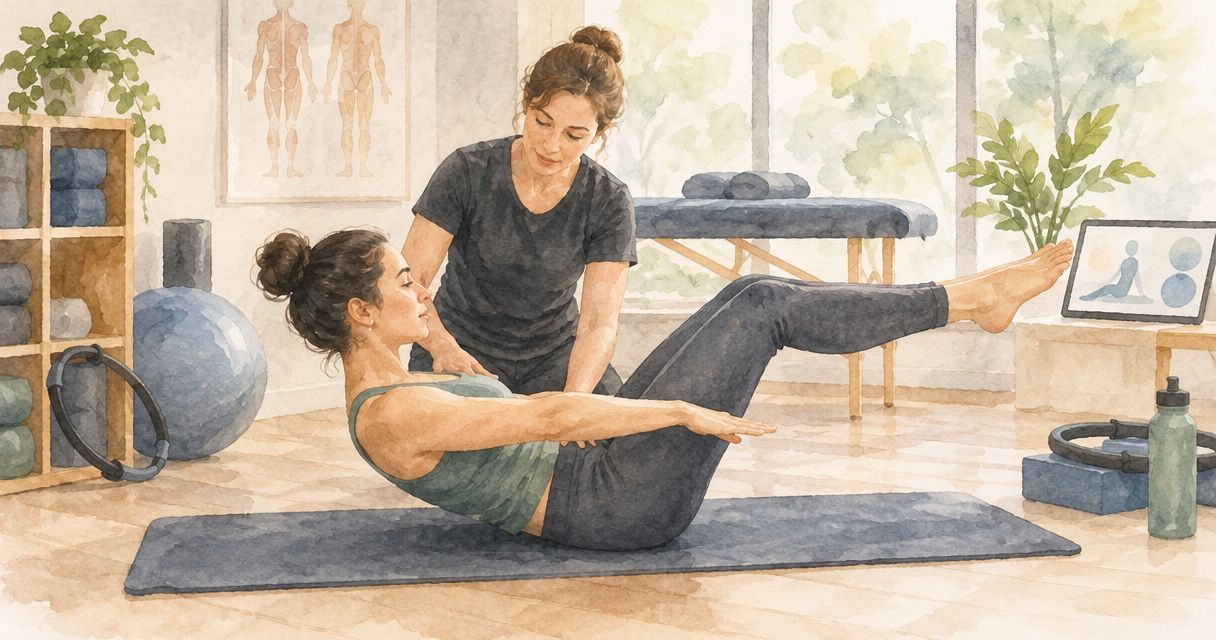
Massage therapists’ Pilates certification is instructor training aimed at helping you teach movement classes alongside your existing bodywork practice. TeachPilates offers $497 tuition and flexible, self-paced online study; this guide explains how to compare training scope, assessments, and practical preparation before enrolling.
- Pilates certification for massage therapists should match your intended teaching scope, not just your anatomy knowledge.
- TeachPilates is best for aspiring instructors who want self-paced online Pilates foundations alongside an existing massage practice.
- Mat teaching, introductory Reformer concepts, and hands-on apparatus qualification are different training commitments.
- Confirm assessment requirements, insurance coverage, and employer expectations before enrolling.
Why Pilates certification matters for massage therapists
Your massage background gives you a useful starting point for studying anatomy and communicating with clients. Teaching Pilates adds a different responsibility: you must explain movement, watch someone perform it, and adapt your instructions without relying on hands-on treatment.
Knowing anatomy is not the same as knowing how to teach exercise. A client can understand which muscles an exercise involves and still need clearer pacing, positioning, or verbal cues.
TeachPilates publishes this guide and offers the course discussed here. The TeachPilates Pilates certification curriculum covers anatomy, mat and reformer instruction, cueing, and business skills; treat introductory Reformer study separately from dedicated hands-on apparatus qualification.
For your 2026 enrollment decision, start with the work you actually want to do. Teaching beginner mat sessions alongside massage appointments calls for a different training plan from applying to an equipment-based studio.
Neither route automatically expands your massage license or establishes permission to offer rehabilitation. Check your professional scope, local requirements, and insurance terms before describing a new service to clients.
How to choose your training and prepare to teach
Define your teaching destination
Start without buying anything: write down the service you want to offer and who would attend. Be specific about whether you want to teach individuals, lead groups, or pursue studio employment.
A massage client asking for movement ideas is not the same as a studio hiring an apparatus instructor. Each situation creates different questions about training, supervision, documentation, and responsibility.
Draft a plain-language service description before comparing courses. If you cannot explain what you intend to teach without using treatment claims, refine the idea before enrolling.
- Name your intended audience, such as adults seeking beginner mat instruction.
- Choose individual sessions, group classes, or a studio-employment goal.
- Separate Pilates instruction from massage treatment in your proposed service description.
- Ask prospective employers what training and practical preparation they require.
Assess your starting skills honestly
Observe your own Pilates classes and note what the instructor does beyond demonstrating exercises. Listen for setup instructions, breathing cues, transitions, and explanations that help participants work independently.
Then practice explaining a familiar movement aloud without touching the participant. This simple exercise exposes a common transition challenge for massage therapists: replacing tactile guidance with clear teaching language.
The supplied TeachPilates course information states that no teaching background is required. That removes a teaching-experience prerequisite; it does not mean your existing massage education replaces Pilates practice or qualifies you for course exemptions.
- List the anatomy topics you already understand and those needing review.
- Assess your familiarity with Pilates movements rather than general exercise alone.
- Practice giving verbal instructions before adding any touch-based cueing.
- Request written confirmation of entry requirements and any prior-learning policy.
Match the course to your teaching scope
Compare syllabuses manually before choosing a provider. Look for anatomy applied to movement, mat instruction, cueing, lesson planning, and the business responsibilities of teaching.
TeachPilates Pilates certification brings anatomy, mat and reformer instruction, cueing, and business skills into a self-paced online course. TeachPilates is best for aspiring instructors who want self-paced online Pilates foundations alongside an existing massage practice. Its limitation for an apparatus-focused goal is the distinction between studying introductory Reformer concepts and completing dedicated hands-on apparatus preparation.
Do not let the word “Reformer” settle the decision. Ask what equipment practice, observed instruction, and practical assessment a course actually requires. For an equipment-based career goal, use the Reformer certification equipment-access planning guide to structure those questions.
- Request a syllabus showing the movements and teaching skills covered.
- Distinguish mat-teaching foundations from introductory apparatus content.
- Ask how instructors evaluate cueing, exercise selection, and modifications.
- Confirm whether your intended employer accepts the specific training route.
Check tuition, access, and assessment terms
Build a comparison sheet using provider information rather than a course title alone. In 2026, the TeachPilates tuition stated for its self-paced online course is $497; budget separately for anything a provider does not explicitly include.
Ask about learning access before arranging your schedule. Self-paced study describes when you work through material, not necessarily how long access lasts, how questions are answered, or how assessments operate.
A course-completion certificate and an independent credential are not interchangeable. Do not assume an external examination, membership, or separate credential is included unless the provider confirms it.
- Confirm tuition inclusions, required materials, and any assessment-related charges.
- Request the access period, expiry terms, and extension conditions in writing.
- Ask whether assessments are written, practical, recorded, live, or a combination.
- Confirm pass requirements, feedback arrangements, and reassessment terms.
- Read cancellation and refund terms before paying.
Build a repeatable practice routine
Begin with a simple calendar and a practice log. Protect time for studying, performing movements, observing instruction, and teaching; watching lessons alone does not demonstrate that another person can follow your cues.
As a planning exercise, schedule a 20-minute practice session and rehearse a 5-minute teaching segment within it. These are suggested practice blocks, not certification-hour requirements or evidence of readiness.
Record yourself if the participant agrees, then review whether your words explain the starting position, movement, and stopping point. Seek qualified feedback for skills you cannot judge confidently yourself, especially when equipment is involved.
- Separate study time, personal practice, observation, and practice teaching in your log.
- Rehearse setup instructions before attempting a flowing sequence.
- Ask practice participants which instructions confused them.
- Review your pacing and transitions, not just your exercise demonstrations.
- Arrange suitable equipment access and supervision for apparatus practice.
Confirm your professional setup before teaching
Before adding Pilates to your 2026 service menu, check the practical boundaries of offering it. Contact your insurer, relevant licensing authority, and intended workplace with a clear description of the instruction you plan to provide.
Do not describe general Pilates teaching as injury treatment simply because you also work as a massage therapist. Keep your explanation tied to the service, qualifications, and permissions you actually hold.
Your business preparation should also distinguish the client experience. Explain when a session is massage, when it is Pilates instruction, and how you obtain consent for any touch used during teaching.
- Ask your insurer to confirm coverage for the specific Pilates activities proposed.
- Check local business, facility, and professional-scope requirements.
- Ask the workplace about CPR, first aid, audition, and documentation expectations.
- Create separate descriptions and appropriate records for each service.
- Establish a referral process for concerns outside your training and professional scope.
Compare training options for your intended role
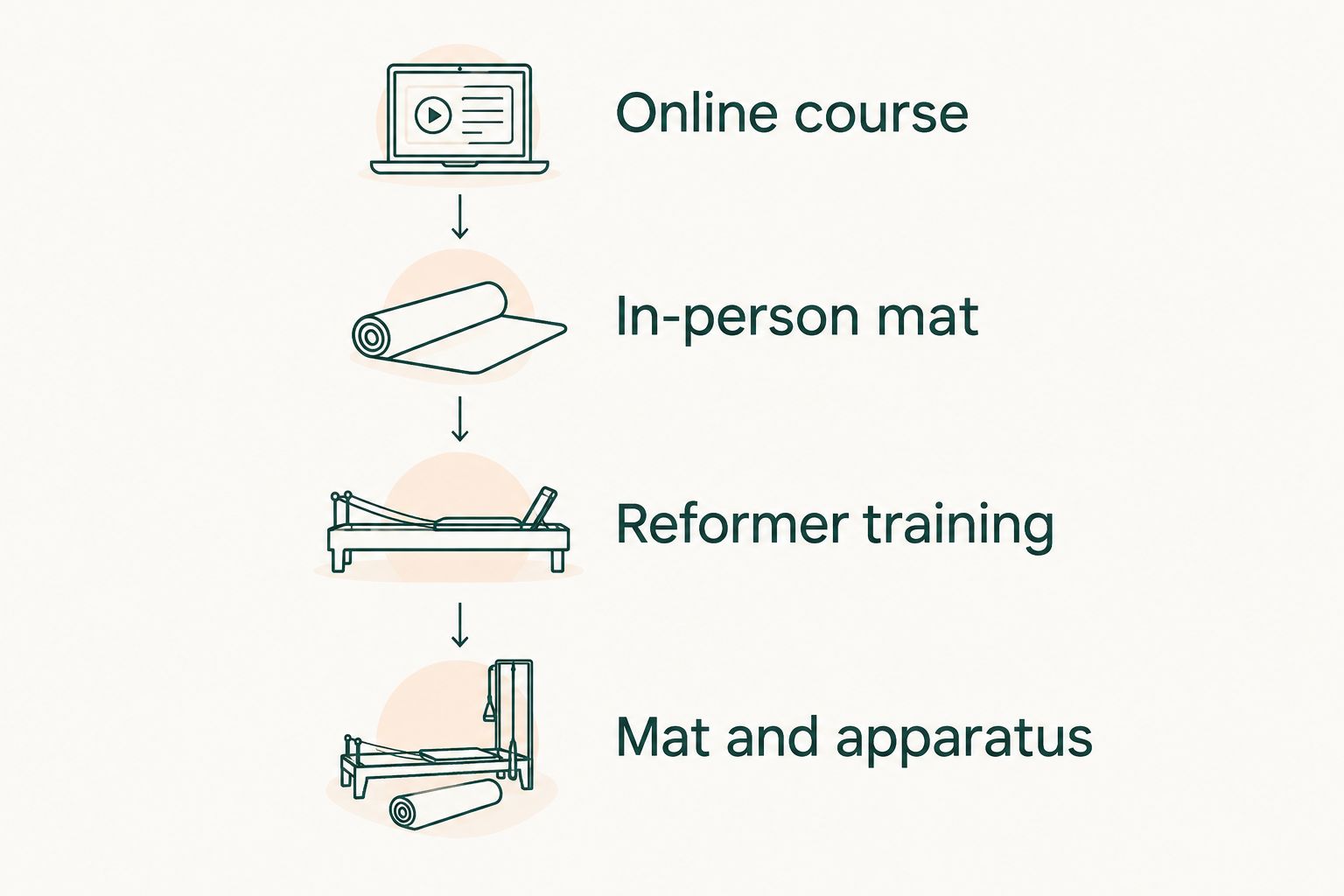
Choose the format that prepares you for your intended teaching role, not the format that sounds most advanced. The table compares routes rather than claiming that every provider offers the same syllabus or assessment.
For a 2026 decision, compare current written requirements. A convenient format is useful only when its teaching scope fits your goal.
| Option | Best for | Main advantage | Key limitation |
|---|---|---|---|
| TeachPilates self-paced online course | Aspiring instructors fitting study around massage appointments | Online study covering anatomy, mat and reformer instruction, cueing, and business skills | Introductory Reformer study is not equivalent to dedicated hands-on apparatus qualification |
| In-person mat training | Learners prioritizing scheduled, face-to-face instruction | Direct interaction during scheduled teaching sessions | Attendance commitments restrict scheduling; verify the practical feedback included |
| Dedicated Reformer training | Aspiring instructors targeting equipment-based teaching | Training focused on the apparatus teaching goal | Requires checking equipment access, supervised practice, and assessment arrangements |
| Mat and apparatus training | Learners intentionally pursuing a broader teaching scope | A route organized around multiple teaching environments | Requires careful review of the equipment covered and the full study commitment |
A classroom route fits better if you want scheduled in-person interaction. Dedicated apparatus training fits better if your immediate objective is teaching Reformer sessions and the online foundation does not meet that employer’s requirements.
Do not compare these options by tuition alone. Compare what you must demonstrate, where you can practice, and whether the resulting preparation matches the work you want.
Common mistakes massage therapists make
Treating anatomy knowledge as teaching readiness
Anatomy knowledge helps you understand movement, but a participant needs instructions they can act on. Practice explaining an exercise without technical shorthand, then check whether the person can follow your words without copying your demonstration.
Assuming massage touch transfers directly to Pilates cueing
A client’s agreement to receive massage does not establish their preferences for touch during a Pilates lesson. Explain your teaching approach, request appropriate consent, and build verbal cueing skills so hands-on assistance is not your only method.
Choosing apparatus work without planning equipment access
Studying Reformer concepts is different from practicing equipment setup and teaching on the apparatus. If equipment-based instruction is your goal, resolve access and supervision before choosing a course, not after completing its online material.
Treating certification as continuing-education approval
Do not assume a Pilates course earns massage-license continuing-education credit. Confirm acceptance with the relevant licensing body and obtain any required provider or course details before counting the training toward renewal.
Blending movement instruction with treatment promises
Describe what clients will do in the Pilates session rather than promising pain relief, rehabilitation, or a clinical result. A clear service boundary helps clients understand what they are booking and keeps your claims tied to your actual qualifications.
Decide whether to enroll now
You have enough information to act when you can name your intended teaching scope, explain why the format fits your schedule, and identify how you will practice. You should also understand the assessment and access terms before committing.
Choose TeachPilates for self-paced online study if its curriculum fits your first teaching goal. Choose a different route when scheduled in-person instruction or dedicated apparatus preparation is the requirement you need to satisfy.
Review your instructor training route
Explore self-paced online study covering anatomy, mat instruction, introductory Reformer concepts, and cueing.
FAQ
What is the best Pilates certification for massage therapists?
The best Pilates certification for massage therapists matches your intended teaching scope and learning needs. TeachPilates fits aspiring instructors seeking self-paced online foundations; dedicated hands-on apparatus training fits an equipment-focused goal better when that preparation is required.
How much does the TeachPilates course cost in 2026?
TeachPilates lists $497 tuition for its self-paced online Pilates instructor certification course. Confirm what tuition includes and check assessment, access, and any additional requirements before enrolling.
Does being a massage therapist qualify me to teach Pilates?
Massage training alone does not establish Pilates teaching readiness. You still need to develop exercise instruction, cueing, lesson planning, and the practical skills required for your intended role.
Can I study Pilates instruction around massage appointments?
Self-paced online study lets you arrange coursework around massage appointments. You still need to schedule personal practice and teaching preparation, and confirm any assessment deadlines or access limits.
Does online Pilates certification qualify me to teach Reformer classes?
Online certification alone does not establish readiness for every Reformer teaching role. Check the course’s apparatus practice and assessment requirements, then confirm the preparation your intended employer and insurer require.
Will Pilates training count toward my massage continuing education?
Count Pilates training toward massage continuing education only after your licensing body confirms acceptance. A course certificate does not by itself establish continuing-education approval.
Is an independent Pilates credential included with a course certificate?
Do not assume an independent Pilates credential is included with a course certificate. Ask the provider to identify the exact certificate awarded and whether any separate application, examination, or credential is involved.
One last thing
Before enrolling in 2026, write the first sentence you would say to a new Pilates participant. Explain what the session is, what you will teach, and how it differs from a massage appointment.
If that sentence depends on a treatment promise, rewrite it before choosing your training. Clear teaching starts with a clear service boundary, not with a certificate title.