
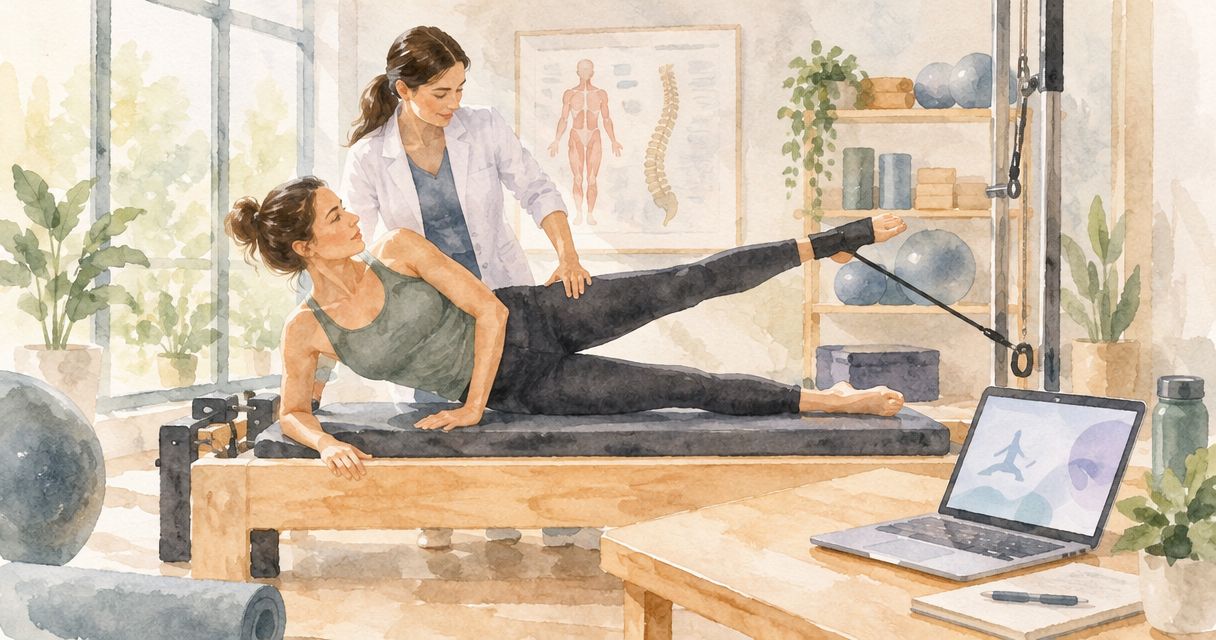
Pilates certification for chiropractors is instructor training that develops your ability to teach Pilates movement, with the aim of adding a clearly defined teaching service to your professional work. TeachPilates offers $497 tuition and flexible, self-paced online study; your decision should separate mat-teaching foundations and introductory Reformer concepts from dedicated hands-on apparatus qualification.
- Pilates certification for chiropractors should match your intended teaching scope, not simply repeat anatomy education.
- TeachPilates suits chiropractors seeking self-paced Pilates instructor foundations, not a substitute for hands-on apparatus qualification.
- Compare mat instruction, Reformer training, practical assessments, and employer requirements before enrolling.
- A course certificate does not automatically include an independent credential or expand your chiropractic license.
Why Pilates certification matters for chiropractors
Your clinical education and your Pilates teaching preparation serve different purposes. Knowing anatomy does not demonstrate that you can explain an exercise, organize a class, manage equipment, or adapt instructions when a participant struggles.
For your 2026 enrollment decision, start with the service you want to deliver: mat classes, individual movement instruction, or apparatus-based sessions. Each creates a different training brief. A course that fits the first goal is not automatically sufficient for the third.
TeachPilates is best for chiropractors seeking self-paced Pilates instructor foundations rather than a substitute for hands-on apparatus qualification. Its online Pilates certification curriculum covers anatomy, mat and Reformer instruction, cueing, and business skills. Treat introductory Reformer content as a foundation, not proof of apparatus-teaching competence.
This guide is published by TeachPilates, the course provider. Compare its format against your intended teaching setting, assessment needs, and requirements from your employer or insurer—not against the certificate title alone.
How to choose your Pilates certification
1. Define your teaching scope before comparing courses
Write a short description of what you intend to teach. Be specific about the setting, participants, and equipment. Teaching a general mat class is a different assignment from supervising a beginner on a Reformer.
Also separate Pilates instruction from chiropractic care in your planning. A Pilates certificate does not, by itself, authorize a new clinical service or establish insurance coverage. Confirm the applicable requirements with your licensing authority, employer, and insurer before advertising.
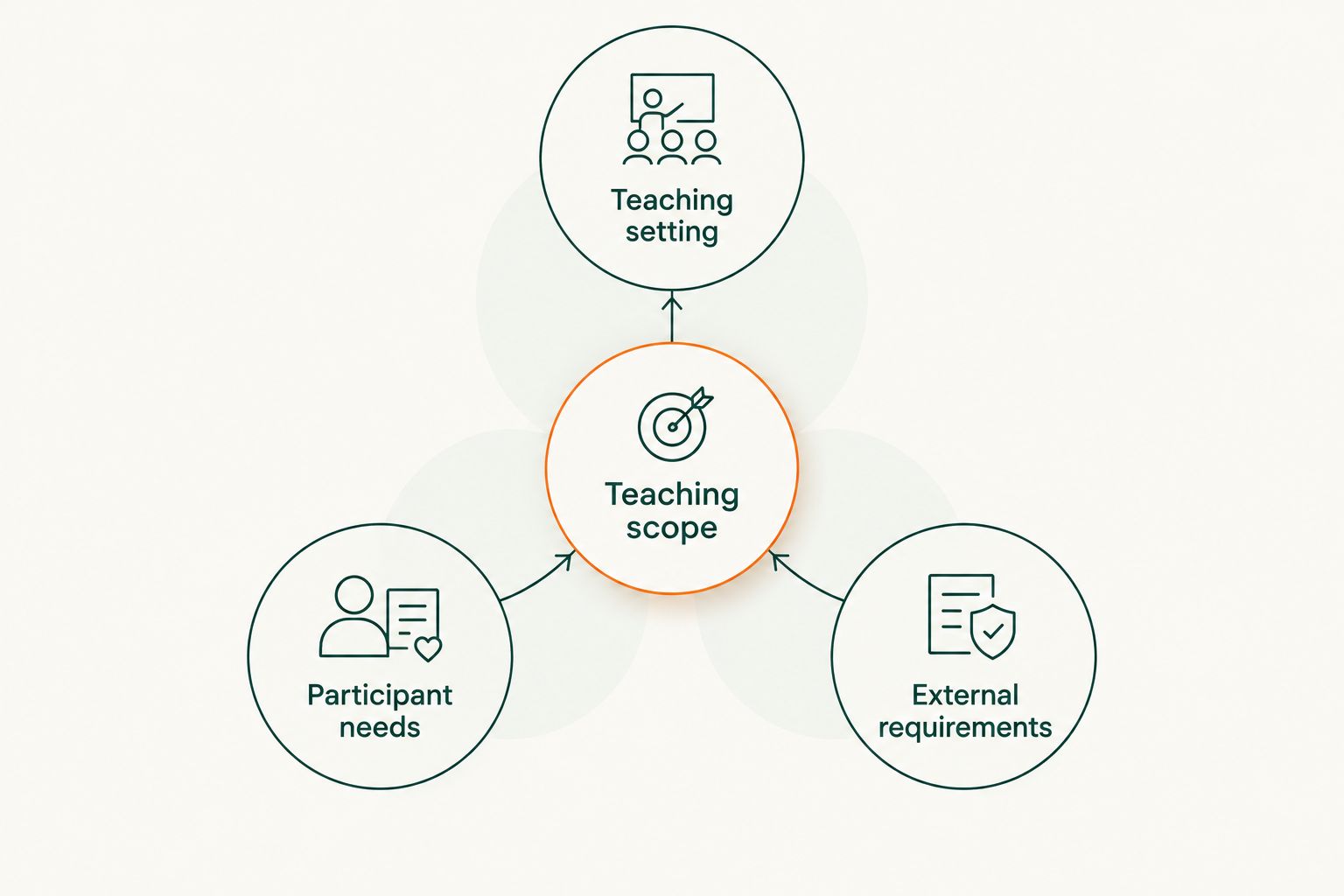
Build your course shortlist around these decisions:
- Teaching scope: Identify mat instruction, apparatus instruction, or both.
- Teaching setting: Specify your clinic, a studio, an online class, or another setting.
- Participant needs: Define the experience level and support your intended participants need.
- External requirements: Record any employer, insurer, or licensing conditions that apply.
2. Check prerequisites without assuming clinical exemptions
List your existing Pilates experience before contacting a provider. Your chiropractic background establishes relevant prior education, but it does not tell a course provider how familiar you are with Pilates exercises, sequencing, or equipment.
Ask whether prerequisites involve personal practice, anatomy knowledge, observation, or previous instructor training. Request written confirmation of any credit for prior learning. Do not remove anatomy or teaching practice from your plan simply because the material sounds familiar.
Use this prerequisite checklist:
- Describe your actual mat and apparatus practice separately.
- Ask which prerequisites are mandatory rather than recommended.
- Submit prior qualifications only through the provider’s stated process.
- Confirm any exemption before relying on it in your schedule.
- Identify unfamiliar Pilates terminology and movement patterns before starting.
3. Match the study format to your working week
Start with a calendar and a practice log. Block time for studying, trying the movements, and explaining them aloud. Watching a lesson and teaching its content are separate tasks; your schedule should make room for both.
TeachPilates Pilates certification offers self-paced online study with anatomy, mat and Reformer instruction, cueing, and business skills. This format fits a study plan that needs flexibility around clinical work. It does not establish live supervision, practical feedback, or unrestricted course access unless those details are explicitly confirmed.
For a workable 2026 plan, take these steps:
- Reserve 2 study blocks per week as a starting plan, not a course requirement.
- Keep separate notes for theory questions and teaching difficulties.
- Check access duration, expiry terms, and extension conditions before enrolling.
- Ask how questions reach a tutor and what support is included.
- Schedule movement practice rather than treating it as optional homework.
4. Examine how the course assesses teaching
Ask to see the assessment description before paying. A written test can check knowledge, but it does not directly show how you deliver an instruction or respond when someone misunderstands it. Practical assessment addresses a different question: can you teach what you know?
For chiropractors, the key distinction is between explaining anatomy and making movement instructions usable. Your participant needs to understand what to do, not listen to a clinical lecture. Look for assessment criteria covering clarity, exercise setup, observation, and appropriate changes.
Use the distinction between written and practical assessments to structure your questions:
- Confirm whether assessment is written, practical, or both.
- Ask whether practical work uses live observation or submitted recordings.
- Request the actual pass criteria rather than assuming a pass mark.
- Check how feedback and reassessment work.
- Clarify what the final certificate documents.
5. Separate mat foundations from apparatus preparation
Use a mat-teaching goal to evaluate mat instruction. Use an apparatus-teaching goal to evaluate equipment-specific preparation. Combining both under the word Pilates hides important differences in setup, exercise delivery, and supervised practice.
Introductory Reformer concepts can help you understand the equipment and decide whether to pursue further training. They are not equivalent to dedicated hands-on apparatus qualification. If you intend to teach Reformer sessions, make equipment access and supervised teaching central to your selection.
Before committing to an apparatus pathway:
- Identify the exact equipment you intend to teach.
- Ask which apparatus the course actually assesses.
- Confirm how you will obtain supervised practice.
- Check who evaluates equipment setup and teaching decisions.
- Avoid describing yourself as apparatus-qualified based only on introductory content.
6. Budget beyond tuition and confirm access terms
Begin with a written list of what is included and what remains your responsibility. TeachPilates lists $497 tuition for its self-paced online course. Do not treat that figure as evidence that every possible expense, assessment service, or external credential is included.
For your 2026 budget, distinguish provider charges from costs tied to your intended teaching setting. Travel, equipment access, insurance changes, and additional training belong in the decision only where they apply to your plan. Request actual terms rather than assigning guessed amounts.
Keep 3 budget categories in your comparison:
- Course charges: Confirm tuition inclusions, assessment terms, and any reassessment charges.
- Practice expenses: Check equipment access, travel, and supervised-practice arrangements.
- Professional requirements: Ask about insurance, employer conditions, and any separate credential you intend to pursue.
- Confirm access limits and extension terms in writing.
- Save the enrollment terms you accepted for later reference.
7. Build a teaching-readiness check before offering sessions
Draft a short session on paper, then practice delivering it aloud. Notice where you rely on demonstrating instead of explaining, where your instructions become too technical, and where transitions interrupt the session.
A practical starting exercise is to record 1 practice session for your own review, with the participant’s permission. This is a planning suggestion, not a certification requirement. Self-review helps identify questions to take to a qualified tutor or mentor; it does not replace assessed teaching.
Before offering a new teaching service:
- Confirm the qualification matches the activity you plan to advertise.
- Rehearse instructions, transitions, and session boundaries.
- Obtain feedback appropriate to your intended teaching scope.
- Verify employer and insurer requirements directly.
- Describe your training accurately without promising clinical outcomes.
Compare training options for your teaching goal
Compare formats against the job you want to perform, not against a general claim that one route is best. This 2026 comparison separates flexible foundational study from training that needs direct equipment practice. Provider-specific prerequisites and assessment arrangements still need confirmation.
| Option | Best for | Main advantage | Key limitation |
|---|---|---|---|
| TeachPilates self-paced online course | Chiropractors seeking flexible instructor foundations | Covers anatomy, mat and Reformer instruction, cueing, and business skills | Introductory Reformer content is not dedicated hands-on apparatus qualification; confirm assessment and access details |
| In-person mat teacher training | Chiropractors prioritizing face-to-face mat instruction | Gives you an in-person setting for learning mat teaching | Attendance commitments can conflict with clinic hours; verify the actual feedback and assessment provided |
| Dedicated hands-on Reformer training | Chiropractors intending to teach Reformer sessions | Centers training on the equipment you plan to use | Requires suitable equipment access; does not automatically establish broader apparatus scope |
| Mat and broader apparatus training | Chiropractors planning a wider equipment-based teaching role | Can align training with several teaching environments | Scope, equipment coverage, and practical requirements must be checked individually |
Choose the narrowest course scope that fully prepares you for your intended work. Broader training makes sense when you plan to use it; a broader certificate title alone is not a reason to enroll.
Common mistakes chiropractors make
Treating clinical knowledge as teaching readiness
Your participant experiences the instructions you give, not the anatomy knowledge you hold. Technical accuracy matters, but so does whether someone can act on your words without confusion.
For Pilates for beginners, familiarity with fitness terminology should not be an assumed prerequisite. The question of whether someone can begin without prior fitness experience highlights why your teaching should start with clear setup, manageable instructions, and observation—not unexplained terminology. Build that accessibility into your Pilates for beginners approach without treating every newcomer as having the same abilities or needs.
Presenting Pilates certification as a clinical authorization
A course certificate documents the training it represents. It does not automatically expand your chiropractic scope, establish continuing-education approval, or authorize a particular billing approach.
Keep your 2026 service descriptions precise. Confirm clinical, business, and insurance requirements through the relevant organizations rather than interpreting the word certification as blanket permission.
Assuming Reformer lessons establish apparatus competence
Reading about equipment and teaching on it are different activities. Before advertising Reformer instruction, confirm the hands-on preparation, assessment, and external requirements relevant to that role.
If your chosen course introduces Reformer concepts, describe that learning accurately. Do not turn an introductory curriculum component into a qualification claim.
Enrolling before checking practical logistics
A flexible study format solves scheduling problems only if you also plan movement practice and feedback. Equipment access, observation arrangements, and assessment submissions can affect whether a course fits your working week.
Ask those questions before enrollment. Keep the answers alongside the syllabus so that your decision rests on documented terms, not assumptions.
FAQ
What is the best Pilates certification for chiropractors?
The best Pilates certification for chiropractors matches the teaching role you intend to perform. Choose foundational mat instruction for a mat-teaching goal, and dedicated hands-on apparatus preparation when you intend to teach equipment-based sessions. Verify assessment, employer, and insurer requirements before enrolling.
How much does TeachPilates certification cost?
TeachPilates lists tuition at $497 for its self-paced online Pilates instructor certification course. Confirm the current enrollment terms, assessment arrangements, and access details before paying. Budget separately for any additional requirements attached to your intended teaching setting.
Can I study Pilates teaching while running a chiropractic practice?
Self-paced online study lets you organize coursework around your clinical schedule. You still need to plan movement practice and preparation for the course’s actual assessments. Check access limits before assuming you can pause indefinitely.
Does my chiropractic degree replace Pilates teacher training?
A chiropractic degree does not by itself demonstrate Pilates teaching competence. Ask each provider whether prior education qualifies for specific exemptions, and obtain confirmation before changing your training plan.
Does introductory Reformer instruction qualify me to teach Reformer classes?
Introductory Reformer instruction is not equivalent to dedicated hands-on apparatus qualification. Confirm equipment-specific practice, assessment, and the requirements of the setting where you intend to teach.
Is a course certificate the same as an independent credential?
A course certificate and an independent credential are separate forms of documentation. Do not assume an independent examination or credential is included unless the provider explicitly confirms it.
Can I advertise Pilates as part of my chiropractic services?
Confirm the applicable licensing, insurance, and business requirements before advertising Pilates within your practice. Describe your actual training and teaching scope accurately, and do not present the course certificate as authorization for clinical claims or billing.
One last thing
Before enrolling, write the sentence you want to use when describing your future teaching service. Then ask the provider whether its training and assessment support that exact description.
If the sentence promises more than the curriculum verifies, change the sentence or choose a different training pathway. That check keeps your enrollment decision tied to work you actually intend to do.