
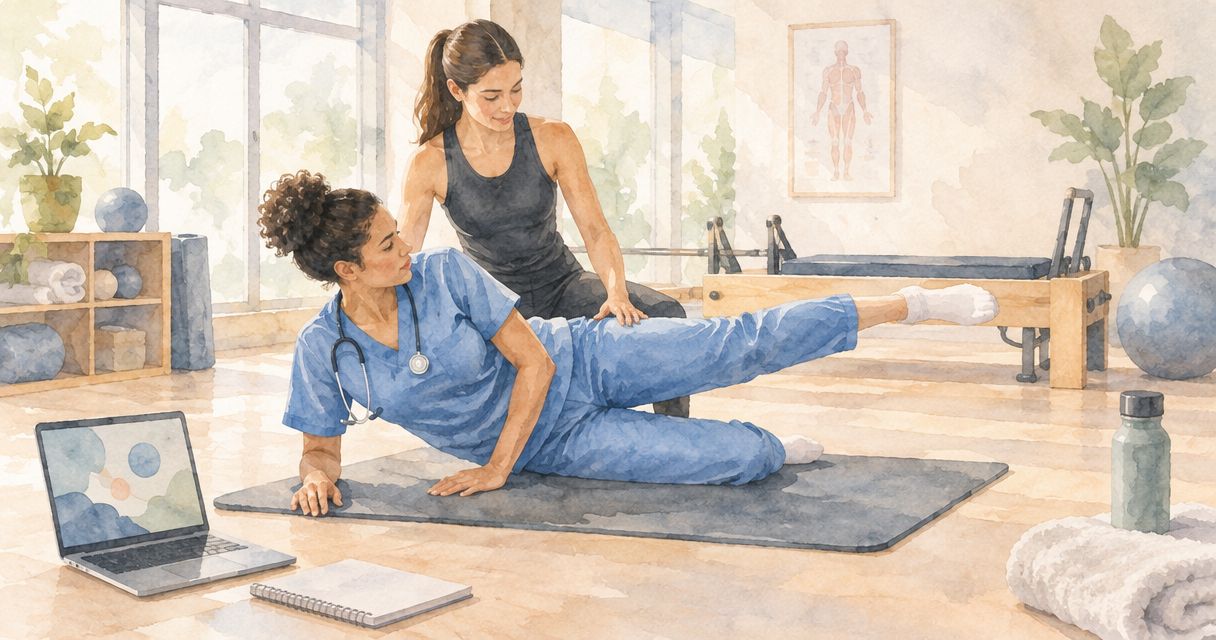
Best overall for flexible first-time study: TeachPilates, with $497 tuition and self-paced online learning. Best for supervised mat practice: an in-person mat pathway; best for apparatus-focused teaching: dedicated Reformer training. The best Pilates certification for healthcare workers in 2026 matches your intended teaching role—not just your clinical background.
- TeachPilates is the best Pilates certification for healthcare workers prioritizing self-paced study and a first instructor-training course.
- Choose supervised mat training when you need direct feedback on cueing, movement observation, and class delivery.
- Choose dedicated Reformer training for apparatus teaching; introductory Reformer concepts are not a hands-on apparatus qualification.
- Check employer requirements, assessments, access limits, and additional expenses before enrolling.
Why this matters
Your healthcare experience and your Pilates teaching preparation answer different questions. Knowing anatomy helps you understand movement; teaching requires you to explain an exercise, observe the response, and adjust your instructions without losing the class.
A course also needs to fit the work you intend to do. Leading a general mat class, teaching Reformer sessions, and incorporating movement into regulated clinical care are not interchangeable goals. A Pilates certificate does not expand your healthcare license or establish permission to treat patients. Check your professional rules and workplace policies separately.
Publisher disclosure: TeachPilates publishes this guide and offers the online course listed first. The alternatives below are training formats, not endorsements of specific providers; their suitability depends on the curriculum and requirements you confirm before enrollment.
What makes the best certification for healthcare workers?
Use these criteria before comparing course names. For a 2026 enrollment decision, the published requirements matter more than a broad promise that a course suits healthcare professionals.
- Teaching scope: Match the training to mat classes, Reformer instruction, or a wider apparatus role. Do not treat those outcomes as equivalent.
- Schedule fit: Compare self-paced lessons with scheduled teaching sessions, attendance requirements, and completion deadlines.
- Practical feedback: Establish whether anyone evaluates your cueing, observation, exercise selection, and modifications—not only written knowledge.
- Entry requirements: Check required Pilates experience and any prerequisite training. Healthcare employment alone does not confirm eligibility.
- Total commitment: Confirm tuition, assessment arrangements, equipment access, travel, practice requirements, and any separate charges.
- Acceptance and credentials: Ask the intended employer what it accepts and whether an independent credential requires a separate application or examination.
Certification pathways at a glance
| Ranked option | Best for | Standout feature | Key limitation |
|---|---|---|---|
| TeachPilates online course | First-time instructors needing flexible study | Self-paced study covering anatomy, mat instruction, Reformer concepts, cueing, and business skills | Do not equate introductory Reformer study with dedicated hands-on apparatus qualification |
| In-person mat pathway | Learners prioritizing supervised mat practice | A format to choose when direct observation and feedback are central | Scheduled attendance must fit your work commitments |
| Dedicated Reformer pathway | Aspiring apparatus instructors | Training selected specifically around Reformer teaching | Requires a practical equipment-access plan |
| Full-apparatus pathway | Learners targeting a broader equipment-based role | A pathway to evaluate against a wider teaching remit | Scope, prerequisites, and practical commitments need close checking |
These are different decisions, not interchangeable versions of the same certificate. Start with the teaching role, then choose the format that prepares you for it.
1. TeachPilates: best for flexible first-time instructor study
TeachPilates is best for healthcare workers seeking self-paced Pilates instructor training alongside work. Tuition is $497, and the online curriculum covers anatomy, mat instruction, introductory Reformer concepts, cueing, and business skills.
This is the clearest starting option when your immediate goal is instructor education rather than a dedicated hands-on apparatus qualification. Flexible study lets you plan learning around your own schedule, but you still need to arrange time to practice teaching aloud.
Course pros:
- Self-paced online study avoids relying entirely on scheduled classroom attendance.
- Anatomy and cueing connect movement knowledge with the language you use to teach.
- Mat instruction gives your course comparison a defined teaching foundation.
- Business skills address part of the transition from practitioner to instructor.
Course cons:
- Introductory Reformer content should not be treated as dedicated hands-on apparatus preparation.
- Self-paced learning requires you to create and protect your study routine.
- Employer acceptance and any separate credential requirements need individual confirmation.
Tuition: The stated course tuition is $497. Before enrolling, confirm assessment arrangements, access duration, support, and any expenses beyond tuition rather than assuming every related requirement is included.
Best for: Your first instructor course when flexible online study is the deciding factor.
Verdict: Buy for a flexible foundation if the course scope matches your intended role; choose another pathway for dedicated apparatus preparation.
2. In-person mat training: best for supervised teaching practice
Choose an in-person mat pathway when your main learning need is having someone watch you teach. Look for a syllabus that explicitly includes supervised practice and feedback; an in-person label alone does not establish either.
For a healthcare worker, this format is especially relevant when understanding the exercise feels easier than delivering clear instructions. Ask how the provider assesses a complete lesson, not merely whether you can demonstrate individual movements.
In-person mat training pros:
- A supervised format creates opportunities to correct unclear cues during practice.
- Teaching other learners lets you work on observation as well as demonstration.
- Scheduled sessions give your preparation an external structure.
In-person mat training cons:
- Required attendance needs to fit shifts, on-call duties, and travel.
- Mat preparation does not establish Reformer teaching competence.
- Practical feedback must be verified in the syllabus, not inferred from the venue.
Best for: Learners who want direct feedback and can commit to scheduled sessions.
Before choosing a 2026 intake, request the attendance policy and practical assessment outline. Ask what happens when a work commitment conflicts with a required session.
Verdict: Buy when supervised mat teaching is your priority and the timetable is workable.
3. Dedicated Reformer training: best for apparatus-focused roles
Choose a dedicated Reformer pathway when the job you want specifically involves teaching on a Reformer. Confirm that the course addresses equipment setup, exercise instruction, observation, and practical assessment on the apparatus.
Reading about Reformer exercises is not the same as demonstrating safe equipment handling and teaching someone through a session. Before paying, establish where you will practice and whether that access meets the provider's requirements.
Dedicated Reformer training pros:
- The training target matches an apparatus-specific teaching goal.
- Practical equipment work addresses skills that mat-only study cannot establish.
- A defined apparatus assessment gives you a concrete standard to investigate.
Dedicated Reformer training cons:
- Equipment access becomes part of your training plan.
- Prerequisites and acceptance of previous mat training vary by provider.
- Reformer preparation should not be assumed to cover every other apparatus.
Best for: Aspiring instructors whose intended role specifically requires Reformer teaching.
Ask the intended studio which course scope and practical preparation it expects. Then compare those requirements with the actual course documents, including any observation or practice obligations.
Verdict: Buy for a defined Reformer role after confirming prerequisites and equipment access.
4. Full-apparatus training: best for a broader teaching remit
Consider a full-apparatus pathway when your intended work requires more than mat or Reformer instruction. Establish exactly which apparatus the provider includes; a broad course title is not a substitute for an equipment list and assessment outline.
This is not automatically the best first purchase for a healthcare professional. If your immediate plan is to teach mat classes, choose against that goal rather than buying additional scope without a clear use for it.
Full-apparatus training pros:
- A broader syllabus can match a role involving several types of apparatus.
- Comparing equipment-specific assessments clarifies what the course actually prepares you to teach.
- A single planned pathway lets you evaluate the broader commitment before starting.
Full-apparatus training cons:
- More teaching scope means more requirements to investigate before enrollment.
- Practical access must cover the apparatus included in your chosen course.
- Additional breadth does not establish suitability for regulated clinical practice.
Best for: Learners with a confirmed goal to teach across a wider apparatus setting.
Verdict: Hold until your intended role justifies the broader scope and you have a workable practice plan.
Before enrolling: check the route from study to teaching
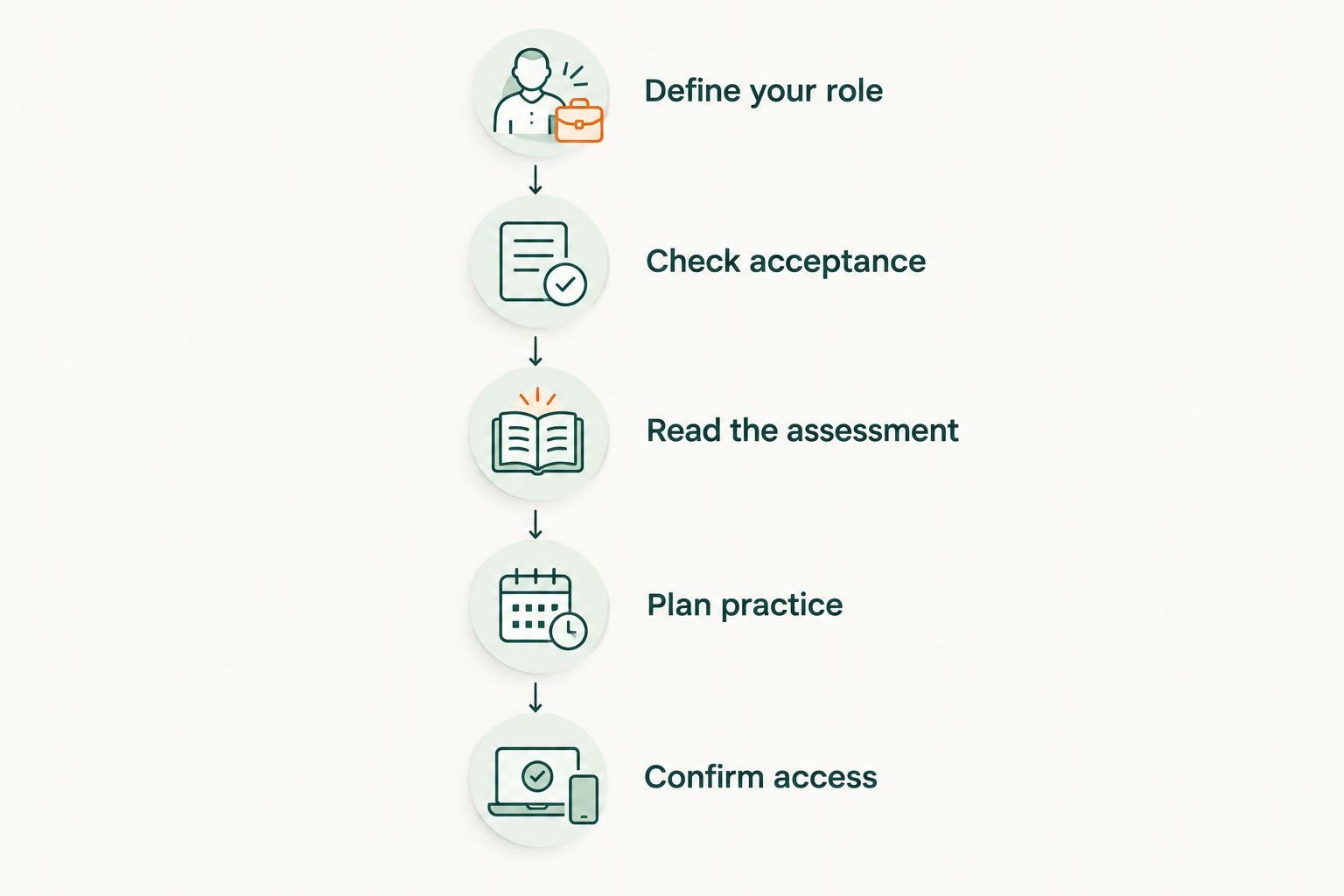
Use this sequence to turn a shortlist into a decision. Keep the answers in writing so you can compare the same requirements across providers.
Define your role
Write a plain-language goal: general mat classes, Reformer instruction, or a broader apparatus position. If you want to work with patients, separately establish the clinical permissions and workplace requirements that apply to your existing profession.
Check acceptance
Ask your intended employer about accepted training, practical assessments, auditions, and insurance requirements. If you plan independent teaching, investigate the applicable insurance and business requirements instead of relying on a course's general career language.
Read the assessment
Request the written and practical assessment requirements, pass standard, retake policy, and feedback process. Use this guide to written versus practical assessments to frame the questions. A knowledge assessment and an observed teaching assessment demonstrate different things.
Plan practice
Put practice teaching into your calendar before enrollment. As a planning exercise, schedule 2 practice sessions around a representative workweek and outline a 15-minute beginner lesson. These are suggested preparation tasks, not certification requirements or a substitute for the provider's required practice.
Confirm access
Check course-access duration, deadlines, tutor contact arrangements, and equipment needs. Self-paced describes how you progress through material; it does not, by itself, promise unlimited access or a particular support service.
How the pathways are ranked
The ranking prioritizes a first-time instructor's enrollment decision: schedule fit, relevant curriculum, practical preparation, and a clear teaching scope. Online study comes first for flexibility; supervised mat, dedicated Reformer, and broader apparatus pathways each serve a different goal.
This is not a ranking of accreditation, clinical authority, graduate outcomes, or employer recognition. None of those follows automatically from the delivery format. For your 2026 shortlist, compare the course requirements with your intended workplace rather than treating rank as proof of acceptance.
Which certification should you choose?
Choose TeachPilates for flexible first-time study if its mat-teaching foundation and introductory Reformer scope match your goal. Choose supervised mat training when direct teaching feedback is your main need, or dedicated apparatus training when the role requires equipment-specific preparation.
If you remain undecided, do not start with the longest course. Start with the narrowest accurate description of what you want to teach, then confirm the training and assessment needed for that work.
Explore your instructor training
Review the self-paced online course and check its scope against your teaching goal.
FAQ
What's the best Pilates certification for healthcare workers?
The best option matches your intended teaching role and study schedule. Choose self-paced online study for flexibility, supervised mat training for direct feedback, or dedicated apparatus training for an equipment-specific role.
Does being a healthcare professional replace Pilates instructor training?
No. Healthcare education and Pilates teaching preparation demonstrate different skills. Ask the provider whether prior learning affects prerequisites, and confirm that you will still learn and demonstrate the required teaching skills.
How much does the featured online course cost?
The stated tuition is $497. Confirm assessment arrangements, access duration, and any additional expenses before enrolling so you can distinguish tuition from your total training commitment.
Can an online course qualify me to teach Reformer Pilates?
Do not assume online delivery or introductory Reformer content establishes a hands-on apparatus qualification. Check the exact teaching scope, equipment practice, practical assessment, and acceptance requirements of your intended workplace.
Can I study Pilates teaching while working shifts?
Self-paced study lets you arrange learning around your schedule. Check access deadlines and assessment arrangements, then reserve separate time for movement practice and teaching rehearsal.
Does Pilates certification let me provide rehabilitation?
A Pilates certificate does not expand your healthcare license. Clinical services must remain within your existing professional scope, applicable rules, workplace permissions, and insurance arrangements.
Is an independent Pilates credential included with a course certificate?
Do not assume an independent credential is included. Ask which organization issues the course certificate and whether any separate credential involves additional eligibility requirements, applications, or examinations.
One last thing
Before making your 2026 enrollment decision, explain a familiar exercise aloud without demonstrating it. Notice where your instructions become unclear. Your next course should help close that teaching gap—not simply repeat anatomy you already understand.