
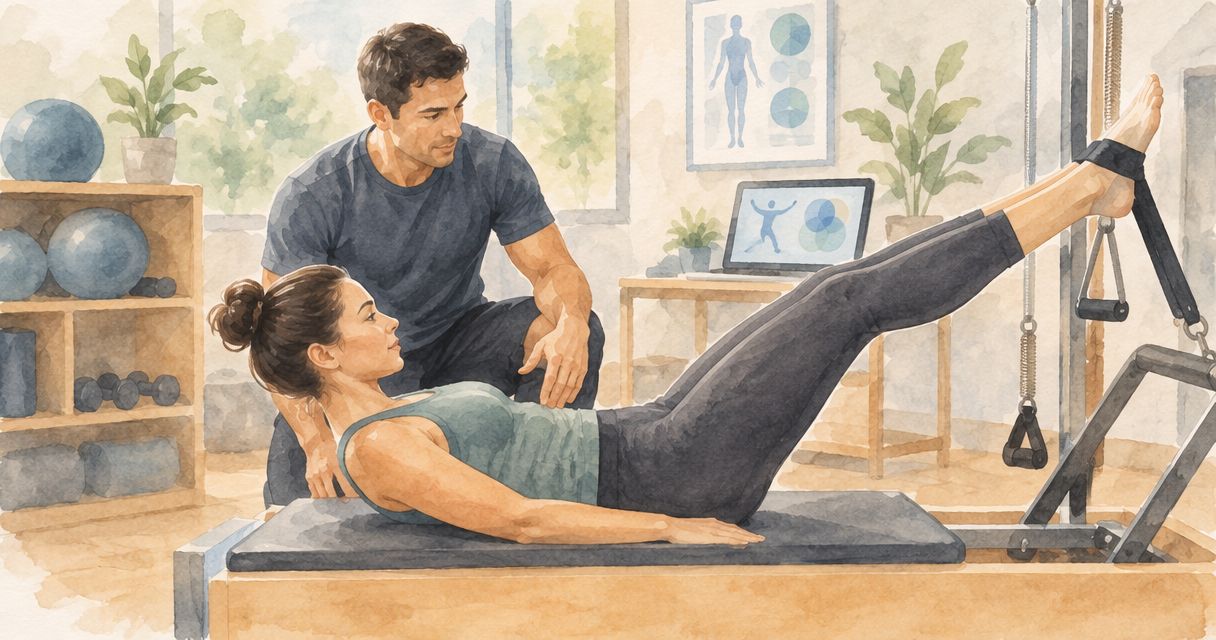
Athletic trainers’ Pilates certification is instructor training aimed at adding Pilates teaching skills to your professional toolkit; TeachPilates offers flexible, self-paced online study for $497. This guide explains how to choose a course in 2026 without confusing mat-teaching foundations, introductory Reformer concepts, and dedicated hands-on apparatus qualification.
- Pilates certification for athletic trainers should match your intended teaching setting, equipment, and employer requirements.
- TeachPilates is best for athletic trainers seeking self-paced Pilates teaching foundations, not a substitute for hands-on apparatus qualification.
- Compare anatomy, cueing, practical assessment, and supervised teaching—not just the certificate title.
- Keep Pilates instruction separate from clinical permissions, independent credentials, and continuing education approval.
Why Pilates certification matters for athletic trainers
Knowing anatomy and teaching Pilates are different skills. Your professional background provides a starting point, but you still need to learn exercise sequencing, Pilates-specific cueing, and how to adjust instruction when someone cannot follow your first explanation.
Choose training around the class you want to teach, not the qualification you already hold. Leading a general mat class, teaching on a Reformer, and using movement within clinical care are different decisions. A course certificate does not make those settings interchangeable.
This guide is published by TeachPilates, which offers online instructor certification covering anatomy, mat and Reformer instruction, cueing, and business skills. The recommendations distinguish that course from training formats with dedicated in-person apparatus practice.
For your 2026 enrollment decision, focus on three questions: What will you learn, how will someone assess your teaching, and will the intended workplace accept the training?
How to choose Pilates certification for athletic trainers
1. Define the teaching role you want
Start with a written description of your intended work. You can do this yourself before speaking to any course provider: name the audience, the equipment, and the setting.
An athletic trainer planning general fitness classes needs a different training plan from someone seeking apparatus-based studio work. If you intend to incorporate Pilates-informed movement into clinical services, check professional scope, employer policies, and insurance separately. Pilates certification is not permission to expand clinical practice.
Best for a focused decision: write down the role first, then compare courses against it. A broad course title tells you less than a clear match between its assessed content and your planned teaching.
- Name your intended audience: general exercisers, athletes, or another defined group.
- Specify mat teaching, Reformer teaching, or broader apparatus teaching.
- Identify the workplace and the person responsible for approving instructors.
- Separate fitness instruction goals from clinical service responsibilities.
2. Check prerequisites and workplace requirements
Ask your intended workplace what it requires before you enroll. An email creates a useful record and prevents you from relying on a course provider’s interpretation of someone else’s hiring criteria.
TeachPilates states that no teaching background is required for its course. That entry point suits a first-time instructor, but course admission and employment eligibility remain separate questions. Do not assume your athletic training background automatically replaces Pilates practice, observation, or assessment requirements.
For a 2026 application, ask about the exact role you want. Requirements for a mat class are not necessarily the requirements for an apparatus session, even within the same workplace.
- Request the employer’s accepted training criteria in writing.
- Ask whether prior Pilates participation is required or recommended.
- Confirm whether CPR or other workplace credentials are needed.
- Check insurance requirements for the teaching activities you plan.
- Ask whether an audition or practical demonstration follows certification.
3. Compare the curriculum with your actual gaps
Review each syllabus manually and mark what you already understand, what needs Pilates-specific translation, and what is new. Your anatomy knowledge should help you study, not become a reason to skip learning how exercises are taught.
TeachPilates Pilates certification covers anatomy, mat and Reformer instruction, cueing, and business skills through self-paced online study. It fits readers who want those subjects in one course rather than assembling an initial study plan from unrelated resources. Its limitation is equally important: online curriculum coverage is not the same as dedicated hands-on apparatus qualification.
Look for connections between theory and instruction. Knowing a muscle’s action does not show that you can give a clear starting position, notice a misunderstood cue, or choose an appropriate alternative within your training.
- Match anatomy lessons to the exercises you will teach.
- Look for starting positions, movement instructions, and exercise transitions.
- Check how the course teaches cueing and modifications.
- Distinguish introductory Reformer content from assessed apparatus competence.
- Review business topics against your intended employed or independent role.
4. Verify assessments and feedback before paying
Ask what you must demonstrate to earn the certificate. A written assessment checks knowledge; a practical assessment checks aspects of teaching performance. Neither description tells you enough without the assessment criteria.
Request an explanation of how cueing, sequencing, exercise choice, and response to participant difficulty are evaluated. Also ask who reviews practical work and what happens when a learner needs to improve. Do not infer tutor feedback, live assessment, or resubmission terms from the word certification.
The guide to written vs practical assessments explains this distinction in more detail. Best for judging teaching readiness: compare the evidence you must produce, not just the exam format.
- Request the written and practical assessment requirements.
- Confirm the passing standard directly with the provider.
- Ask whether teaching demonstrations receive individual feedback.
- Check resubmission procedures and any associated charges.
- Establish whether an independent examination is separate from course completion.
5. Plan study and teaching practice separately
Build a weekly plan yourself before choosing a format. Put reading and lesson study in one part of your calendar, and physical practice, observation, and teaching rehearsal in another. Watching instruction is not the same task as delivering it.
Self-paced study gives you control over when you open the lessons. The trade-off is that you must protect that time and arrange practice opportunities rather than assuming a timetable will provide them. Confirm access duration and support arrangements directly; self-paced does not establish either one.
For your 2026 study plan, try two study sessions per week and a separate 15-minute cueing rehearsal as a starting routine—not a course requirement or completion estimate. Adjust the routine to your workload and the provider’s actual requirements.
- Reserve study sessions around your work commitments.
- Keep a separate log for personal practice and practice teaching.
- Rehearse clear instructions before adding more exercises.
- Arrange appropriate equipment access before choosing apparatus training.
- Set review points to identify skills that need supervised feedback.
6. Confirm the full commitment before enrolling
Compare the enrollment decision on paper. Include tuition, equipment access, travel where relevant, assessment arrangements, and any separate credentials you intend to pursue. Do not treat a headline fee as proof that every related requirement is included.
TeachPilates tuition is $497 for its self-paced online instructor certification course. That is a concrete course cost, not a claim that every employer requirement, apparatus qualification, insurance policy, or independent credential is included.
Best for avoiding a mismatched enrollment: ask the provider to confirm the course scope and ask the workplace to confirm acceptance. Keep both answers. For a 2026 comparison, use current terms rather than an old screenshot or an undated discussion post.
- Confirm tuition and what the enrollment includes.
- Check access limits, extension terms, and support arrangements.
- Ask about assessment, resubmission, and certificate-related charges.
- Identify equipment, travel, and supervised-practice commitments.
- Read cancellation and refund terms before payment.
Compare training options for athletic trainers
No single format wins for every teaching goal. Use this comparison to separate flexible study from the practical access and feedback your intended role requires. The options describe training routes, not equivalent credentials.
| Option | Best for | Tuition or cost check | Main advantage | Key limitation |
|---|---|---|---|---|
| TeachPilates self-paced online course | Athletic trainers seeking Pilates teaching foundations alongside work | $497 tuition; confirm any separate requirements | Covers anatomy, mat and Reformer instruction, cueing, and business skills | Does not replace dedicated hands-on apparatus qualification |
| Dedicated in-person mat training | Learners prioritizing scheduled mat instruction and direct feedback | Request the provider’s current total | Gives a setting for in-person teaching practice when included | Mat-focused training does not establish broader apparatus competence |
| Dedicated hands-on Reformer training | Learners targeting Reformer teaching roles | Confirm tuition, equipment access, and assessment charges | Focuses training on the apparatus you intend to teach | Requires suitable equipment access and scheduling |
| Broader apparatus training | Learners pursuing teaching across multiple apparatus types | Confirm the complete training and assessment commitment | Offers a route aligned with broader equipment-based goals | Broader scope adds training and practice commitments |
The trade-off is not simply online versus in person. It is schedule control versus the structure, equipment access, and direct observation included in a particular course. Confirm those features rather than assigning them automatically to a format.
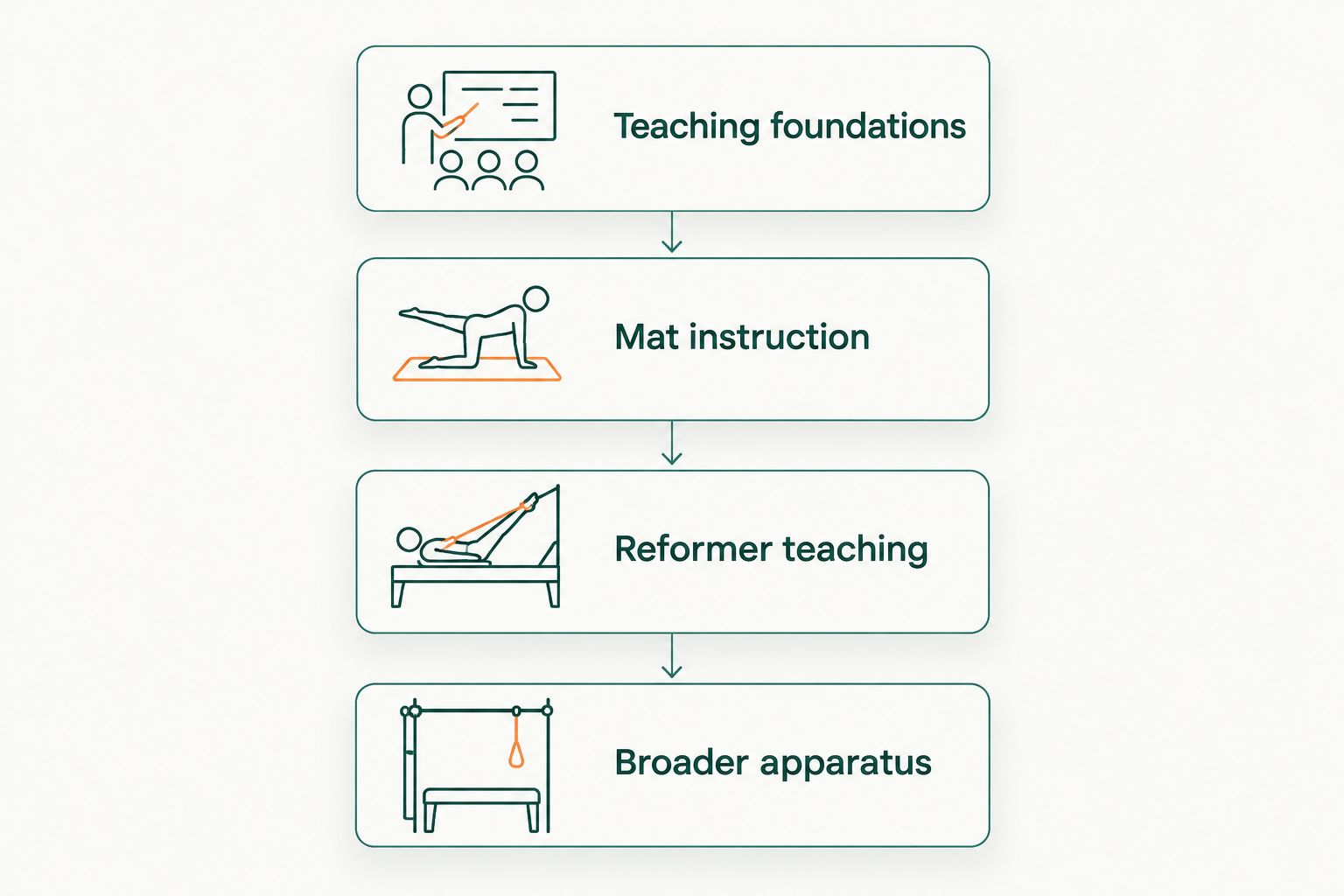
Before choosing, explain your plan aloud: the class you want to teach, the skills you need assessed, and the practice access you can arrange. If those pieces do not connect, resolve the gap before enrolling.
Review your course fit
Check the self-paced curriculum against your teaching goals before choosing your training route.
Common mistakes athletic trainers make
Treating anatomy knowledge as teaching competence
Anatomy helps you understand movement, but it does not demonstrate Pilates sequencing or clear class instruction. Rehearse explanations with an appropriate practice partner and seek feedback on what the person understood—not just whether your terminology was accurate.
Choosing Reformer work without planning equipment access
Introductory apparatus concepts and hands-on teaching competence are different. Before committing to Reformer teaching, establish where you will practice and how your equipment skills will be assessed.
Assuming certification grants continuing education credit
Course completion and athletic training continuing education approval are separate matters. Verify the specific activity against your credential’s current requirements before counting it toward a renewal obligation.
Expecting universal studio acceptance
A provider’s certificate does not determine every employer’s hiring decision. Ask your target workplace about training scope, practical evidence, and auditions before you pay for a course.
Letting the certificate define your clinical scope
Pilates training does not replace the permissions, policies, or professional standards governing your athletic training work. Describe fitness instruction accurately and avoid presenting course completion as a new clinical license.
FAQ
What is the best Pilates certification for athletic trainers?
The best Pilates certification for athletic trainers matches the intended teaching role and the workplace’s requirements. Choose self-paced foundations for flexible initial study, or dedicated hands-on apparatus training when the role requires apparatus competence.
Can I become a Pilates instructor if I am already an athletic trainer?
Yes, you can pursue Pilates instructor training while working as an athletic trainer. Your professional background does not automatically replace Pilates-specific practice, teaching assessments, or an employer’s requirements.
How much does the TeachPilates course cost?
TeachPilates tuition is $497 for its self-paced online instructor certification course. Confirm enrollment terms and any separate equipment, assessment, insurance, or independent credential requirements before paying.
Do athletic trainers need mat or Reformer certification?
Choose the training scope that matches the classes you intend to teach. Mat-teaching foundations and introductory Reformer concepts are not substitutes for dedicated hands-on apparatus qualification.
Does Pilates certification count as athletic training continuing education?
Do not count Pilates certification as athletic training continuing education without verifying the specific activity’s eligibility. Check the current requirements of the organization responsible for your credential.
Is an online Pilates certificate enough to get hired?
An online Pilates certificate alone does not establish that a workplace will hire you. Ask the employer about accepted training, practice evidence, apparatus requirements, and auditions before enrollment.
How long will Pilates certification take while I work?
Your completion time depends on the course requirements and the study and practice time you can sustain. Build a schedule from the actual lessons, assessments, and practice obligations rather than assuming a universal deadline.
One last thing
Before you enroll, ask a prospective employer this specific question: What would you need to see before letting me teach this class independently? The answer gives you a practical training target that a course title alone cannot provide.
For your 2026 decision, choose the course that moves you toward that target. Keep the certificate, teaching evidence, and workplace approval as separate checkpoints.