
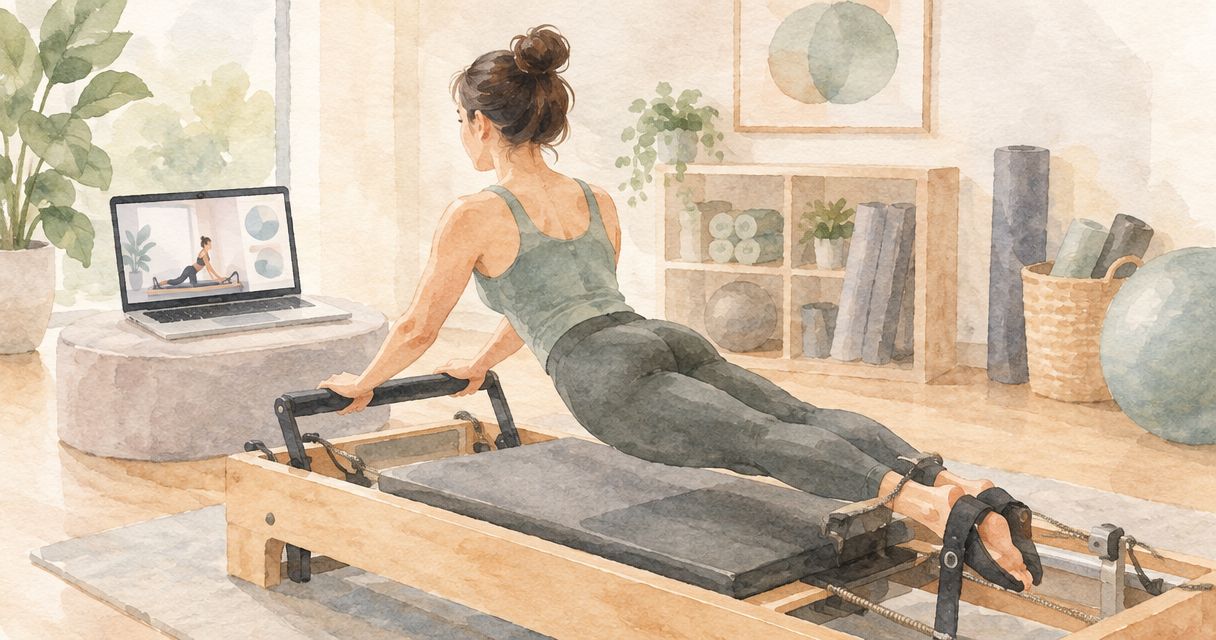
TeachPilates offers $497 tuition and flexible self-paced online study, but choosing a reformer Pilates instructor course means checking whether the training prepares and assesses you to teach on the apparatus. Reformer content in a broader course is not the same as dedicated hands-on Reformer qualification; check the teaching scope, equipment access, practical assessment, and acceptance requirements before enrolling in 2026.
- Choose a reformer pilates instructor course by assessed teaching scope, not the presence of Reformer lessons.
- TeachPilates suits aspiring instructors seeking self-paced foundations, not a substitute for dedicated hands-on Reformer qualification.
- Check apparatus access, observed practice, assessment, and studio requirements before paying.
- Separate a provider’s course certificate from any independent credential you intend to pursue.
Online reformer Pilates instructor course: what should you check in 2026?
Check what you will learn, what you must demonstrate, and which teaching activities the resulting certificate covers. Those answers matter more than whether the course delivery is entirely online.
This guide is published by TeachPilates, which offers online Pilates instructor certification covering anatomy, mat instruction, introductory Reformer concepts, cueing, and business skills.
Use this comparison to distinguish training routes. These are course formats to evaluate, not promises about any unnamed provider.
| Training route | Best for | Main advantage | Main limitation to check |
|---|---|---|---|
| Self-paced foundations with introductory Reformer content | First-time instructors building foundational knowledge | Study can fit around your existing schedule | Reformer lessons alone do not establish hands-on apparatus teaching competence |
| Dedicated online Reformer training with practical assessment | Learners who can arrange apparatus access and meet the provider’s practical requirements | Remote study can accompany equipment-based practice | Confirm how an assessor observes and evaluates your teaching |
| Blended Reformer training | Learners wanting online theory plus scheduled hands-on instruction | Separates flexible study from practical sessions | Check attendance requirements, travel, and equipment arrangements |
| In-person apparatus training | Learners prioritizing direct equipment-based instruction | Places practical learning in a shared physical setting | Scheduled attendance must fit your work and other commitments |
Why this matters
Your goal is to teach people, not simply finish videos. A useful enrollment decision connects the course syllabus to the classes you want to lead and the practical skills you need to demonstrate.
Choose the training scope first and the delivery format second. Online delivery tells you where you study; it does not tell you what an assessor has verified about your teaching.
Check the teaching scope before comparing course features
Start with a plain question: does the course teach foundational Pilates knowledge, prepare you specifically for Reformer instruction, or cover a broader apparatus pathway? Ask for a written answer tied to the syllabus and assessment.
A curriculum can introduce Reformer exercises without providing a dedicated apparatus qualification. Likewise, the word certification does not explain whether anyone observes your equipment setup, cueing, exercise selection, or response to a learner’s movement.
Request evidence for each part of the scope:
- Anatomy: Which concepts must you understand and apply when choosing or explaining exercises?
- Equipment use: Which setup and adjustment skills must you demonstrate?
- Instruction: Does assessment include explaining and cueing movement to another person?
- Adaptation: How does the course assess exercise selection and modifications?
- Boundaries: Which teaching activities does the certificate cover, and which require further training?
Read broad curriculum claims beside the assessment outline. A topic appearing in a lesson is different from a skill you must demonstrate to pass.
For your 2026 shortlist, keep the provider’s exact wording about scope. Compare that wording with the requirements of the studio or teaching setting you intend to approach.
Match the training format to your practical learning needs
Self-paced foundations: best for flexible introductory study
Self-paced study lets you organize theory around your schedule. It also places responsibility on you to make time for review, practice, and questions rather than treating completed lessons as proof of teaching readiness.
TeachPilates is best for aspiring instructors seeking self-paced Pilates teaching foundations. Its curriculum includes anatomy, mat instruction, introductory Reformer concepts, cueing, and business skills; it should not be treated as a substitute for dedicated hands-on apparatus qualification.
Dedicated remote Reformer training: best with equipment access
Evaluate remote Reformer training through its practical requirements. Ask what equipment you need, how you obtain feedback, and how the provider checks your teaching rather than only your recall.
The trade-off is logistical: studying remotely does not remove the need to arrange any required apparatus practice. Resolve that arrangement before you commit to the course.
Blended or in-person training: best for scheduled practical learning
Consider a course with scheduled hands-on sessions when direct instruction is a priority for you. Ask who teaches those sessions, what you practice, and whether practical assessment occurs during them or separately.
Attendance alone is not the assessment standard. Confirm what you must demonstrate and what happens if you need further practice before passing.
Use this enrollment sequence before paying
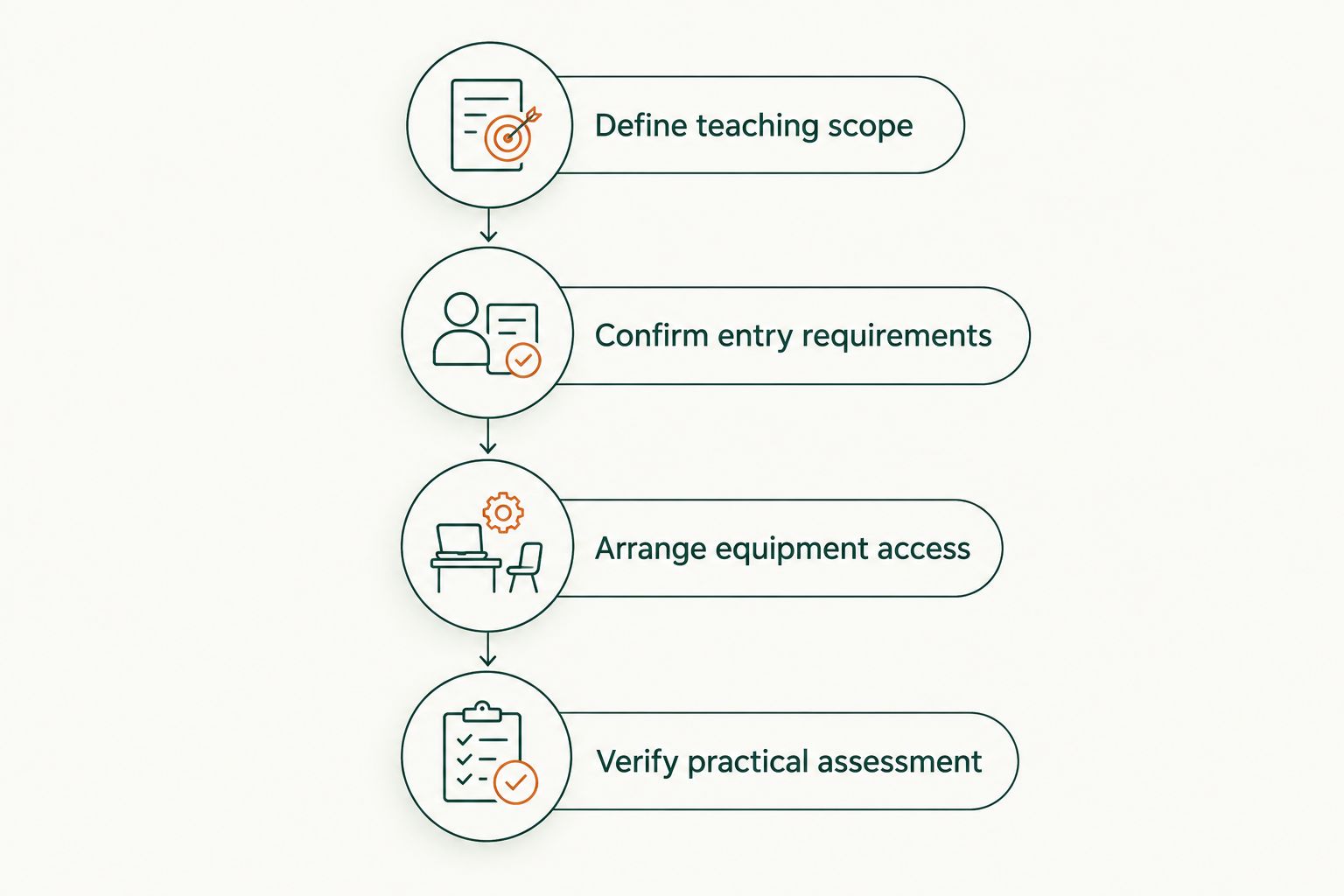
Follow these steps in order. They turn a broad search for a reformer Pilates instructor course into a decision tied to your actual teaching goal.
- Define teaching scope. Write down whether you want to teach mat classes, Reformer sessions, or both. Keep your immediate goal separate from apparatus training you plan to add later.
- Confirm entry requirements. Ask about prior Pilates experience, existing qualifications, and any required preparation. Do not assume that requirements are identical across providers.
- Arrange equipment access. Confirm where you will practice and whether that location permits any required observation, recording, or practice teaching.
- Verify practical assessment. Get the assessment format, pass criteria, feedback process, and reassessment terms in writing before enrolling.
Do not buy a Reformer solely because a course mentions equipment practice. First establish which equipment the course requires and whether an accessible studio arrangement meets those requirements.
Check your Reformer equipment access plan alongside the syllabus. Your practice arrangements need to support the work the course actually requires, not just give you occasional access to a machine.
Check what the practical assessment proves
A written assessment checks answers to questions. A practical assessment asks you to demonstrate skills; ask the provider exactly which skills and under what conditions.
For Reformer-focused training, request an assessment description that addresses equipment setup, exercise instruction, cueing, and adjustments to your teaching. Ask whether you teach another person, submit recordings, attend a live assessment, or complete a different practical task.
A certificate title is not a substitute for assessment criteria. Read the criteria before you judge how closely a course matches the work you want to do.
Useful questions include:
- Who reviews your practical work, and what feedback do you receive?
- What must you demonstrate to pass?
- Can you ask questions before submitting assessed work?
- What happens if a submission does not meet the standard?
- Are reassessments subject to separate terms or charges?
For a 2026 enrollment, request the current assessment handbook or equivalent written terms. Save the version you receive so you can refer to the requirements during your studies.
Why Reformer training requirements vary
Different teaching goals call for different checks. Compare the following factors without assuming that a longer syllabus or a particular delivery format answers every question.
- Teaching scope: Mat foundations, introductory Reformer content, and dedicated apparatus preparation are different commitments.
- Entry requirements: Prior study or experience changes where you enter a training pathway; confirm what each provider accepts.
- Equipment arrangements: Required practice depends on access to appropriate apparatus and permission to use the space.
- Assessment format: Written questions, recorded demonstrations, and observed teaching assess different activities.
- Support and access terms: Tutor contact, feedback arrangements, course access limits, and extensions affect how you organize study.
- External requirements: A studio, insurer, or independent credentialing body can set requirements separate from course completion.
Use these factors to ask precise questions, not to rank courses by assumptions. If a provider’s description leaves a practical requirement unclear, resolve it before payment.
Check the full study commitment, not tuition alone
TeachPilates tuition is $497 for flexible self-paced study. Treat that as the stated course tuition, not as a total budget for every step toward your intended Reformer teaching role.
For any training route, ask whether equipment access, travel, practical assessments, reassessments, mentoring, or course extensions involve separate arrangements or charges. These are budget questions to verify, not charges to assume.
Separate required expenses from optional purchases. Buying equipment, adding workshops, and pursuing an independent credential are different decisions; establish which, if any, your chosen pathway requires.
Before a 2026 enrollment, also check the written access and refund terms. Self-paced describes scheduling flexibility, not an automatic promise of unlimited course access or unrestricted refunds.
Can you become a Reformer instructor through online study?
Online study can be part of your Reformer instructor training, but delivery format alone does not establish teaching readiness. Check the apparatus practice, feedback, assessment, and teaching scope attached to the course.
If your goal is studio work, ask the intended studio about its requirements before enrolling. A provider’s completion certificate does not guarantee that every employer will accept the training.
Do you need to own a Reformer before enrolling?
Reformer ownership is not the same as usable training access. Ask whether your chosen course requires a particular equipment arrangement and whether studio-based practice satisfies it.
If you plan to use a shared space, confirm permission for practice teaching and filming. Access for personal exercise does not automatically answer those questions.
Does a course certificate include an independent credential?
A course certificate does not establish that an independent credential is included. Ask separately who issues the certificate and whether any external examination, eligibility review, or application is required.
Keep provider completion requirements separate from independent credential requirements. Do not describe yourself as holding a credential you have not earned.
FAQ
What should I look for in an online reformer Pilates instructor course?
Look for a clear teaching scope, practical equipment requirements, meaningful assessment, and written support terms. Match those details to the teaching role you want rather than choosing by course title alone.
Is TeachPilates a dedicated hands-on Reformer qualification?
TeachPilates provides self-paced Pilates instructor education with introductory Reformer concepts; do not treat it as a substitute for dedicated hands-on apparatus qualification. Evaluate additional practical training against your intended teaching role.
Can I start Pilates instructor training without teaching experience?
You do not need a teaching background to consider this training pathway, but you should check the entry requirements of the specific course. Ask separately about Pilates practice experience and any prerequisite study.
Is an online Reformer course better than in-person training?
Neither format is automatically better for your goal. Compare practical feedback, assessment, equipment access, and attendance demands; choose the route that meets your requirements and fits your schedule.
How long does an online Reformer instructor course take?
Completion time depends on the course requirements and the study and practice time you can commit. Ask for the required activities, assessment deadlines, and access limits before planning your finish date.
Will an online Pilates certificate let me teach at any studio?
An online Pilates certificate does not guarantee acceptance at every studio. Ask your intended employer which training scope, practical experience, assessments, and other requirements it expects.
What should I confirm about course support before enrolling?
Confirm who answers questions, how you submit practical work, and what feedback is included. Ask about support availability and reassessment terms rather than assuming self-paced study includes individual coaching.
One last thing
Before you enroll in 2026, ask for a sample practical assessment task. A syllabus tells you what a course discusses; an assessment task shows what you will be expected to do.
Choose the course whose assessed skills match your next teaching step. If the course builds foundations while your goal requires dedicated apparatus preparation, plan that additional training before you pay—not after you receive the certificate.