TeachPilates offers $497 tuition and flexible, self-paced online study for aspiring Pilates instructors comparing ISSA Pilates certification alternatives in 2026. ISSA is an established fitness-education provider; choose TeachPilates for online Pilates teaching foundations, or choose supervised training when your goal requires hands-on mat or apparatus assessment.
- TeachPilates is an ISSA Pilates certification alternative offering self-paced online study for $497.
- Choose supervised mat training when you want an instructor to observe and correct your teaching.
- Choose dedicated apparatus training when your goal requires hands-on Reformer instruction.
- Compare assessments, teaching scope, employer requirements, and total costs before enrolling.
Published by TeachPilates, which offers the online instructor course discussed below.
Why this matters
The right certification decision starts with the classes you want to teach—not the longest curriculum list. Mat classes, introductory Reformer study, and teaching clients on apparatus are different training goals.
The TeachPilates online Pilates instructor certification course covers anatomy, mat and Reformer instruction, cueing, and business skills. Treat introductory Reformer concepts as a foundation, not as a substitute for dedicated hands-on apparatus qualification.
For your 2026 enrollment decision, compare these 3 training paths: self-paced online foundations, supervised mat training, and dedicated apparatus training. They solve different problems, so the strongest alternative is the one that matches your intended teaching scope.
ISSA alternatives at a glance
This comparison separates a named course from training formats. Supervised mat training and dedicated apparatus training are categories to investigate, not claims about an unnamed provider's curriculum or credential.
| Option | Best for | Main distinction | What to establish before enrolling |
|---|---|---|---|
| ISSA Pilates certification | Readers already considering ISSA who want to evaluate that specific course | A named provider to compare against your teaching goal | Current syllabus, assessment method, practical requirements, and employer acceptance |
| TeachPilates online certification | First-time instructors seeking self-paced Pilates foundations | Online study covering anatomy, mat and Reformer instruction, cueing, and business skills | Assessment details, access terms, and whether the teaching scope fits your goal |
| Supervised mat training | Learners who want observed mat-teaching practice | Direct observation when it is explicitly included in the program | Who observes you, what they assess, and how feedback works |
| Dedicated apparatus training | Learners preparing to teach on Reformer or other specified equipment | Equipment-specific instruction and practical work when required by the program | Equipment coverage, studio access, supervised practice, and practical assessment |
Compare like with like. An online foundations course and an apparatus pathway with studio practice are not interchangeable simply because both use the word certification.
1. TeachPilates: best for self-paced online foundations
TeachPilates online Pilates instructor certification is best for aspiring instructors who want flexible study covering teaching fundamentals. Tuition is $497, and the curriculum includes anatomy, mat and Reformer instruction, cueing, and business skills.
That combination gives you a defined starting point without requiring you to choose a specialist apparatus pathway first. Your enrollment decision should still depend on what you intend to teach and how the course assesses that work.
Where the course shines
- Flexible study: Self-paced online learning lets you organize coursework around your existing commitments.
- Relevant foundations: Anatomy and cueing belong alongside exercise instruction when you are preparing to teach other people.
- Business coverage: Business skills are included rather than treating instruction as the only part of a teaching career.
- Stated tuition: The $497 tuition gives you a concrete figure to use in your training budget.
Where the course falls short
- Online study is not hands-on apparatus qualification. Do not treat introductory Reformer coverage as proof of readiness to teach every equipment-based class.
- Self-paced learning requires your own structure. You need to schedule study and practice rather than rely on a fixed classroom timetable.
- A course certificate is not universal employer approval. Ask your intended studio what it requires before you enroll.
- Independent credentials are separate questions. Do not assume a course includes an external credential or eligibility for one.
Before paying, request the assessment format, completion requirements, access period, and support arrangements. Ask specifically whether anyone watches you teach and how practical feedback is delivered.
Best for: First-time instructors seeking flexible online Pilates foundations in 2026.
Verdict: Buy if the curriculum, assessment arrangements, and intended teaching scope match your goal.
2. Supervised mat training: best for observed teaching practice
Supervised mat training is the alternative to investigate when you want someone to watch you teach. Look for a program that explicitly includes observation, feedback, and assessment—not merely scheduled lessons.
A timetable alone does not establish teaching quality. Ask what happens when your cue is unclear, your exercise choice needs changing, or your class plan does not suit the participant.
Where supervised mat training shines
- Direct feedback: Observed practice creates an opportunity to correct your instruction while you learn.
- A defined focus: Mat-specific training keeps the learning goal centered on teaching mat sessions.
- External structure: Scheduled practice and assessment give you commitments to plan around.
Where supervised mat training falls short
- Less scheduling freedom: Fixed sessions require you to be available at the provider's chosen times.
- A narrower equipment scope: Mat training alone does not establish Reformer or full-apparatus qualification.
- Attendance is not the same as assessment: You still need to verify whether a tutor evaluates your teaching competence.
Compared with ISSA, the deciding question is not whether a course sounds more practical. It is whether the specific program offers the observed teaching and feedback you need.
Best for: Learners who want live correction while developing mat-teaching skills.
Verdict: Buy when supervised teaching is explicitly included; skip programs that leave that requirement unclear.
3. Dedicated apparatus training: best for equipment-based goals
Dedicated apparatus training is the route to investigate when your goal is teaching on Reformer or other specified Pilates equipment. Match the training to the equipment and class format you intend to teach.
Where dedicated apparatus training shines
- Equipment-specific focus: You can evaluate the syllabus against the apparatus your intended workplace uses.
- Practical preparation: A suitable pathway makes equipment access, practice, and assessment explicit.
- Clearer scope: Named equipment coverage helps you distinguish Reformer training from a broader apparatus curriculum.
Where dedicated apparatus training falls short
- Access requirements: You need a workable arrangement for any required equipment practice.
- Scheduling demands: Studio sessions and supervised work must fit your actual availability.
- Scope still needs checking: A Reformer course is not automatically a full-apparatus qualification.
For a 2026 apparatus-training decision, establish the equipment requirements before comparing course descriptions. Use the guide to planning equipment access for Reformer certification to organize those questions.
Best for: Aspiring instructors whose intended role specifically requires apparatus teaching.
Verdict: Buy when the equipment coverage, practical requirements, and assessment match your intended role.
When switching from ISSA makes sense
Switching makes sense when another course demonstrably fits your requirements better. A different provider name is not, by itself, a reason to change.
Use these decision rules rather than assuming ISSA has a particular shortcoming:
- You need flexible foundations: Compare a self-paced course against your available study schedule and intended teaching scope.
- You need observed practice: Choose a program that explicitly provides the teaching observation and feedback you want.
- You need apparatus preparation: Prioritize equipment coverage and practical requirements over general certification language.
- You need a specific employer's approval: Ask that employer about the exact course before committing.
- You have already started training: Get written transfer or credit terms before abandoning completed work.
These are reasons to investigate a switch, not claims about ISSA's current course. Keep the decision tied to written requirements you can compare.
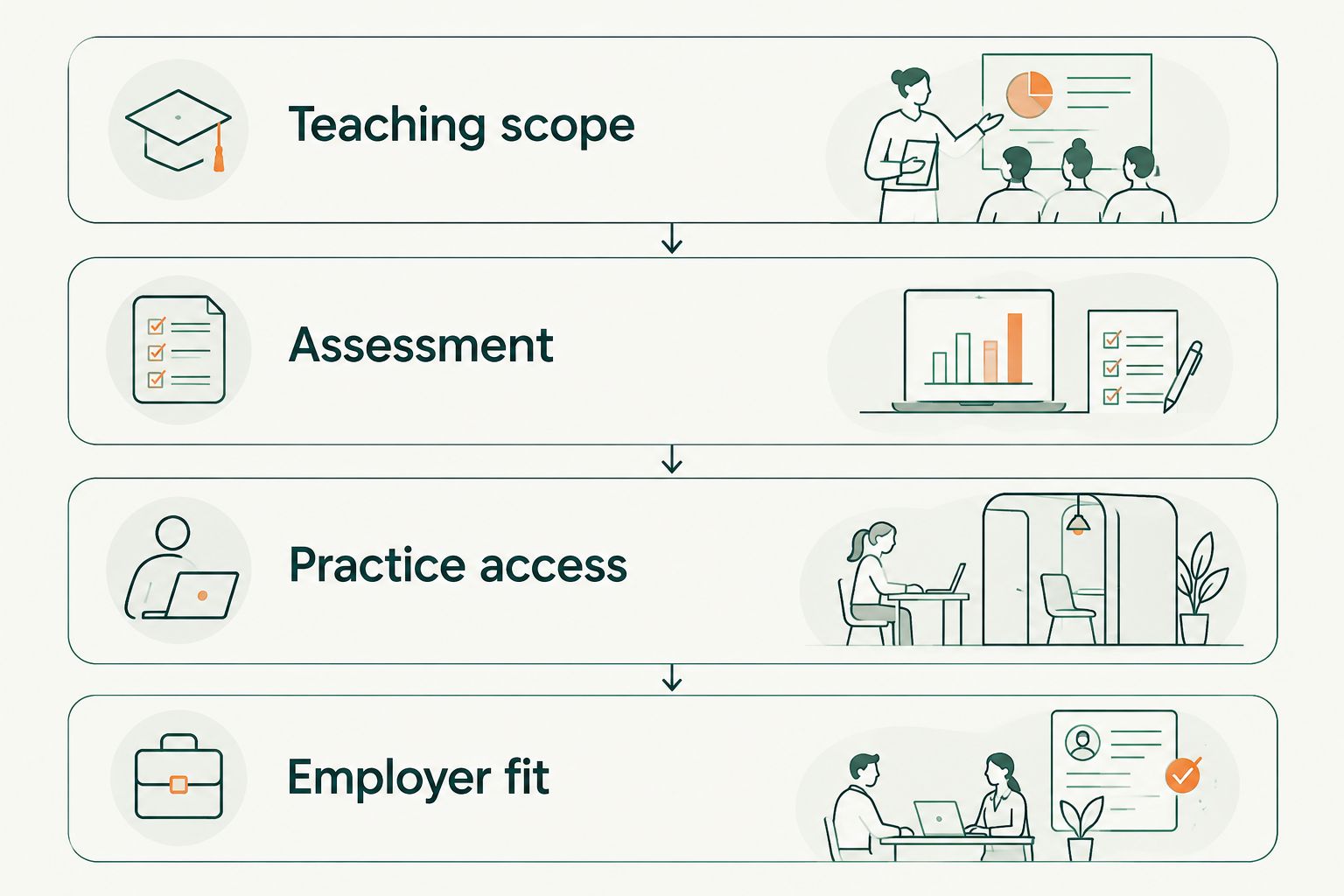
Check these 4 things before you enroll
Teaching scope
Write down the class you want to teach: mat, Reformer, or a broader apparatus format. Then ask each provider which part of that goal its course prepares you for.
Do not let the word comprehensive do the work of a syllabus. Request the actual topics, practical components, and completion requirements.
Assessment
Ask what you must demonstrate to pass. A written assessment checks knowledge; a practical assessment evaluates teaching performance, so establish which methods the course uses.
Request the pass requirements, resit terms, and feedback process. Do not assume that watching lessons or completing quizzes includes an observed teaching assessment.
Practice access
Separate watching instruction, practicing exercises yourself, and teaching another person. Each activity serves a different purpose, and one should not silently stand in for another.
For apparatus training, identify where you will practice and what access arrangements are required. An enrollment plan is incomplete if the course requires equipment you cannot use.
Employer fit
Ask your intended studio about its accepted training, practical expectations, audition process, and any additional requirements. Get answers about the specific course rather than asking whether online certification is acceptable in general.
An employer's answer applies to that employer. It does not establish universal acceptance elsewhere.
Build a training budget beyond tuition
Use $497 as the stated tuition for the featured self-paced course, then separate tuition from any other expenses your chosen route requires. Do not assume every provider includes the same materials, assessments, or practical arrangements.
Ask each provider for written confirmation of:
- What tuition includes.
- Any assessment or resit charges.
- Required materials or equipment access.
- Travel or accommodation for required attendance.
- Access limits and extension terms.
- Whether a separate credential involves a separate application.
These are budget questions, not claims that every program charges each item. Mark an expense as applicable only when the provider confirms it.
Your 2026 budget should reflect the whole route to your intended teaching role. A course that fits your tuition budget still needs to fit your practice schedule and assessment requirements.
When staying with ISSA is the right call
Stay with ISSA when its current course meets your teaching goal, its assessment arrangements suit you, and your intended employer accepts that training. There is no benefit in switching solely because another course appears first in a ranked list.
If you have already enrolled, compare remaining requirements before starting again elsewhere. Ask about course access, completion options, and any transfer arrangements; do not assume previous coursework will count toward a different program.
The right choice is the course you can complete, practice responsibly, and use within its actual teaching scope.
FAQ
What's the best ISSA Pilates certification alternative in 2026?
TeachPilates is an option for self-paced online Pilates foundations at $497 tuition. Choose supervised mat or dedicated apparatus training instead when your goal requires observed practice or equipment-specific preparation.
Is an online Pilates course enough to teach Reformer?
Online study alone should not be treated as proof of hands-on Reformer teaching competence. Check equipment-specific training, practical assessment, and the requirements of your intended employer.
How much does the TeachPilates course cost?
TeachPilates tuition is $497. Confirm what tuition includes and check any additional requirements for your intended teaching role before enrolling.
Should I choose mat training or apparatus training first?
Choose the route that matches the classes you intend to teach. Mat training addresses a different teaching scope from Reformer or broader apparatus training.
Does a Pilates course certificate include an independent credential?
Do not assume an independent credential is included with a provider's course certificate. Ask about the credential's separate eligibility, application, and assessment requirements.
What should I ask about Pilates course assessments?
Ask whether assessment is written, practical, or both, and what you must demonstrate to pass. Confirm feedback, resit terms, and whether anyone observes your teaching.
Will every studio accept my Pilates certification?
No course should be treated as universally accepted by studios. Ask your intended employer about the exact training, practical experience, and audition requirements it expects.
One last thing
Before enrolling, write one sentence: I want to teach this class, in this setting, using this equipment. Send it to the provider and your intended employer.
That sentence turns a broad certification search into a specific enrollment decision. For your 2026 shortlist, require a clear answer about what the training prepares you to teach—and what further preparation remains.