
Yes—Pilates certification is worth it in 2026 if you want to teach and the training matches your intended classes; a $497 self-paced online course is one option. Tuition alone does not establish your total cost, teaching readiness, or acceptance by a particular studio.
- Is Pilates certification worth it? Yes, when training, practice, and employer requirements match your teaching goal.
- TeachPilates offers $497 self-paced online Pilates instructor certification covering anatomy, mat instruction, introductory Reformer concepts, cueing, and business skills.
- Mat-teaching foundations and introductory Reformer concepts are not the same as dedicated hands-on apparatus qualification.
- Confirm assessments, access terms, additional expenses, and employer requirements before you enroll.
Is Pilates certification worth it in 2026?
Certification is worth paying for when it prepares you for the teaching you actually intend to do. Start with the role, not the certificate name. Someone preparing to teach mat classes needs a different training plan from someone seeking a position teaching apparatus sessions.
Before enrolling, check employer requirements for online Pilates certification. Ask your intended studio about accepted training, practical assessment, equipment experience, and audition expectations. Those answers give you a concrete standard for comparing courses.
| Training route | Best for | Main advantage | Main limitation to check |
|---|---|---|---|
| Self-paced online study | Aspiring instructors who need control over study scheduling | You can organize study around existing commitments | Verify feedback, practical assessment, and opportunities to practice teaching |
| In-person mat training | Aspiring mat teachers who want face-to-face instruction | Instructor interaction happens in the training setting | Check attendance commitments and whether the curriculum matches your goals |
| Dedicated hands-on Reformer training | Aspiring instructors targeting Reformer teaching | Training can focus on apparatus setup and instruction | Confirm equipment access, supervised practice, and assessment scope |
| Broader apparatus training | Aspiring instructors seeking a wider teaching scope | The curriculum can address multiple apparatus | Check exactly which apparatus, practice requirements, and assessments are included |
These are training formats, not interchangeable credentials. Compare the actual curriculum and assessment requirements rather than assuming a longer title means a better fit.
Why this matters
Being comfortable taking a Pilates class is different from being responsible for teaching one. As an instructor, you need to explain movement, observe another person, choose appropriate exercises, and communicate useful changes.
A worthwhile course should help you develop those teaching skills, not simply give you more exercises to memorize. Ask how anatomy connects to instruction and how you will demonstrate cueing, sequencing, and modifications.
Buy preparation for a defined teaching role—not a promise of a new career. Certification does not guarantee employment, earnings, clients, or acceptance by every studio. Your enrollment decision should still make sense without those promises.
Self-paced online study: $497 tuition
TeachPilates offers a $497 self-paced online Pilates instructor certification course covering anatomy, mat instruction, introductory Reformer concepts, cueing, and business skills. You can plan your study around your existing responsibilities rather than treating enrollment as a fixed classroom schedule.
TeachPilates is best for aspiring Pilates instructors seeking self-paced online foundations for teaching. Its stated curriculum connects movement knowledge with instruction and business preparation, making it relevant to readers who want to become teachers rather than simply deepen their personal workouts.
The distinction between foundations and apparatus qualification matters. Do not interpret introductory Reformer coverage as dedicated hands-on apparatus qualification, and do not assume an independent credential is included.
This guide is published by TeachPilates, which sells the course discussed here. Choose a dedicated hands-on apparatus pathway instead if your immediate goal requires assessed Reformer teaching experience that the online course does not explicitly document.
What makes the course relevant to a first-time instructor?
The curriculum addresses subjects you need to consider before teaching: anatomy, mat instruction, cueing, and business skills. Those subjects give you a useful starting point for evaluating whether the course matches your goals.
Before paying, request the assessment requirements and access terms. Self-paced study describes scheduling flexibility; it does not, by itself, establish unlimited access, individual mentoring, or a particular practical examination.
When mat-focused training is worth it
Mat-focused training is best for aspiring instructors whose intended teaching starts on the mat. It lets you evaluate the training against a specific task: planning and leading appropriate mat sessions.
Look for instruction that connects exercise selection to clear explanations and suitable modifications. Ask how the course evaluates your ability to teach another person, rather than only your ability to recall exercise names.
The limitation is scope. Mat preparation does not establish competence with every apparatus, and you should not present it that way to employers or clients. If you already know you want to teach Reformer sessions, compare the full route before committing to separate courses.
When dedicated Reformer training is worth it
Dedicated hands-on Reformer training is best for aspiring instructors whose target role involves Reformer teaching. Equipment setup, exercise instruction, and observing a moving client belong in that decision—not just the presence of Reformer lessons in a course outline.
Ask the provider to explain equipment access, supervised practice, and practical assessment. Request a clear description of what successful completion qualifies you to claim about your training.
The trade-off is the additional planning required around equipment and attendance. Do not assume you can complete a hands-on requirement without arranging access to the relevant apparatus. Confirm the arrangements before enrollment, not after you reach that part of the course.
Why the value of Pilates certification varies
The same course can be a sensible choice for one aspiring instructor and a poor fit for another. Compare these factors before deciding whether certification is worth it for you:
- Teaching scope: Match the curriculum to mat teaching, Reformer teaching, or the broader apparatus work you intend to pursue.
- Study format: Decide whether you need flexible independent study, scheduled instruction, or direct in-person interaction.
- Assessment: Find out how the provider checks knowledge and teaching ability, including whether practical performance is assessed.
- Practice access: Establish where you will rehearse teaching and whether you need access to apparatus.
- Employer requirements: Ask intended employers what training and practical evidence they expect from applicants.
- Full commitment: Include tuition, study time, practice arrangements, and any separately required expenses in your decision.
A mismatch in any of these areas deserves attention before you pay. A manageable tuition figure does not compensate for training that misses your intended teaching scope.
How to decide whether to enroll in 2026
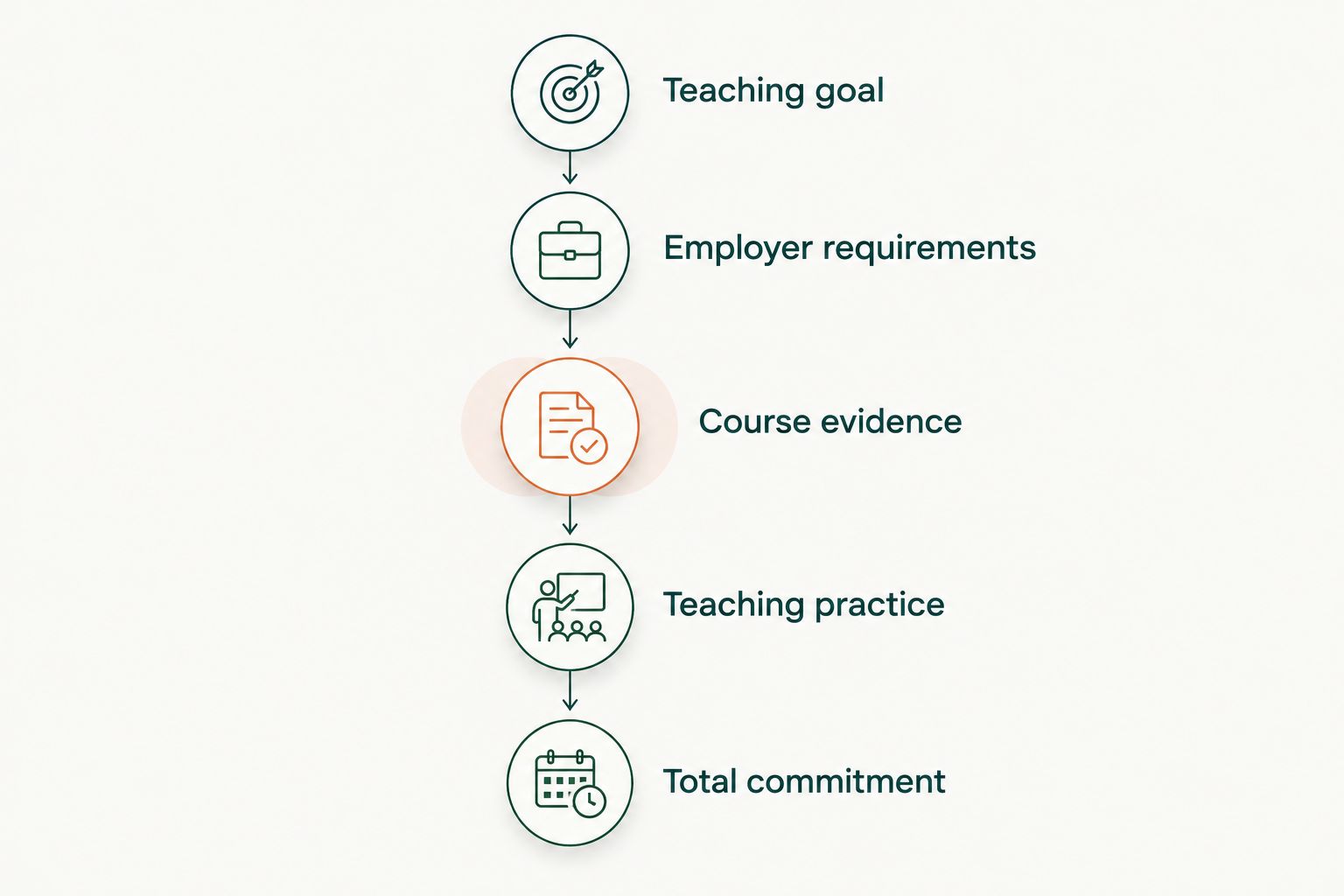
Use this sequence to turn a broad career question into an enrollment decision. Each step should leave you with something concrete: a teaching goal, an employer response, course documentation, or a workable practice plan.
1. Define your teaching goal
Write down what you want to teach and where. Be specific about mat classes versus apparatus sessions, and whether you are preparing to apply to a studio or organize your own teaching.
Avoid choosing a course because its title sounds more advanced. Your first training decision should serve the role you intend to pursue.
2. Check employer requirements
Contact the studios or organizations where you would like to teach. Ask about accepted training, practical assessment, auditions, insurance, and any CPR requirements that apply to their instructors.
Keep the responses with your course notes. An employer's stated requirements are more useful to your decision than a general claim that a certificate opens doors.
3. Review course evidence
Read the curriculum and request clear assessment information. Check whether instruction covers the skills your intended role requires and how the provider evaluates those skills.
Also confirm course-access limits, support arrangements, completion conditions, and refund terms. Do not treat an unanswered question as an included benefit.
4. Plan teaching practice
Decide where and with whom you will rehearse explanations, demonstrations, and class sequencing. If your pathway requires apparatus, arrange appropriate equipment access and supervision.
Give practice its own place in your schedule. Watching instruction and delivering instruction are different activities; your preparation should account for both.
5. Confirm total commitment
List tuition alongside any separately required assessments, equipment access, travel, insurance, or additional training. Include an item only when it applies to your chosen pathway, and verify the amount with the relevant provider.
Then ask whether you can commit the time as well as the money. If either remains unclear, resolve it before enrolling.
A complete plan does not require you to know your entire teaching career in advance. It requires a clear next step and enough information to judge whether the course supports it.
What should you budget beyond tuition in 2026?
The stated TeachPilates tuition is $497. Treat that as the course tuition, not a verified total for becoming ready to teach in every setting.
Ask whether your chosen pathway involves separate assessment charges, required materials, equipment access, travel, or further practical training. Check insurance and CPR expectations with the organization where you plan to teach. These are questions to verify, not charges to assume apply to every course.
If you plan to teach independently, separate training expenses from business expenses. Space, administration, and client acquisition belong in your business planning; a course certificate does not remove those responsibilities.
Build your budget from confirmed requirements, not a generic industry total. Without a verified teaching rate, paid workload, and operating costs, a precise break-even date would be guesswork.
Is Pilates certification worth it if you only want personal practice?
Instructor certification is not the first choice if your only goal is improving your own practice. Teacher training should serve an interest in instruction: explaining exercises, observing others, and making teaching decisions.
If you are undecided, ask to review the course outline before committing. Look for genuine interest in the teaching content, not just enthusiasm for taking classes.
Is online Pilates certification worth it if studios want experience?
Online certification is worth considering when its scope and assessment match the studio's requirements. Ask the studio directly rather than assuming either automatic acceptance or automatic rejection.
Keep training and experience separate in your planning. A course can provide structured study, while an employer can still require practical evidence, an audition, or additional preparation.
Is Pilates certification worth it without a guaranteed job?
Certification can be worth it without a guaranteed job if the training serves a realistic teaching plan. You still need to evaluate the course without assuming a particular income or hiring outcome.
If the purchase only makes sense with immediate employment, pause. Confirm local requirements and consider whether you can afford the training without relying on unverified earnings.
FAQ
Is Pilates certification worth it in 2026 for a beginner?
Yes, Pilates certification is worth considering for a beginner who wants to teach and chooses training matched to that goal. Check prerequisites, assessment requirements, and intended employers' expectations before enrolling.
How much is TeachPilates tuition?
TeachPilates tuition is $497 for its self-paced online Pilates instructor certification course. Confirm current enrollment terms and budget separately for any additional requirements relevant to your teaching plan.
Is online Pilates certification as useful as in-person training?
Online Pilates certification is useful when its curriculum, assessment, and teaching scope match your needs. In-person training is the better fit when you specifically need face-to-face instruction or hands-on apparatus preparation.
Can I teach Reformer Pilates after studying mat Pilates?
Mat Pilates training alone does not establish Reformer teaching competence. Check the dedicated apparatus instruction, equipment practice, and assessment your intended employer requires.
Does Pilates certification guarantee a job?
No, Pilates certification does not guarantee a job, earnings, or universal studio acceptance. Ask intended employers about accepted training and hiring requirements before choosing a course.
Does a course certificate include an independent credential?
Do not assume a course certificate includes an independent credential. Verify the issuing organization, separate eligibility requirements, and any additional assessment directly.
Should I enroll now or get more information first?
Enroll when you can explain how the curriculum, assessment, practice arrangements, and total commitment support your teaching goal. Get more information first if the course scope or employer requirements remain unclear.
One last thing
Before enrolling in 2026, write the sentence you hope to put on a studio application: what you trained to teach, how your teaching was assessed, and what practical preparation you completed.
Then compare that sentence with the course documentation. If the documentation does not support the claim, do not buy the course expecting to make it. That check keeps your enrollment decision honest and your future teaching scope clear.