$497 tuition and flexible, self-paced study make TeachPilates' online Pilates instructor certification a practical option for aspiring teachers. Pilates certification requires focused study and teaching practice: the challenge is explaining movement, applying anatomy, and cueing another person—not simply completing your own workout. Completing a course does not guarantee acceptance by every studio or qualify you for every type of apparatus teaching.
- Is Pilates certification hard? The challenge is applying anatomy and cueing while teaching, not just performing exercises.
- TeachPilates suits first-time instructor candidates seeking self-paced online study at $497 tuition.
- Separate mat-teaching foundations and introductory Reformer concepts from dedicated hands-on apparatus qualification.
- Before enrolling, check assessments, practice requirements, access terms, and your intended employer’s requirements.
Is Pilates certification hard to get?
Pilates certification is demanding, but you do not need to arrive knowing how to teach. You need a training format that fits your schedule, a clear understanding of the assessments, and opportunities to turn course material into teaching practice.
TeachPilates is best for aspiring Pilates instructors who want self-paced online study. Its curriculum covers anatomy, mat and Reformer instruction, cueing, and business skills. The limitation is scope: treat introductory Reformer concepts separately from dedicated hands-on apparatus qualification.
Use the TeachPilates course information to compare that curriculum with the teaching role you want. For a 2026 enrollment decision, the useful question is not whether certification sounds easy; it is whether the training and assessment match your starting point and intended work.
| Training format | Best for | Main advantage | Main challenge or limitation |
|---|---|---|---|
| Self-paced online study | Learners who need control over their study schedule | You can organize study around existing commitments | You must schedule practice deliberately and check how feedback works |
| Scheduled in-person training | Learners who prefer a set class schedule | Attendance provides an external study structure | You must fit your availability around scheduled sessions |
| Dedicated hands-on apparatus training | Learners preparing for apparatus-specific teaching | Equipment practice directly addresses the intended teaching setting | Equipment access and practical requirements need separate planning |
These are format comparisons, not promises about every provider. Check what a particular course actually includes rather than assuming its delivery format determines its teaching scope.
Why this matters before you enroll
An easy enrollment process is not the same as an easy qualification. A course can be straightforward to purchase while still requiring careful study, practice, and assessment preparation.
Choosing only by perceived difficulty also risks buying the wrong training. If you want to teach mat classes, investigate mat-teaching preparation; if you want to teach on a Reformer, investigate the practical equipment training your intended setting requires.
Your 2026 decision should separate three questions: Can you fit the training into your life? Does it assess the skills you need? Will your intended teaching setting accept the qualification? A positive answer to one does not answer the others.
What makes Pilates certification challenging?
Applying anatomy to movement
Recognizing an anatomical term is different from using it to explain an exercise. Your goal is to connect what you study with movement, positioning, and the instructions you give.
For example, after reviewing a movement, explain which joints move and what position you want the learner to maintain. Use plain language first, then check your explanation against the course material. This turns recall into something you can use while teaching.
Study anatomy to improve your instructions, not just to memorize vocabulary. Stay within fitness instruction rather than treating anatomy knowledge as permission to diagnose injuries or provide rehabilitation.
Cueing someone who does not move like you
Personal Pilates experience gives you a learner's perspective. Teaching asks you to communicate with someone who does not automatically understand your preferred cue.
Practice explaining the starting position, movement, and intended control without performing the entire exercise alongside the learner. Notice where your explanation becomes confusing. Rewriting that cue is useful preparation, not evidence that you are unsuited to teaching.
Observing while you speak
Teaching requires attention to both your words and the person moving. Reading a prepared explanation aloud is a starting exercise, but it does not show whether you can respond when someone misunderstands it.
When appropriate and within your current training scope, practice with a willing partner. Ask what they understood before adding more instructions. Do not turn practice into unsupervised work with injuries or needs beyond your preparation.
Demonstrating knowledge under assessment conditions
Assessment difficulty depends on the actual requirements. A written assessment asks you to demonstrate knowledge; a practical assessment asks you to show teaching skills. Neither label tells you the provider's pass standard, submission rules, or retake policy.
Before paying, investigate written versus practical assessments. Prepare for the task you will actually face rather than assuming every Pilates course uses the same exam.
Why Pilates certification difficulty varies
The same course will not present the same challenge to every learner. Compare these factors before deciding whether a program fits you:
- Starting knowledge: Familiarity with movement terminology changes what you need to learn first. Do not mistake unfamiliar vocabulary for an inability to teach.
- Teaching scope: Mat instruction, introductory equipment concepts, and dedicated apparatus preparation are different learning goals. Compare equivalent scope when judging difficulty.
- Study structure: Self-paced learning gives you scheduling control but leaves you responsible for maintaining momentum. Scheduled training sets attendance commitments for you.
- Practice access: Your intended teaching scope determines what space, equipment, and practice arrangements you need. Resolve access before choosing equipment-dependent training.
- Assessment and feedback: Find out how knowledge and teaching skills are evaluated, what feedback is available, and what happens if you need another attempt.
Avoid treating any single factor as a shortcut. Previous fitness experience does not replace learning Pilates-specific teaching skills, and a flexible schedule does not remove the need to practice.
How do you prepare without making training harder than necessary?
Use a preparation sequence that moves from choosing your scope to demonstrating your skills. The aim is to make each study session serve the teaching work you want to do.
Define your scope
Write down what you want to teach: mat classes, apparatus sessions, or another clearly defined format. Then identify the course content and practical preparation that match that goal.
If you have a particular employer in mind, ask which qualifications and additional requirements it accepts. Do this before enrolling, not after completing a course that does not fit the role.
Check requirements
Read the prerequisites, assessment description, access terms, and completion conditions. No prior teaching background is required for the TeachPilates course, but that does not mean every provider has identical entry requirements.
For your 2026 comparison, request clear answers about study access, feedback, practical submissions, and any required external examination. Do not assume lifetime access, unlimited retakes, or an independent credential unless the provider explicitly confirms them.
Study actively
After a lesson, close your notes and explain the main idea aloud. Then return to the material and correct anything you missed or described inaccurately.
For movement lessons, connect the explanation to the starting position, the action, and the cue you would give. Rewatching material has a purpose when you know which part you are trying to understand.
Practice cueing
Choose material within your current preparation and rehearse a short explanation. Record yourself if that helps you hear unnecessary words or instructions that arrive too late.
Keep your practice focused on teaching clarity rather than producing a polished performance. A cue is useful when the learner understands what to do, not when it sounds elaborate.
Review readiness
Compare your preparation with the published assessment requirements. Identify the specific knowledge or teaching task that still needs work.
Ask targeted questions where the course provides a way to do so. “I cannot explain this starting position clearly” gives you a more useful next action than “I am bad at Pilates.”
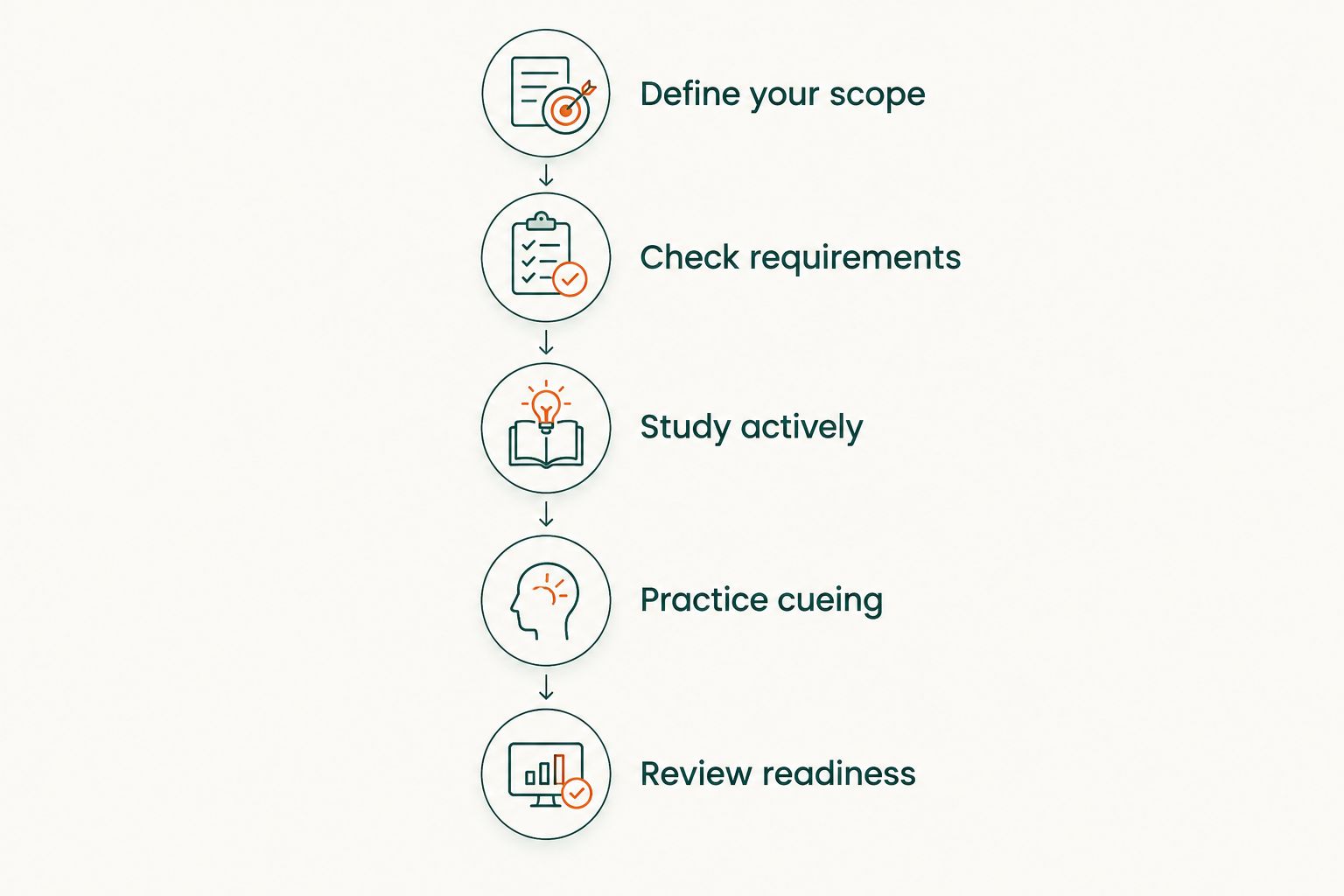
The sequence separates enrollment research from learning and assessment preparation. You do not need to solve every future career question before starting, but you do need to know what the course prepares you to teach.
What should you check about tuition and course access?
TeachPilates lists $497 tuition for its self-paced online instructor certification. That is the course tuition, not a statement that every expense involved in beginning to teach is included.
Before committing your 2026 training budget, check whether your chosen pathway requires separate equipment access, travel, practical training, insurance, CPR training, or an external examination. Ask which items apply to your situation rather than treating every possible expense as mandatory.
Access terms matter alongside tuition. Confirm when access begins, whether there is a completion deadline, and what happens if your schedule changes. Self-paced describes how you organize study; it does not, by itself, establish an unlimited access period.
Compare the full training requirement, not tuition alone. A course fits when its scope, study arrangements, assessments, and total commitments align with your goal.
Review your instructor training option
Compare the $497 self-paced course curriculum with your teaching goals and study schedule.
Can you get certified without teaching experience?
You can start the TeachPilates course without a teaching background. Its suitability still depends on whether self-paced online learning and its curriculum match your goals.
Give yourself permission to sound like a beginner when practicing instructions. Teaching is the skill you are preparing to learn, not a skill you must already demonstrate perfectly before enrolling.
Is online Pilates certification easier than in-person training?
Online Pilates certification is more flexible when the course is self-paced; flexibility does not establish that its assessments are easier. Compare published requirements rather than judging difficulty from the delivery format.
Choose self-paced study when control over your schedule matters and you can organize your own practice. Choose scheduled instruction when a fixed timetable better supports how you learn, while checking the actual feedback and practical training included.
Does certification mean you are ready to teach Reformer classes?
A certification title alone does not establish Reformer teaching readiness. Check whether the training provides introductory concepts or dedicated hands-on apparatus preparation, and compare that scope with the intended studio's requirements.
For a 2026 decision, do not treat mat foundations, online equipment lessons, and practical apparatus qualification as interchangeable. Ask what you must demonstrate on the equipment before teaching independently.
FAQ
Is Pilates certification hard if I have never taught before?
Pilates certification requires learning teaching skills, but previous teaching experience is not required for the TeachPilates course. Focus on anatomy, clear cueing, and practice rather than expecting yourself to teach confidently before training begins.
Do I need to be an advanced Pilates practitioner before enrolling?
Entry requirements depend on the course, so check the provider's stated prerequisites before enrolling. Do not assume that being able to perform advanced exercises is the same as being prepared to explain foundational movements.
How much does the TeachPilates course cost?
TeachPilates tuition is $497 for its self-paced online Pilates instructor certification. Check which additional arrangements your intended teaching pathway requires rather than assuming tuition covers every expense of starting to teach.
What should I ask about the certification exam?
Ask about the assessment format, pass requirements, practical submissions, feedback, and retake terms. Prepare against the provider's published requirements rather than assuming all Pilates certification exams are alike.
Can an online Pilates course qualify me to teach every apparatus?
Do not assume an online Pilates course qualifies you to teach every apparatus. Compare its exact teaching scope and hands-on preparation with the requirements of the setting where you want to work.
Will every studio accept my Pilates certification?
Course completion does not guarantee acceptance by every studio. Ask your intended employer which qualifications, practical preparation, auditions, and other requirements apply before choosing training.
How do I know whether I am ready for assessment?
Use the course's published assessment requirements to judge readiness. Check whether you can explain the required material and demonstrate the teaching tasks without relying entirely on your notes.
One last thing
Before enrolling, try explaining a familiar foundational movement without demonstrating it. Notice which words tell the learner where to start, what to move, and what to keep controlled.
Your next move is to choose training that helps you close that teaching gap—not simply collect a certificate. For your 2026 plan, match the course to the work you want to do, then verify the assessment and employer requirements before paying.