
Yes—an online Pilates certification is legitimate when the course provides relevant instruction, meaningful assessment, and a clearly defined teaching scope that fits your intended work. TeachPilates offers $497 tuition and flexible, self-paced online study; course completion does not guarantee studio acceptance or replace dedicated hands-on apparatus training. For your 2026 enrollment decision, judge the curriculum, assessment, and employer requirements—not the online label alone.
- Is online Pilates certification legitimate? Yes, when instruction, assessment, and teaching scope match your intended work.
- TeachPilates offers self-paced Pilates instructor training for $497, covering anatomy, mat instruction, introductory Reformer concepts, cueing, and business skills.
- A course certificate does not automatically include an independent credential or guarantee studio acceptance.
- Confirm employer expectations and practical assessment before choosing online Pilates teacher training.
Is an online Pilates certification legitimate?
Yes, but a legitimate course and the right qualification for your teaching goal are different things. You need to establish what the provider teaches, how it evaluates your understanding, and whether your intended teaching setting accepts that preparation.
TeachPilates publishes this guide and offers online Pilates instructor certification. That connection matters: use the same checks below for this course as you would for any alternative.
| Check | Evidence to request | What it does not establish |
|---|---|---|
| Curriculum | Written topics covering the instruction you want to deliver | That every apparatus or client population is covered |
| Assessment | An explanation of written and practical assessment requirements | That completing lessons proves teaching competence |
| Teaching scope | A clear distinction between mat instruction and apparatus preparation | That introductory Reformer study equals hands-on qualification |
| Certificate | The issuing organization and completion requirements | That an independent credential is included |
| Acceptance | Written requirements from your intended employer or insurer | That acceptance elsewhere guarantees acceptance for you |
These checks turn a vague question about legitimacy into a decision you can verify before enrolling.
Why this matters before you enroll
Your goal is not simply to receive a certificate. You want to understand movement, communicate clearly, and prepare for the classes you intend to teach.
Online delivery describes how you study. It does not, by itself, tell you whether you receive feedback on your cueing, demonstrate teaching skills, or qualify for a particular studio role.
For a 2026 course comparison, start with the work you want to do. Someone preparing to teach mat classes needs a different training plan from someone seeking dedicated Reformer instruction. Neither should assume that the word certification answers every question about scope.
What makes an online Pilates course credible?
A credible course explains its requirements before you commit. Look for specific answers rather than relying on a badge or a broad promise of recognition.
Curriculum that connects knowledge to teaching
Anatomy should support the decisions you make when explaining movement. Mat instruction should help you understand exercise setup, execution, and appropriate progression—not just memorize a sequence.
Cueing matters because knowing an exercise yourself is different from helping someone else perform it. Ask how the course teaches verbal instructions, modifications, and observation.
Business lessons serve a separate purpose. They help you prepare for the practical responsibilities of teaching, but they do not substitute for movement instruction or assessment.
Assessment that explains what you must demonstrate
Ask whether assessment checks knowledge, teaching performance, or both. A written exam and a practical teaching assessment provide different evidence.
Written questions can check your understanding of concepts. A teaching demonstration gives an assessor something different to evaluate: how you explain, observe, and respond. Request the assessment format, passing requirements, feedback process, and reassessment terms before enrolling.
Do not assume a practical assessment exists because a course uses video lessons. Watching instruction and demonstrating instruction are separate activities.
Clear boundaries around the certificate
Find out exactly who issues the certificate and what you must complete to receive it. Then ask whether any separately administered credential requires another application, exam, or eligibility review.
If a provider describes a course as recognized or accredited, request the name of the recognizing organization and the scope of that recognition. A broad label is not enough to establish acceptance by your preferred studio.
Which training format fits your teaching goal?
Compare formats by the support and practice they provide, not by assuming online means weak or in-person means sufficient. The following are decision categories, not claims about every course in each category.
| Format | Best for | Main advantage | Limitation to investigate |
|---|---|---|---|
| Self-paced online study | Learners who need control over their study schedule | You organize study around existing commitments | How feedback and teaching assessment work |
| Live online instruction | Learners who want scheduled interaction without attending a classroom | You can ask questions during scheduled sessions | How instructors observe and assess physical skills remotely |
| In-person instruction | Learners who prioritize direct observation and hands-on apparatus practice | Instruction and practice take place in a shared physical setting | Whether the schedule, curriculum, and assessment fit your goal |
| Blended training | Learners who want independent study plus supervised sessions | Different activities can use different teaching formats | Which practical components are actually included |
Choose the format that addresses your learning needs and intended teaching scope. A self-paced course requires you to organize your study; a scheduled course requires you to accommodate its timetable. Neither format removes the need to practice teaching.
Mat foundations are not a full apparatus qualification
A course can introduce Reformer concepts without providing the same preparation as dedicated hands-on apparatus training. Keep that distinction clear when comparing curricula or describing your education to a studio.
Mat-teaching foundations focus your attention on instruction without relying on a Reformer. Apparatus teaching adds equipment-specific decisions, including setup, adjustment, and safe use. An introductory lesson is not evidence that you have demonstrated those skills under supervision.
If Reformer teaching is your goal, ask what equipment access the course requires and how your practical work is assessed. Also ask your intended studio what apparatus preparation it expects.
For your 2026 training plan, describe the outcome precisely: mat preparation, introductory Reformer study, or dedicated apparatus training. Avoid treating those descriptions as interchangeable.
Why acceptance of online Pilates certification varies
Acceptance depends on the requirements of the organization making the decision. The certificate's delivery format is only part of the information that organization needs.
- Teaching role: A mat-class position and a Reformer position call for different preparation.
- Curriculum scope: The employer needs to understand what your training actually covered.
- Assessment evidence: A completion record and an evaluated teaching demonstration show different things.
- Practical preparation: Observation, personal practice, and practice teaching are distinct activities; ask which are required.
- Employer requirements: A studio can set its own hiring expectations, including an audition or further training.
- Insurance requirements: Check the insurer's conditions for your intended activities rather than assuming course completion settles coverage.
Get those answers before paying tuition. The guide to checking employer requirements for online Pilates certification gives you a focused next step if you already have a studio in mind.
How do you check a course before enrolling?
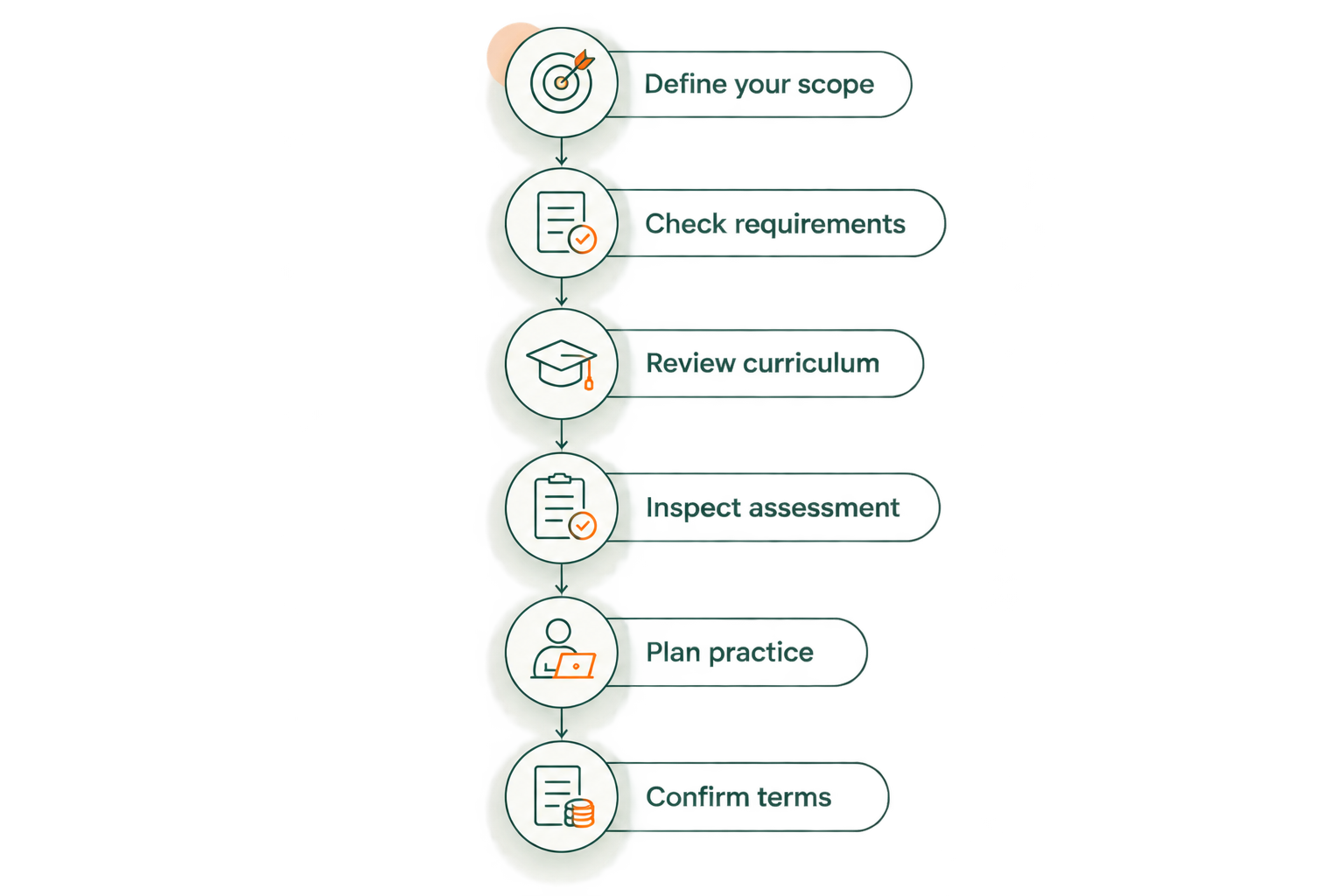
Use this sequence to connect the course to a real teaching goal. Keep the provider's written answers so you can compare requirements without relying on memory.
- Define your scope. Write down whether you want to teach mat classes, pursue apparatus instruction, or build foundations before further training.
- Check requirements. Ask your intended employer about accepted preparation, auditions, and any additional conditions. Ask an insurer separately about coverage requirements.
- Review curriculum. Match the course topics to the teaching scope you identified. Request clarification wherever a description is broad.
- Inspect assessment. Confirm what you must demonstrate, who evaluates it, and how you receive feedback.
- Plan practice. Decide how you will rehearse explanations and gain appropriate experience within the course's requirements and your current competence.
- Confirm terms. Read access limits, prerequisites, completion requirements, refund terms, and any additional charges before enrolling.
A course that fits your schedule but not your intended role is the wrong fit. Resolve that mismatch before you start studying.
Where does TeachPilates fit?
TeachPilates is best for aspiring Pilates instructors seeking self-paced online foundations. The $497 course covers anatomy, mat instruction, introductory Reformer concepts, cueing, and business skills.
The advantage is control over your study schedule. The boundary is equally important: introductory Reformer concepts should not be represented as dedicated hands-on apparatus qualification, and enrollment does not establish acceptance by a particular studio.
Before enrolling, confirm the current prerequisites, assessment format, tutor support, and access terms. Choose a different training arrangement if your priority is supervised apparatus practice or a specific employer requires preparation this course does not document.
Review your instructor training options
Explore self-paced study covering anatomy, mat instruction, introductory Reformer concepts, cueing, and business skills.
Will an online certificate get me hired?
An online certificate does not guarantee a job. Ask the studio you want to work with whether it accepts the course and what else it requires before considering you for a teaching role.
Send the curriculum and assessment details rather than asking only whether online training is acceptable. For your 2026 job search, a specific question about a specific course is more useful than a general question about online education.
Does a course certificate include an independent credential?
A course certificate does not automatically include an independent credential. Treat those as separate unless the provider explicitly documents otherwise.
Ask who awards each credential, what eligibility requirements apply, and whether a separate assessment is required. Do not describe yourself as holding an independent credential simply because you completed a provider's course.
Can I learn online and add hands-on training later?
You can plan online study alongside later hands-on training, but do not assume another provider will accept your coursework toward its requirements. Confirm any transfer arrangement directly before relying on it.
Keep your syllabus, assessment records, and completion documents. Those materials let a future training provider evaluate what you studied without guessing from the certificate title.
FAQ
Is online Pilates certification legitimate in 2026?
Yes—online Pilates certification is legitimate when the course provides relevant instruction, meaningful assessment, and a clearly defined teaching scope. Confirm that the preparation also meets the requirements of your intended employer or insurer.
Will every Pilates studio accept an online certificate?
No—an online certificate does not guarantee acceptance by every Pilates studio. Ask your intended employer about the specific course, assessment, and teaching role before enrolling.
Is an online Pilates course enough to teach Reformer?
Introductory online Reformer study is not the same as dedicated hands-on apparatus qualification. Check equipment practice, assessment, and the requirements of the studio where you want to teach.
How much is TeachPilates tuition?
TeachPilates tuition is $497 for self-paced online Pilates instructor training. Confirm the current enrollment terms and ask whether your training plan requires any additional expenses.
What should I ask about an online Pilates exam?
Ask whether the assessment evaluates knowledge, teaching performance, or both. Also request the passing requirements, feedback process, and reassessment terms.
Does a Pilates course certificate include an independent certification?
A Pilates course certificate does not automatically include an independent credential. Verify the issuing organization and any separate eligibility or examination requirements.
Should I choose online or in-person Pilates training?
Choose the format that meets your teaching goal, learning needs, and employer requirements. Self-paced study offers scheduling control, while in-person training is the more direct fit when your priority is supervised hands-on apparatus practice.
One last thing
Before your 2026 enrollment decision, ask your intended studio this: Does this specific curriculum and assessment meet your requirements for the role I want?
That answer is more useful than a generic assurance that a course is legitimate. Choose training backward from the teaching you want to do—not forward from the certificate you want to receive.