
Career-changer Pilates instructor training is preparation for teaching Pilates with the aim of moving into a new profession without abandoning your current responsibilities. TeachPilates offers self-paced online study for $497; your next move is to match the course’s teaching scope, assessments, and practical preparation to the work you want to do.
- TeachPilates suits first-time instructors seeking self-paced Pilates training alongside their current work.
- Learning how to become a pilates instructor starts with choosing mat teaching or an apparatus-focused pathway.
- Compare certification scope, practical assessments, and employer requirements before enrolling.
- Keep your career transition separate from course completion: a certificate does not promise employment.
Why Pilates instructor training matters for career changers
A career change involves two decisions: what you need to learn and how you will manage the transition. Choosing a course without checking both leaves you with an enrollment decision, not a teaching plan.
For your 2026 transition, start with the classes you want to teach. Mat classes, Reformer sessions, and broader apparatus instruction require different preparation; a course mentioning equipment does not establish qualification to teach every apparatus independently.
TeachPilates is best for aspiring instructors who want self-paced online Pilates training alongside their current responsibilities. Its curriculum covers anatomy, mat instruction, Reformer instruction, cueing, and business skills. Treat introductory Reformer concepts separately from dedicated hands-on apparatus qualification.
You can review TeachPilates against your intended teaching role before committing. This guide is published by TeachPilates, so the comparison below explains both where its format fits and where another training route fits better.
How to become a Pilates instructor while changing careers
1. Define the teaching role you want
Start with the work, not the certificate name. Decide whether you want to lead mat classes, pursue Reformer teaching, or build toward instruction across several apparatus types. That choice determines what you should ask a training provider.
Then describe your intended setting: group classes, individual sessions, or another clearly defined format. Ask prospective studios what preparation they expect for that role rather than assuming every employer interprets a course certificate the same way.
Your first role does not have to cover every part of Pilates. Choose a focused starting scope, then expand through appropriate training and practice.
- Write down whether your first goal is mat or apparatus teaching.
- Describe the class format you want to lead.
- Ask prospective employers about their qualification requirements.
- Separate your initial teaching goal from later specializations.
2. Check prerequisites and test your study routine
No teaching background is required for the TeachPilates course. That answers the entry question, but it does not replace an honest look at your movement experience, confidence explaining exercises, or ability to study consistently.
Before enrolling, test a routine that resembles the work you intend to do. For example, reserve two study sessions and one practice session each week. This is a planning suggestion, not a course requirement or a promise about completion time.
Use your actual 2026 work calendar, including busy periods and personal commitments. A self-paced format gives you control over scheduling; it still requires protected time for learning and rehearsal.
- Review the provider’s stated entry requirements.
- Identify anatomy topics you need to learn or revisit.
- Test your proposed study slots before enrolling.
- Set aside space for movement practice.
- Ask what learning support and access conditions apply.
3. Match the training format to your responsibilities
You can begin comparing formats manually with a simple worksheet. List scheduled attendance, travel, opportunities for feedback, assessment methods, and the teaching scope each course actually covers. Compare those details before comparing certificate titles.
TeachPilates offers self-paced online Pilates instructor training for readers who need study to fit around existing commitments. Its curriculum includes anatomy, mat and Reformer instruction, cueing, and business skills, making it relevant to the transition from practitioner to teacher.
The limitation matters: self-paced study is not the same as supervised hands-on apparatus preparation. If your target role requires dedicated Reformer or broader apparatus qualification, select training that explicitly includes the necessary practical work and assessment.
- Choose self-paced study when control over lesson timing matters most.
- Choose scheduled instruction when you need fixed attendance and live interaction.
- Check how you receive corrections on your teaching.
- Confirm access terms instead of assuming unlimited access.
- Compare introductory equipment content with dedicated apparatus training.
4. Verify assessments and credential scope
Read the assessment requirements before paying tuition. Ask whether the course checks written knowledge, exercise demonstration, spoken cueing, lesson planning, or observed teaching. A list of curriculum topics does not tell you how competence is assessed.
Written and practical assessments answer different questions. Written work can check your understanding; practical assessment examines what you do when explaining and teaching movement. Use this guide to written versus practical assessments to frame your questions.
Also distinguish the provider’s course certificate from any separate independent credential. Do not assume an external examination, professional membership, or independent certification is included unless the provider explicitly confirms it.
- Request the assessment format and passing requirements.
- Ask whether practical teaching receives individual feedback.
- Check retake conditions and any associated charges.
- Confirm exactly what certificate successful completion provides.
- Ask whether independent credentials require separate applications or examinations.
5. Practice teaching before expanding your scope
Begin with a simple practice plan rather than trying to imitate a full studio timetable. Choose a short sequence, explain its purpose, rehearse your instructions, and check whether another person understands your words.
Try a 10-minute cueing rehearsal as a manageable practice task, not a professional readiness standard. Recording yourself can help you notice rushed explanations, unclear transitions, or instructions that depend on your demonstration rather than your language.
Self-review has a limit: you cannot reliably identify every gap in your own teaching. Seek qualified feedback, and keep practice within your training and the participant’s needs. Do not use informal rehearsal as permission to teach unfamiliar apparatus.
- Rehearse a sequence with a clear beginning and ending.
- Practice explaining movement without relying only on demonstration.
- Review a recording for unclear or conflicting cues.
- Ask a qualified instructor for specific corrections.
- Keep a record of questions that need further instruction.
6. Build a staged transition into teaching
Course enrollment is a learning commitment; leaving your current job is a separate financial decision. Build your 2026 transition around confirmed requirements, completed preparation, and actual teaching opportunities rather than an assumed graduation-to-employment timeline.
Create a personal budget that separates tuition from other possible expenses. Check whether your chosen pathway involves travel, equipment access, mentoring, further assessments, insurance, or independent credential applications. Do not label any of these as included without written confirmation.
Then define your decision points. You can research employers while studying, but wait until you understand their requirements before treating a prospective role as part of your income plan.
- Set a study commitment you can maintain alongside work.
- Record confirmed expenses separately from estimates.
- Ask employers about recruitment and teaching demonstrations.
- Check relevant insurance and local business requirements.
- Base any reduction in current work on your actual circumstances.
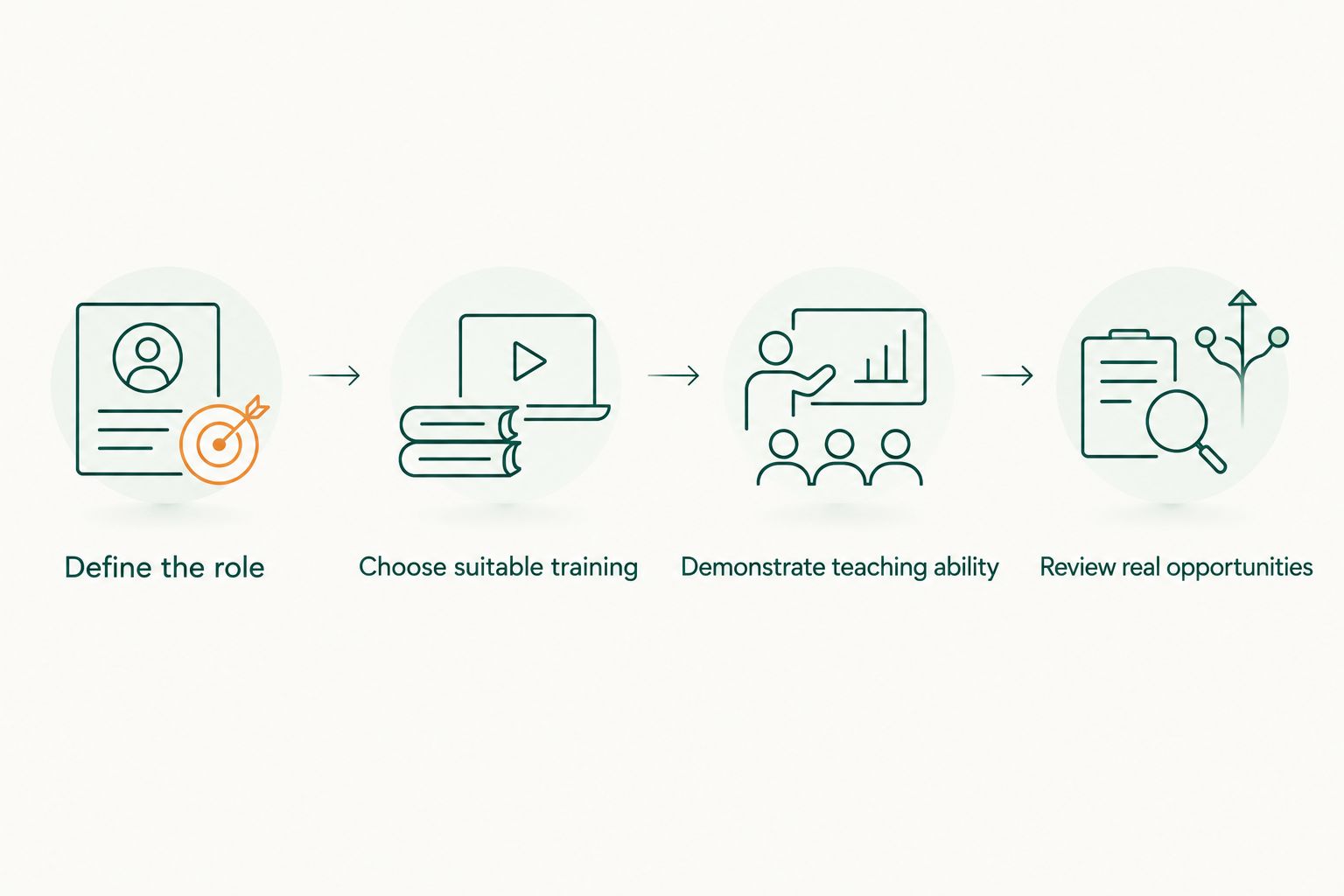
Your transition works best as a sequence of decisions: define the role, choose suitable training, demonstrate teaching ability, and review real opportunities. Keep those stages separate so progress in one does not disguise an unresolved requirement in another.
Compare training options for your career change
For a 2026 enrollment decision, compare formats against the same intended role. A flexible mat-focused starting route and a dedicated apparatus pathway solve different problems; neither should be judged as a substitute for the other.
The options below describe training formats, not verified packages from unnamed providers. Confirm each provider’s curriculum, attendance requirements, assessment arrangements, and full charges directly.
| Option | Best for | Main advantage | Key limitation | What to verify |
|---|---|---|---|---|
| TeachPilates self-paced online course | First-time instructors fitting study around existing work | Flexible study covering anatomy, mat instruction, Reformer instruction, cueing, and business skills | Introductory Reformer concepts are not dedicated hands-on apparatus qualification | Assessment format, support, access terms, and fit with your target role |
| Scheduled in-person mat training | Learners prioritizing face-to-face instruction | A format suited to live demonstration and interaction | Attendance and travel must fit your calendar; mat scope does not establish apparatus preparation | Practical feedback, attendance rules, and assessment scope |
| Blended online and practical training | Learners wanting independent study plus scheduled practical sessions | Combines separate study and practical components | The balance varies by provider; a practical component alone does not establish sufficient preparation | What happens in person and what teaching skills are assessed |
| Dedicated hands-on apparatus training | Career changers targeting equipment-specific teaching | Training directed at the apparatus named in the program | A narrower equipment course does not automatically cover every apparatus | Equipment covered, supervised practice, and practical assessment |
Choose the format that prepares you for your intended work, not the one with the broadest-sounding title. A useful comparison ends with a clear answer about what you can demonstrate, not just what content you can access.
Common mistakes career changers make
Treating every Pilates certificate as interchangeable
Course titles do not establish identical training scope. Compare the actual curriculum and assessments, then check whether the studios you want to approach accept that preparation for the specific role.
Confusing flexibility with less work
Self-paced learning changes when you study, not whether you need to understand anatomy or practice teaching. Put learning and rehearsal in your calendar before assuming an online course fits your working week.
Assuming Reformer content equals apparatus qualification
A curriculum can introduce Reformer concepts without providing dedicated hands-on qualification. Ask what equipment you will physically use, who observes your teaching, and what practical competence you must demonstrate.
Planning an income change around course completion
Finishing training does not promise a job, earnings, or universal studio acceptance. Keep your household decisions tied to your own financial position and confirmed opportunities, not a projected teaching schedule.
FAQ
How do I become a Pilates instructor while working full time?
Choose a teaching scope, check the relevant training requirements, and build a study-and-practice schedule around your current job. Self-paced learning gives you scheduling control, but you still need time to rehearse teaching and complete assessments.
Do I need a teaching background before enrolling?
No teaching background is required for the TeachPilates course. Review its curriculum and assessment requirements to understand the learning involved before you enroll.
Is online Pilates training better than in-person training for career changers?
Online training fits learners who prioritize scheduling flexibility; in-person training fits learners who prioritize face-to-face instruction. Compare practical feedback and teaching scope rather than treating either format as automatically better.
Can I teach Reformer after studying it in an online course?
Introductory Reformer content does not by itself establish dedicated hands-on apparatus qualification. Check the practical training, assessment, and employer requirements for the Reformer role you want.
Does a Pilates course certificate include an independent credential?
Do not assume a course certificate includes an independent credential. Ask which organization awards each credential and whether a separate application, examination, or fee applies.
How long should I allow for a Pilates teaching career change?
Plan your transition around the course requirements, your available study time, and the preparation needed for your intended role. Course completion and finding suitable teaching work are separate milestones, so avoid treating them as a single deadline.
Should I leave my job before starting Pilates instructor training?
Do not make leaving your job a prerequisite for starting training. Test your study routine, check the full commitment, and make employment decisions using your own finances and confirmed opportunities.
One last thing
Before you enroll in 2026, write a plain-language description of the class you want to teach. Include the format, equipment, and setting, then ask both the training provider and a prospective employer what preparation that class requires.
Agreement about the work matters more than enthusiasm about a certificate. That question gives you a practical way to check whether your chosen course is the right first step or whether you need a different pathway.