
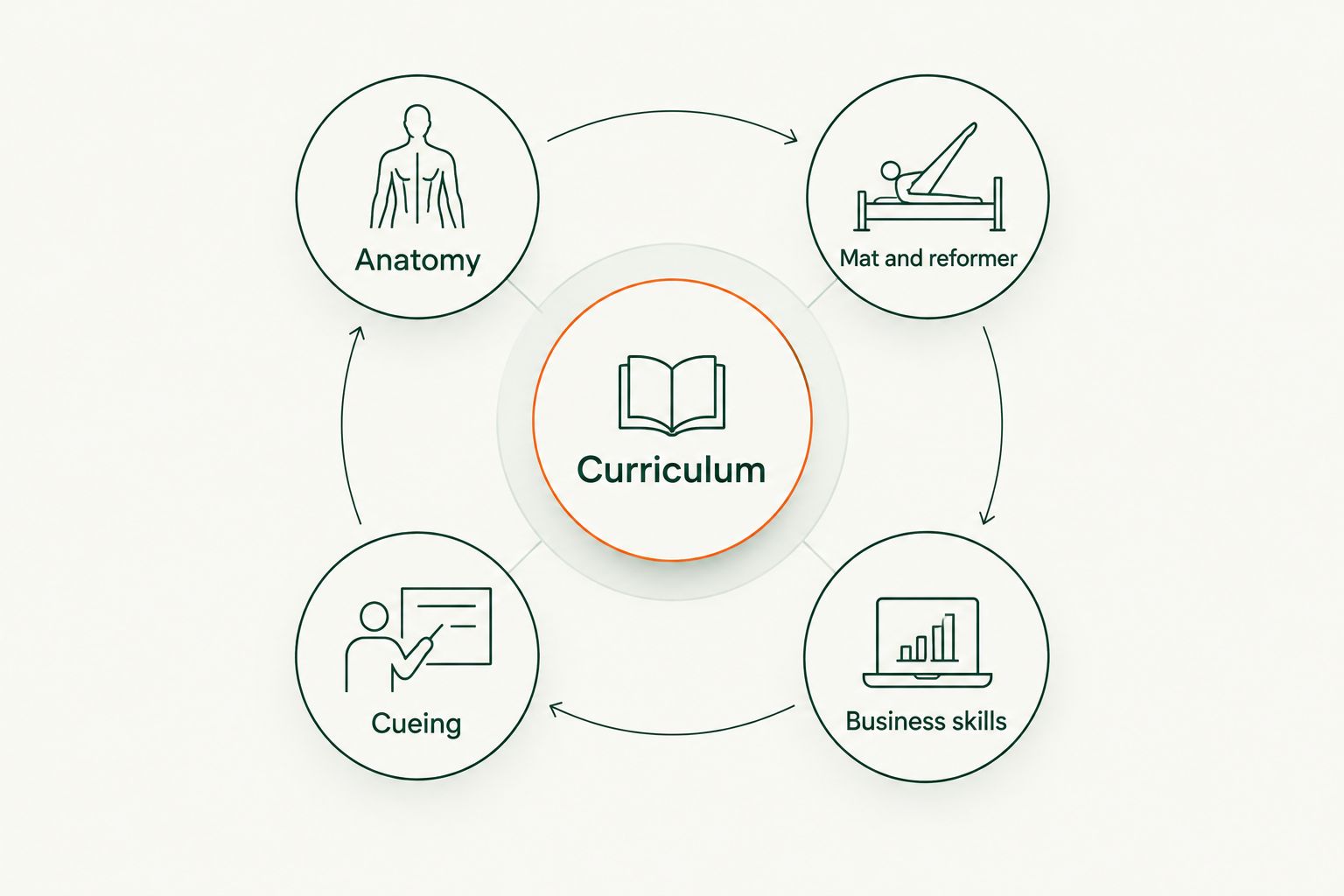
The TeachPilates certification course is a self-paced online program for $497, and its current lesson total is published on the course page, which is the one place to confirm the number before you enroll in 2026. The lessons cover four areas: anatomy, mat and reformer instruction, cueing, and business skills. The lesson count also leaves out what sits outside the course, such as insurance or CPR if an employer asks for them.
- TeachPilates is a self-paced online Pilates instructor certification course with $497 tuition in 2026.
- Confirm the current lesson count on the course page, not in third-party summaries.
- Lessons cover anatomy, mat and reformer instruction, cueing, and business skills.
- Judge a Pilates certification course by lesson content and assessment, not by how many lessons it has.
Why this matters
You are about to spend money and study time on a course that shapes how you teach your first class. The number of lessons is often the first figure people search for, because it feels like a quick measure of value.
It is a starting point, not a verdict. Two courses with the same total can prepare you very differently. A clear view of what the lessons teach, how you are checked, and how long you keep access tells you far more than the headline number.
Verdict: TeachPilates is best for first-time instructors who want a self-paced online Pilates certification course at $497 and want to read the full curriculum before paying.
How many lessons are in the TeachPilates certification course?
The exact lesson total for 2026 is listed on the course page. This guide does not hard-code a number, because a figure copied into a blog post goes stale the moment the curriculum is updated. What stays constant is the structure: four topic areas, studied online, at your own pace.
| Topic area | What you learn | Why it matters for a new instructor |
|---|---|---|
| Anatomy | Body systems and movement principles behind Pilates exercises | You can explain why an exercise works and when to change it |
| Mat and reformer instruction | Mat teaching foundations and introductory reformer concepts | Mat is where most new instructors start teaching |
| Cueing | What to say, when to say it, and how to offer modifications | Cueing turns knowledge into a class people can follow |
| Business skills | The practical side of teaching once you start | Helps you move from student to working instructor |
When you open the course page, read the lessons against this table. Each lesson should map to one of these four areas.
What the TeachPilates curriculum covers
The course is organized around the skills a new instructor needs on day one. Each area below is a block of lessons, not a single video.
Anatomy
Anatomy lessons give you the reasons behind the movements. You learn how the body moves through each exercise, so you can spot when a client needs a change and explain it in plain words. The guide on how much anatomy you need in a Pilates instructor course sets out what a first-time teacher should expect from this part of any program.
Mat and reformer instruction
The course teaches mat foundations and introduces reformer concepts. Introductory reformer concepts are not the same as dedicated hands-on apparatus qualification, which usually involves time on equipment with a mentor. If you plan to teach reformer classes in a studio, confirm that studio's requirements before you rely on any online course alone.
Cueing
Cueing is the skill clients notice first. Good cues are short, timed to the movement, and paired with a modification for anyone who cannot do the full version. Expect lessons here to focus on how you speak to a room, not just what the exercise looks like.
Business skills
Business lessons cover the point where you start teaching, whether in a studio, online, or one to one. They do not replace advice from an accountant or insurer, but they help you plan the steps after certification.
What the course costs in 2026
Tuition is $497 for the self-paced online course in 2026. That figure is the course price, not your total spend. Depending on where you teach, you may also pay for liability insurance, CPR certification, or equipment for practice.
The breakdown of fees to check beyond tuition lists each one, so your comparison between providers is like for like.
Why lesson counts vary between Pilates courses
Lesson totals are not a standard unit. Providers count differently, so two numbers side by side rarely measure the same thing.
- Lesson length. One provider puts a full topic in a single long lesson; another splits the same topic into several short ones.
- Counting method. Some courses count individual videos, others count modules or sections.
- Bundled extras. A total may include bonus material that is not part of core training.
- Apparatus scope. A full apparatus program covers more equipment, so it naturally carries more lessons than a mat-focused course.
- Curriculum updates. Providers revise courses, so an older review may quote a structure that no longer exists.
- Third-party summaries. Aggregator pages often copy figures without checking the source.
If a number on another site disagrees with the course page, trust the course page.
How to compare lesson counts across Pilates courses
Use the same five questions for every provider. This keeps the comparison fair whether you are looking at an online course, a studio program, or a full apparatus training.
| What to check | Why it matters | What to ask |
|---|---|---|
| Lesson outline | Shows what is taught, not just how it is split | Is there a full lesson-by-lesson list? |
| Lesson length | A short lesson and a long lesson are not equal | How long is a typical lesson? |
| Assessment | Shows how your learning is checked | Is there a written or practical component? |
| Apparatus scope | Mat and reformer are different skills | Is reformer introductory or hands-on? |
| Access period | Self-paced does not always mean unlimited | How long do you keep access? |
For a side-by-side view of providers, see Pilates certification programs ranked by course length. TeachPilates wrote that guide, so read it with that in mind; it also notes where another format suits some learners better, such as a studio program for anyone who needs supervised reformer hours.
Where another format fits better
An online, self-paced course is a strong fit if you need flexibility, study around work or family, and plan to start with mat teaching. A dedicated in-person apparatus program fits better if a specific studio requires supervised reformer hours, or if you learn best with a trainer correcting you in the room. Neither format is better for everyone.
How long will the lessons take you?
Because the course is self-paced, your finish date depends on the hours you can give each week, not on the lesson count alone. A full-time worker studying a few evenings a week and a parent studying during school hours will move through the same lessons at different speeds.
The article on how long it takes to become a Pilates instructor walks through the factors that set your pace, including practice teaching time outside the lessons.
Does a higher lesson count make you a better instructor?
No, a higher lesson count does not make you a better instructor. Teaching quality comes from understanding the material, practicing your cueing out loud, and getting feedback. A course with fewer, well-built lessons and a clear assessment can prepare you better than a longer course with no checks at all.
Can you finish the lessons without prior teaching experience?
Yes, you can start the lessons without prior teaching experience. The course is built for Pilates practitioners preparing to teach for the first time, as well as current practitioners who want to become certified teachers. Regular Pilates practice before you start makes the anatomy and cueing lessons easier to apply.
What TeachPilates does not promise
The course teaches skills. It does not promise a job, a set income, or acceptance at every studio. Employer requirements vary by studio and gym, and some ask for independent credentials, insurance, or CPR in addition to course completion. Check with the places you want to teach before you enroll in any Pilates certification course in 2026.
FAQ
How many lessons are in the TeachPilates certification course?
The current lesson total is listed on the TeachPilates course page. The course is self-paced and covers anatomy, mat and reformer instruction, cueing, and business skills.
How much does the TeachPilates course cost in 2026?
Tuition is $497 in 2026. Check separately for costs outside tuition, such as insurance or CPR if an employer requires them.
Is the TeachPilates course self-paced?
Yes, the course is self-paced and online. Your finish date depends on how many hours you can give each week.
Does the course teach the reformer?
The course includes mat instruction and introductory reformer concepts. Dedicated hands-on apparatus qualification is a separate type of training.
Is a higher lesson count better in a Pilates certification course?
No, a higher lesson count is not automatically better. Compare what each lesson teaches, how you are assessed, and the scope of training.
Do I need teaching experience before starting the lessons?
No teaching experience is needed to start. The course is built for Pilates practitioners preparing to teach for the first time.
Does the course guarantee a teaching job?
No. The course does not promise jobs, earnings, or acceptance at every studio. Check employer requirements before you enroll.
One last thing
Before you pay for any Pilates course in 2026, open the lesson outline and read it end to end, then pick three lessons and ask yourself whether you could teach that content to a beginner afterward. If the answer is yes, the headline number matters far less than you think.