
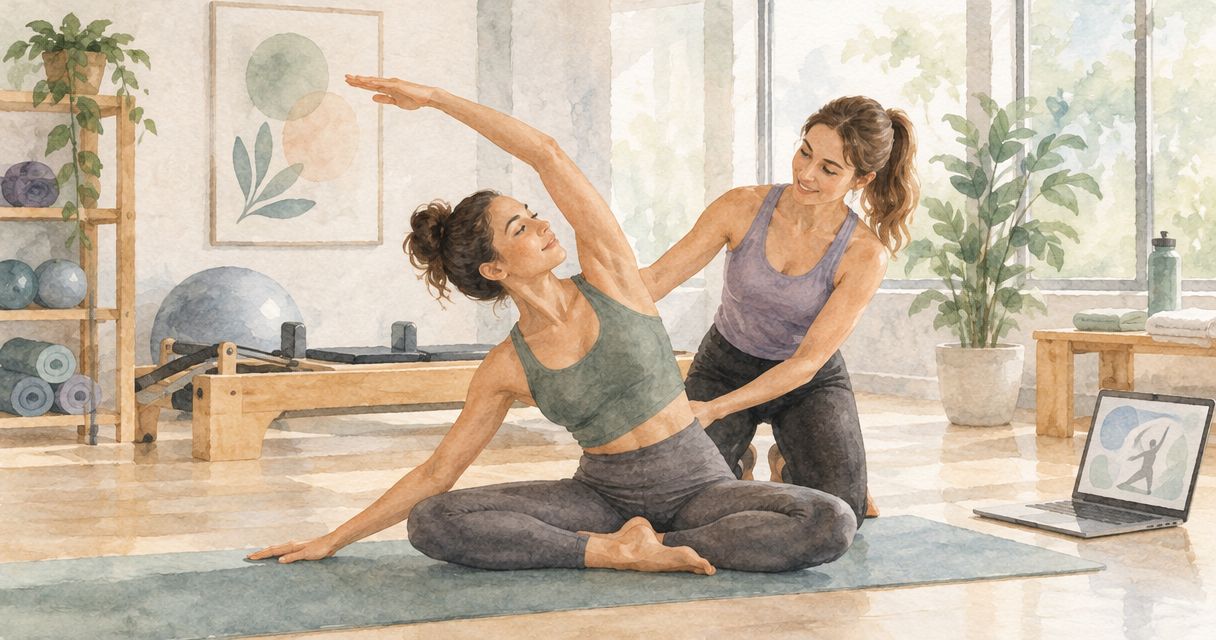
No—you do not need exceptional flexibility to become a Pilates instructor; you need to learn movement, explain it clearly, and teach within your training. With $497 tuition and flexible self-paced study, the online course described below offers a starting point, but course-specific assessment requirements and hands-on apparatus preparation still need checking before you enroll.
- Do you need to be flexible to become a Pilates instructor? No—prioritize controlled movement, clear cueing, and appropriate modifications.
- TeachPilates suits aspiring instructors seeking self-paced online Pilates certification, not a substitute for dedicated hands-on apparatus preparation.
- Check practical assessments before enrolling, especially if a movement is difficult or restricted.
- Separate mat-teaching foundations and introductory Reformer concepts from dedicated apparatus qualification.
Why this matters
If tight hamstrings or a limited forward bend have kept you from exploring teacher training, separate your personal movement range from your ability to learn to teach. Those are different questions. A deep stretch does not demonstrate that you can explain an exercise, observe another person, or choose an appropriate alternative.
TeachPilates offers online Pilates instructor certification covering anatomy, mat and Reformer instruction, cueing, and business skills. This guide is published by TeachPilates to help you assess that training route honestly. For your 2026 enrollment decision, focus on the course's teaching scope and assessment requirements rather than whether you look like an advanced demonstrator.
Do you need to be flexible to become a Pilates instructor?
Exceptional flexibility is not the same as teaching readiness. Your preparation should develop movement understanding, communication, observation, and appropriate exercise choices—not simply a larger stretch.
Use these checks to distinguish a flexibility concern from a training requirement:
- Identify the actual limitation. Describe the movement that is difficult rather than labeling your whole body inflexible. Bending forward, reaching overhead, and moving through a particular exercise are different tasks.
- Read the practical assessment requirements. Ask what you must demonstrate, what assessors evaluate, and how they handle a documented movement restriction. Do not assume that a course accepts every substitution.
- Match training to your teaching goal. Mat instruction and equipment-based instruction need different preparation. An introductory explanation of Reformer exercises does not establish hands-on apparatus competence.
- Plan practice alongside study. Reading anatomy and watching demonstrations support learning, but you also need to practice explaining, observing, and applying what you study.
A useful enrollment question is: Can this course prepare and assess me for the kind of teaching I want to do? That question tells you more than asking whether you can touch your toes.
What matters more than an impressive stretch?
A teacher has to make movement understandable to someone else. Your personal demonstration is one teaching tool, not the entire lesson.
Imagine explaining a mat exercise to a beginner. You need to describe the starting position, communicate the movement, watch the response, and recognize when your explanation has not worked. Performing a larger version yourself does not resolve unclear instructions.
| Preparation area | What it contributes | What it does not establish |
|---|---|---|
| Personal practice | Familiarity with movement and your own responses | Readiness to teach every body or exercise |
| Anatomy study | Language for understanding movement | Authority to diagnose or treat an injury |
| Cueing practice | Clearer explanations and instructions | That every learner understands the same cue |
| Observation practice | Attention to how someone performs a task | An independent healthcare qualification |
| Business study | Preparation for the practical side of teaching | Guaranteed clients, employment, or earnings |
Judge your readiness by teaching tasks, not a photograph of your deepest stretch. During practice, notice whether your instructions help another person understand the task without needing to copy you continuously.
You do not have to arrive at training already able to teach. You do need to approach it as learning a responsibility, not collecting a certificate for your existing exercise ability.
Self-paced online study: $497 tuition
TeachPilates offers a self-paced online Pilates instructor certification course for $497. The stated curriculum covers anatomy, mat and Reformer instruction, cueing, and business skills. That combination is relevant if you want to move from personal practice toward learning to instruct.
TeachPilates is best for aspiring Pilates instructors who want self-paced online study. The advantage is control over your study pace. The limitation is that an online curriculum does not, by itself, establish dedicated hands-on apparatus qualification or acceptance by a particular employer.
Before enrolling in 2026, ask how practical teaching is assessed and how a movement restriction would be handled. Also confirm course-access terms, tutor support, and any requirements beyond tuition. Self-paced describes how you study; it does not answer every question about assessment or access.
No teaching background is required for this course, but that does not make teaching practice unnecessary. Treat the curriculum as preparation for a new skill rather than proof that you already have it.
Mat foundations and Reformer preparation are different decisions
Choose a route around what you intend to teach. Do not let flexibility become a distraction from a more consequential issue: whether your preparation matches the equipment and teaching setting.
The comparison below describes training formats, not verified features of unnamed providers. Confirm the actual curriculum and assessment with each course you consider in 2026.
| Training format | Best for | Main advantage | Limitation to check |
|---|---|---|---|
| Self-paced online study | Learners who need control over study timing | Lets you organize study around your schedule | How practical performance and teaching receive feedback |
| In-person mat training | Learners prioritizing direct mat-teaching practice | Provides a setting for face-to-face instruction | Whether scheduled attendance fits your commitments |
| Dedicated apparatus training | Learners intending to teach equipment-based sessions | Centers preparation on the relevant equipment | Equipment access, supervised practice, and assessment scope |
A mat-teaching foundation can help you build exercise vocabulary and cueing skills. It should not be presented as automatic permission to teach every apparatus. Likewise, introductory Reformer concepts are not interchangeable with dedicated hands-on Reformer preparation.
If equipment-based teaching is your goal, read the guide to planning equipment access for Reformer certification before choosing a course. Resolve access and practice arrangements before treating the course title as evidence of readiness.
Why flexibility matters differently across training tasks
The relevance of your movement range depends on the task you are learning. Keep these curriculum areas separate when you assess your concerns:
- Anatomy: Learning movement terminology requires understanding, not an extreme personal range. Use anatomy study to describe what an exercise asks the body to do.
- Mat instruction: Your practice helps you understand starting positions and movement sequences. Ask which exercises you must demonstrate and what the assessment expects.
- Reformer instruction: Equipment setup and exercise instruction add tasks beyond your personal range of motion. Clarify whether the course introduces concepts or assesses dedicated hands-on apparatus skills.
- Cueing: Clear instructions should explain the task rather than demand that every student match your shape. Practice describing an appropriate range without using your body as the only reference.
These distinctions prevent an unhelpful conclusion: that becoming more flexible will solve every training concern. A deeper stretch does not replace anatomy study, equipment preparation, or clear communication.
How can you prepare if you feel stiff?
Start with a learning plan rather than a promise to change your body before enrollment. You can investigate training requirements while continuing appropriate personal practice.
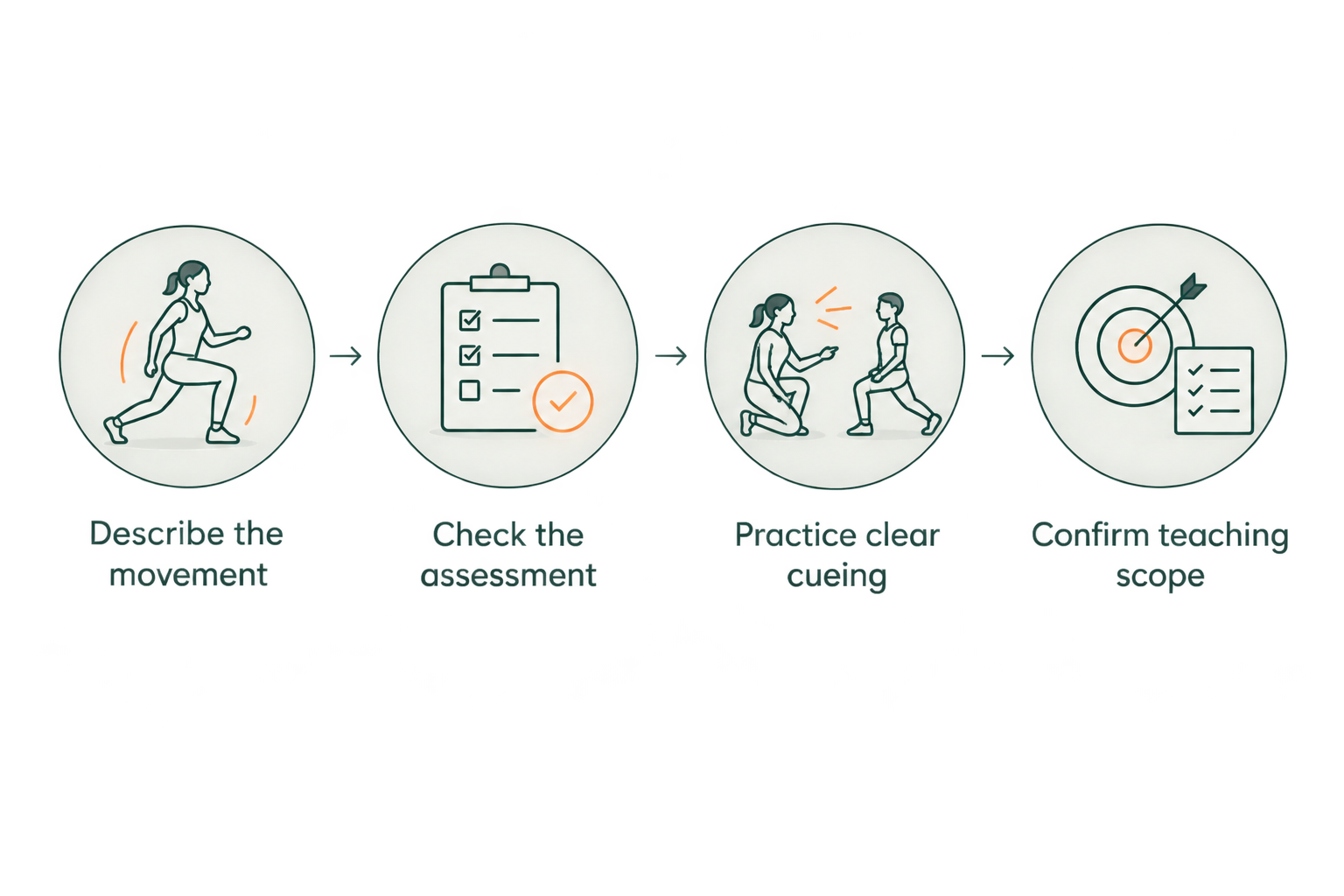
Describe the movement
Write down the exercise or position that concerns you. Note whether the issue is unfamiliarity, difficulty controlling the movement, discomfort, or an existing restriction you have already discussed with a healthcare professional.
This description gives a training provider something specific to answer. Saying that you are not flexible leaves too much unclear, especially when you need an assessment decision rather than general encouragement.
Check the assessment
Ask whether the course includes written work, practical demonstration, practice teaching, or another assessment format. Then ask what happens when you cannot perform a required movement as shown.
Request the actual policy before paying. An encouraging enrollment conversation is not a substitute for knowing how the assessment applies to your circumstances.
Practice clear cueing
Choose a familiar exercise within your experience and practice explaining its setup aloud. Keep the language concrete: where to begin, what moves, and how to stop.
Your goal is not to sound polished immediately. It is to notice where your explanation depends on the listener watching you rather than understanding your words. Work within your experience and seek feedback during training.
Confirm the teaching scope
Write down the setting you want to teach in: mat classes, online instruction, or equipment-based sessions. Then compare that goal with the course's stated preparation and any requirements of the setting.
For a 2026 application, ask a prospective employer directly which training and practical experience they require. Do not treat a course certificate, an independent credential, and an employer's hiring requirements as interchangeable.
A specific question is easier to resolve than a general fear about being unsuitable. Keep the provider's written answers with your enrollment information so you can compare courses on the same basis.
Can you teach Pilates if you cannot touch your toes?
Not touching your toes does not, by itself, establish that you cannot learn to teach Pilates. It also does not tell you whether you meet a particular course's practical requirements.
Check the exercises and demonstrations the provider assesses. Focus on learning to explain and adapt movement within your training rather than treating one forward bend as an entrance exam.
Should you wait until you are more flexible before enrolling?
Do not make exceptional flexibility your enrollment deadline. Make the decision around your readiness to study, practice, and meet the course's stated requirements.
If your concern involves pain, a recent injury, or a medical restriction, get individualized guidance from an appropriate healthcare professional. A training provider can explain course requirements; it cannot replace that clinical advice.
Does a flexible body make someone a better Pilates teacher?
Flexibility alone does not establish teaching competence. A flexible practitioner still needs to learn observation, communication, exercise selection, and the limits of their teaching scope.
The useful question is whether an instructor can help a student understand and perform an appropriate task. Personal range is not a substitute for that work.
FAQ
Do you need to be flexible to become a Pilates instructor?
No—you do not need exceptional flexibility to begin preparing to teach Pilates. Check the practical assessment requirements of your chosen course and develop movement understanding, cueing, and observation skills.
Can I train as a Pilates instructor if I have tight hamstrings?
Tight hamstrings alone do not establish whether you are suitable for instructor training. Describe the movements you find difficult and ask the provider how those movements feature in assessment.
Do I need a teaching background to enroll?
TeachPilates does not require a teaching background for its course. You still need to learn and practice the skills involved in explaining movement and instructing others.
How much is the self-paced online course?
TeachPilates tuition is $497 for its self-paced online Pilates instructor certification course. Confirm access terms, assessment arrangements, and any requirements beyond tuition before enrolling.
Does online Pilates study qualify me to teach every apparatus?
No—online study should not be treated as automatic qualification to teach every apparatus. Distinguish mat-teaching foundations and introductory Reformer concepts from dedicated hands-on apparatus preparation.
Should I stretch through pain to prepare for teacher training?
No—do not use painful stretching as an enrollment requirement you have set for yourself. Seek individualized guidance from an appropriate healthcare professional and ask the course provider about practical requirements.
Will a Pilates certificate guarantee a studio job?
No—a Pilates certificate does not guarantee a studio job or universal acceptance. Ask prospective employers which qualifications, practical experience, and audition requirements they apply.
One last thing
Before you enroll in 2026, ask a provider to explain how it evaluates a trainee whose movement looks different from the demonstration. The answer should identify the assessment requirement and the process for discussing restrictions—not simply reassure you that everyone passes.
Your next move is to verify the teaching standard, not chase a deeper stretch. A clear answer helps you choose training with realistic expectations and a practical plan.