
No—you do not need to become a certified personal trainer before pursuing Pilates instructor training. A $497 self-paced online course offers a direct starting point, but course admission, permission to teach, and an employer’s hiring requirements are separate checks. Choose training for the Pilates classes you want to teach, then confirm the requirements of your intended workplace and insurer.
- Do you need to be a personal trainer to teach Pilates? No—not as a universal prerequisite.
- TeachPilates is best for aspiring instructors seeking self-paced online Pilates teaching foundations.
- Personal training certification does not replace Pilates-specific instruction, assessment, or apparatus practice.
- Check employer requirements, insurance, and teaching scope before enrolling or accepting clients.
Why this matters
Do not buy a personal training course solely because you assume it is the entry ticket to Pilates teaching. Start with the work you want to do: teach mat classes, teach Reformer sessions, or offer broader personal training alongside Pilates. Those goals call for different preparation.
This guide is published by TeachPilates, which offers self-paced online Pilates instructor certification for $497. Its curriculum covers anatomy, mat instruction, introductory Reformer concepts, cueing, and business skills. That makes it relevant to your enrollment decision, but it does not establish universal employer acceptance or replace dedicated hands-on apparatus qualification.
For your 2026 training decision, separate what a course teaches from what a particular job requires. A certificate’s title alone does not answer either question.
Do you need to be a personal trainer to teach Pilates?
No. Personal trainer certification and Pilates instructor training prepare you for different teaching responsibilities. A personal trainer credential is not a universal admission requirement for Pilates education, and it should not be treated as a substitute for Pilates-specific preparation.
Use this comparison to choose your starting route. The “best for” labels describe the training goal—not a guarantee that a particular employer will accept a qualification.
| Training route | Best for | Main benefit | Limitation to check |
|---|---|---|---|
| Pilates-specific training | Teaching Pilates | Focuses your study on Pilates movement, instruction, and cueing | Confirm whether the course prepares you for mat, Reformer, or broader apparatus teaching |
| Personal trainer certification | Offering broader fitness coaching | Prepares you for the personal training role covered by that credential | Do not assume it includes Pilates-specific teaching assessment |
| Both routes | Offering personal training and Pilates as separate services | Lets you pursue preparation for each service | Adds a separate training commitment; check whether both are necessary for your goal |
If Pilates teaching is your goal, assess Pilates training first. If your intended employer requires an additional personal trainer credential, factor that requirement into your plan before paying tuition.
The useful question is not simply whether you need another certificate. It is whether your chosen education matches the service you intend to deliver.
Starting without a personal training background
You do not need previous teaching experience to begin the course described here. You do need to approach instructor education as learning to teach—not merely learning more exercises for your own workouts.
Taking a class and leading one demand different attention. As a participant, you follow instructions; as an instructor, you explain movement, observe participants, choose appropriate modifications, and recognize when a request exceeds your training.
Before enrolling, ask the provider:
- What Pilates experience does admission require?
- What anatomy knowledge should you bring, and what does the course teach?
- How does the course assess your ability to explain and demonstrate movement?
- What practice teaching should you arrange alongside your study?
- What teaching scope does the completion certificate describe?
Start with the published prerequisites, not assumptions about your fitness résumé. You can be new to teaching while still taking your preparation seriously.
Starting as a certified personal trainer
If you already hold a personal trainer credential, use your existing knowledge as a foundation—not proof that you are ready to teach Pilates. Compare your previous coursework with the Pilates curriculum and identify the material you have not studied or demonstrated.
For example, knowing general exercise terminology does not show that you can cue a Pilates sequence clearly. Likewise, experience coaching clients does not document apparatus-specific instruction or assessment.
Ask a Pilates provider whether it recognizes prior study and what evidence it requires. Do not assume that your credential automatically removes lessons, practice expectations, or assessments.
If you want to combine services, keep their descriptions accurate. Explain which qualification supports your personal training work and which supports your Pilates teaching. Clear boundaries help clients understand what they are booking.
Mat foundations versus Reformer teaching
Mat teaching foundations and introductory Reformer concepts are not the same as dedicated hands-on apparatus qualification. This distinction matters more than whether you started as a personal trainer.
For mat instruction, examine how the course teaches movement explanation, sequencing, observation, and modifications. Ask how you will demonstrate those skills rather than relying only on a curriculum list.
For Reformer teaching, investigate equipment access, supervised practice, apparatus-specific instruction, and assessment. Reading about a Reformer or watching demonstrations does not itself document your ability to teach on one.
Before choosing a 2026 course, write down the exact class format you want to lead. Then compare that goal with the provider’s stated scope and the workplace’s requirements. If Reformer teaching is your priority, use the Reformer certification equipment-access guide to structure your questions.
Do not describe yourself as qualified across every Pilates apparatus because a course includes introductory equipment material. State what you studied and what you were assessed to teach.
Why Pilates teaching requirements vary
There is no useful shortcut that turns every course’s admission rules into every studio’s hiring policy. Your decision involves several separate requirements:
- Course admission: Check the provider’s stated prerequisites, including previous Pilates experience and any required background.
- Teaching scope: Confirm whether the education addresses mat teaching, introductory equipment concepts, or dedicated apparatus instruction.
- Employer policy: Ask the workplace which credentials, practical assessments, and supporting documents it accepts.
- Insurance terms: Describe your planned activities accurately and ask what training documentation the insurer requires.
- Local rules: Check the rules that apply where you will operate and the services you intend to provide.
- Independent credentials: Distinguish a training provider’s completion certificate from a separate credential issued by another organization.
These checks answer different questions. Employer acceptance does not establish insurance coverage, and course completion does not establish permission to provide services outside your training.
For 2026 enrollment, get relevant requirements in writing before choosing a course. That gives you a concrete basis for comparing programs instead of collecting certificates without a defined purpose.
How to choose your next step
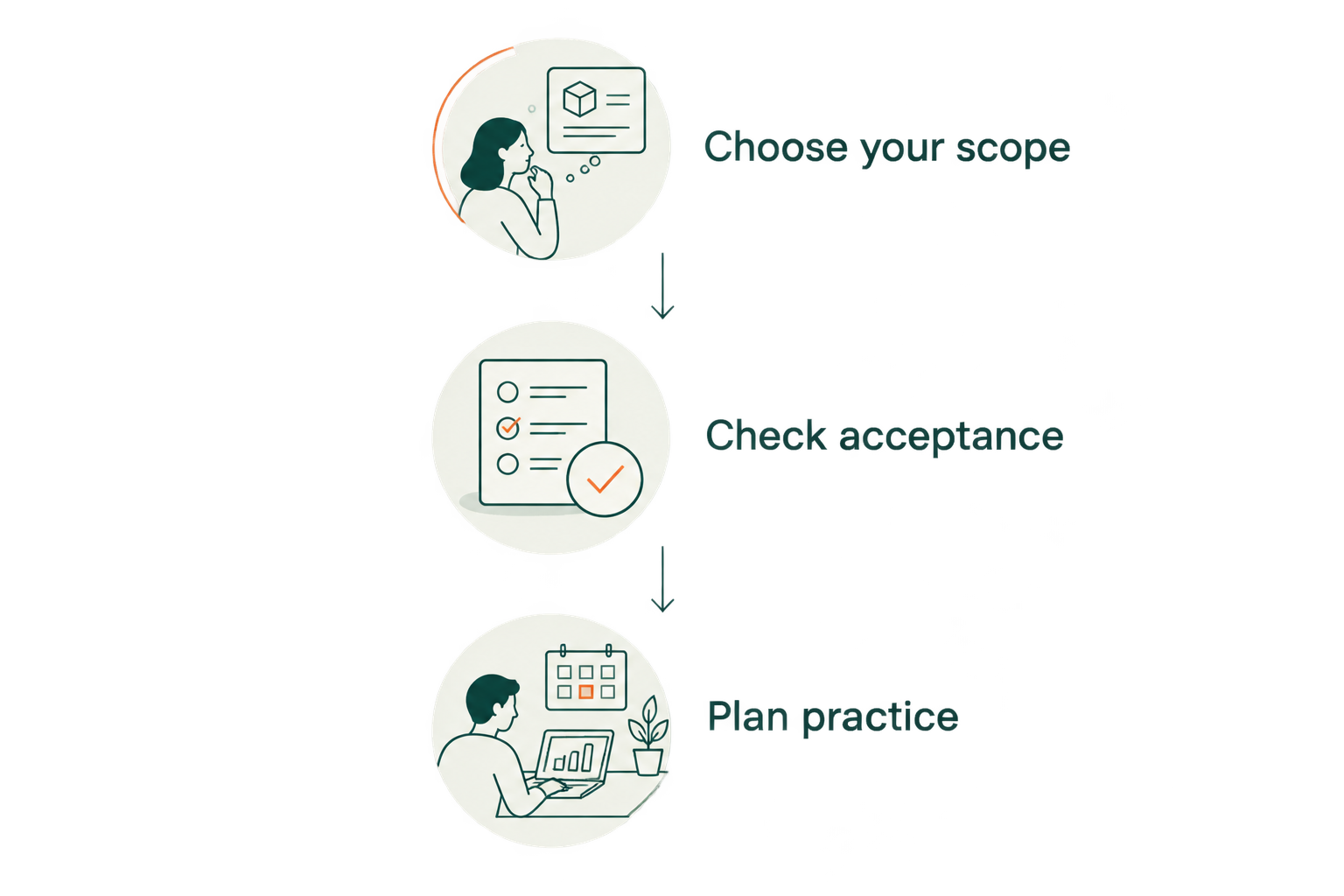
Make 3 decisions before enrolling: what you want to teach, where you want to teach, and how you will demonstrate readiness. This keeps your training plan tied to a real teaching goal.
- Choose your scope. Specify mat classes, Reformer sessions, or another clearly defined service. Avoid using “teach Pilates” as shorthand for every format.
- Check acceptance. Contact the intended employer and insurer with the course name and curriculum. Ask what additional evidence they require.
- Plan practice. Identify how you will rehearse instruction, receive feedback, and complete the assessments required for your intended role.
A useful message to a studio is straightforward: explain the format you want to teach, name the course you are considering, and ask whether its completion meets the studio’s requirements. Request details about auditions, apparatus preparation, and any additional credentials rather than asking only whether the course is “recognized.”
Where the self-paced course fits
TeachPilates is best for aspiring instructors seeking self-paced online Pilates teaching foundations. The $497 tuition and flexible study format provide a clear starting point for comparing your options.
The stated curriculum includes anatomy, mat instruction, introductory Reformer concepts, cueing, and business skills. Those subjects address the transition from participating in Pilates to preparing to teach it.
The limitation is equally important: online study and introductory Reformer content must not be presented as dedicated hands-on apparatus qualification. Before enrolling, confirm assessment methods, current access terms, tutor support, and the exact wording of the certificate. Do not assume that a separate independent credential is included.
For a 2026 enrollment decision, choose this route because its scope and study format fit your goal—not because any course can promise a job or acceptance at every studio.
Review your instructor training option
Explore the $497 self-paced course and check its scope against your teaching goals.
Can I teach Pilates with only a personal trainer certificate?
A personal trainer certificate alone does not establish Pilates-specific teaching preparation. Review what your credential actually assessed, then compare that with the Pilates service you want to offer.
Ask your employer and insurer whether your documented education meets their requirements. Do not advertise Pilates expertise solely on the basis of a different fitness qualification.
Do I need both qualifications to get hired?
You need both only when the role or employer requires both. A position combining personal training and Pilates presents a different qualification question from a position focused only on Pilates instruction.
Ask the hiring manager to identify required credentials separately from preferred credentials. That distinction helps you avoid paying for an additional course before you know whether it serves your goal.
Does certification mean I can start teaching immediately?
Certification alone does not answer every readiness or permission question. Before accepting clients, complete 4 checks: your teaching scope, employer acceptance, insurance coverage, and applicable local requirements.
Also assess whether you can explain exercises, observe participants, and respond appropriately within your training. A completion document and practical teaching readiness are related, but they are not interchangeable.
FAQ
Do you need to be a personal trainer to teach Pilates in 2026?
No—a personal trainer credential is not a universal prerequisite for Pilates instructor training. Check the chosen course’s admission rules and the requirements of your intended employer, insurer, and location.
Can I train as a Pilates instructor without teaching experience?
Yes. TeachPilates states that no teaching background is required; review its current prerequisites and plan time to practice explaining, demonstrating, and observing movement.
Does a personal trainer qualification replace Pilates certification?
Do not treat a personal trainer qualification as a replacement for Pilates-specific preparation. Compare its assessed content with the Pilates teaching role and ask the employer and insurer what documentation they require.
Is online Pilates training enough to teach Reformer classes?
Online study alone does not establish dedicated hands-on Reformer qualification. Check apparatus-specific practice, assessment, equipment access, and the intended workplace’s requirements.
How much is the self-paced Pilates instructor course?
TeachPilates lists $497 tuition for its self-paced online instructor certification course. Confirm current assessment, access, and completion terms before enrolling, and separate tuition from any additional preparation your intended role requires.
Do all studios accept the same Pilates certificate?
Do not assume universal studio acceptance. Send the intended studio the course name, curriculum, teaching scope, and assessment details before you enroll.
Is a course certificate the same as an independent credential?
No—a course completion certificate and a separately issued independent credential are different. Check who issues each document and whether any separate application or assessment is required.
One last thing
Ask the workplace before you buy the prerequisite you think it wants. A short, specific requirements check is more useful than adding a personal training certificate to your plan without a reason.
Keep the reply alongside your course information. When you compare training, you can then judge each option against a documented teaching goal rather than a vague promise of being “fully qualified.”