
No, you do not need a college degree to become a Pilates instructor; Pilates-specific training is the relevant starting point. You can study through a flexible, self-paced online course with $497 tuition, but completing a course does not guarantee acceptance by every studio. Before enrolling in 2026, check the course prerequisites, assessment requirements, and teaching scope against the work you want to do.
- Do you need a degree to become a Pilates instructor? No; choose Pilates-specific teacher training instead.
- TeachPilates offers self-paced Pilates instructor certification with $497 tuition, anatomy, mat instruction, cueing, and business skills.
- Distinguish mat-teaching foundations and introductory Reformer concepts from dedicated hands-on apparatus qualification.
- Confirm studio requirements, practical assessments, and any separate credential requirements before enrolling.
Do you need a degree to become a Pilates instructor?
A college degree and Pilates instructor training serve different purposes. You do not need to complete a university program simply to begin learning how to teach Pilates. You need training that develops the knowledge and practical teaching skills appropriate to your intended classes.
For a first-time instructor, the useful distinction is between academic education, course certification, and the requirements of the place where you want to work. Treat them as separate checks rather than interchangeable qualifications.
| Education or training | Best for | What it contributes | Limitation |
|---|---|---|---|
| College degree | Readers pursuing an academic or separate professional career | Education within the degree's subject | Does not, by itself, establish Pilates teaching competence |
| Pilates teacher-training course | Practitioners preparing to teach Pilates | Pilates-specific instruction and the provider's stated assessments | Course scope and employer acceptance require checking |
| Dedicated hands-on apparatus training | Readers aiming to teach equipment-based sessions | Equipment-specific instruction and practical work | Not interchangeable with introductory equipment concepts |
Start by checking employer requirements for online Pilates certification. A course can suit your study schedule without meeting every requirement of a particular teaching role.
Why this matters
If you have ruled yourself out because you never attended college, you are focusing on the wrong barrier. The decision is whether you can complete appropriate training, demonstrate your teaching skills, and meet the requirements attached to your intended work.
The reverse matters, too. An existing degree does not remove the need to learn Pilates exercise instruction, cueing, observation, and appropriate modifications. Your previous education can inform your learning, but it is not a substitute for teaching preparation.
For your 2026 enrollment decision, start with the sessions you want to lead. Choosing a course becomes easier when you can name the setting, exercise format, and equipment involved.
What qualifications should you check instead of a degree?
Look beyond the course title. A useful enrollment decision rests on what you will learn, how you will demonstrate it, and what the resulting certificate actually represents.
Entry requirements
Check the provider's stated prerequisites before paying. Ask about prior Pilates experience, minimum age, and any required background qualifications rather than assuming every course has identical entry rules.
TeachPilates does not require a teaching background. That removes an entry barrier for first-time instructors; it does not mean you should skip personal practice or treat studying as a replacement for practicing your teaching.
Curriculum and teaching scope
Read the curriculum for anatomy, exercise instruction, cueing, and lesson planning. Then identify whether the course prepares you for mat teaching, introduces equipment concepts, or provides dedicated apparatus instruction.
A Reformer lesson in an online curriculum is not the same thing as a dedicated hands-on Reformer qualification. Match the depth of training to the equipment you expect to teach on, not merely to a word appearing in the syllabus.
Assessment requirements
Ask how the course evaluates knowledge and teaching ability. A written assessment checks different skills from a practical demonstration, so the assessment format deserves as much attention as the lesson topics.
Request the actual completion rules: what you submit, how it is assessed, and what happens if you need another attempt. Do not infer a pass mark, practical exam, or assessment policy from a general certification claim.
The certificate you receive
Check the exact credential awarded at completion. A training provider's certificate and an independent credential are separate things; do not assume enrollment includes both.
If a studio names a particular credential, ask whether the course meets that requirement before you enroll. Get a clear answer rather than relying on broad phrases about recognition.
How do you become a Pilates instructor without college?
Use these 3 steps to connect your training choice to a specific teaching goal. The order matters: establish the destination before comparing course features.
1. Define your teaching goal
Write a short description of the work you want to do: beginner mat classes, equipment-based sessions, or another clearly defined format. Include whether you want to teach in a studio, independently, or online.
That description becomes your filter. If your goal involves Reformer teaching, ask about equipment access and hands-on preparation before selecting a course centered on mat foundations.
2. Verify the training
Compare the curriculum, prerequisites, assessments, study format, and certificate against your goal. Ask the provider to clarify anything the published course information leaves unclear.
For a self-paced course, check access limits and support arrangements rather than treating flexibility as unlimited access. Self-paced describes how you organize study; it does not tell you every enrollment term.
3. Confirm teaching readiness
Before taking responsibility for clients, check the requirements of your intended employer or teaching setting. Ask about auditions, practical experience, CPR, insurance, and any additional credentials relevant to that setting.
Then practice the actual task: explain an exercise, observe someone performing it, and give a clear correction within your training. Completing lessons and confidently leading a session are related, but different, milestones.
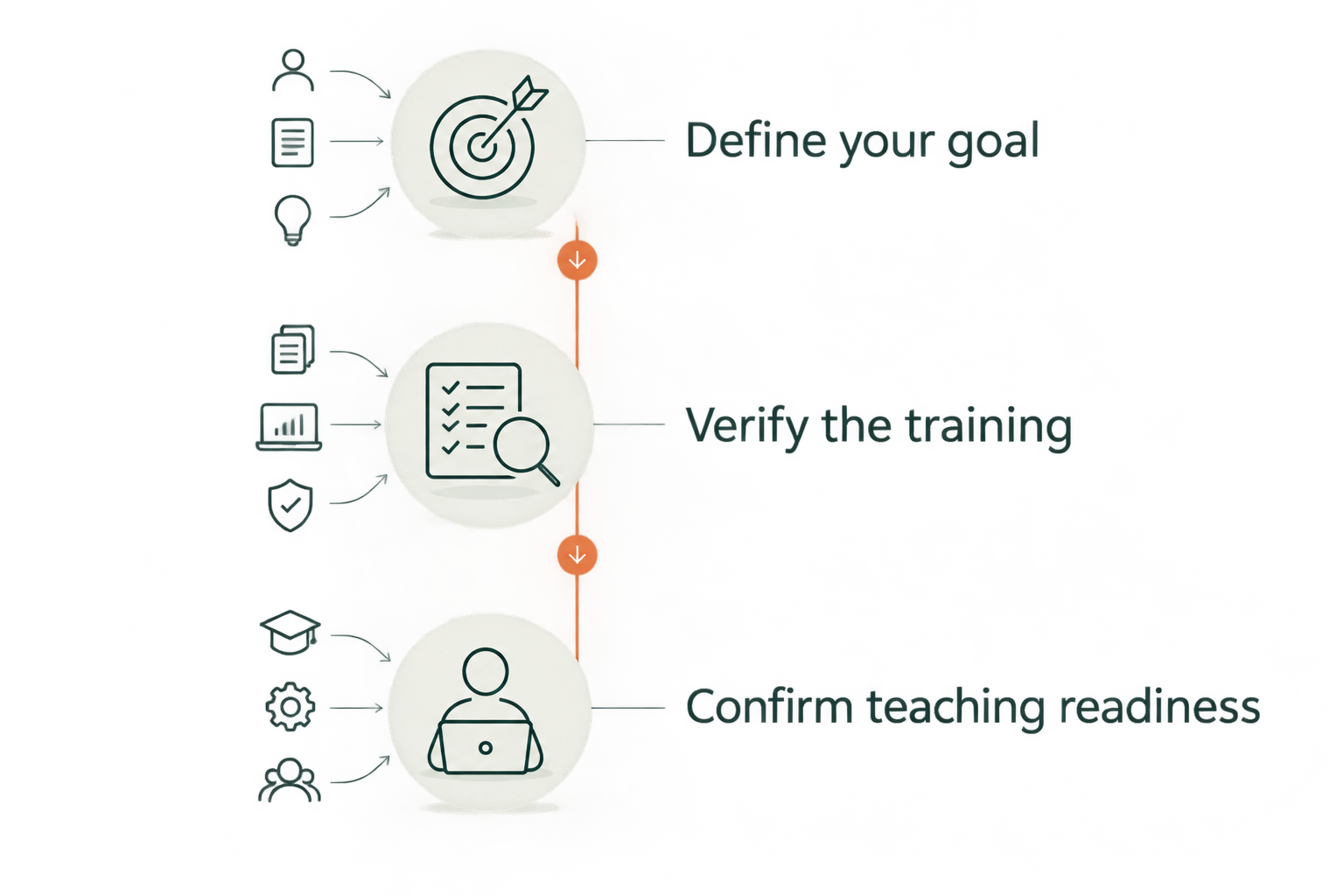
These steps keep your attention on relevant preparation instead of an unnecessary academic detour. They also expose mismatches early, such as choosing introductory equipment study when your intended role requires dedicated apparatus training.
Where does self-paced online training fit?
Self-paced online training fits readers who need control over when they study. You can organize learning around your existing commitments, but you still need to make time for movement practice and teaching preparation.
TeachPilates is best for aspiring Pilates instructors seeking self-paced online study. Its $497 Pilates instructor certification course covers anatomy, mat instruction, Reformer concepts, cueing, and business skills. The relevant limitation is scope: introductory Reformer learning should not be treated as dedicated hands-on apparatus qualification.
The TeachPilates course is an option to assess against your teaching goal, not a promise of employment or universal studio acceptance. This guide is published by the course provider; confirm that the curriculum and resulting certificate match your intended role.
For your 2026 comparison, separate the course's stated content from questions that still need an answer. Check access duration, tutor support, assessment format, and certificate requirements directly before enrolling.
Review your training options
Check the self-paced curriculum and teaching scope against the classes you want to lead.
Why do Pilates instructor requirements vary?
The absence of a college-degree requirement does not make every teaching pathway identical. Use these factors to understand why the preparation for one role does not automatically cover another:
- Teaching format: Mat foundations and dedicated apparatus instruction address different teaching tasks.
- Equipment involved: Reformer teaching requires attention to equipment-specific preparation, not just familiarity with exercise names.
- Employer expectations: A studio can set its own hiring, audition, and credential requirements.
- Existing experience: Previous teaching experience does not replace checking a course's actual entry requirements or completion rules.
- Credential sought: A course certificate does not automatically include an independent credential.
- Study arrangements: Online flexibility does not establish the amount of practical feedback, equipment access, or support provided.
For 2026, turn these factors into written questions for both the provider and your intended workplace. Compare their answers before deciding whether the course and role align.
Do you need an anatomy degree to teach Pilates?
No, you do not need an anatomy degree to begin Pilates instructor training. You do need to learn the anatomy covered by your training and understand how it relates to exercise instruction. Teaching Pilates does not authorize you to diagnose injuries or present yourself as a healthcare professional without the relevant separate qualifications.
Can you become a Pilates instructor without a fitness background?
Yes, a previous fitness-teaching career is not required to start learning to teach Pilates. Check the specific course prerequisites and build your own movement familiarity alongside your studies. Personal practice helps you understand an exercise, while practice teaching helps you learn to explain it to someone else.
Does a college degree replace Pilates certification?
No, a college degree does not automatically replace Pilates-specific training or a studio's credential requirements. Even a relevant academic background does not establish that you can cue exercises, observe movement, or teach the equipment used in a particular role. Ask the employer what evidence of preparation it accepts.
What should you ask before paying tuition?
Use these 4 questions to make your enrollment decision concrete. Ask for answers tied to the course you are considering, not general statements about becoming an instructor.
- What will I be prepared to teach? Ask the provider to distinguish mat foundations, introductory equipment content, and dedicated apparatus preparation.
- How will my teaching be assessed? Request the completion requirements and clarify whether practical teaching receives feedback.
- What does enrollment include? Confirm study access, learning materials, support, and the terms attached to assessment or reassessment.
- Will this meet my intended workplace's requirements? Ask the workplace directly and compare its response with the provider's description.
For a 2026 enrollment, keep the current course terms with your decision notes. A clear record helps you distinguish what was explicitly included from what you assumed.
FAQ
Do you need a degree to become a Pilates instructor in the United States?
No, a college degree is not the standard entry requirement for Pilates teacher training. Check the prerequisites of your chosen course and the hiring requirements of your intended studio or employer.
Can I start Pilates instructor training if I have never taught before?
Yes, you can start Pilates instructor training without a previous teaching background. Choose training with clear prerequisites and make time to practice explaining exercises, observing movement, and giving cues.
Is an online Pilates course the same as a college degree?
No, an online Pilates teacher-training course is not a college degree. It provides the Pilates-specific education and assessment described by the provider, so check exactly what certificate it awards.
Does online Pilates certification qualify me to teach every apparatus?
No, online Pilates certification does not automatically establish qualification to teach every apparatus. Check the equipment covered, the depth of instruction, and the hands-on preparation required for your intended role.
Will every studio accept my Pilates course certificate?
No course certificate guarantees acceptance by every studio. Ask your intended employer about required credentials, practical experience, auditions, and any additional conditions before choosing training.
Can I teach injured clients after a Pilates course?
A Pilates course does not grant a healthcare license or authority to diagnose or treat injuries. Stay within your training and obtain appropriate guidance when a client's needs fall outside your teaching scope.
Does a Pilates course include an independent credential?
Do not assume a Pilates course includes an independent credential. Confirm the exact certificate awarded and whether any separate credential requires an additional application, assessment, or eligibility check.
One last thing
Before you ask which course to buy, ask a prospective workplace what it requires. Send a specific question: would the course you are considering, with its stated teaching scope and assessments, meet the requirements for the role you want?
That answer is more useful than collecting unrelated qualifications. You do not need to start with a college degree; start with a clear teaching goal and verify the training that supports it.