
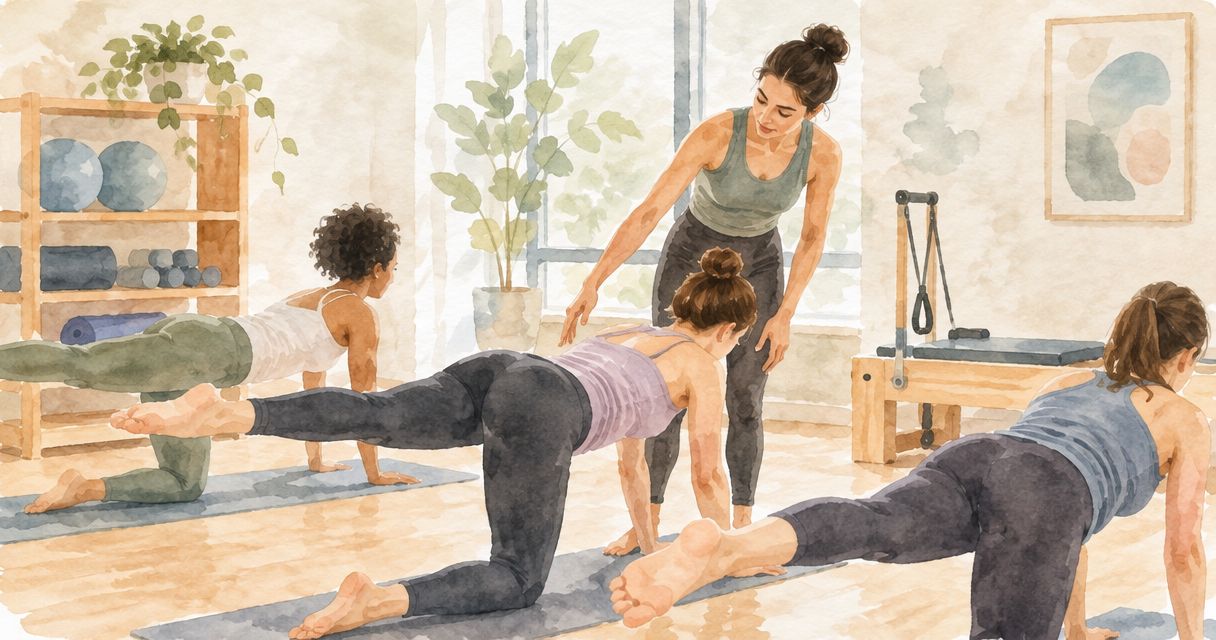
You can teach Pilates right after certification when your training covers the class you plan to teach, you can demonstrate safe instruction, and you meet the requirements of your teaching setting. A $497 self-paced training route lets you study flexibly, but completing a course does not guarantee studio acceptance or qualify you to teach every apparatus or client population.
- You can teach Pilates right after certification when your teaching scope, practical readiness, and workplace requirements align.
- TeachPilates offers self-paced Pilates instructor certification for $497; choose it for flexible study, not guaranteed studio acceptance.
- Mat-teaching foundations and introductory Reformer concepts are not the same as dedicated hands-on apparatus qualification.
- Before accepting clients, confirm insurance coverage, employer requirements, and your ability to teach rather than simply perform exercises.
Can you start teaching Pilates right after certification?
Yes, provided the qualification matches the work and you are ready to lead the session. Certification marks completion of a training program; your next step is to check what that training prepares you to teach and what your intended workplace requires.
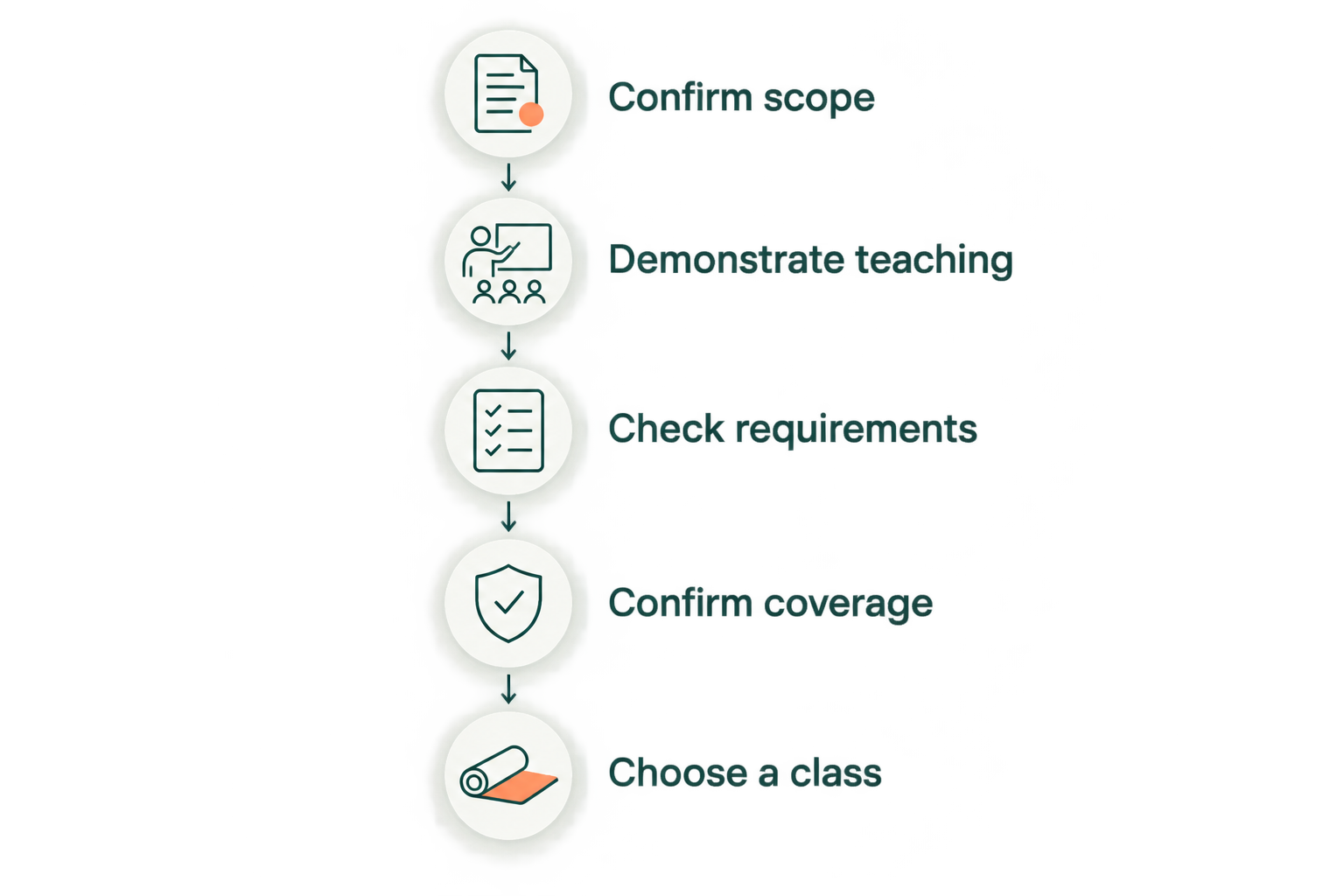
Use this 2026 starting checklist alongside the Pilates instructor requirements, CPR, and insurance checks. Treat each step as a decision, not a paperwork exercise.
- Confirm scope. Read the course description and completion documents. Identify whether your education covers mat instruction, introductory apparatus concepts, or dedicated apparatus teaching.
- Demonstrate teaching. Lead a practice session aloud, watch the participant, and adapt your instructions. Completing an exercise yourself is different from helping someone else understand it.
- Check requirements. Ask your intended employer or venue which certificates, assessments, CPR credentials, and other documents it requires.
- Confirm coverage. Describe your planned activities accurately to an insurer. Ask whether the policy covers your teaching format, equipment, and location.
- Choose a class. Begin with a session you can explain, observe, and adapt within your training. Do not accept a broader teaching brief just because a space becomes available.
A missing requirement is a reason to resolve that requirement—not a reason to assume your entire training was unsuitable. Equally, having every document ready does not replace the ability to give clear instructions and respond when someone struggles.
Why this matters
Your first teaching decision is not simply whether you have earned a certificate. It is whether you can deliver the particular session a client or studio expects.
For your 2026 teaching plan, separate three questions: what you studied, what you can demonstrate, and what the setting accepts. A positive answer to one does not answer the others.
This distinction also protects your enrollment decision. Before paying for training, work backward from the role you want: teaching beginner mat sessions requires a different preparation plan from leading equipment-based classes. Choose education for the work, rather than choosing work to justify a certificate you already bought.
Which teaching setting fits your preparation?
Compare the teaching task before comparing job titles. “Pilates instructor” alone does not tell you which equipment, clients, or delivery format a role involves.
| Teaching option | Best for | Practical advantage | Limitation to address |
|---|---|---|---|
| Mat instruction | New instructors whose training and demonstrated skills cover mat teaching | Lets you focus on exercise explanation, observation, and class structure without operating a Reformer | Mat preparation does not establish apparatus-teaching competence |
| Reformer instruction | Instructors with relevant apparatus education and hands-on preparation | Aligns your teaching with equipment-based sessions | Introductory Reformer concepts do not equal dedicated hands-on qualification |
| Live online instruction | Instructors prepared to teach and observe through a camera | Allows remote delivery of sessions within your teaching scope | Camera framing limits what you can see; you need a plan for unclear movement or instructions |
Choose the format you are prepared to teach, not the format that looks easiest to sell. Each option still requires clear scope, suitable coverage, and compliance with the relevant workplace or venue requirements.
Mat instruction: start with a class you can explain
For a first mat session, select exercises you understand well enough to explain without copying a demonstration. Know the intended movement, the setup, and an appropriate alternative within your training.
Keep the teaching plan manageable. A shorter list of well-taught movements is a better starting point than a crowded sequence that leaves you unable to observe participants or answer questions.
Reformer instruction: check apparatus preparation separately
A curriculum can introduce Reformer principles without providing the hands-on preparation needed for independent apparatus teaching. Ask exactly what practical training and assessment the role expects.
Do not use mat certification as a substitute for that conversation. Before accepting a Reformer class, confirm your preparation for equipment setup, operation, exercise instruction, and the studio's procedures with the relevant training provider and employer.
Live online instruction: rehearse the viewing conditions
Test the camera position you will actually use. Check whether a participant can see your demonstrations and whether you can observe the movements you intend to teach.
Plan what you will do when the view is inadequate. Pausing to clarify an instruction or changing the exercise is more responsible than continuing a sequence you cannot meaningfully observe.
Why the time between certification and teaching varies
There is no useful single start date without knowing your training, intended role, and remaining checks. Your path depends on these factors:
- Training scope. Anatomy, mat instruction, Reformer concepts, cueing, and business education cover different parts of preparation. Check which teaching activities your course actually assesses.
- Practical readiness. Knowing exercise names is not the same as giving instructions, observing a participant, and making an appropriate adjustment.
- Assessment status. Confirm that you have completed the provider's required assessments rather than assuming that finishing lesson content means certification is complete.
- Employer expectations. Ask the studio which credentials and teaching demonstrations it accepts before committing to a start date.
- Teaching arrangements. Clarify insurance, venue conditions, equipment access, and online delivery arrangements for the work you intend to do.
Build your 2026 start date around completed checks, not an assumed waiting period. If everything required is ready, an arbitrary delay adds nothing; if something important remains unresolved, the certificate date does not make it disappear.
What should you be able to demonstrate before your first class?
Show that you can teach a person, not recite a sequence. Use a practice session to identify where your explanations, observation, or planning need work.
Give a complete setup instruction before asking the participant to move. Explain the starting position and the action in plain language, then watch whether the instruction produces the movement you intended.
Next, practice responding to confusion. If repeating the same words does not help, try a clearer explanation or an appropriate alternative you learned during training. Avoid improvising advice outside your competence.
Finally, rehearse the transitions and ending. You should know how the session progresses, what equipment is needed, and how to stop or change an exercise when continuing is inappropriate.
Ask a qualified mentor or prospective employer for feedback when possible. Request specific observations about your cueing, pacing, exercise choices, and ability to notice what the participant is doing—not simply whether you seemed confident.
Confidence is useful. Observable teaching skill is the stronger basis for accepting a class.
How does TeachPilates fit a first-time instructor's plan?
TeachPilates offers a self-paced online Pilates instructor certification course for $497, covering anatomy, mat and Reformer instruction, cueing, and business skills. No teaching background is required, making the course relevant to practitioners preparing to teach for the first time.
TeachPilates is best for aspiring Pilates instructors who want self-paced online study. The practical advantage is flexibility; the limit is that online course completion alone does not establish acceptance by a particular studio or independent apparatus-teaching competence.
For a 2026 enrollment decision, review the TeachPilates course against the role you want. Ask about current assessment methods, practical feedback, access terms, and the precise teaching scope before enrolling.
Keep the distinctions clear. Mat-teaching foundations and introductory Reformer concepts are not a dedicated hands-on apparatus qualification, and a provider's course certificate is not automatically a separate independent credential.
This guide is published by TeachPilates. Choose the training route that matches your intended work, including dedicated hands-on apparatus education when that is what your target role requires.
What should you ask a studio before accepting your first class?
Ask the studio to describe the actual class, not just confirm that it hires newly certified instructors. Find out which equipment, participant level, and responsibilities the position involves.
Then ask which qualifications it accepts and whether it requires an audition, supervised teaching, CPR documentation, or other onboarding steps. Get a clear answer about your specific course rather than relying on a general statement about online education.
Bring your course outline and assessment information to the conversation. These documents let the employer evaluate what you studied without guessing from the certificate title.
Discuss what happens when a participant needs support beyond your training. Clarify whom you should ask for help and which classes are appropriate for you to cover. Do not agree to substitute for an unfamiliar format solely to secure your first opportunity.
Can you teach Pilates while you are still training?
Practice teaching during training and independently selling instruction are different decisions. Follow your course's practice arrangements, identify yourself accurately as a trainee, and confirm the supervision and insurance conditions for the activity.
Do not describe an unfinished qualification as completed. When an opportunity exceeds your current preparation, ask whether observation or supervised participation is appropriate instead.
Does online certification qualify you to teach Reformer classes?
Online certification alone does not establish hands-on Reformer teaching competence. Check the specific apparatus curriculum, practical assessment, and employer expectations rather than treating “online” or “certified” as a complete answer.
If a role requires dedicated apparatus qualification, introductory Reformer content is not a substitute. Choose additional practical preparation that addresses the requirement.
Do you need another credential after course certification?
Course certification and an independent credential are separate qualifications. Whether you need another credential depends on the role, employer, and professional pathway you intend to pursue.
Do not assume a separate examination or credential is included in tuition. Confirm what the course awards and compare that with the documents your intended workplace requests.
FAQ
Can I teach Pilates right after certification?
You can teach Pilates right after certification when your training covers the session, you can demonstrate appropriate teaching skills, and you meet the requirements of your setting. Confirm employer expectations and insurance before accepting clients.
Do I have to wait after passing my Pilates course?
Base your start date on completed requirements and teaching readiness, not an assumed waiting period. Check that your certification is complete and that the employer or venue has accepted the required documents.
Is online Pilates certification enough to get hired?
Online Pilates certification does not guarantee that a particular studio will hire you. Ask the employer whether it accepts the specific course and what practical assessment or additional preparation it requires.
Can I teach Reformer Pilates with mat training?
Mat training alone does not establish Reformer teaching competence. Confirm the apparatus-specific education, hands-on preparation, and assessments required for the classes you want to lead.
What should I check about insurance before teaching Pilates?
Check whether the policy covers your intended activities, teaching location, equipment, and delivery format. Describe the work accurately to the insurer rather than assuming all Pilates instruction falls under the same coverage.
Should I practice teaching before taking paying clients?
Practice teaching before taking paying clients so you can identify gaps in your instructions, observation, and class planning. Use feedback to decide which sessions are within your current competence.
Does a Pilates course certificate include an independent credential?
A Pilates course certificate does not automatically include a separate independent credential. Check exactly what the provider awards and whether your target employer requests an additional qualification.
One last thing
Before accepting your first class in 2026, write its description as if a client were booking it today. State the format, equipment, intended participant, and what you will teach.
Now compare that description with your training and demonstrated skills. If the class promises more than you are prepared to deliver, narrow the class—not the meaning of your qualification. A clear first teaching offer is more useful than a broad instructor title.