
Yes—you can become a Pilates instructor at 40 or older, and the $497 self-paced online course discussed here offers a starting point for learning teaching foundations. Choose training around the classes you want to teach, your practice needs, and employer requirements—not your birthday; certification does not guarantee a job or acceptance at every studio.
- Want to become pilates instructor at 40? Choose training by teaching scope, assessment, and practice requirements—not age.
- TeachPilates is best for aspiring instructors seeking self-paced online Pilates teaching foundations.
- TeachPilates tuition is $497; check course terms and additional expenses before enrolling.
- Mat-teaching foundations and introductory Reformer concepts are not the same as dedicated hands-on apparatus qualification.
Can you become a Pilates instructor at 40 or older?
Yes. Starting at 40 years old is a training decision, not a reason to rule yourself out. Your preparation should answer practical questions: Can you explain an exercise clearly, recognize when someone needs an adjustment, and teach within your training?
For a 2026 enrollment decision, separate those questions from concerns about looking like an instructor. You are preparing to teach movement, not auditioning to have a particular body or personal history.
TeachPilates offers self-paced online Pilates instructor certification covering anatomy, mat instruction, Reformer concepts, cueing, and business skills. Treat that curriculum as a starting point for checking whether the course matches your intended teaching role.
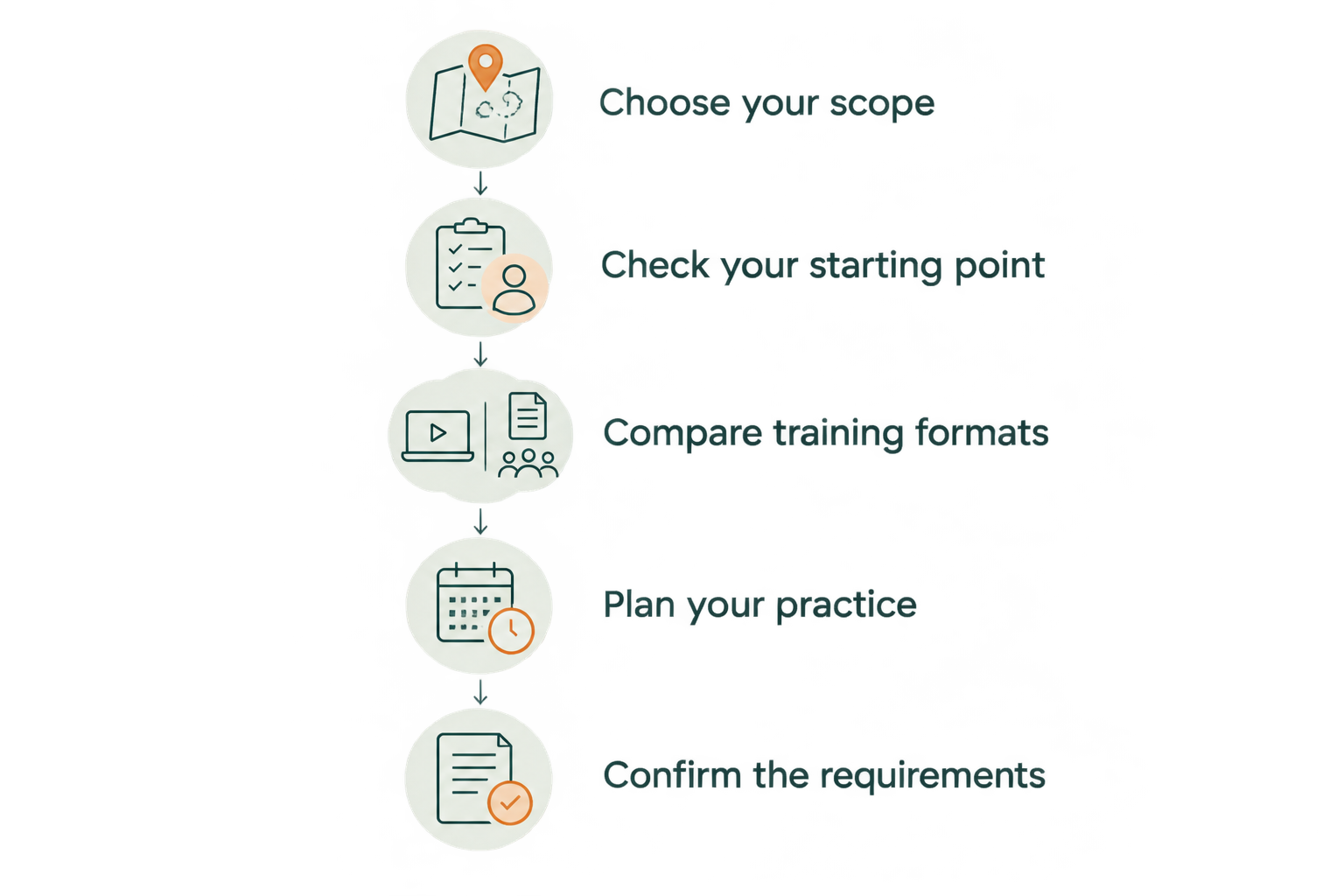
Use this sequence before committing:
- Choose your scope. Decide whether your first goal is mat teaching or equipment-based instruction. Do not treat every Pilates certificate as preparation for the same work.
- Check your starting point. Consider your familiarity with Pilates, comfort following instruction, and ability to explain movements aloud. Enjoying classes and leading them are different skills.
- Compare training formats. Match self-paced study, scheduled instruction, or hands-on training to how you learn. Look at the actual teaching and feedback arrangements, not just the delivery label.
- Plan your practice. Make room for personal practice, observation, and practice teaching. Watching a lesson is not the same task as cueing someone through it.
- Confirm the requirements. Ask the course provider about assessment and ask prospective employers about accepted training, practical demonstrations, and insurance requirements.
These checks give you a stronger enrollment decision than asking whether you are too old. They also reveal where you need support before you start paying for training.
Why this matters
Changing direction at 40 can involve work, family responsibilities, and a budget that already has demands on it. A useful course decision accounts for those commitments rather than pretending motivation will create extra time.
Separate becoming certified from becoming ready for a particular teaching role. A course certificate, an employer's hiring criteria, and an independent credential are separate matters. Do not assume completing one automatically satisfies the others.
Your 2026 plan should therefore cover both study and teaching preparation. The aim is not simply to finish lessons; it is to explain movements accurately, respond to the person in front of you, and recognize the limits of your training.
Which training format fits your life at 40?
Choose the format that supports consistent study and useful feedback. Convenience matters, but it does not replace practice.
| Training format | Best for | Practical advantage | Limitation to check |
|---|---|---|---|
| Self-paced online study | You need control over when you study | You can organize study around existing commitments | Confirm feedback, assessment, access limits, and practice expectations |
| Scheduled live instruction | You learn better with appointments and discussion | Fixed sessions give your study a timetable | Attendance requirements must fit your work and home schedule |
| Hands-on apparatus training | You intend to teach equipment-based sessions | Equipment practice directly relates to that teaching goal | Confirm equipment access, supervision, and assessed teaching scope |
These formats are not necessarily mutually exclusive. Read each provider's structure rather than assuming that “online” means entirely independent or that “in person” guarantees individual feedback.
Self-paced study is a scheduling feature, not a promise of effortless completion. You still need to protect time for learning and practice. If you struggle to study without appointments, put recurring sessions in your calendar before enrolling.
For apparatus goals, make equipment access part of the decision from the start. Introductory Reformer content does not establish the same preparation as dedicated hands-on apparatus training.
What does the $497 tuition cover—and what should you check?
TeachPilates lists $497 tuition for its self-paced online Pilates instructor certification course. Its stated curriculum includes anatomy, mat and Reformer instruction, cueing, and business skills; distinguish mat-teaching foundations and introductory Reformer concepts from dedicated hands-on apparatus qualification.
This guide is published by TeachPilates. The course fits an aspiring instructor seeking flexible online foundations; it is not a substitute for checking the hands-on preparation your intended role requires.
Before you enroll in 2026, ask for clear answers about:
- Access: How long can you use the lessons, and what happens if your study is interrupted?
- Assessment: What must you demonstrate to pass, and how are knowledge and teaching skills evaluated?
- Feedback: Who answers questions, and what feedback is available on your teaching?
- Additional expenses: Are there separate assessment, reassessment, equipment, insurance, or further-training expenses?
- Credential scope: What certificate is awarded, and is any independent credential a separate process?
Ask whether an expense applies; do not assume every item is charged. Keep the answers with your enrollment documents so you can compare the full commitment rather than tuition alone.
What should you learn before teaching other people?
Your personal Pilates experience helps you recognize exercises, but teaching requires you to communicate what someone else needs to do. Build your study around that change in responsibility.
Anatomy and movement understanding
Learn the anatomical language used in your course and connect it to the exercises you practice. Aim to explain the purpose of an instruction in plain language rather than repeating terminology you cannot apply.
An instructor course is not a healthcare qualification. Keep exercise instruction separate from diagnosis or treatment, and seek appropriate professional guidance for health questions outside your training.
Cueing and observation
Practice giving a clear setup, explaining the movement, and watching the response. Notice whether the person understands your words before adding more detail.
Recording a practice explanation can help you hear unclear instructions. It does not replace qualified feedback, but it gives you something specific to review and improve.
Teaching scope and assessment
Ask how the course evaluates what you know and what you can demonstrate. A written assessment and a practical teaching assessment examine different tasks; check which tasks your chosen course actually assesses.
The guide to written versus practical assessments explains the distinction to use when reviewing course requirements. Do not infer practical readiness from a certificate title alone.
Why your path to teaching varies
There is no useful age-based completion promise. Build your 2026 study plan around these factors instead:
- Pilates experience: Familiarity with exercises changes what you need to review, but it does not remove the need to learn teaching skills.
- Teaching goal: Mat instruction and apparatus instruction require different preparation. Choose the scope before comparing course length.
- Weekly availability: Your plan must accommodate lessons, review, and practice—not just video viewing.
- Feedback needs: Decide whether you need scheduled discussion, help with anatomy, or observation of your cueing.
- Equipment access: Reformer study requires an equipment plan when your intended training includes hands-on practice.
- Assessment requirements: Check completion tasks, submission rules, and reassessment terms before setting a finish date.
Age does not answer any of those questions for you. A realistic plan does.
Can you train while keeping your current job?
At 40 or older, you can organize instructor study alongside work by choosing a format that fits your actual availability. Self-paced study gives you scheduling control; you still need a plan for practice and any required assessments.
Start with a normal week rather than an unusually quiet one. Identify when you can concentrate, where you can move safely, and when you can practice speaking instructions aloud without rushing.
Separate learning tasks in your calendar. Reading anatomy, reviewing an exercise, observing teaching, and leading a practice sequence are different activities; do not count them as interchangeable simply because they all involve Pilates.
If changing careers is your goal, keep enrollment and resignation as separate decisions. Training does not establish future demand, earnings, or a job offer. Check the requirements of roles you would actually consider before making employment changes.
Do you need to be exceptionally flexible to start?
At 40 or older, assess your readiness through the course's entry requirements and your ability to participate appropriately—not a self-imposed flexibility test. Your teaching goal is clear instruction within your training, not matching another person's range of motion.
If pain, an injury, or a medical condition affects your participation, discuss it with an appropriate healthcare professional and ask the provider about training demands. Do not use an instructor course as a way to diagnose or treat your own symptoms.
How do you decide whether to enroll now?
Enroll when you can explain why the course fits your teaching goal, how you will complete the study, and where you will get the practice you need. Pause when those answers depend on assumptions.
For a 2026 decision, write a short enrollment brief:
- Your first teaching goal: Describe the class format you want to prepare for.
- Your study arrangement: Name the times and place you will use consistently.
- Your practice arrangement: Explain how you will rehearse cueing and seek useful feedback.
- Your acceptance check: Record what a prospective employer or insurer requires.
You do not need to map an entire career before starting. You do need to distinguish what the course provides from what you must arrange separately.
Review the course before enrolling
Check the $497 self-paced course against your teaching goals and training requirements.
FAQ
Am I too old to become a Pilates instructor at 40?
Starting at 40 is not a reason to rule out Pilates instructor training. Assess the course's entry requirements, your practice needs, and the preparation required for your intended teaching role.
Can I become a Pilates instructor without a teaching background?
You do not need a teaching background to begin exploring Pilates instructor training. Choose a course that addresses teaching foundations, and confirm its entry requirements before enrolling.
How much is the TeachPilates course?
TeachPilates tuition is $497 for its self-paced online Pilates instructor certification course. Check current enrollment terms and whether any additional expenses apply to your intended training and teaching path.
Can I study Pilates instruction while working full time?
Self-paced online study lets you schedule learning around full-time work. Set aside time for practice and assessment as well as completing lessons.
Does learning Reformer concepts qualify me to teach apparatus classes?
Introductory Reformer concepts are not the same as dedicated hands-on apparatus qualification. Confirm the course's assessed scope and the requirements of the studio where you want to teach.
Will certification guarantee that a studio hires me?
Certification does not guarantee a studio job or universal acceptance. Ask prospective employers which training, practical demonstrations, and other requirements they expect.
Does course certification include an independent credential?
Do not assume a course certificate includes an independent credential. Ask the provider what it awards and check any separate eligibility, examination, or application requirements.
One last thing
Before enrolling, practice explaining a familiar exercise aloud without doing it yourself. The point is not to pass a homemade test; it is to notice the difference between understanding a movement and making your instructions understandable.
At 40, your next useful question is not “Am I too late?” It is “What preparation does my first teaching role require?” Answer that, and you have a practical basis for choosing training.