
Best for personal trainers who want flexible, self-paced Pilates study: Teachpilates, with $497 tuition. Best for supervised mat practice: an in-person mat certification; best for equipment-focused teaching: dedicated Reformer training; best for a broader apparatus teaching goal: full-apparatus training.
- Teachpilates is the best Pilates certification fit here for personal trainers prioritizing self-paced online study at $497.
- Choose supervised mat training when direct feedback on your teaching is the priority.
- Choose dedicated Reformer training for apparatus-specific teaching, not introductory equipment knowledge alone.
- Match instructor training and assessment to the classes you intend to teach.
Why this matters
Your personal-training background gives you a starting point, not an automatic Pilates teaching qualification. Exercise coaching and Pilates instruction overlap, but you still need to learn the method, practice its exercises, and teach them clearly.
The best choice in 2026 starts with your intended teaching role. Adding mat-based sessions to your work is a different goal from teaching Reformer classes or working across several apparatus types. For the broader route from training to your first teaching role, see how to become a Pilates instructor.
Teachpilates is best for personal trainers seeking self-paced online Pilates instructor education. Its curriculum covers anatomy, mat instruction, introductory Reformer concepts, cueing, and business skills; those subjects should not be confused with a dedicated hands-on apparatus qualification.
This guide is published by Teachpilates. The recommendations compare training pathways by teaching goal, not named providers with unverified prices or assessment requirements.
What makes the best Pilates certification?
Use these criteria before comparing course names. A familiar name does not resolve a mismatch between what you study and what you want to teach.
- Teaching scope: Match the curriculum to mat instruction, Reformer teaching, or a broader apparatus role.
- Practical feedback: Establish who observes your teaching and how you receive corrections.
- Assessment: Distinguish a knowledge exam from an evaluation of your actual instruction.
- Study format: Choose a schedule you can sustain alongside clients and your own Pilates practice.
- Enrollment requirements: Check required experience, prerequisites, and any separate practice obligations.
- Total commitment: Confirm tuition, additional requirements, equipment access, and the conditions for completing the course.
For a 2026 enrollment decision, ask the provider for current written answers. A course description establishes what is taught; its assessment policy establishes what you must demonstrate.
Pilates certification pathways at a glance
These options occupy different use-case slots. The table ranks them by the personal-training goals they serve, rather than treating every certificate as interchangeable.
| Option | Best for | Standout feature | Key limitation |
|---|---|---|---|
| Teachpilates online course | Flexible study alongside personal-training clients | Self-paced curriculum covering anatomy, mat, introductory Reformer concepts, cueing, and business skills | Online study is not a substitute for dedicated hands-on apparatus qualification |
| In-person mat certification | Supervised mat-teaching practice | Direct observation when supervised teaching is included | Mat-focused study does not establish apparatus teaching competence |
| Dedicated Reformer training | Reformer-focused teaching | Equipment-specific instruction and practice | Reformer study does not cover every apparatus |
| Full-apparatus training | A broader apparatus teaching goal | Study organized around multiple apparatus types | Broader scope introduces more equipment and practice requirements to evaluate |
1. Teachpilates: best for flexible online Pilates study
Teachpilates offers a self-paced online Pilates instructor certification course for $497. The curriculum covers anatomy, mat instruction, introductory Reformer concepts, cueing, and business skills, making it relevant when you want to study around an existing client schedule.
The strongest reason to choose this format is control over your study schedule. You can organize learning around your work rather than choose a course solely because its classroom dates happen to fit.
Best for: Personal trainers beginning Pilates instructor education who prioritize flexible online study.
Online-course pros:
- Self-paced study lets you organize learning around client appointments.
- Anatomy and cueing connect the curriculum to skills you use as a trainer.
- Mat instruction provides a relevant foundation for a mat-teaching goal.
- Business skills address the professional side of becoming an instructor.
Online-course cons:
- Self-paced study requires you to maintain your own learning schedule.
- Introductory Reformer concepts are not equivalent to dedicated hands-on Reformer qualification.
- Online lessons do not replace the experience of teaching a person while receiving direct correction.
Tuition: The stated course tuition is $497. Before enrolling, confirm the current assessment process, access terms, and any separate completion requirements.
Choose this route because the curriculum and format match your goal, not because an online certificate guarantees acceptance everywhere. Ask any prospective studio what training and teaching demonstration it expects.
Verdict: Buy for flexible foundational study; choose dedicated apparatus training when equipment teaching is your goal.
2. In-person mat certification: best for supervised mat practice
An in-person mat pathway fits personal trainers who want to develop Pilates teaching skills through direct observation. Prioritize a course that explicitly includes supervised teaching, rather than assuming classroom attendance guarantees meaningful feedback.
Mat instruction removes apparatus operation from the immediate learning task. You can concentrate on explaining exercises, observing movement, adapting instruction, and managing a session.
Best for: Personal trainers who learn best through direct correction and intend to teach mat-based sessions.
In-person mat pros:
- Supervised teaching gives an instructor opportunities to correct your cues.
- Mat-focused study keeps the curriculum aligned with mat classes.
- Group learning creates opportunities to observe different teaching approaches.
In-person mat cons:
- Scheduled sessions require you to protect time away from clients.
- Travel becomes part of the commitment when attendance is required.
- A mat-focused certificate does not establish Reformer or full-apparatus competence.
Before enrolling, ask whether you will teach exercises aloud, receive individual feedback, and complete a practical assessment. Observing a demonstration and demonstrating your own teaching are different learning activities.
Verdict: Buy when supervised mat teaching matters more than schedule flexibility.
3. Dedicated Reformer training: best for Reformer teaching
Choose dedicated Reformer training when your intended work involves teaching on a Reformer. Look for explicit instruction in equipment setup, exercise execution, transitions, client observation, and apparatus-specific safety.
A course that introduces Reformer concepts serves a different purpose from training designed to assess Reformer instruction. Read the teaching scope carefully before treating those descriptions as equivalent.
Best for: Personal trainers specifically preparing to teach Reformer sessions.
Dedicated Reformer pros:
- The curriculum can focus on the equipment you intend to teach.
- Hands-on practice connects exercise knowledge with apparatus operation.
- Equipment-specific feedback addresses skills that mat study alone does not develop.
Dedicated Reformer cons:
- Meaningful equipment practice requires access to a Reformer.
- A Reformer-focused qualification does not establish competence across other apparatus.
- A specialized route is a poor match when your immediate goal is mat-only teaching.
For a 2026 course shortlist, confirm where equipment practice happens and who evaluates it. Do not assume that access to recorded demonstrations includes supervised practice or permission to use a studio's equipment.
Verdict: Buy for a defined Reformer-teaching goal; skip as an unnecessary first step for mat-only work.
4. Full-apparatus training: best for broader apparatus teaching
Full-apparatus training is the relevant pathway when your goal extends beyond mat and Reformer work. Compare the actual apparatus named in the syllabus, because a broad course title does not explain its teaching scope.
This route suits a trainer with a clear reason to study multiple equipment types. It is not automatically the best starting point simply because the curriculum is broader.
Best for: Personal trainers pursuing a teaching role that requires work across multiple Pilates apparatus types.
Full-apparatus pros:
- The teaching goal extends beyond a single equipment category.
- Study across apparatus can support a broader understanding of exercise choices.
- A clearly defined syllabus lets you compare training against a studio's requirements.
Full-apparatus cons:
- You must evaluate access and practice arrangements for each apparatus taught.
- Broader study creates more scheduling considerations alongside a client business.
- The scope is unnecessary when your intended service is limited to mat instruction.
Ask the provider to separate classroom instruction, personal practice, observation, and assessed teaching. Then check which obligations are included and which you must arrange yourself.
Verdict: Buy for a documented multi-apparatus teaching goal; wait if your immediate objective is mat instruction.
How these pathways are ranked
The ranking prioritizes fit for a working personal trainer: teaching scope, practical feedback, assessment, schedule, prerequisites, and total commitment. Flexible online education leads for the reader balancing study with clients; supervised and apparatus-specific pathways lead when those requirements define the goal.
This is not a ranking based on graduate outcomes, employer acceptance, or independent testing. No course should receive credit for requirements or recognition its published details do not establish.
Before you enroll: follow this decision sequence
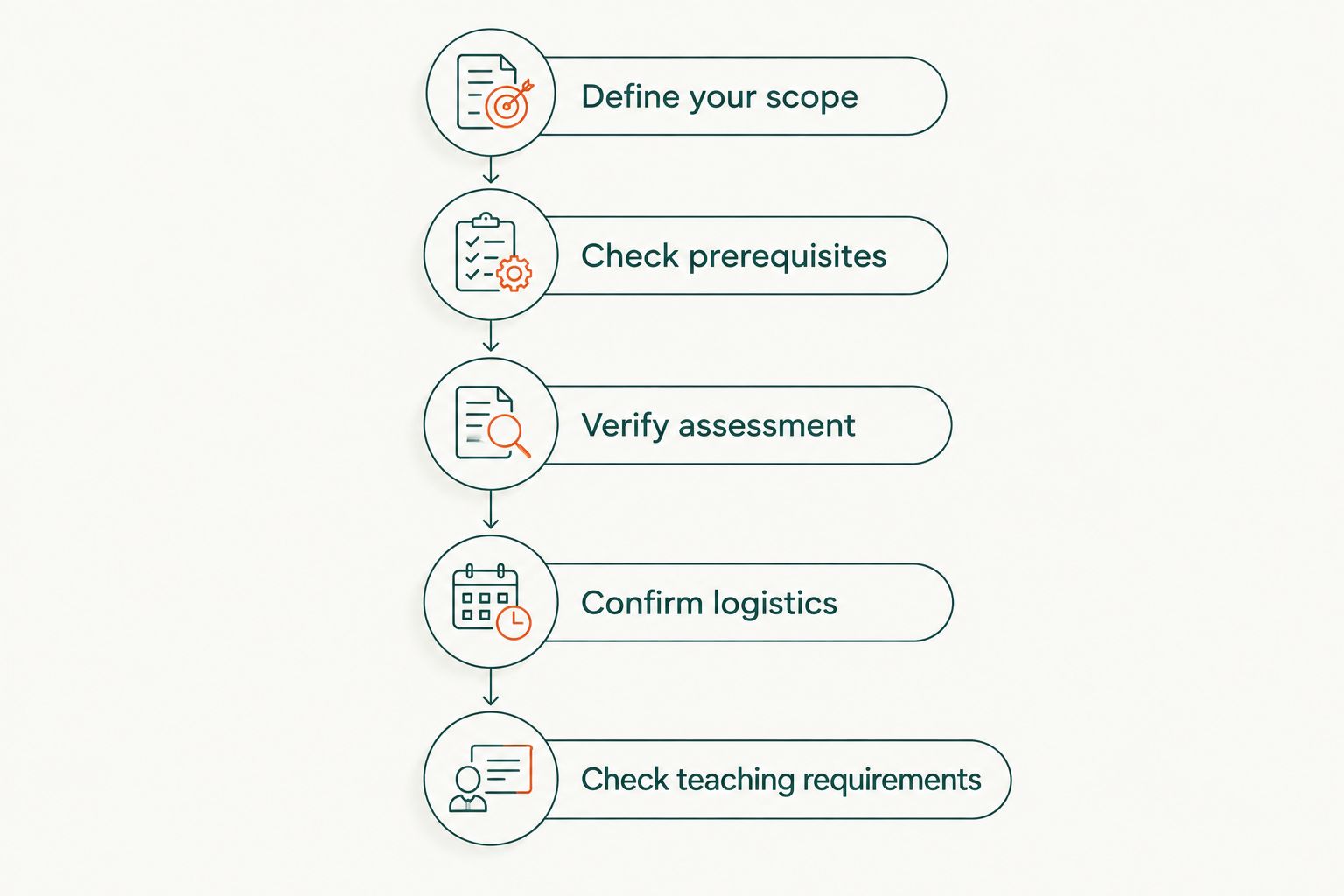
Use this sequence to turn a broad 2026 course search into a specific enrollment decision. Finish each step before moving to the next.
Define your scope
Write down the sessions you intend to teach: mat, Reformer, or multiple apparatus. Keep that teaching goal visible while comparing courses so that extra content does not distract you from essential preparation.
Check prerequisites
Ask whether your existing Pilates practice meets the entry requirements. Personal-training experience is useful background, but it does not override a provider's stated prerequisites.
Verify assessment
Find out whether completion requires a written exam, a practical teaching evaluation, or both. The guide to written vs practical assessments explains the distinction to investigate.
Confirm logistics
Check course access, deadlines, equipment arrangements, and any separate practice obligations. For self-paced study, decide where learning and practice will fit in your actual working week.
Check teaching requirements
If you want to work with a particular studio, ask what it requires before enrolling. A provider's certificate and a studio's hiring decision are separate matters.
Which Pilates certification should you choose?
Choose the smallest training scope that fully prepares you for your intended teaching role. That is a better decision rule than choosing the longest syllabus or the most impressive certificate title.
For flexible foundational study in 2026, the self-paced online option is the default recommendation here. Choose supervised mat training for direct teaching feedback, dedicated Reformer training for Reformer instruction, and full-apparatus study for a broader equipment role.
Before committing, explain an exercise aloud, observe someone performing it within your competence, and notice what you struggle to communicate. Use that experience to ask better questions about feedback and assessment—not to replace formal preparation.
Explore your instructor training
Review the self-paced online course and its curriculum before choosing your training route.
FAQ
What's the best Pilates certification for a personal trainer?
The best Pilates certification matches the sessions you intend to teach. Choose self-paced online study for schedule flexibility, supervised mat training for direct feedback, or dedicated apparatus training for equipment teaching.
How much is the Teachpilates online course?
Teachpilates states tuition of $497 for its self-paced online Pilates instructor certification course. Confirm current assessment, access, and completion requirements before enrolling.
Does my personal-training certification qualify me to teach Pilates?
A personal-training certification does not establish Pilates-specific teaching competence. Learn the method, practice teaching it, and check the requirements of the setting where you intend to work.
Is online Pilates certification better than in-person training?
Online study is better suited to schedule flexibility; in-person training is better suited to direct observation when supervised teaching is included. Compare the actual feedback and assessment arrangements, not just the delivery format.
Can introductory Reformer lessons qualify me to teach Reformer classes?
Introductory Reformer concepts are not equivalent to dedicated hands-on Reformer qualification. Check the course's apparatus-specific practice and assessment requirements against your intended teaching role.
Should I choose mat or full-apparatus training first?
Choose mat training first when your intended work is mat instruction. Choose a broader apparatus pathway when your teaching goal specifically requires multiple equipment types.
Will every studio accept the same Pilates certificate?
Do not assume universal studio acceptance. Ask each prospective studio about its training, practical assessment, and teaching-demonstration requirements before choosing a course.
One last thing
Your most useful enrollment question is not just whether you receive a certificate. Ask: What must I demonstrate before I pass?
For your 2026 decision, use the answer to distinguish knowledge checks from teaching evaluation. A course should prepare you for the instruction you intend to deliver, not merely give you a title to add to your profile.