At $497 tuition, Teachpilates is the best fit here for flexible, self-paced Pilates teaching foundations. Choose mentored mat training for direct teaching feedback, dedicated hands-on Reformer training for apparatus instruction, or comprehensive apparatus training for a broader equipment-based teaching goal.
- Teachpilates is the best Pilates certification for home-based instructors seeking self-paced study and mat-teaching foundations.
- Choose mentored mat training when direct feedback matters more than scheduling flexibility.
- Choose dedicated hands-on Reformer training before planning an apparatus-based teaching service.
- Match assessments, insurance requirements, and teaching scope before enrolling.
Why your home-teaching plan comes first
The best Pilates certification for home-based instructors depends on what you intend to teach, not simply where you study. Learning online, teaching online, and teaching clients inside your home are different decisions. A course that fits your schedule still needs to match your intended teaching scope.
For your 2026 enrollment decision, start with the service you want to offer: mat sessions, remote instruction, or apparatus-based lessons. Then work backward to training, assessed practice, equipment access, and the conditions your insurer requires.
Publisher disclosure: Teachpilates publishes this guide and offers the self-paced course included below. The alternatives are training formats, not independently tested provider rankings.
What makes the best certification for home-based instructors?
Use these criteria before comparing course names. A convenient study format is valuable, but it does not replace evidence that you can teach.
- Teaching scope: The course should distinguish mat instruction from apparatus instruction and explain what its certificate represents.
- Practical assessment: Look for a clear explanation of how teaching, cueing, observation, and modifications are assessed.
- Feedback: Establish whether you receive individual corrections, who provides them, and how you ask follow-up questions.
- Study access: Confirm deadlines, access duration, extension terms, and any scheduled attendance before enrolling.
- Full commitment: Account for tuition, required practice, equipment access, travel, assessment charges, and any separate credential requirements.
- Home-business fit: Check whether the curriculum addresses business skills, and separately verify insurance and local operating requirements.
Your strongest option is the course whose assessed scope matches the sessions you intend to deliver. A longer curriculum is not automatically a better match for a mat-only plan.
Home-based Pilates certification options at a glance
These four options serve different teaching goals. The order favors a first-time instructor starting with flexible home study, not someone already committed to opening an apparatus studio.
| Option | Best for | Standout feature | Key limitation |
|---|---|---|---|
| Teachpilates self-paced course | Flexible teaching foundations | Anatomy, mat and Reformer instruction, cueing, and business skills | Introductory Reformer learning is not a substitute for dedicated hands-on apparatus qualification |
| Mentored mat training | Individual teaching feedback | A format built around guided mat-teaching practice | Scheduled feedback and attendance reduce study flexibility |
| Dedicated hands-on Reformer training | Reformer-focused home teaching | Apparatus-specific practice and instruction | Requires access to suitable equipment and supervision |
| Comprehensive apparatus training | Broader equipment-based teaching | A pathway covering multiple apparatus disciplines | Broader scope creates additional equipment and training commitments |
1. Teachpilates: best for flexible home-study foundations
Teachpilates offers self-paced online Pilates instructor certification covering anatomy, mat and Reformer instruction, cueing, and business skills. It fits aspiring instructors who want to study from home and build teaching foundations without following a fixed classroom timetable.
Teachpilates is best for aspiring home-based instructors who want flexible study and mat-teaching foundations. Treat the Reformer material as introductory learning rather than proof of a dedicated hands-on apparatus qualification.
Teachpilates pros:
- Self-paced online study fits around existing commitments.
- Anatomy and cueing connect movement knowledge with teaching language.
- Mat instruction aligns with a teaching plan that does not depend on apparatus.
- Business skills belong in the curriculum alongside exercise instruction.
Teachpilates cons:
- Self-directed study requires you to protect practice time, not just finish lessons.
- Reformer content does not establish dedicated hands-on apparatus competence.
- Enrollment alone does not establish acceptance by an insurer, employer, or independent credentialing body.
Before enrolling, confirm the current assessment format, practical-feedback arrangements, access duration, and any separate charges. Keep those answers with your enrollment records so you know the conditions attached to your training.
Best for: First-time instructors prioritizing flexible study and a mat-focused starting point in 2026.
Verdict: Buy for self-paced foundations; choose dedicated practical apparatus training for a Reformer teaching goal.
2. Mentored mat training: best for direct teaching feedback
Mentored mat training makes guided practice the deciding feature. Choose this format when you want an instructor to observe how you explain movements, respond to a learner, and adjust a session.
Do not assume the word mentored guarantees individual assessment. Ask whether the feedback covers your actual teaching or only general questions during a group session.
Mentored mat training pros:
- Direct observation gives a tutor something specific to correct.
- Scheduled practice creates an external commitment to prepare.
- Mat-focused learning keeps the training aligned with a mat-teaching service.
Mentored mat training cons:
- Live appointments limit when you can study and practise.
- Group feedback is not the same as individual feedback.
- Mat training does not establish apparatus-teaching competence.
Ask the provider to describe a typical feedback cycle: what you submit, who reviews it, what corrections you receive, and whether you can demonstrate improvement afterward. That answer tells you more than an unspecified promise of support.
Best for: Aspiring instructors who want personal correction before teaching independently.
Verdict: Buy when observed teaching and actionable feedback are confirmed features.
3. Hands-on Reformer training: best for apparatus-focused teaching
Dedicated hands-on Reformer training is the relevant route when your home-teaching plan centers on the Reformer. The important distinction is supervised equipment practice, not whether the theory lessons arrive online or in a classroom.
Look for a clearly stated apparatus scope and practical assessment. Watching demonstrations does not give you the same opportunity to practise setup, observe a moving client, and receive corrections.
Hands-on Reformer training pros:
- Apparatus-specific practice matches an apparatus-based teaching goal.
- Supervision creates opportunities to correct equipment handling.
- Practical assessment can examine teaching decisions on the equipment itself.
Hands-on Reformer training cons:
- You need suitable equipment access throughout the practical work.
- Travel and scheduled attendance can complicate home study.
- Reformer training alone does not establish competence across every Pilates apparatus.
Before choosing this route in 2026, confirm where you will complete practice and how the provider assesses it. Buying equipment before establishing those requirements reverses the decision: training scope should inform the equipment plan.
Best for: Aspiring instructors specifically planning Reformer sessions at home.
Verdict: Buy for a defined Reformer teaching plan; skip as an unnecessary first step for mat-only teaching.
4. Comprehensive apparatus training: best for broader teaching scope
Comprehensive apparatus training fits a goal that extends beyond mat work and a single apparatus. Because providers define their curricula differently, request an explicit list of the equipment and teaching skills included.
This route makes sense when you intend to use that breadth. It is not automatically the right first purchase because the course title sounds more complete.
Comprehensive apparatus training pros:
- A broader curriculum can align with a multi-apparatus teaching plan.
- Training across equipment creates opportunities to study different teaching contexts.
- A defined apparatus pathway gives you a clearer basis for planning further practice.
Comprehensive apparatus training cons:
- Required equipment access is more involved than a mat-only setup.
- A broader curriculum adds learning commitments beyond your immediate service.
- The word comprehensive does not prove independent recognition or universal acceptance.
Request the syllabus, assessment requirements, attendance commitments, and equipment-access conditions together. Evaluate the whole pathway rather than comparing its title with a shorter course.
Best for: Aspiring instructors committed to a broader apparatus-based teaching service.
Verdict: Buy for a confirmed multi-apparatus goal; wait if you have not decided what you will teach.
How these options are ranked
The ranking prioritizes flexible study, teaching-scope fit, practical feedback, and the commitments involved in starting from home. It does not claim that one certificate is accepted everywhere or that any route guarantees employment.
For a first-time home-based instructor, the default is a focused starting point rather than the widest possible syllabus. Change the order when your goal changes: direct feedback puts mentored mat training first; Reformer teaching puts dedicated apparatus training first.
Choose your route before you equip your space
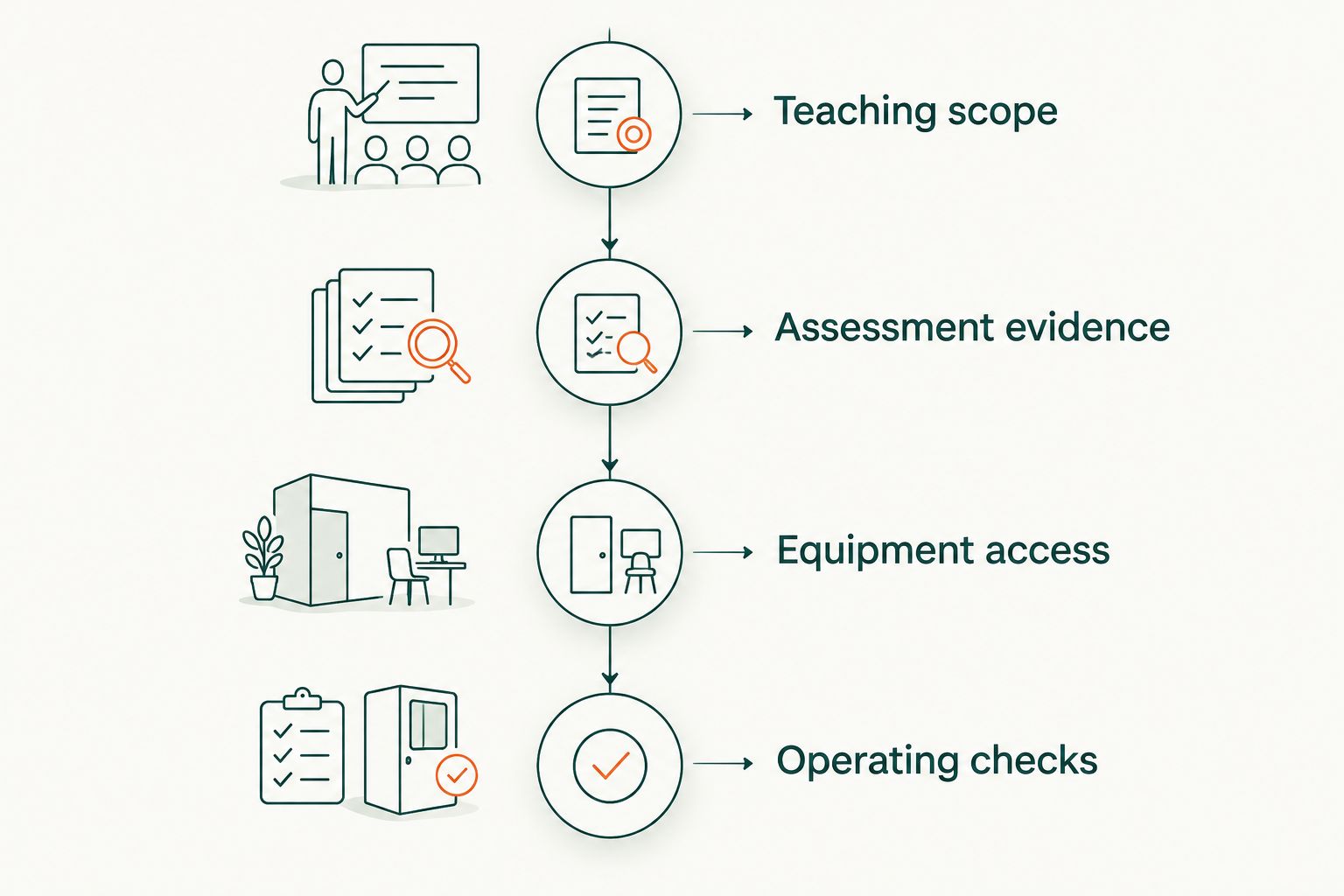
Use this sequence to turn your 2026 shortlist into an enrollment decision. Keep each answer specific enough that a course provider can confirm whether its program fits.
Teaching scope
Write down the service you intend to offer first. “Mat sessions for clients at home” is a more useful starting point than “teach Pilates,” because it gives you a defined training question.
Assessment evidence
Ask how the course checks your knowledge and your teaching separately. The distinction between written and practical assessments matters: explaining an exercise on paper and teaching it to another person are different tasks.
Equipment access
Separate what you need to learn from what you need to buy. Comparing Pilates accessory sets is a separate decision from choosing training: Pilates accessory sets do not replace apparatus-specific practice, assessed teaching, or a clearly defined course scope.
Operating checks
Before accepting clients, confirm insurance conditions, permission to use your space, and any applicable local requirements. For remote teaching, ask the insurer specifically about online sessions rather than assuming home-based cover includes them.
The sequence matters because equipment cannot resolve a mismatch between your certificate and your intended service. Establish the teaching scope first, then make the practical arrangements that support it.
Test your teaching habits before committing
Try a 5-minute opening explanation of a familiar mat exercise, then plan a 10-minute practice lesson within your existing knowledge. These are preparation exercises, not certification standards or permission to teach paying clients.
Make 2 recordings of your explanation and compare them. Listen for clear starting instructions, an understandable movement goal, and language a beginner can follow without copying you continuously.
- Can you explain the starting position without rushing?
- Can you state the movement goal in plain language?
- Can you recognize when a question exceeds your current knowledge?
- Can you identify what you need a tutor to review?
Use the exercise to choose your support needs. If you struggle to judge your own explanations, prioritize observed practice and individual feedback rather than assuming more recorded lessons will solve the problem.
Which certification should you choose?
Choose the self-paced option if your immediate goal is flexible study and mat-teaching foundations. Choose mentored mat training if direct correction is your main requirement, or dedicated hands-on Reformer training if apparatus instruction is the service you intend to offer.
For a 2026 enrollment, get written answers on teaching scope, prerequisites, assessments, access limits, and additional requirements before paying. A clear answer is more valuable than a broad promise about becoming “fully certified.”
Review your course fit
Explore self-paced training covering anatomy, mat instruction, cueing, introductory Reformer concepts, and business skills.
FAQ
What's the best Pilates certification for teaching from home?
The best fit depends on whether you intend to teach mat sessions, online lessons, or apparatus-based sessions. Choose self-paced foundations for flexibility, mentored mat training for direct feedback, or dedicated hands-on training for Reformer instruction.
Can I study Pilates instruction entirely from home?
You can study through a self-paced online course from home. Confirm how practical teaching is assessed and whether your chosen teaching scope requires supervised equipment practice elsewhere.
Do I need teaching experience before enrolling?
The introductory pathway described here does not require a prior teaching background. Confirm the current course prerequisites and distinguish eligibility to enroll from readiness to teach independently.
Does online Reformer content qualify me to teach on a Reformer?
Online Reformer content alone does not establish dedicated hands-on apparatus competence. Check the practical training, assessment, and insurance conditions for the Reformer teaching you intend to offer.
Is a course certificate the same as an independent credential?
A course certificate and an independent credential are different things. Confirm the awarding organization and any separate eligibility or examination requirements before assuming an independent credential is included.
What should I ask about course access?
Ask when access starts, when it ends, and whether assessments have separate deadlines. Request the extension terms and any associated charges before enrolling.
Can I teach paying clients immediately after finishing a course?
Course completion alone does not settle every requirement for teaching paying clients. Confirm your assessed scope, insurance conditions, and applicable home-business requirements before accepting bookings.
One last thing
Ask who will watch you teach. A syllabus tells you what a course covers; an assessment process tells you how someone checks that you can use it. Keep that distinction at the center of your decision, even when the study format fits perfectly.