Best for flexible first-time study: Teachpilates, with $497 tuition and self-paced online learning. Best for direct feedback: mentored mat training; best for an equipment-based teaching goal: hands-on Reformer training—choose by teaching scope, not your dance résumé or athletic achievements.
- Teachpilates is the best Pilates certification for dancers and athletes seeking flexible online foundations, not a hands-on apparatus qualification.
- Choose mentored mat training when your priority is supervised cueing and beginner teaching practice.
- Choose hands-on Reformer training when equipment-based instruction is your intended teaching role.
- Match your 2026 course choice to assessments, practice access, and employer requirements before enrolling.
Why this matters
Your movement background gives you experience as a participant. Teaching requires another skill: explaining a movement to someone who cannot copy your range, coordination, or pace.
For your 2026 enrollment decision, separate learning Pilates from demonstrating that you can teach it. A course title alone does not establish practical competence, apparatus scope, or acceptance by a studio.
Teachpilates is best for dancers and athletes who want self-paced online Pilates instructor foundations. This guide is published by Teachpilates and compares training formats rather than making unverified claims about named competitors.
What makes the best Pilates certification for dancers and athletes?
Use these criteria before comparing certificates. The strongest match is the course whose teaching scope and assessment fit the work you intend to do.
- Teaching scope: Distinguish mat instruction, introductory Reformer concepts, dedicated Reformer qualification, and training across additional apparatus.
- Teaching feedback: Check whether someone evaluates your explanations, exercise choices, and response to a learner—not just your written answers.
- Anatomy in practice: Look for lessons that connect anatomy to movement observation, exercise selection, and appropriate modifications.
- Realistic scheduling: Match study requirements, attendance, and practice access to rehearsals, travel, competition, or existing work.
- Entry and completion requirements: Read prerequisites, assessment rules, access terms, and any required practice records before enrolling.
- Employer fit: Ask prospective studios what training and practical evidence they require. Do not assume any certificate guarantees acceptance.
Your existing performance skills should help you study, not become a reason to skip beginner teaching practice. Ask how the course prepares you to teach people whose movement experience differs from yours.
Pilates certification options at a glance
These are training pathways, not interchangeable credentials. The ranking prioritizes a first-time instructor's decision, with the online option first for readers who need flexible foundational study.
| Rank and option | Best for | Standout feature | Key limitation |
|---|---|---|---|
| 1. Teachpilates online course | Flexible first-time study | Self-paced curriculum covering anatomy, mat instruction, Reformer concepts, cueing, and business skills | Introductory equipment content is not a dedicated hands-on apparatus qualification |
| 2. Mentored mat training | Supervised teaching feedback | A pathway built around observation and feedback on mat teaching | Mat training alone does not establish Reformer teaching scope |
| 3. Hands-on Reformer training | Equipment-based teaching goals | Direct practice with the apparatus you intend to teach | Requires suitable equipment access and scheduled practical work |
| 4. Full-apparatus training | A broader apparatus teaching goal | A pathway covering more than mat and Reformer alone | Adds scope that a mat-only teaching goal does not require |
1. Teachpilates: best for flexible online foundations
The Teachpilates online Pilates certification course suits aspiring instructors who need self-paced study alongside an existing movement practice. Its curriculum covers anatomy, mat instruction, Reformer concepts, cueing, and business skills. Treat the equipment content as introductory rather than evidence of a dedicated hands-on apparatus qualification.
Best for: Your first instructor course when flexible online learning and mat-teaching foundations match your intended starting point.
Teachpilates pros
- Self-paced study lets you organize learning around your own schedule.
- Anatomy and cueing belong in the same curriculum as exercise instruction.
- Business skills address a part of teaching beyond performing movements.
- Mat and introductory Reformer content help you distinguish foundational study from a later apparatus pathway.
Teachpilates cons
- Introductory Reformer concepts do not replace practical apparatus qualification.
- Self-paced study puts responsibility for a workable study routine on you.
- The course does not establish universal studio acceptance or guarantee employment.
Before enrolling in 2026, confirm assessment methods, practical submission requirements, tutor access, and course-access terms against your needs. Flexible pacing answers when you study; it does not answer how your teaching is assessed.
Verdict: Buy if you want online foundations and understand the teaching scope; skip as a substitute for dedicated hands-on Reformer training.
2. Mentored mat training: best for supervised teaching feedback
Mentored mat training is the pathway to prioritize when your main need is feedback on teaching another person. Select a course that explicitly includes observation of your instruction, correction of your cueing, and opportunities to apply that feedback.
Dancers can perform movements without needing a detailed verbal explanation. Athletes can be accustomed to coaching shorthand. Neither habit establishes that your instructions will make sense to a complete beginner.
Best for: You can perform mat exercises but want a teacher to assess how clearly you explain and adapt them.
Mentored mat training pros
- Observed teaching makes your instructions available for direct critique.
- A mat-focused scope keeps your initial teaching goal specific.
- Repeated feedback gives you a way to revise cues rather than merely collect them.
Mentored mat training cons
- Scheduled feedback sessions need space in your calendar.
- Mat qualification does not establish apparatus competence.
- The word mentor does not explain how much individual feedback you receive; check the actual arrangements.
Ask whether feedback addresses lesson planning, pacing, modifications, and your response when a learner misunderstands. A demonstration watched without comment is not the same learning experience as an assessed teaching session.
Verdict: Buy when supervised mat teaching is your priority; hold if the provider cannot explain its feedback process.
3. Hands-on Reformer training: best for equipment-based teaching
Hands-on Reformer training belongs first when your intended role specifically involves teaching on a Reformer. Choose a pathway with explicit apparatus instruction, suitable practice access, and assessment relevant to that teaching role.
Do not confuse familiarity from attending Reformer classes with readiness to teach them. Your training decision must address equipment setup, exercise instruction, and teaching practice—not just your own workout experience.
Best for: You want to teach Reformer sessions and can arrange the practical access that your chosen course requires.
Hands-on Reformer training pros
- Practical work connects instruction to the apparatus you intend to use.
- Equipment-focused assessment can address skills a written test cannot show.
- A defined Reformer pathway keeps your training aligned with an equipment-based role.
Hands-on Reformer training cons
- Apparatus access creates a scheduling requirement beyond online study.
- Reformer training is not automatically training on every Pilates apparatus.
- A course's entry requirements can affect whether it is an appropriate first step; verify them before enrolling.
For a 2026 training plan, settle equipment access before committing. Use the Reformer certification equipment-access guide to organize questions about where and how you will practice.
Verdict: Buy for a defined Reformer teaching goal; wait if required equipment access is unresolved.
4. Full-apparatus training: best for broader studio teaching goals
Full-apparatus training is the route to investigate when your intended work extends beyond mat and Reformer. Read the actual equipment list and assessment scope rather than treating the course name as proof of coverage.
This pathway is not automatically the best first purchase because it covers more. Extra scope is useful only when it serves the teaching role you want and you can complete its practical requirements.
Best for: You have a defined goal involving several Pilates apparatus and a workable plan for the required training.
Full-apparatus training pros
- A broader pathway can match a role that requires multiple apparatus.
- A connected curriculum can organize your study across different teaching settings.
- Explicit apparatus coverage makes it easier to compare training with a studio's requirements.
Full-apparatus training cons
- A broader equipment scope creates more practical access to arrange.
- Additional apparatus study is unnecessary for a strictly mat-focused starting goal.
- A broad course title still does not prove that an independent credential is included.
Ask which apparatus are taught, which are assessed, and what completion documents mean. Keep those answers separate from any independent examination you might pursue later.
Verdict: Buy for a verified broader teaching requirement; skip as an automatic upgrade from a mat-focused course.
Turn your movement experience into teaching practice
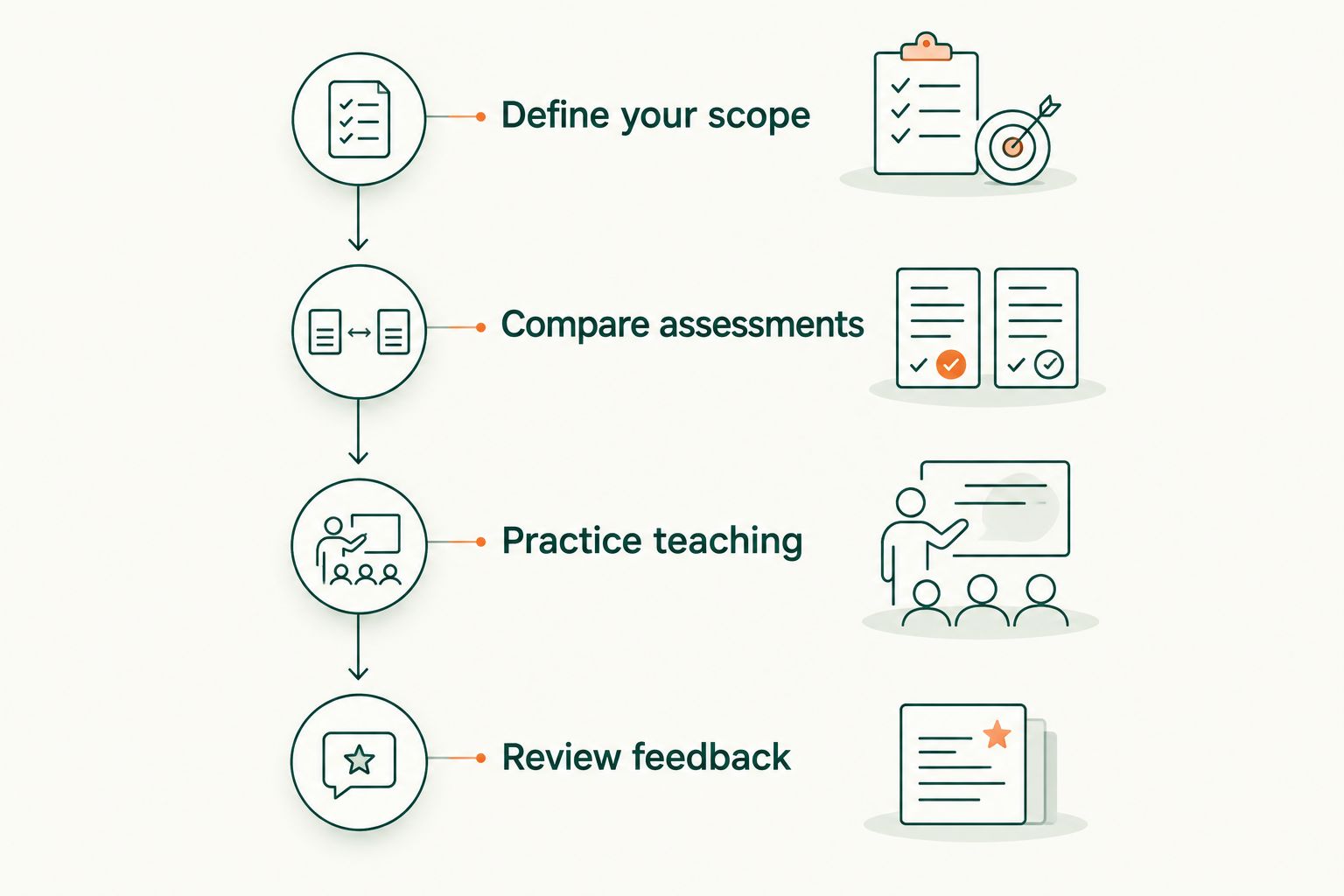
Use this sequence to test your readiness to learn teaching skills. It is a preparation exercise, not a certification assessment or permission to teach beyond your training.
Define your scope
Write down the first kind of session you want to teach: mat, Reformer, or a broader apparatus setting. Then ask 2 prospective employers which qualifications and practical evidence they expect for that role; treat this as a suggested research task, not an industry requirement.
Compare assessments
Ask what you must demonstrate to complete each course. Separate written knowledge, movement demonstration, and observed teaching so that you do not mistake one for another.
Practice teaching
Plan a 10-minute practice lesson using material you already understand, within an appropriate supervised learning setting. Focus on clear setup instructions and pacing rather than fitting in difficult exercises.
Review feedback
Prepare 3 versions of a cue: a plain movement instruction, a setup reminder, and a simpler explanation. Ask your teacher which version communicates the intended action most clearly and revise it.
The useful test is not whether you look accomplished while demonstrating. It is whether you can explain an appropriate task clearly, notice misunderstanding, and respond within your training.
What to confirm before you enroll
Build your 2026 enrollment decision around written answers, not a certificate image. Keep the following checks together so you can compare like-for-like.
- Prerequisites: Ask about prior Pilates experience, anatomy study, and any entry assessment.
- Assessments: Confirm what is written, practical, observed, or submitted remotely, plus the completion and resubmission rules.
- Access: Check course-access duration, tutor availability, and any equipment or attendance requirements.
- Costs: Request the full list of required tuition, assessment, mentoring, equipment-access, and independent-exam charges.
- Teaching scope: Ask exactly what the provider's certificate covers and compare that with your intended workplace's requirements.
Do not assume a provider's completion certificate includes an independent credential. Ask who issues each document and whether a separate application or assessment is required.
Review your online training option
Explore self-paced study covering anatomy, mat instruction, cueing, and business skills.
How these pathways are ranked
This ranking uses teaching scope, feedback, anatomy application, scheduling, completion requirements, and employer fit. It ranks formats for different goals; it does not claim that one provider outperforms competitors on unverified results.
Online foundations lead for flexible first-time study. Mentored mat training fits a feedback-first goal, hands-on Reformer training fits apparatus teaching, and broader training fits a verified need for additional equipment scope.
Which Pilates certification should you choose?
Choose the narrowest pathway that fully supports your intended teaching role. For an undecided dancer or athlete in 2026, start by deciding whether you want to teach mat or apparatus—not by chasing the longest course title.
Choose flexible online foundations when independent study fits your life. Choose supervised practical training when observed teaching or equipment competence is the immediate requirement. Ask your intended workplace before paying, rather than asking it to accept your choice afterward.
FAQ
What's the best Pilates certification for dancers and athletes?
The best choice matches your intended teaching scope and required practical assessment. Choose online foundations for flexible study, mentored mat training for supervised feedback, or hands-on Reformer training for an equipment-based goal.
Does being a dancer mean I can skip Pilates teacher training?
A dance background does not establish Pilates teaching competence. Ask each provider whether prior learning affects entry or credit, and still evaluate how the course assesses your instruction.
Is online Pilates certification enough to teach Reformer classes?
Online foundational study alone does not establish a dedicated hands-on Reformer qualification. Confirm apparatus training, practical assessment, and your intended employer's requirements before choosing a course.
Is mat or Reformer certification better for an athlete?
Mat training fits a mat-teaching goal; Reformer training fits a Reformer-teaching goal. Your sport does not determine the qualification you need—the sessions you intend to teach do.
What should I check about Pilates certification costs?
Check the full required cost, not tuition alone. Ask about assessments, resubmissions, mentoring, apparatus access, and any separate independent examination before enrolling.
Will a Pilates certificate guarantee studio employment?
A Pilates certificate does not guarantee employment or universal studio acceptance. Ask prospective employers about training scope, practical assessments, auditions, and other conditions relevant to the role.
Can Pilates instructor training qualify me to rehabilitate injuries?
Pilates instructor training alone does not establish a healthcare qualification. Keep instruction within your training and refer diagnosis or treatment questions to an appropriately qualified healthcare professional.
One last thing
Before choosing a course, practice explaining a familiar movement without demonstrating it. Ask your teacher to observe: the gap between what you can perform and what you can clearly explain is a useful guide to the feedback your training should provide.