Best for flexible first-time study: Teachpilates, with $497 tuition and self-paced online learning. Best for live correction: in-person mat training. Best for a Reformer teaching goal: dedicated hands-on Reformer training. This 2026 guide compares beginner pathways so you can choose training that matches what you want to teach.
- Teachpilates is the best Pilates certification for beginners who prioritize self-paced study and mat-teaching foundations.
- Choose in-person mat training when live feedback matters more than studying around your own schedule.
- Introductory Reformer concepts do not replace dedicated hands-on apparatus qualification.
- Confirm prerequisites, assessments, teaching scope, and employer requirements before enrolling.
Why this matters
No teaching experience and no Pilates experience are different starting points. You can begin preparing for an instructor role without having taught a class, but you still need to understand the movements you intend to teach.
The best beginner course connects anatomy, movement practice, cueing, and assessment. A certificate alone does not establish that you can observe a participant, explain an exercise clearly, and adjust your instruction when something is not working.
This guide is published by Teachpilates, which offers one of the options discussed. The recommendations compare training formats rather than claim that every provider has been independently tested. Choose another format when its teaching scope or feedback structure better matches your goal.
What makes the best Pilates certification for beginners?
Use these criteria before comparing course names. For a beginner choosing training in 2026, the strongest fit is the course whose requirements and teaching scope you can explain before paying.
- Clear entry requirements: Distinguish prior teaching experience from expected Pilates practice, anatomy knowledge, or prerequisite study.
- Defined teaching scope: Identify whether the course develops mat-teaching foundations, Reformer instruction, or broader apparatus teaching.
- Practical assessment: Find out whether anyone evaluates your cueing, observation, exercise selection, and modifications—not just your recall.
- Appropriate feedback: Establish how you get answers and whether feedback addresses your actual teaching.
- Workable study format: Match scheduled attendance, independent study, equipment access, and practice requirements to your life.
- Transparent completion terms: Check tuition, additional obligations, access limits, assessment conditions, and the credential awarded.
Ask for the assessment criteria before enrollment. The distinction between written and practical assessments matters because knowing an exercise name is different from teaching the exercise clearly.
Beginner certification pathways at a glance
These options are not equivalent credentials. The table separates the learning format from the teaching goal so you do not mistake broader subject coverage for deeper practical preparation.
| Option | Best for | Standout feature | Key limitation |
|---|---|---|---|
| Teachpilates online course | Flexible first-time study | Self-paced curriculum covering anatomy, mat instruction, cueing, business skills, and introductory Reformer concepts | Introductory apparatus content is not dedicated hands-on Reformer qualification |
| In-person mat training | Learners who prioritize live correction | Scheduled, face-to-face learning focused on mat teaching | Attendance and travel must fit your schedule; feedback arrangements need checking |
| Dedicated hands-on Reformer training | Beginners specifically targeting Reformer teaching | Training centered on the apparatus you intend to teach | Requires suitable equipment access and confirmation of entry requirements |
| Full-apparatus training pathway | Learners with a defined broader apparatus goal | A pathway extending beyond mat-only teaching | Broader scope adds equipment and scheduling considerations |
1. Teachpilates: best beginner certification for flexible study
Teachpilates offers a self-paced online Pilates instructor certification course for $497. Its curriculum covers anatomy, mat instruction, cueing, business skills, and introductory Reformer concepts, giving you a structured starting point without fixed classroom attendance.
Teachpilates is best for first-time instructor candidates who want self-paced Pilates certification focused on mat-teaching foundations. Treat the Reformer content as introductory learning, not proof of dedicated hands-on apparatus qualification.
Teachpilates pros
- Self-paced study lets you organize coursework around your existing commitments.
- Anatomy and cueing connect movement knowledge with the language of teaching.
- Mat instruction gives your first teaching goal a defined focus.
- Business skills address a part of instructor preparation beyond exercise technique.
Teachpilates cons
- Self-paced study requires you to maintain your own learning routine.
- Introductory Reformer concepts do not replace dedicated practical apparatus training.
- Online coursework does not remove the need to practice observing and teaching real movement.
Best for: You already enjoy Pilates and want an accessible, structured route into instructor study without committing to scheduled classroom attendance.
Before enrolling in 2026, confirm the current assessment format, feedback arrangements, access terms, and completion requirements. Match those details to your intended teaching setting rather than assuming that any course certificate meets every employer's expectations.
Verdict: Buy if flexible study and mat-teaching foundations match your first goal.
2. In-person mat training: best for live correction
An in-person mat pathway puts your learning in a shared physical setting. Choose it when you want an instructor to see how you demonstrate, hear your cues, and discuss your decisions during scheduled sessions.
The format alone does not guarantee individual attention. Ask how much of the training involves watching demonstrations, practicing yourself, and teaching while someone observes.
In-person mat training pros
- Face-to-face sessions support immediate questions and demonstrations.
- Teaching practice can happen in the same setting as instruction.
- Scheduled attendance provides an external structure for your study.
In-person mat training cons
- Attendance and travel can conflict with work or caregiving.
- Mat-focused training does not establish full-apparatus teaching competence.
- Individual feedback depends on the provider's actual teaching arrangements.
Best for: You learn better through live correction and can reliably attend the required sessions.
Ask to see the practical assessment description, not just the class calendar. You need to know whether a tutor evaluates your teaching or whether attendance is the main completion condition.
Verdict: Buy when live feedback is your priority and the practical assessment is clearly defined.
3. Hands-on Reformer training: best for a Reformer teaching goal
Dedicated hands-on Reformer training centers your preparation on apparatus-based teaching. If your goal is specifically to teach Reformer sessions, select a pathway that addresses equipment use and supervised teaching rather than relying on an introductory module.
Before committing, confirm whether the provider accepts complete beginners or expects prior mat training, Pilates practice, or anatomy study. Also establish where you will complete any required equipment practice.
Hands-on Reformer training pros
- Training focuses on the apparatus you intend to teach.
- Physical practice lets you connect equipment setup with instruction.
- Supervised teaching provides a setting for feedback on apparatus-specific decisions.
Hands-on Reformer training cons
- Equipment access becomes part of your training plan.
- Entry requirements can make it unsuitable as an immediate first step.
- Reformer training alone does not establish competence across every Pilates apparatus.
Best for: You have a specific Reformer teaching goal and can arrange the required practical access.
For a 2026 enrollment decision, get the equipment and attendance requirements in writing. A course that fits your study schedule but leaves you unable to complete its practical work is the wrong purchase.
Verdict: Buy only when prerequisites, equipment access, and supervised practice are confirmed.
4. Full-apparatus training: best for a broader teaching plan
A full-apparatus pathway is for learners whose intended teaching work extends beyond mat classes or Reformer alone. Compare the actual apparatus taught and assessed; a broad course title is not a substitute for a scope statement.
This is not automatically the strongest first choice for every beginner. Start here when you understand why you need the broader scope and can support the associated practical learning.
Full-apparatus training pros
- The pathway can align with a broader apparatus-teaching goal.
- Studying different apparatus creates opportunities to compare exercise choices.
- A clearly specified pathway lets you plan beyond an initial mat qualification.
Full-apparatus training cons
- Access to the required apparatus needs planning.
- Broader content does not guarantee more feedback on your teaching.
- You risk choosing more scope than your immediate goal requires.
Best for: You have a defined broader teaching goal and a realistic plan for practical training across the included apparatus.
Ask whether the pathway is modular and what each completed stage qualifies you to teach. Do not assume that partial completion produces a standalone credential.
Verdict: Wait until the broader teaching goal and practical commitments are clear.
How these pathways are ranked
The ranking prioritizes beginner fit: clear scope, a workable learning format, relevant curriculum, practical assessment, and manageable completion requirements. It does not rank providers by reputation, graduate employment, or independent recognition.
Self-paced learning takes the first slot for flexibility, not for universal suitability. In-person mat training fits better when live correction is non-negotiable; dedicated apparatus training fits better when apparatus teaching is your actual destination.
What “no experience” means before you enroll
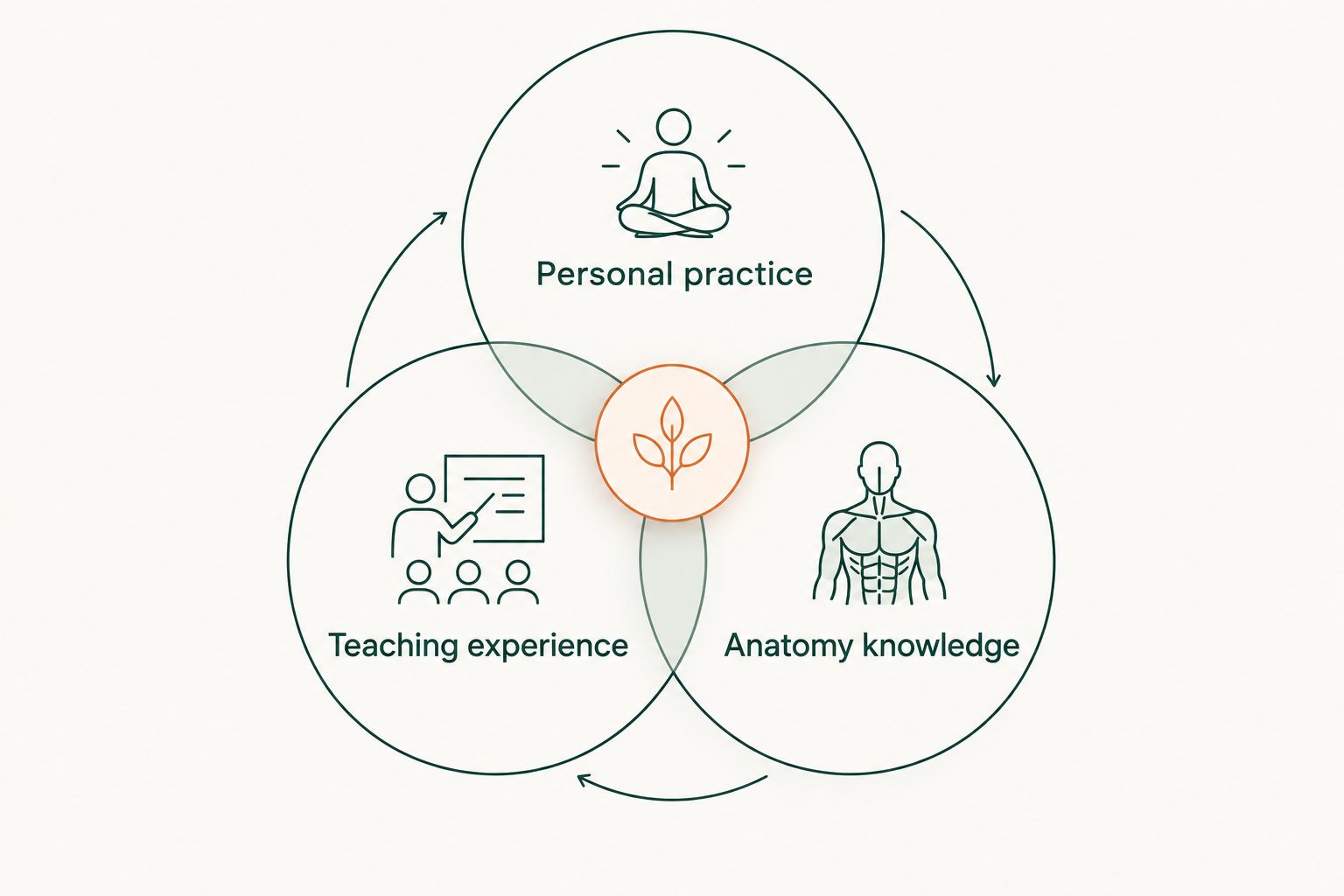
Separate your starting point into Personal practice, Teaching experience, and Anatomy knowledge. You might be comfortable participating in Pilates while being entirely new to explaining movement to someone else.
- Personal practice: Can you follow foundational exercises and describe what you are doing?
- Teaching experience: Have you practiced giving instructions, observing another person, and changing an explanation?
- Anatomy knowledge: Can you connect basic movement terms to the exercises you are studying?
You do not need to pretend these skills are already equal. Use the weakest area to identify the support you need from a course, tutor, or practice arrangement.
Specialist audiences add another scope question. Preparing to teach Pilates classes for postpartum parents requires you to distinguish general beginner instruction from population-specific preparation; do not assume an entry-level certificate establishes specialist competence.
Check the full commitment, not just tuition
Teachpilates lists $497 tuition for its self-paced course. For any 2026 training decision, keep the enrollment charge separate from the other requirements you must satisfy to finish and begin teaching in your intended setting.
Ask whether the quoted tuition includes assessment, reassessment, learning materials, and any required tutor interaction. Confirm whether separate practice sessions, equipment access, travel, or independent examinations apply. Do not assume that an unmentioned item is included.
Access terms deserve the same attention. Self-paced describes how you organize study; it does not, by itself, establish unlimited access or an unrestricted completion window.
Before payment, record these answers together:
- What credential does successful completion award?
- What work must you submit or demonstrate?
- Who evaluates your practical teaching, if practical assessment is included?
- What are the access and completion limits?
- Which obligations sit outside tuition?
An independent credential is separate unless the enrollment terms explicitly include it. Keep course completion, independent examination eligibility, and a studio's hiring decision as distinct questions.
Turn coursework into teaching preparation
Your study plan should include more than consuming lessons. Build a cycle of learning an exercise, practicing it, explaining it aloud, and reviewing what your explanation helped another person understand.
Use plain cues and ask your practice participant what they understood. If you need to repeat the same instruction without improvement, change the explanation rather than simply speaking louder.
Keep a practice log that separates observation, personal movement practice, and practice teaching. Record the task, the feedback, and what you need to repeat. Follow the course's own rules for documenting required work rather than substituting a personal log for formal evidence.
For your first teaching setting, ask the studio or organization what it expects before choosing training. Request its requirements for course scope, practical assessment, insurance, and any additional credentials. Never interpret enrollment as a promise of employment or universal acceptance.
Which beginner certification should you choose?
Choose Teachpilates when your first priority is flexible online study with mat-teaching foundations, anatomy, cueing, and business content. Confirm the assessment and access details, then build practical teaching into your preparation.
Choose in-person mat training when scheduled, live correction matters more than independent pacing. Choose dedicated Reformer training when that is your teaching goal, and reserve full-apparatus training for a clearly defined broader plan.
The best Pilates certification for beginners is the one that prepares you for your intended teaching scope—not the one with the broadest title. In 2026, make that decision before comparing certificates or committing to a course.
FAQ
What's the best Pilates certification for beginners with no teaching experience?
Teachpilates is the best fit for beginners who prioritize self-paced online study and mat-teaching foundations. Choose in-person mat training instead if live correction is your main requirement.
Can I start Pilates teacher training with no Pilates experience?
Check the provider's entry requirements before enrolling with no Pilates experience. No teaching background and no personal movement practice are different starting points, so ask what preparation the course expects.
How much is the Teachpilates beginner course?
Teachpilates lists tuition of $497 for its self-paced online instructor certification course. Confirm current enrollment terms and whether any additional requirements apply to your intended teaching setting.
Is online Pilates certification better than in-person training?
Online training fits independent scheduling; in-person training fits learners who prioritize face-to-face instruction. Compare practical assessment and feedback arrangements rather than assuming either format guarantees teaching readiness.
Does introductory Reformer content qualify me to teach Reformer classes?
Introductory Reformer content does not replace dedicated hands-on apparatus qualification. Confirm the course's assessed scope and the requirements of the studio where you want to teach.
Will a Pilates course certificate be accepted by every studio?
Do not assume universal studio acceptance. Ask your intended employer which training scope, assessments, insurance, and credentials it requires before you enroll.
Does course enrollment include an independent Pilates credential?
Treat an independent credential as separate unless the enrollment terms explicitly include it. A provider's completion certificate and an independent examination are different things.
One last thing
Before enrolling, ask: “What will I have to demonstrate—not just remember—to complete this course?” The answer tells you whether the assessment matches the teaching responsibility you want to take on.
If your target is a first mat class, start by evaluating preparation for that class. Broader apparatus training can be a separate decision rather than an obligation you take on before your first teaching goal is clear.