
Best for self-paced foundations: TeachPilates, with $497 tuition and flexible online study. Best for scheduled interaction: live online mat training. Best for apparatus practice: hybrid Reformer training. The best online Pilates certification programs in 2026 match the teaching you want to do—not simply the certificate you want to receive.
- TeachPilates belongs among the best online Pilates certification programs for self-paced teaching foundations, with $497 tuition.
- Live online mat training fits learners who need scheduled interaction; verify how practical teaching receives feedback.
- Hybrid Reformer training fits apparatus goals when it includes equipment practice and assessed teaching.
- Choose your intended teaching scope before comparing tuition, assessments, access terms, and employer requirements.
Why this matters
A course covering Reformer concepts is not the same as dedicated hands-on Reformer qualification. Likewise, completing online lessons does not establish that a particular studio will accept your certificate. Your enrollment decision needs to connect curriculum, practical assessment, and the work you intend to pursue.
TeachPilates offers self-paced online study covering anatomy, mat instruction, introductory Reformer concepts, cueing, and business skills. TeachPilates is best for aspiring Pilates instructors seeking flexible, self-paced teaching foundations. Choose dedicated hands-on apparatus training when your goal requires more than introductory equipment knowledge.
This article is published by TeachPilates. The 2026 comparison below ranks training routes by their intended use; it does not present unverified competitor offerings as equivalent programs.
What makes the best online Pilates certification programs?
Use these criteria before you compare course names. A strong enrollment decision answers each question with something more specific than a course badge or promotional headline.
- Teaching scope: Does the course prepare you for mat instruction, introduce apparatus concepts, or assess hands-on apparatus teaching? Keep those outcomes separate.
- Practical assessment: How will you demonstrate observation, cueing, exercise selection, and modifications? A knowledge quiz and a teaching demonstration assess different abilities.
- Feedback: Who reviews your teaching, what do they review, and how do you receive corrections? Confirm whether feedback is individual or general.
- Study access: Check lesson access, deadlines, submission windows, and extension terms. Self-paced study describes scheduling flexibility, not necessarily unlimited access.
- Full commitment: Compare tuition alongside equipment access, travel, assessments, and any other required charges. Separate compulsory requirements from optional extras.
- Fit with your goal: Ask your intended studio or teaching setting what training it accepts. A provider's course description does not replace that answer.
Online Pilates certification routes at a glance
The table compares learning formats, not interchangeable credentials. For your 2026 shortlist, choose a teaching destination first, then investigate providers offering that route.
| Training route | Best for | Standout feature | Key limitation |
|---|---|---|---|
| TeachPilates self-paced course | Flexible teaching foundations | Online anatomy, mat instruction, introductory Reformer concepts, cueing, and business skills | Introductory apparatus content is not dedicated hands-on apparatus qualification |
| Live online mat training | Scheduled interaction | Real-time classes when included in the provider's format | Attendance commitments; no substitute for apparatus training |
| Hybrid Reformer training | Equipment-based teaching goals | A route combining remote theory with hands-on equipment training | Requires suitable equipment access and practical arrangements |
| Blended full-apparatus training | Broader apparatus teaching goals | Training organized around multiple apparatus types | Greater scheduling and equipment coordination than a mat-focused route |
1. TeachPilates: best for self-paced Pilates teaching foundations
TeachPilates offers an online instructor certification course with $497 tuition. You study at your own pace, with curriculum covering anatomy, mat instruction, introductory Reformer concepts, cueing, and business skills.
The fit is clearest when you want a structured starting point without committing to a fixed classroom timetable. Keep the scope distinction clear: introductory Reformer learning is not a replacement for dedicated hands-on apparatus training and assessment.
TeachPilates pros:
- Self-paced study lets you organize lessons around your existing commitments.
- Anatomy and cueing connect movement knowledge with teaching language.
- Mat instruction provides a defined foundation for your learning.
- Business skills address the work around teaching, not only exercise content.
TeachPilates cons:
- Self-paced learning requires you to maintain your own study routine.
- Introductory Reformer content does not establish full apparatus qualification.
- Acceptance by a particular employer requires a separate check.
Best for: First-time instructor candidates who want flexible online foundations and understand the distinction between course completion and role-specific requirements.
Verdict: Buy when the curriculum fits your intended starting scope and your teaching destination accepts the training.
2. Live online mat training: best for scheduled interaction
A live online mat route suits you when a fixed timetable helps you stay engaged. Look for a format that clearly explains its live teaching, learner participation, and feedback arrangements rather than assuming every scheduled session includes individual coaching.
Mat training focuses your enrollment decision on floor-based instruction. It is not the right substitute when the role you want specifically requires Reformer or broader apparatus competence.
Live online mat training pros:
- Scheduled sessions provide external structure for your study.
- Interactive sessions create opportunities to ask questions as topics arise.
- A mat-focused scope makes the intended teaching area easier to identify.
Live online mat training cons:
- Fixed attendance can conflict with work or caring responsibilities.
- Video participation does not guarantee individual practical feedback.
- Mat training alone does not cover dedicated apparatus qualification.
Best for: Learners who want scheduled participation and intend to begin with mat instruction.
Before enrolling, ask whether teaching demonstrations happen live, through recordings, or through another assessment arrangement. Those details matter more than the word live in the course description.
Verdict: Buy when the timetable works and the provider explains how your teaching receives assessment and correction.
3. Hybrid Reformer training: best for apparatus practice
Choose a hybrid Reformer route when your goal specifically involves teaching on the Reformer. The format to investigate combines online theory with dedicated equipment practice and practical teaching assessment; confirm that the individual provider actually includes those elements.
Reformer learning involves more than recognizing exercises on a screen. You need training that addresses equipment setup, client positioning, exercise choices, and teaching decisions within the provider's stated scope.
Hybrid Reformer training pros:
- Online theory separates some study from studio attendance.
- Hands-on sessions let you work directly with the equipment.
- Practical assessment can examine apparatus teaching rather than theoretical recall alone.
Hybrid Reformer training cons:
- Equipment access needs a workable arrangement before enrollment.
- Travel and attendance commitments reduce scheduling flexibility.
- Entry requirements can differ, including expectations about prior training.
Best for: Aspiring instructors whose intended role requires dedicated Reformer preparation.
Ask where practice happens, who supervises it, and how competence is assessed. Do not assume that watching apparatus lessons satisfies a practical requirement.
Verdict: Buy for a Reformer-specific goal only after confirming equipment access, prerequisites, and hands-on assessment.
4. Blended full-apparatus training: best for broader teaching scope
A full-apparatus route belongs on your shortlist when you deliberately want training beyond mat and Reformer instruction. Read the actual apparatus list and assessment requirements; comprehensive is a label, not a sufficiently precise description of teaching scope.
This route needs a realistic plan for studio attendance and equipment practice. If your immediate goal is mat instruction, broader apparatus training is a separate commitment rather than an automatic upgrade.
Blended full-apparatus training pros:
- Broader curriculum can align with a multi-apparatus teaching goal.
- Equipment-specific learning keeps different teaching demands visible.
- Blended delivery can combine remote theory with practical studio work.
Blended full-apparatus training cons:
- Coordinating equipment, supervision, and attendance requires planning.
- Broader scope is unnecessary if your intended role only requires mat teaching.
- Transfer of previous training needs explicit provider approval.
Best for: Learners pursuing a clearly defined multi-apparatus pathway rather than a first introduction to teaching.
Request the apparatus coverage and completion requirements in writing. Compare those requirements with your intended studio role, not with the length of another provider's sales page.
Verdict: Hold until you have a specific broader teaching goal and a practical plan for completing it.
How the routes are ranked
The order prioritizes a first-time instructor's decision: flexible foundations first, scheduled mat interaction second, then equipment-specific and broader apparatus pathways. It does not rank certificate prestige or claim that one format produces better teachers.
For a 2026 enrollment, teaching scope comes before convenience. Feedback, assessment, access terms, and the full commitment then determine which individual course deserves your money.
Check what the assessment actually proves
Ask what you must demonstrate to complete the course. Written questions can assess anatomy and exercise knowledge; practical teaching assessments examine how you apply that knowledge when giving instructions and responding to movement.
For each shortlisted provider, request a clear explanation of:
- Knowledge checks: Which topics are assessed, and what constitutes a pass?
- Teaching demonstrations: What must you teach, and who evaluates it?
- Corrections: What feedback follows an unsuccessful submission?
- Completion terms: What deadlines, resubmission rules, and charges apply?
Read the distinction between written and practical Pilates assessments before treating different certificates as evidence of identical skills. A course should make its assessment expectations understandable before you enroll.
Match the training to the people you want to teach
Picture your intended class before choosing your course. Teaching a general mat session, introducing beginners to apparatus, and working in a multi-apparatus studio are different goals. Your training plan should reflect the actual instruction you expect to deliver.
Prospective clients comparing yoga and Pilates are choosing an activity, not an instructor credential. As a future teacher, you need to explain your class content and your training scope clearly rather than treating general interest in Pilates as evidence that any qualification fits.
For example, parents attending a beginner class still need clear instructions and appropriate exercise choices. That audience description does not establish a specialist qualification, and neither does completing a general instructor course.
Keep your eventual class description factual. Name what you teach, avoid clinical promises, and do not advertise apparatus expertise beyond your training and assessed competence.
Compare the commitment beyond tuition
For 2026, start your comparison with the required total commitment rather than the headline payment alone. Ask each provider which elements are included and which you must arrange separately.
Keep a written record of these answers:
- Are course assessments included, and do resubmissions carry separate charges?
- Does the route require equipment practice or studio attendance?
- Are observation and practice-teaching arrangements your responsibility?
- What happens if you need longer to complete the course?
- Is any separate examination or credential outside the course required for your goal?
Do not assume an independent credential comes with a provider's completion certificate. Ask which organization issues each credential and what separate application, assessment, or eligibility requirements apply.
A lower initial payment is not a useful comparison if the courses prepare you for different teaching scopes. Compare mat-focused routes with mat-focused routes before considering broader equipment training.
Build your enrollment decision in the right order
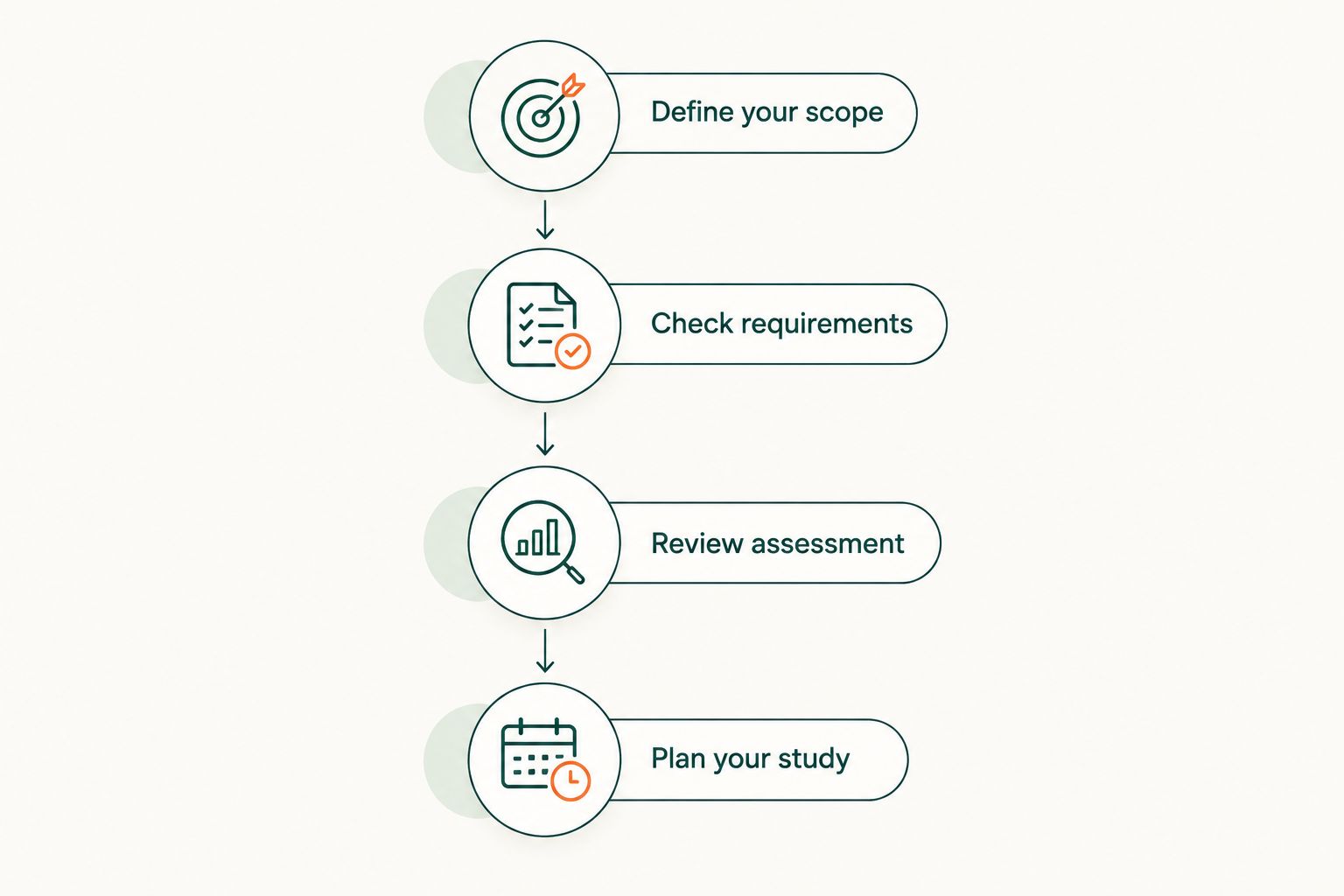
Use a short decision sequence to prevent convenience from deciding your teaching scope. Start with the work you want to do, then check whether the course provides an appropriate route toward it.
- Define your scope: Choose mat foundations, dedicated Reformer teaching, or broader apparatus training.
- Check requirements: Ask your intended teaching setting about accepted training and any additional conditions.
- Review assessment: Confirm how knowledge and practical teaching are evaluated.
- Plan your study: Resolve attendance, equipment, access terms, and required payments before enrolling.
Keep the provider's answers alongside your enrollment documents. Written details give you a clearer basis for deciding than remembered promises from a sales conversation.
Which online Pilates certification route should you choose?
Choose the self-paced foundation route if you want flexible study and a clear starting curriculum. Choose live online mat training if scheduled interaction is your priority, and investigate hybrid Reformer training when equipment teaching is the actual goal.
For broader apparatus work, choose a pathway explicitly built around that scope. Do not enroll in a foundation course expecting its certificate to become a different qualification later without further training.
Your strongest 2026 choice is the course whose curriculum, assessment, and practical requirements match your intended teaching setting. Confirm those details before payment, not after finishing the lessons.
FAQ
What's the best online Pilates certification for a first-time instructor?
TeachPilates fits first-time instructor candidates seeking self-paced teaching foundations, with $497 tuition. Its curriculum covers anatomy, mat instruction, introductory Reformer concepts, cueing, and business skills; confirm that this scope matches your intended role.
Can I become a Pilates instructor through online study?
Online study is a route to instructor education, but the course must match the teaching you intend to do. Check practical assessment, employer requirements, and any equipment-based training your role requires.
Does online Reformer content qualify me to teach on a Reformer?
Introductory online Reformer content is not the same as dedicated hands-on Reformer qualification. Check equipment practice, supervised teaching, and practical assessment before choosing a Reformer pathway.
Is live online training better than self-paced study?
Live online training fits learners who need scheduled interaction; self-paced study fits learners who need control over their timetable. Neither format alone establishes the quality of feedback or the depth of practical assessment.
Do I need teaching experience before enrolling?
Prior teaching experience is not required for the TeachPilates course. Check the entry requirements of any other provider, especially for apparatus pathways or courses that build on previous training.
Will every studio accept an online Pilates certificate?
No course certificate guarantees acceptance by every studio. Ask your intended employer about accepted training, practical demonstrations, and any additional requirements before enrolling.
Is an independent credential included with course completion?
Do not assume an independent credential is included with a course completion certificate. Ask the provider to identify the credential issuer and any separate examination or application requirements.
One last thing
Ask your intended studio what it expects you to demonstrate in an audition. That answer can sharpen your course comparison: you need training that helps you understand and practice the teaching tasks involved, not just complete lesson screens.
A certificate records completion of stated requirements. Choose those requirements as carefully as you choose the course name.