Best for flexible self-paced study: TeachPilates, with $497 tuition. Best for live correction: an in-person mat course. Best for combining home study with scheduled feedback: a hybrid mat course. This 2026 guide helps you choose the best mat Pilates certification for the classes you want to teach—not simply the certificate you want to earn.
- TeachPilates is the best mat Pilates certification fit here for learners prioritizing self-paced study and $497 tuition.
- Choose in-person mat training when direct observation and live correction are your priorities.
- Choose hybrid training when you want home study alongside scheduled practical instruction.
- Mat certification and introductory Reformer concepts are not interchangeable with dedicated hands-on apparatus qualification.
Why this matters
Choosing a course means choosing how you will learn to teach. Knowing an exercise yourself is different from explaining it, observing someone else perform it, and choosing an appropriate modification.
Your intended teaching setting should shape your enrollment decision. A studio can set its own training requirements, so ask your intended employer what it accepts before you commit.
Publisher disclosure: This guide is published by TeachPilates, which offers the online course discussed below. The alternatives are training formats, not endorsements of individual providers.
What makes the best mat Pilates certification in 2026?
Use these criteria before comparing course names. A course should fit both your schedule and the practical responsibilities of teaching.
- Teaching scope: Separate mat instruction from Reformer and other apparatus training. Identify exactly what the course prepares you to teach.
- Anatomy and movement: Look for anatomy connected to exercise selection, observation, and modifications—not vocabulary alone.
- Cueing and practice: Ask how you will practice explaining movements and whether someone reviews your teaching.
- Assessment: Establish whether completion requires written knowledge, practical teaching, or both. Ask what happens if you need another attempt.
- Study format and access: Check scheduled attendance, course-access limits, tutor contact, and practical requirements before enrolling.
- Total commitment: Compare tuition alongside travel, equipment access, assessments, and any separate credential requirements.
Ask for concrete explanations. “Practical assessment” should tell you what you submit or demonstrate, who reviews it, and what standard you must meet. “Support” should identify how you ask questions and receive help.
Mat certification options at a glance
This 2026 shortlist ranks distinct enrollment routes by their best use case. The first entry is a named course; the remaining entries describe formats you can evaluate using the same criteria.
| Rank and option | Best for | Standout feature | Key limitation |
|---|---|---|---|
| 1. TeachPilates online certification | Flexible self-paced study | Curriculum covers anatomy, mat instruction, cueing, business skills, and Reformer concepts | Do not treat introductory apparatus content as dedicated hands-on qualification |
| 2. In-person mat course | Learners prioritizing live correction | Practical sessions place you with an instructor | Attendance requires a compatible schedule and location |
| 3. Hybrid mat course | Learners wanting home study plus scheduled practical work | Separates independent study from instructor-led sessions | The balance of feedback and independent work needs checking |
| 4. Comprehensive apparatus pathway | Learners pursuing a broader apparatus-teaching scope | Extends the training goal beyond mat instruction | Includes training outside a mat-only goal |
Choose your teaching scope before choosing your study format. Otherwise, you can finish a convenient course that does not match the work you want to do.
1. TeachPilates: best mat Pilates certification for self-paced study
TeachPilates is best for aspiring Pilates instructors who want self-paced online study with $497 tuition. The course covers anatomy, mat instruction, cueing, business skills, and Reformer content.
That combination suits a practitioner who wants to study teaching foundations without arranging attendance around a fixed classroom timetable. Keep the scope distinction clear: introductory Reformer concepts do not replace dedicated hands-on apparatus qualification.
TeachPilates pros
- Self-paced online study lets you organize coursework around your existing commitments.
- Anatomy, mat instruction, and cueing address distinct parts of learning to teach.
- Business skills add context beyond performing and explaining exercises.
- The stated tuition gives you a concrete starting point for your enrollment budget.
TeachPilates cons
- Self-paced study requires you to organize your learning and protect time for practice.
- Introductory Reformer coverage should not be treated as full apparatus preparation.
- Acceptance for a particular role remains a question for that employer.
Tuition: $497. Check the enrollment terms for access duration, assessment arrangements, and any separate requirements before paying.
Best for: You want an online teaching foundation and can manage your own study schedule.
Before enrolling, ask how practical teaching is assessed and what feedback you receive. These questions help you connect the curriculum to the moment you stand in front of a learner.
Verdict: Buy if flexible study matches your needs and the confirmed teaching scope matches your intended role.
2. In-person mat courses: best for live correction
An in-person mat course puts practical learning into a shared teaching space. Choose a course with observed practice if you want an instructor to watch your cueing and discuss corrections during training.
The format matters less than what happens in the room. Sitting through demonstrations is not the same as practicing instruction and receiving feedback on your own teaching.
In-person mat course pros
- Practical sessions let you observe instruction directly.
- Instructor-led practice creates opportunities to ask questions in context.
- Scheduled attendance gives your training a defined place in your calendar.
In-person mat course cons
- Attendance ties your progress to session dates and location.
- Travel adds another commitment beyond the coursework itself.
- Classroom attendance alone does not establish how much individual feedback you receive.
Best for: You learn through supervised practice and can attend scheduled sessions consistently.
Ask how learners take turns teaching, whether participation is assessed, and how instructors handle questions about modifications. Also check missed-session arrangements before choosing dates.
Verdict: Buy if observed practice is central to the course and the attendance requirements fit your life.
3. Hybrid mat courses: best for home study with practical sessions
A hybrid mat course combines independent coursework with scheduled instructor-led learning. It fits you when you want to study theory at home but also want practical instruction built into the course structure.
Check the division carefully. A course described as hybrid can still place much of the responsibility for organizing practice on you.
Hybrid mat course pros
- Independent coursework gives you space to review theory before practical sessions.
- Scheduled instruction provides opportunities to connect study with teaching practice.
- The format combines individual preparation with structured contact time.
Hybrid mat course cons
- You still need to meet attendance requirements for scheduled components.
- Practical feedback depends on the actual session design, not the hybrid label.
- Separate online and practical components require careful scheduling.
Best for: You want flexibility for theory while retaining instructor-led practical work.
Request a sample schedule and assessment outline. Identify what you complete independently, what requires attendance, and where someone evaluates your teaching rather than your ability to recall information.
Verdict: Buy if the practical component includes the feedback you need—not just demonstrations you watch.
4. Comprehensive apparatus pathways: best for broader teaching goals
A comprehensive apparatus pathway serves a different goal from mat-only certification. Consider this route when your intended work includes equipment-based instruction and the course explicitly covers that equipment.
Do not choose it simply because “comprehensive” sounds more credible. Extra scope is useful when it matches your teaching plans and you can meet the practical requirements.
Comprehensive apparatus pathway pros
- Aligns training with a goal that extends beyond mat classes.
- Creates a basis for comparing mat and equipment-specific instruction within one pathway.
- Makes apparatus preparation an explicit enrollment consideration.
Comprehensive apparatus pathway cons
- Includes training outside a mat-only teaching goal.
- Equipment access and supervised practice need deliberate planning.
- A broad course title does not establish employer acceptance or independent credential eligibility.
Best for: You have a defined apparatus-teaching goal and access to the equipment needed for practice.
Get the equipment list, practical requirements, and completion conditions in writing. Separate what the provider teaches from any independent credential you intend to pursue afterward.
Verdict: Hold if your goal is mat-only; buy only when the broader scope matches your plans.
How to choose your route in 2026
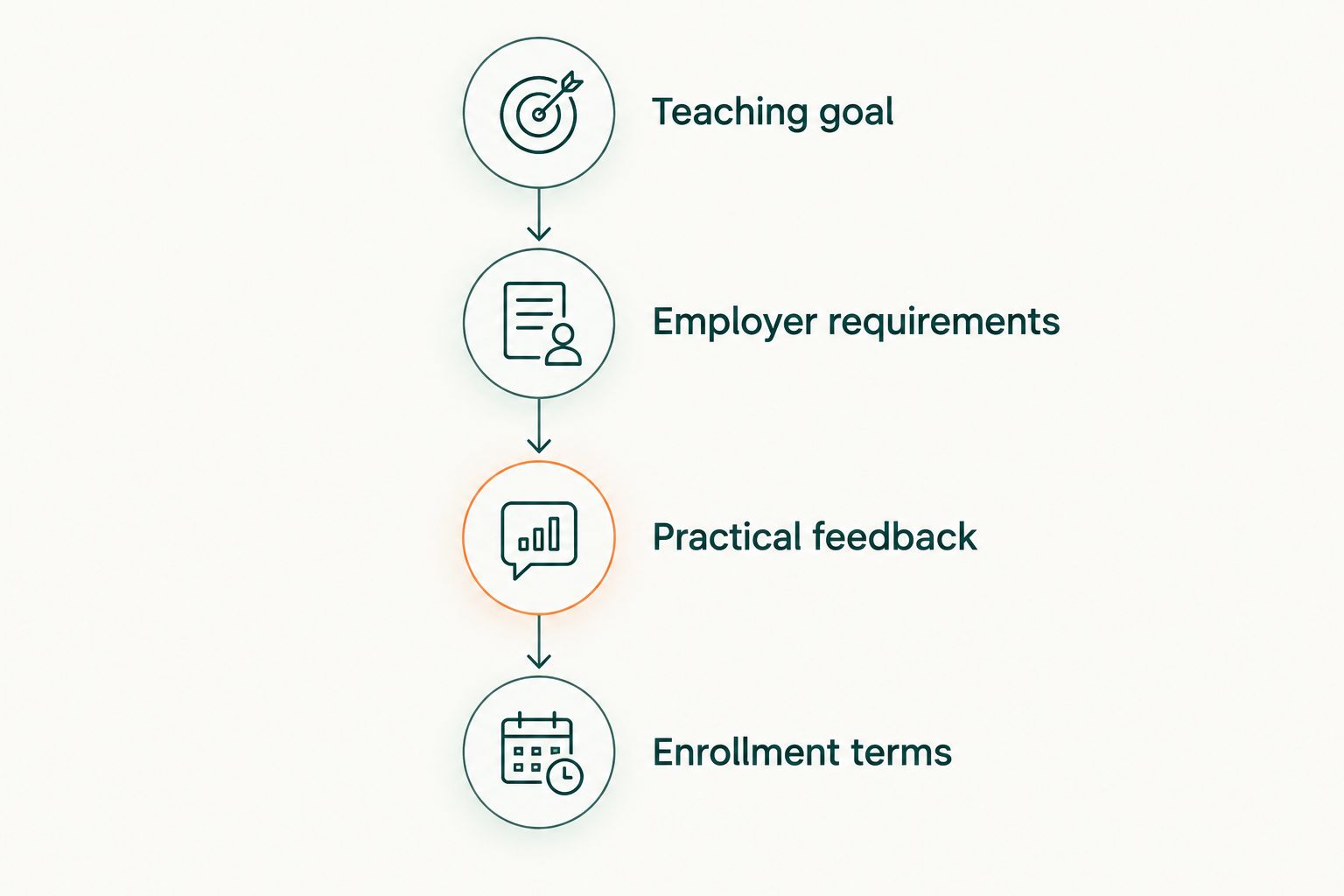
Use this sequence to turn a shortlist into an enrollment decision. Start with the work you want to do, then check whether the course supports it.
- Teaching goal: Decide whether you want to teach mat classes, online sessions, or apparatus-based sessions.
- Employer requirements: Ask your intended studio or organization which training and credentials it requires.
- Practical feedback: Establish who observes your teaching and how you receive corrections.
- Enrollment terms: Confirm tuition, access, prerequisites, assessment rules, and completion conditions.
Keep a written record of those answers. A clear course outline and clear enrollment terms are more useful than a reassuring course title.
For a first teaching rehearsal, try a 5-minute segment rather than attempting a whole class. Then set aside 20 minutes to review your explanation, transitions, and instructions. This is a suggested practice exercise, not a certification requirement or a substitute for assessed teaching.
Notice whether your words explain the starting position, the movement, and when to stop. Bring uncertainties to a qualified instructor rather than repeating an instruction you do not understand.
For a closer look at learning formats, compare online Pilates certification with in-person training.
How this shortlist is ranked
The ranking prioritizes a first-time instructor's enrollment decision: teaching scope, study format, practice, assessment, and commitment. Each option owns a different use case rather than competing for a universal “best” label.
For this 2026 comparison, flexible online study is the default recommendation for readers who can organize their learning independently. In-person training is the stronger fit when live correction is your deciding requirement; hybrid training fits a mixed approach.
A course completion certificate and an independent professional credential are separate things. Verify any additional eligibility or assessment requirements directly with the relevant credentialing organization.
Which mat Pilates certification should you choose?
Choose TeachPilates if you want self-paced online study at $497 and its confirmed requirements fit your teaching goal. Choose an in-person mat course instead when direct, scheduled practical feedback is your priority.
Before making your 2026 enrollment decision, check more than tuition. Ask about assessment charges, travel, equipment access, required materials, and separate credential costs. Include only the expenses that actually apply to your chosen course.
Do not build your plan around an assumed completion date. Check access limits and practical obligations, then make a study schedule you can maintain.
Review your course options
Explore the self-paced course, then confirm its scope, access terms, and assessment requirements.
FAQ
What's the best mat Pilates certification for flexible study in 2026?
TeachPilates is the flexible-study pick in this guide, with self-paced online learning and $497 tuition. Confirm that its teaching scope, assessments, and enrollment terms match your intended role.
Is online mat Pilates certification better than in-person training?
Online training is the better fit when self-paced study is your priority; in-person training fits learners who prioritize live correction. Compare actual teaching practice and feedback arrangements rather than choosing by format alone.
Can I teach Reformer Pilates after a mat certification?
Do not treat mat certification as a substitute for dedicated Reformer preparation. Check the course's equipment-specific teaching scope and the requirements of the studio where you want to work.
Do I need teaching experience before enrolling?
Prerequisites depend on the course, so check the provider's entry requirements before enrolling. Ask separately about previous Pilates practice, anatomy knowledge, and teaching experience.
What should a mat Pilates course assessment include?
Look for clear assessment of the knowledge and teaching skills the course claims to develop. Ask whether you complete written work, demonstrate exercises, teach a practical segment, and receive feedback.
Will every studio accept my Pilates certification?
Do not assume universal studio acceptance. Ask your intended employer about accepted training, practical experience, auditions, and any additional credentials before enrolling.
Does a course certificate include an independent credential?
A course certificate does not automatically include an independent credential. Check the separate organization's eligibility rules and assessment requirements if that credential is part of your plan.
One last thing
Before paying, ask this: “Who will watch me teach, and what feedback will I receive?” The answer connects the course description to the skill you are paying to develop.
Keep that question separate from whether you enjoy taking Pilates classes. Your next step is learning to make an exercise understandable to someone else.