
Best for flexible foundations: Teachpilates, with $497 tuition and self-paced online study. Best for a full-apparatus teaching goal: supervised comprehensive training; best for Reformer specialization: dedicated hands-on Reformer training. This 2026 guide compares training routes so you can choose the right scope—not just a certificate with “comprehensive” in its name.
- Teachpilates suits first-time instructors seeking self-paced Pilates certification foundations, not a substitute for dedicated hands-on apparatus qualification.
- The best comprehensive Pilates certification matches your intended equipment, supervised practice needs, and prospective employer’s requirements.
- Compare full-apparatus, Reformer, and mat training separately; their teaching scopes are not interchangeable.
- Confirm assessments, equipment access, prerequisites, and independent credential eligibility before enrolling.
Why this matters
A course can cover anatomy, exercise instruction, cueing, and business skills without preparing you to teach every Pilates apparatus. Curriculum breadth and demonstrated teaching competence are different things. Your enrollment decision needs to account for both.
Start with the work you want to do: teach mat classes, lead Reformer sessions, or work across a fully equipped studio. Then compare the training needed for that role. The mat-versus-full-apparatus training guide helps you separate these scopes before comparing course names.
Authorship disclosure: Teachpilates publishes this guide and offers the online course included below. The recommendations compare training formats, not independently tested provider rankings; a supervised apparatus pathway fits better when your goal requires hands-on equipment qualification.
What makes the best comprehensive Pilates certification?
Use these criteria to evaluate a 2026 syllabus before you commit:
- Teaching scope: Look for the exact equipment and class formats covered. A Reformer introduction is not the same as dedicated Reformer teacher training.
- Supervised practice: Establish who observes your teaching, how feedback works, and which equipment you use during practice.
- Assessment quality: Ask how the provider evaluates anatomy knowledge, exercise selection, cueing, modifications, and practical teaching.
- Access and scheduling: Check course access limits, scheduled attendance, equipment arrangements, and assessment booking requirements.
- Entry and credential requirements: Separate course prerequisites, the provider’s certificate, and eligibility for any independent credential.
- Total commitment: Compare tuition alongside required travel, equipment access, mentoring, assessments, and other applicable expenses.
A detailed syllabus beats a broad promise. Ask the provider to connect each claimed teaching outcome to a lesson, practice requirement, or assessment.
Pilates certification routes at a glance
The order below starts with an accessible foundation route, then separates the equipment-specific and scheduling decisions. It is not a claim that online foundations replace comprehensive apparatus training.
| Training option | Best for | Standout feature | Key limitation |
|---|---|---|---|
| Teachpilates online course | First-time instructors needing flexible foundations | Self-paced anatomy, mat instruction, introductory Reformer concepts, cueing, and business study | Does not replace dedicated hands-on apparatus qualification |
| Supervised full-apparatus pathway | Aspiring instructors targeting broad studio apparatus work | A route built around the equipment you intend to teach | Requires close scrutiny of apparatus coverage, supervision, and logistics |
| Dedicated Reformer pathway | Practitioners specifically targeting Reformer teaching | Equipment-focused training and practical skill development | Reformer scope alone does not establish full-apparatus preparation |
| Staged mat-to-apparatus pathway | Career changers building their training in phases | Separates foundational study from later apparatus specialization | Prior learning does not automatically transfer between providers |
1. Teachpilates: best for self-paced instructor foundations
Teachpilates is best for aspiring Pilates instructors who want self-paced online foundations before choosing further apparatus training. The course covers anatomy, mat and Reformer instruction, cueing, and business skills; treat the Reformer material as introductory concepts rather than a dedicated hands-on apparatus qualification.
The $497 tuition gives you a stated enrollment cost to compare with your training budget. Flexible study lets you organize coursework around existing commitments, but you still need a deliberate plan for practicing instruction.
Teachpilates pros:
- Self-paced online study supports learners who cannot organize their week around fixed classroom attendance.
- Anatomy and cueing sit alongside exercise instruction rather than being separate enrollment decisions.
- Business skills address part of the transition from practitioner to instructor.
- Mat foundations and introductory Reformer concepts help you identify your next training goal.
Teachpilates cons:
- Introductory Reformer content is not a substitute for dedicated hands-on apparatus qualification.
- Online study does not itself establish access to studio equipment or supervised teaching.
- You must confirm assessment requirements, access terms, and employer expectations before relying on the certificate for a particular role.
Best for: You are preparing to teach for the first time and want flexible foundational study, with further training selected around your intended teaching scope.
Verdict: Buy for foundations; skip as a replacement for full-apparatus qualification.
2. Supervised full-apparatus training: best for broad studio scope
A supervised full-apparatus pathway is the best route to investigate when you intend to teach across multiple types of studio equipment. Compare the actual syllabus and practical requirements rather than assuming every provider uses “comprehensive” identically.
Ask whether the pathway covers mat, Reformer, Cadillac or trapeze table, chairs, and barrels. Then ask which of those areas receive supervised practice and practical assessment. A topic appearing in a course outline does not establish the depth of instruction.
Supervised full-apparatus training pros:
- Connects your course search to the broad equipment scope you want to teach.
- Lets you prioritize observed teaching and equipment-specific feedback.
- Supports a direct discussion with prospective studios about their training expectations.
Supervised full-apparatus training cons:
- Equipment access and attendance requirements need to fit your location and schedule.
- A broad syllabus still needs scrutiny: coverage alone does not prove assessment depth.
- The provider’s certificate does not automatically include an independent credential.
Best for: You want to work across a fully equipped studio and can arrange the required attendance, practice, and equipment access.
For a 2026 enrollment, request the current course handbook rather than relying on a summary page. Identify who signs off practical work and whether the final assessment includes the equipment you expect to teach.
Verdict: Buy when full-apparatus teaching is your goal and the documented requirements match it.
3. Dedicated Reformer training: best for Reformer specialization
Dedicated Reformer training is the route to compare when your intended work centers on Reformer sessions rather than the full apparatus repertoire. Evaluate instruction in equipment setup, exercise execution, cueing, observation, and adapting a session to the participant.
Your own Reformer practice gives you experience as a participant. Teaching adds different responsibilities: explaining setup, watching movement, choosing instructions, and recognizing when you need further guidance.
Dedicated Reformer training pros:
- Keeps the training decision focused on a clearly defined teaching goal.
- Lets you evaluate equipment-specific practice and assessment directly.
- Avoids treating an introductory equipment module as a complete teaching pathway.
Dedicated Reformer training cons:
- Reformer preparation does not establish competence across other apparatus.
- You need to verify access to suitable equipment for required practice.
- Additional prerequisites or mat training requirements depend on the provider.
Best for: You specifically want to teach Reformer sessions and have identified the expectations of your intended studio or teaching setting.
Before enrolling, ask to see the practical assessment criteria. A useful answer explains what you must demonstrate—not simply how much course material you must complete. Use the written-versus-practical assessment guide to organize those questions.
Verdict: Buy for a Reformer-specific goal; skip if you need full-apparatus scope.
4. Staged mat-to-apparatus training: best for phased study
A staged pathway starts with mat foundations and adds apparatus training later. It suits you when you want to make one training decision at a time rather than commit immediately to a broad equipment pathway.
The critical issue is transferability. A receiving provider decides whether earlier coursework meets its entry or credit requirements; completing one certificate does not establish automatic acceptance elsewhere.
Staged mat-to-apparatus training pros:
- Separates your immediate learning goal from later specialization.
- Gives you space to develop cueing and lesson-planning habits before adding apparatus complexity.
- Lets you investigate local studio expectations before choosing further training.
Staged mat-to-apparatus training cons:
- Providers do not automatically accept one another’s coursework.
- You risk repeating content if transfer arrangements are unclear.
- A later apparatus stage still requires its own equipment and assessment planning.
Best for: You are changing careers or organizing study around existing commitments and want a deliberate sequence.
Get any transfer decision in writing before using it to justify enrollment. Ask exactly which prior modules count, what documentation is required, and which practical requirements remain.
Verdict: Buy when the sequence is documented; wait when progression depends on an unconfirmed transfer promise.
How to choose your training route
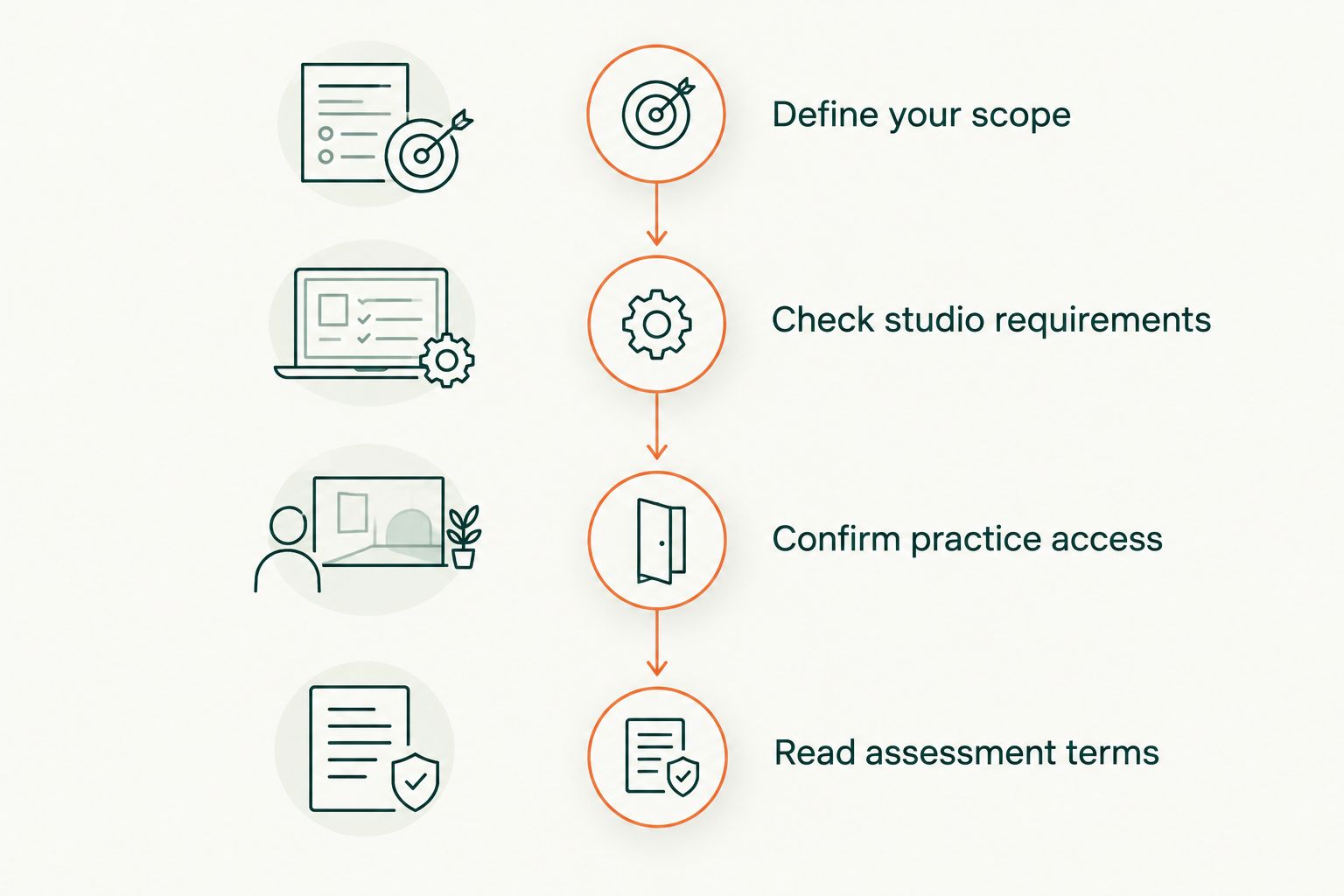
Use this sequence to turn the comparison into an enrollment decision. Keep the answers together so you can compare providers on the same terms.
Define your scope
Write down the class format and equipment you intend to teach. “Pilates instructor” is too broad to settle whether you need mat foundations, dedicated Reformer preparation, or full-apparatus training.
Check studio requirements
Ask prospective studios which training they accept, what practical demonstration they expect, and whether they require a separate credential. Do this before enrolling—not after completing a course.
Confirm practice access
Establish where you will practice, who can observe you, and how required work is recorded. For self-paced study, put practice appointments into your calendar rather than leaving them as an intention.
Read assessment terms
Request prerequisites, assessment criteria, resit terms, course access limits, and any progression conditions. For your 2026 shortlist, use the current written terms supplied by each provider.
As a personal planning exercise, draft a 10-minute mat teaching segment and 2 lesson outlines for different beginner needs. These are suggested preparation tasks, not provider requirements or evidence of qualification. Use them to identify questions about cueing, exercise selection, and feedback.
Review your online training option
Explore self-paced instructor foundations and compare them with your intended teaching scope.
How these routes are ranked
This guide ranks formats by fit: flexible foundations, broad apparatus scope, Reformer specialization, and phased progression. It does not assign unsupported scores, claim provider testing, or treat certificates with different scopes as equivalent.
The deciding criteria are teaching scope, supervised practice, assessments, access, prerequisites, and total commitment. For comprehensive apparatus goals, documented practical preparation takes priority over convenience.
Which Pilates certification should you choose?
For a 2026 decision, choose supervised full-apparatus training if you already know you want broad apparatus teaching. Ask prospective employers to confirm the route before you commit.
Choose online foundations when you need flexible introductory instructor study and understand what further practical preparation your goal requires. Choose dedicated Reformer training for Reformer-specific work, or a staged route when the progression requirements are clear.
FAQ
What’s the best comprehensive Pilates certification for a beginner?
The best comprehensive Pilates certification for a beginner matches the equipment you intend to teach and provides clearly documented practice and assessment requirements. If your goal is full-apparatus studio work, investigate supervised full-apparatus pathways rather than treating introductory online equipment content as equivalent.
Is online Pilates certification the same as comprehensive apparatus training?
No. Online delivery describes how you study, while comprehensive apparatus scope describes what equipment and teaching skills the program covers. Check practical supervision and assessment separately from the delivery format.
Should I choose mat or Reformer training first?
Choose the sequence that meets your intended teaching role and the receiving provider’s prerequisites. Mat foundations and Reformer specialization serve different scopes, and earlier study does not automatically transfer into another program.
Do I need teaching experience before enrolling?
Teaching-experience prerequisites depend on the course. Ask about prior Pilates practice, anatomy knowledge, teaching background, and equipment experience separately so you understand the actual entry requirements.
Does a Pilates course certificate include an independent credential?
Do not assume an independent credential is included with a provider’s course certificate. Confirm the separate credential’s eligibility rules, application process, and assessment requirements before choosing training on that basis.
Will every studio accept my Pilates certification?
No course choice establishes universal studio acceptance. Ask the studios where you want to teach about accepted training, practical auditions, teaching scope, and any additional requirements before enrollment.
What should I check besides tuition before enrolling in 2026?
Check required equipment access, travel, mentoring, assessments, materials, resits, and course access terms. Request an itemized explanation of required and optional expenses rather than assuming tuition covers every part of qualification.
One last thing
Ask each provider one question: “What must I demonstrate before you certify me to teach this equipment?” A useful answer names observable teaching skills and the assessment used to judge them. That tells you more about fit than the word “comprehensive” alone.