Best for flexible first-time study: TeachPilates, with $497 tuition and self-paced online learning. Best for a mat-only teaching goal: dedicated mat training. Best for a Reformer teaching goal: dedicated hands-on Reformer training. This 2026 affordable Pilates certification guide compares those routes with broader apparatus training so you can choose by teaching scope, not tuition alone.
- TeachPilates offers affordable Pilates certification at $497, with self-paced study for aspiring instructors.
- Choose dedicated mat training when your teaching goal is mat classes rather than apparatus instruction.
- Choose hands-on Reformer training when your goal requires supervised equipment practice and assessment.
- Compare assessment, access terms, employer requirements, and additional expenses before enrolling.
Why this matters
An affordable course needs to prepare you for the teaching you actually intend to do. Buying online foundations when you need a hands-on apparatus qualification leaves a gap; buying broader apparatus training before deciding what you want to teach adds unnecessary scope.
TeachPilates is best for aspiring instructors seeking self-paced Pilates teaching foundations. Its curriculum covers anatomy, mat instruction, introductory Reformer concepts, cueing, and business skills. Treat introductory equipment study and dedicated hands-on apparatus qualification as different training goals.
This guide is published by TeachPilates. It compares the course with training formats rather than presenting an unverified ranking of competing providers, prices, or recognition claims.
What makes the best affordable Pilates certification?
Use these criteria to compare your 2026 shortlist before looking at the course title or checkout page:
- Teaching scope: The curriculum should match mat classes, Reformer instruction, or broader apparatus work—not leave you guessing which is covered.
- Assessment: Ask how the provider checks anatomy knowledge, exercise selection, cueing, modifications, and practical teaching.
- Practice and feedback: Separate watching lessons from teaching someone and receiving specific corrections.
- Study access: Confirm deadlines, access expiry, equipment needs, and the support available while you study.
- Total commitment: Compare tuition alongside required travel, equipment access, assessments, and other enrollment conditions.
- Workplace fit: Ask your intended studio or insurer about its requirements before purchasing training.
A course name is not enough evidence. Ask for the syllabus, assessment requirements, and completion terms in writing so you can compare the same categories across your shortlist.
Affordable Pilates certification options at a glance
The order below starts with flexible foundations, then moves toward narrower or broader practical teaching goals. These are distinct routes, not claims that every provider within a format offers the same training.
| Option | Best for | Standout feature | Key limitation |
|---|---|---|---|
| TeachPilates | Self-paced first-time study | Online anatomy, mat, cueing, introductory Reformer, and business curriculum | Introductory Reformer content is not a substitute for dedicated hands-on apparatus qualification |
| Dedicated mat training | A mat-only teaching goal | Concentrates your training comparison on mat instruction | Does not establish Reformer or other apparatus competence |
| Dedicated hands-on Reformer training | A Reformer-specific teaching goal | Centers your selection on equipment practice and practical assessment | Requires checking equipment access and supervised practice arrangements |
| Broader apparatus training | Teaching across multiple apparatus | Expands the training scope beyond mat and Reformer alone | Adds scope you do not need if your goal is mat-only teaching |
1. TeachPilates: best for self-paced first-time study
TeachPilates offers an online Pilates instructor certification course for aspiring and current practitioners. You study at your own pace, with a curriculum covering anatomy, mat instruction, cueing, business skills, and introductory Reformer concepts.
Best for: You want structured teaching foundations without committing to scheduled classroom attendance. This route fits a reader whose immediate priority is learning how to explain movement and plan instruction, rather than obtaining a dedicated hands-on apparatus qualification.
TeachPilates pros
- Self-paced online study lets you arrange lessons around your existing commitments.
- Anatomy and mat instruction connect movement knowledge with teaching foundations.
- Cueing content addresses how you communicate exercises to another person.
- Business lessons include a practical subject beyond exercise technique.
TeachPilates cons
- Introductory Reformer concepts do not replace dedicated hands-on equipment training.
- Online self-study requires you to organize your own consistent practice routine.
- You must check an intended employer's requirements rather than assume acceptance.
TeachPilates tuition: $497. Before enrolling in 2026, confirm the current assessment process, support arrangements, access terms, and any separate requirements relevant to your teaching plan.
Do not read an online course description as proof that a particular studio will accept the certificate. Ask the studio directly, describing both the course format and the role you want.
Verdict: Buy if you want self-paced foundations; hold if your immediate goal requires dedicated hands-on apparatus qualification.
2. Dedicated mat training: best for a mat-only teaching goal
Dedicated mat training focuses your search on teaching exercises performed on a mat rather than on apparatus. Compare courses by their mat syllabus, teaching practice, feedback, and assessment—not simply by whether “mat” appears in the title.
Best for: You already know that mat classes are your intended starting point. This option gives you a narrower brief for comparing providers than a general search for Pilates certification.
Dedicated mat training pros
- Keeps your training decision aligned with a defined mat-teaching goal.
- Lets you compare mat exercise instruction and class planning directly.
- Avoids treating apparatus content as necessary when it is outside your intended scope.
Dedicated mat training cons
- Mat training alone does not establish apparatus teaching competence.
- Practical feedback and assessment arrangements require provider-by-provider checking.
- Later apparatus study requires a separate review of entry and transfer rules.
Ask how you progress from demonstrating exercises to observing a participant, choosing an appropriate variation, and giving useful instructions. Knowing a sequence yourself is different from teaching it clearly.
For a 2026 enrollment decision, request examples of assessment tasks and the feedback process. A clearly described teaching assessment is more useful than a vague promise that you will feel confident after completion.
Verdict: Buy when your goal is specifically mat teaching; hold when you are already committed to Reformer instruction.
3. Hands-on Reformer training: best for a Reformer teaching goal
Dedicated hands-on Reformer training is the route to investigate when equipment instruction is your intended work. Evaluate how a course teaches setup, exercise selection, participant observation, cueing, and practical equipment use.
Best for: You want to teach Reformer sessions and need training built around that apparatus. Choose by the actual practice and assessment requirements, not by the presence of Reformer videos in an otherwise general course.
Hands-on Reformer training pros
- Aligns your training search with the apparatus you intend to teach.
- Makes equipment access and supervised practice explicit selection criteria.
- Lets you examine how practical teaching competence is assessed.
Hands-on Reformer training cons
- You need a workable plan for required equipment access.
- Attendance and practice arrangements must fit your schedule.
- Reformer-focused study does not automatically cover other apparatus.
Before enrolling, ask where practice happens, who supervises it, and whether you must arrange access independently. Get clear answers about the distinction between observing a lesson, practicing exercises yourself, and teaching another person.
If a studio is your intended workplace, check its training requirements first. That conversation belongs before enrollment, not after you finish a course that does not meet its expectations.
Verdict: Buy when Reformer teaching is your defined goal and the practical arrangements work; wait if equipment access is unresolved.
4. Broader apparatus training: best for a multi-apparatus goal
Broader apparatus training is the category to compare when your intended teaching scope extends beyond mat and Reformer. Require an explicit equipment list and syllabus; do not assume the word “complete” tells you what a program includes.
Best for: You have a clear reason to train across multiple apparatus. The strongest reason is a defined teaching plan or workplace requirement, not the idea that a longer course title must mean a better choice.
Broader apparatus training pros
- Supports a training plan that includes multiple apparatus.
- Lets you assess how mat and equipment instruction connect within a curriculum.
- Provides a wider scope to compare against a studio's stated requirements.
Broader apparatus training cons
- Adds subjects outside a mat-only or Reformer-only goal.
- Requires careful checking of access, attendance, and practice obligations.
- A broad course description still does not establish independent credential eligibility.
Ask which apparatus are taught and assessed, which prerequisites apply, and what completion actually certifies. Also ask whether any independent credential requires a separate application, eligibility review, or examination.
Verdict: Buy for a defined multi-apparatus goal; skip this scope if you only want to begin with mat instruction.
How these routes are ranked
The ranking prioritizes fit for a first-time instructor: teaching scope, assessment clarity, practical preparation, study access, and total commitment. Self-paced foundations come first because this guide addresses readers comparing a flexible entry route with more specialized training.
This is not a cheapest-to-most-expensive provider ranking. Apart from the stated course tuition, no competing provider's current fees or assessment arrangements are assumed.
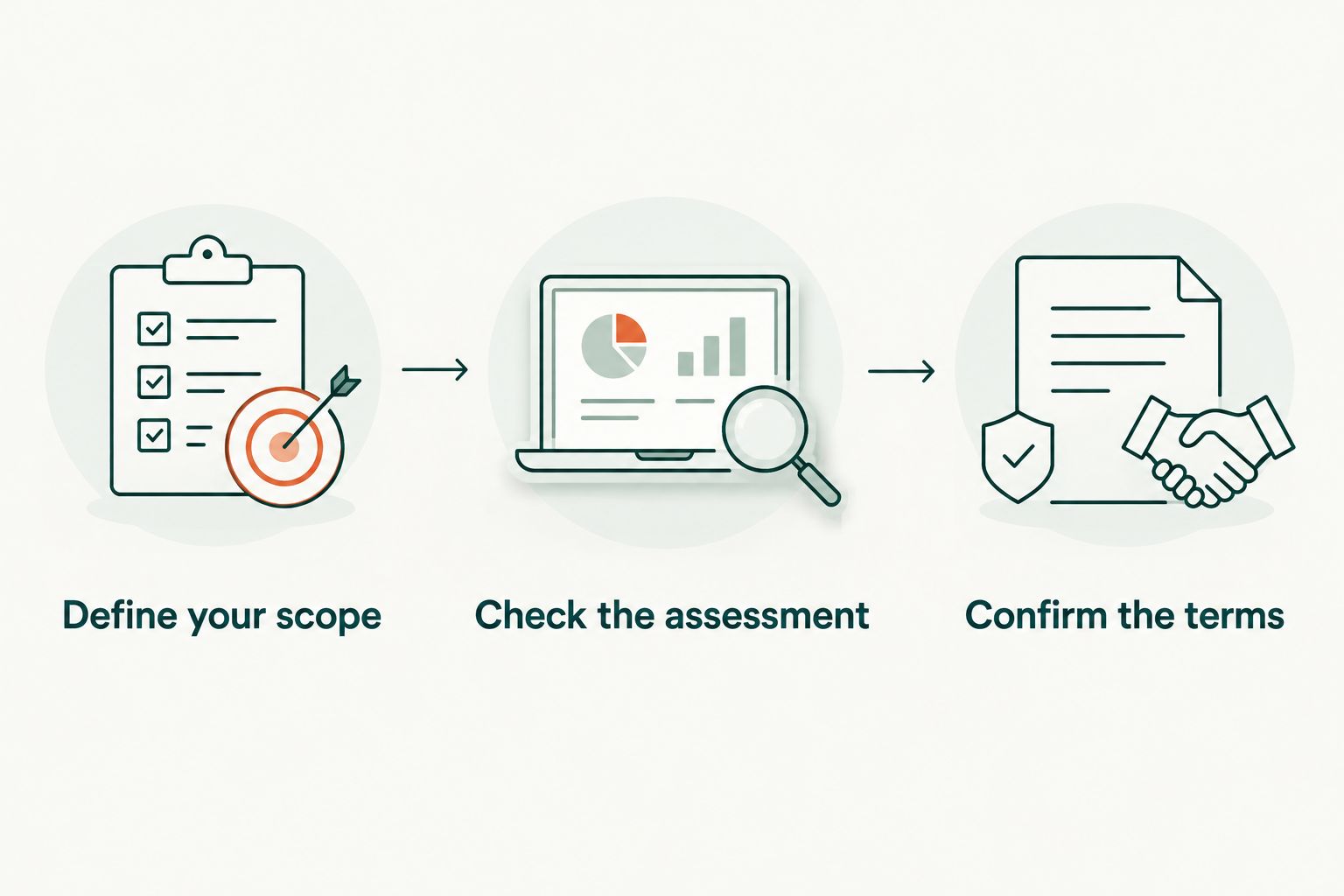
Check your enrollment decision in three steps
Define your scope
Write down what you want to teach first: mat, Reformer, or multiple apparatus. Then identify the setting, such as online classes or a particular studio, and ask what that setting requires.
Check the assessment
Request a written explanation of theory and practical assessments. Use this guide to written versus practical Pilates assessments to frame questions about demonstrations, teaching submissions, feedback, and completion requirements.
Confirm the terms
Check tuition, access duration, required materials, assessment arrangements, and any expenses you must arrange separately. Save the written terms that apply to your 2026 enrollment rather than relying on a promotional summary.
Your decision should answer two questions: Does the training match what you intend to teach, and can you complete its actual requirements? If either answer is unclear, resolve it before enrolling.
Which affordable Pilates certification should you choose?
Choose TeachPilates for $497 self-paced study when your priority is Pilates teaching foundations. Choose dedicated mat training when you want to compare a mat-specific route, and dedicated hands-on Reformer training when equipment instruction is your immediate goal.
For your 2026 decision, keep introductory Reformer concepts separate from assessed hands-on apparatus preparation. Choose broader apparatus training only when that wider scope serves a defined purpose.
Explore your instructor training
Review the $497 self-paced course against your teaching goals and enrollment questions.
FAQ
What's the best affordable Pilates certification for flexible study?
TeachPilates is a fit for aspiring instructors seeking $497 self-paced online study. Its curriculum covers anatomy, mat instruction, cueing, business skills, and introductory Reformer concepts; check that this scope matches your intended teaching role.
Is online Pilates certification better than in-person training?
Neither format is better for every teaching goal. Compare flexibility with your need for supervised practice, direct feedback, and equipment access, then check the intended workplace's requirements.
Does introductory Reformer content qualify me to teach Reformer classes?
Do not treat introductory Reformer content as a dedicated hands-on apparatus qualification. Check the practical training, assessment, and employer requirements for the Reformer role you want.
What should I check besides Pilates course tuition?
Check access limits, assessment arrangements, required materials, travel, and equipment access. Ask which expenses apply to your chosen course rather than assuming that every possible expense is required.
Do I need teaching experience before starting Pilates certification?
TeachPilates states that no teaching background is required. Other providers set their own prerequisites, so check movement experience, prior training, and practical requirements before enrolling.
Will a Pilates certificate guarantee studio acceptance?
No Pilates course should be treated as a guarantee of acceptance by every studio. Ask your intended employer about its certificate, practical experience, audition, and other requirements before purchasing training.
Is an independent Pilates credential included with course completion?
Do not assume an independent credential is included with a course certificate. Check the credentialing body's eligibility and examination requirements separately, and request written confirmation of what your course awards.
One last thing
Before you enroll, send your intended studio a short description of the course and ask whether it meets the requirements for the specific role you want. A direct answer is more useful than a course title that sounds impressive.
If you are not targeting a studio yet, define your teaching scope anyway. The right affordable course is the one that serves your next teaching goal—not every possible future goal.