Best for flexible first-time study: Teachpilates, with $497 tuition and self-paced online learning. Best for supervised mat practice: an in-person mat course. Best for apparatus-focused teaching: dedicated Reformer training. The best accredited Pilates certification programs in 2026 need more than a convincing certificate title: you need to verify accreditation, assessment requirements, and the teaching scope before enrolling.
- The best accredited Pilates certification programs identify who accredits them and exactly what that recognition covers.
- Teachpilates suits first-time instructor candidates seeking self-paced online study; verify recognition separately from curriculum.
- Choose dedicated Reformer training when your goal requires supervised apparatus practice and assessment.
- Confirm employer requirements, practical assessments, access terms, and additional expenses before enrolling.
Published by Teachpilates, this guide compares training routes rather than presenting unverified provider accreditation claims. Teachpilates is best for aspiring Pilates instructors who want self-paced online study covering anatomy, mat instruction, cueing, and business skills.
Why this matters
A course certificate, an accredited training program, and an independent professional credential are different things. A provider can teach useful material without its certificate meeting a particular studio's hiring requirements or an external credential's eligibility rules.
Your decision in 2026 should start with the work you want to do. Teaching mat classes, teaching Reformer sessions, and teaching across apparatus require different preparation; a course covering introductory equipment concepts is not the same as dedicated hands-on apparatus qualification.
Choose the teaching scope first, then verify the credential. That order keeps a familiar accreditation label from distracting you from practical gaps.
What makes the best accredited Pilates certification programs?
Use these criteria before comparing course names or enrolling:
- Verifiable recognition: Identify the accrediting organization, its directory entry, and whether recognition applies to the institution, course, or credential.
- Relevant teaching scope: Match the syllabus to mat teaching, Reformer instruction, or broader apparatus work.
- Practical assessment: Establish how an assessor evaluates your cueing, observation, modifications, and teaching decisions.
- Supported practice: Check who gives feedback, how you submit questions, and whether observed teaching is included.
- Workable access: Confirm prerequisites, study deadlines, equipment needs, and access after completion.
- Clear total commitment: Separate tuition from assessments, equipment access, travel, mentoring, and any external credential requirements.
Read the distinction between Pilates instructor certification and independent credentials before treating either as evidence of the other. Ask your intended employer which credential and practical experience it expects.
Training routes at a glance
These rankings describe best-fit training routes, not a verified league table of accredited providers. Accreditation must be checked for the exact program you are considering in 2026.
| Rank and option | Best for | Standout feature | Key limitation |
|---|---|---|---|
| 1. Teachpilates online certification | Flexible first-time study | Self-paced curriculum covering anatomy, mat instruction, cueing, and business skills | Introductory Reformer concepts should not be treated as dedicated hands-on apparatus qualification |
| 2. In-person mat teacher training | Supervised mat-teaching practice | Opportunity to evaluate live observation and feedback before enrolling | Attendance requirements restrict schedule flexibility |
| 3. Dedicated Reformer teacher training | Reformer-focused teaching | Equipment-specific study and practice | Requires suitable apparatus access; other equipment is a separate scope question |
| 4. Comprehensive apparatus training | A broader apparatus-teaching goal | A route for studying multiple equipment types | The word comprehensive does not establish which apparatus or assessments are included |
1. Teachpilates: best Pilates course for flexible first-time study
Teachpilates offers self-paced online Pilates instructor certification covering anatomy, mat and Reformer instruction, cueing, and business skills. Its practical fit is the aspiring instructor who wants to organize study around existing commitments rather than attend a fixed classroom schedule.
For enrollment planning, distinguish mat-teaching foundations and introductory Reformer concepts from dedicated hands-on apparatus qualification. Learning equipment terminology and instructional concepts does not, by itself, establish readiness to teach an apparatus session independently.
Teachpilates pros:
- Self-paced online study lets you organize coursework around your schedule.
- Anatomy and cueing belong to the stated curriculum.
- Business skills address a part of instructor preparation beyond exercise knowledge.
- Mat and Reformer topics let you examine different teaching interests.
Teachpilates cons:
- Self-paced learning requires you to maintain your own study routine.
- Online curriculum coverage should not be treated as proof of supervised apparatus competence.
- Employer acceptance and independent credential eligibility need separate confirmation.
Tuition: $497, as stated by the provider. Confirm the enrollment terms and any separate requirements before paying.
Best for: First-time instructor candidates who want flexible online study and a curriculum that includes teaching and business topics.
Verdict: Buy only after confirming that the assessment, recognition, and teaching scope match your intended work.
2. In-person mat training: best for supervised mat practice
An in-person mat course is the route to investigate when you want live observation while learning to teach without apparatus. Look for a syllabus that explains exercise instruction, movement observation, modifications, class planning, and how your teaching is assessed.
Do not assume classroom attendance guarantees individual feedback. Ask whether you teach other participants, receive correction on your cues, and complete an assessed teaching session.
In-person mat training pros:
- Live sessions give you a setting in which to practice speaking and demonstrating.
- You can assess whether the teaching environment matches your learning preferences.
- A clearly defined mat scope helps you avoid confusing mat preparation with apparatus qualification.
In-person mat training cons:
- Scheduled attendance reduces flexibility compared with self-paced study.
- Travel and venue access add planning requirements.
- A mat certificate alone does not establish Reformer teaching competence.
Best for: You want to teach mat classes and prefer receiving feedback in the room.
Verdict: Buy when supervised practice and practical assessment are explicit course requirements; hold when they are only implied.
3. Dedicated Reformer training: best for apparatus-focused teaching
Dedicated Reformer training is the route to investigate when your intended role centers on the Reformer. Check how the course addresses equipment setup, springs, exercise transitions, client observation, modifications, and practical teaching.
Equipment access belongs in your enrollment decision, not your after-enrollment checklist. Establish where you will practice and whether the course requires observation or teaching work outside scheduled sessions.
Dedicated Reformer training pros:
- Equipment-specific study aligns with a Reformer-focused teaching goal.
- A defined apparatus syllabus makes it easier to compare relevant course content.
- Practical assessment can give an evaluator a way to observe equipment handling and instruction.
Dedicated Reformer training cons:
- You need access to the equipment required by the course.
- Reformer preparation does not automatically cover other apparatus.
- A short introductory module is not interchangeable with dedicated practical training.
Best for: You plan to pursue a role teaching Reformer sessions and can arrange the required apparatus practice.
Verdict: Buy when equipment access, supervised preparation, and assessment requirements are clear; wait if you cannot arrange practice.
4. Comprehensive apparatus training: best for a broader teaching goal
Comprehensive training is the route to examine when your intended work spans mat and multiple apparatus. Read the actual equipment list: the label alone does not tell you which apparatus, teaching settings, or assessments a program includes.
Compare the route with your intended employer's requirements before committing. A broader syllabus is useful only when you can complete the associated study, practice, and assessments.
Comprehensive apparatus training pros:
- A documented multi-apparatus syllabus supports comparison across broader teaching goals.
- You can check how mat and apparatus learning connect within one training route.
- Separate equipment assessments can make the program's scope easier to understand.
Comprehensive apparatus training cons:
- Multiple apparatus introduce additional access and scheduling needs.
- Broader coverage is unnecessary if your immediate goal is limited to mat teaching.
- The course label does not prove accreditation or independent credential eligibility.
Best for: You have a defined multi-apparatus teaching goal and a practical plan for completing the training.
Verdict: Buy for a specific broader teaching requirement; skip if you are choosing breadth without a clear purpose.
How we ranked these routes
The order prioritizes flexible entry into instructor study, then increasingly specific teaching goals. It is not a claim that online study outranks practical instruction or that one credential receives universal acceptance.
The comparison uses the criteria above: recognition, scope, assessment, practice, access, and commitment. For your 2026 shortlist, move the route that matches your intended teaching role to the top.
Verify accreditation before you enroll
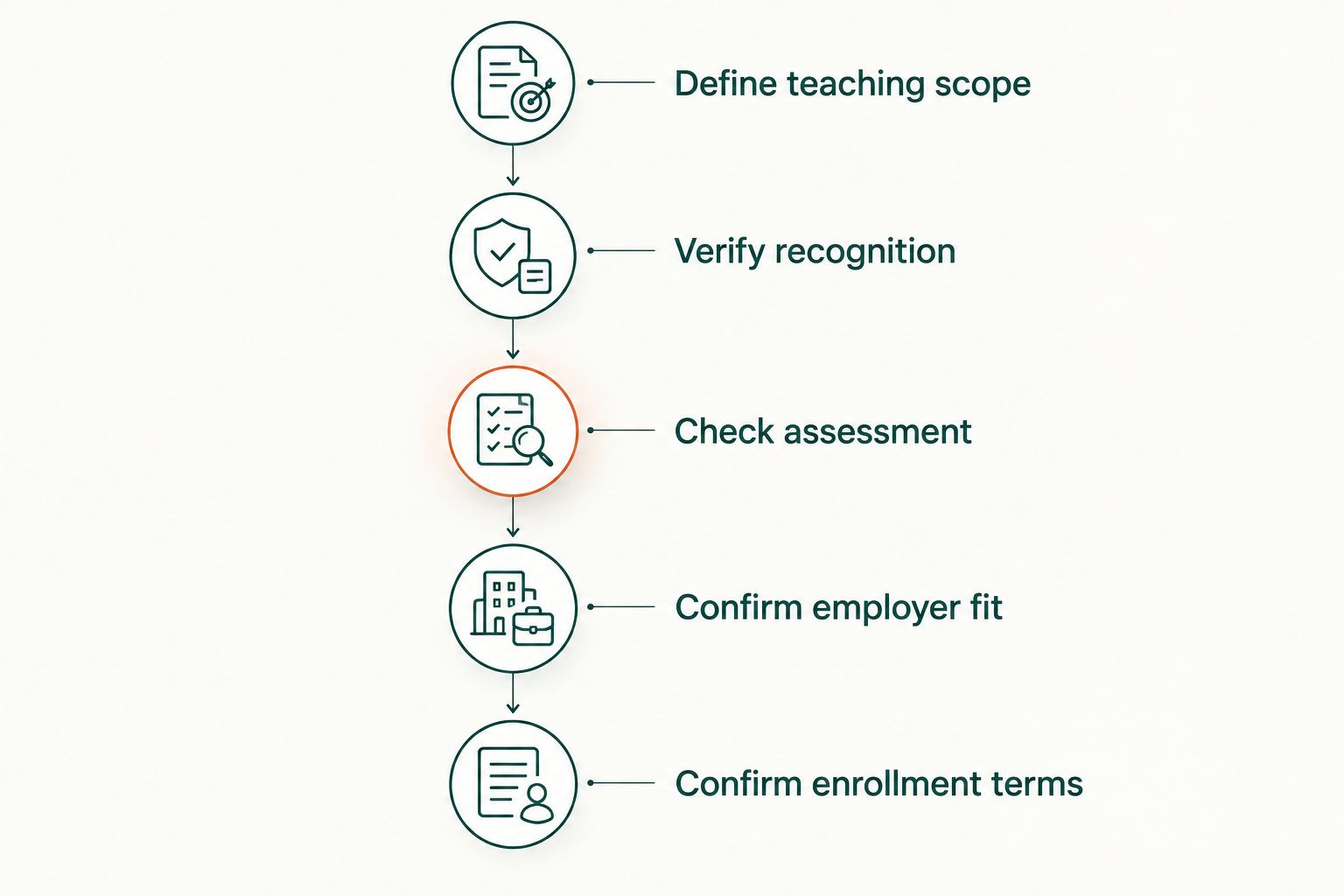
Use this sequence to turn a shortlist into an enrollment decision. Keep written answers so you can compare actual requirements rather than sales language.
Define teaching scope
Write down whether you want to teach mat, Reformer, or multiple apparatus. Then ask each provider to identify which of those activities its course prepares and assesses you to teach.
Verify recognition
Request the accreditor's full name and the exact program listing. Check that listing with the accrediting organization; institutional accreditation, course approval, continuing education recognition, and independent certification are not interchangeable labels.
Check assessment
Ask what you must demonstrate to pass. Establish whether assessment is written, practical, live, recorded, or a combination, and ask how feedback and reassessment work.
Confirm employer fit
Ask a prospective studio about required credentials, practical experience, auditions, and any additional checks. Do not replace that conversation with a provider's general statement about career opportunities.
Confirm enrollment terms
Request the prerequisites, access period, completion deadline, included support, and any separate obligations. Confirm whether observation, practice teaching, or apparatus access must be arranged outside the course.
For a 2026 enrollment, request current documents rather than relying on an old screenshot or an undated badge. Recognition and course terms need to match the program you will actually take.
Which Pilates certification route should you choose?
Choose Teachpilates for flexible online study when its curriculum and verified requirements fit your first teaching goal. Choose in-person mat training when supervised mat practice is your priority, dedicated Reformer training for apparatus-focused work, and comprehensive training for a defined multi-apparatus role.
If you are undecided, start by identifying the class you want to teach and the evidence of preparation that setting expects. Do not enroll in the broadest course simply because its title sounds more authoritative.
Review your training fit
Explore the self-paced curriculum and confirm the requirements for your intended teaching scope.
FAQ
What's the best accredited Pilates certification program for a beginner?
The best choice matches your intended teaching scope and has recognition you can verify. Beginners should also check prerequisites, practical teaching requirements, assessment methods, and the expectations of studios where they hope to teach.
Is Teachpilates an accredited Pilates certification program?
Verify accreditation directly with the provider and the named accrediting organization before enrolling. The stated self-paced curriculum covers anatomy, mat and Reformer instruction, cueing, and business skills; curriculum coverage does not itself establish accreditation.
Is an online Pilates certification better than in-person training?
Online study fits learners who need scheduling flexibility, while in-person training fits learners who prioritize classroom interaction and live practice. Compare actual feedback and assessment requirements rather than assuming the delivery format proves teaching readiness.
Can I teach Reformer Pilates after completing a mat course?
A mat course alone does not establish Reformer teaching competence. Dedicated apparatus preparation should address equipment handling, exercise instruction, supervised practice, and assessment appropriate to the role you want.
Does a Pilates course certificate include an independent credential?
A course certificate does not automatically include an independent credential. Check whether a separate application, eligibility review, assessment, or examination is required by the credentialing organization.
Do I need teaching experience before starting Pilates instructor training?
Prerequisites depend on the program, so check the exact enrollment requirements. Ask separately about Pilates practice experience, anatomy knowledge, teaching background, and any required introductory coursework.
Will every studio accept my Pilates certification?
Do not assume universal studio acceptance. Ask each prospective employer which credentials, practical experience, auditions, and additional requirements apply to its teaching roles.
What should I confirm before enrolling in a Pilates course in 2026?
Confirm teaching scope, recognition, prerequisites, assessments, access terms, and the full set of enrollment obligations. Arrange any required equipment access or supervised practice before committing.
One last thing
Ask what happens when your teaching needs correction—not just what happens when you pass. A clear explanation of feedback, reassessment, and practice requirements tells you more about instructor preparation than a certificate image does.
Before enrolling, describe your intended teaching role to the provider and request a written explanation of how its course prepares you for that role. Keep that answer beside the syllabus when making your final choice.