

A Pilates instructor course should teach you how to define your teaching scope, plan your costs, set client policies, attract suitable clients, and manage bookings—not just how to promote yourself. Teachpilates offers $497 tuition and flexible self-paced study, with business skills alongside anatomy, mat and reformer instruction, and cueing. For your 2026 enrollment decision, look for business lessons that turn those subjects into practical decisions without promising jobs, earnings, or universal studio acceptance.
- A Pilates instructor course should connect business skills to teaching scope, client policies, costs, and bookings.
- Teachpilates suits aspiring instructors seeking self-paced online study covering teaching foundations and business skills.
- Introductory Reformer concepts do not replace dedicated hands-on apparatus qualification.
- Ask what business assignments and feedback you receive before enrolling in instructor training.
Pilates instructor course: what should business lessons cover?
Business lessons should help you organize a teaching service you can describe accurately and deliver responsibly. You need more than advice to post on social media: you need decisions about whom you teach, what you offer, and how you handle the work surrounding a class.
This article is published by Teachpilates. The checklist below describes what to look for in business training; it is not a claim that every suggested exercise appears in its curriculum.
| Business subject | What the lesson should explain | What you should produce |
|---|---|---|
| Teaching scope | How your training relates to the sessions you offer | An accurate service description |
| Costs and finances | How to separate teaching income from operating expenses | A working budget |
| Client policies | How bookings, cancellations, and communication work | Written client terms |
| Client acquisition | How to explain your offer to suitable prospects | A clear class invitation |
| Administration | How to organize scheduling, payments, and records | A repeatable workflow |
| Professional development | How to identify gaps before expanding your services | A further-training plan |
In 2026, use these outputs to compare courses rather than judging the business component by its title. A lesson called business essentials tells you little until you know what you will practice.
Why this matters before you enroll
Teaching knowledge and business preparation solve different problems. Anatomy and cueing help you explain movement; business lessons help you explain your service, communicate boundaries, and account for the work outside the session.
Neither replaces the other. A polished booking process cannot compensate for teaching beyond your preparation, and exercise knowledge alone does not establish clear cancellation terms.
Choose business training that supports your first realistic teaching role. If you want to teach at an established studio, employer expectations deserve attention before branding. If you intend to organize your own classes, bookings, venue arrangements, and client communication become more immediate decisions.
Start with your teaching scope, not your logo
Your first business exercise should be a plain-language description of what you intend to teach. Name the format, the intended participant, and the limits of your preparation without adding credentials you have not earned.
Mat-teaching foundations and introductory Reformer concepts are not interchangeable with dedicated hands-on apparatus qualification. A course covering reformer material does not, by that fact alone, establish that you are prepared for every apparatus-based role.
A useful lesson asks you to review a proposed class description against your actual training. Can you explain what the session includes without suggesting rehabilitation, specialist expertise, or an independent credential that has not been verified?
Keep the description specific enough for a prospective client or studio to understand. Replace a sweeping promise about transforming every body with a factual explanation of the class format and your teaching approach.
The benefit is clarity. The limitation is that a written description cannot demonstrate practical teaching competence; that requires its own preparation and assessment.
Compare the business model you actually want
Before comparing business modules in 2026, decide where you expect to teach. These are planning routes, not promises of available work or descriptions of fixed industry arrangements.
| Teaching route | Best for | Business lessons to prioritize | Main advantage | Main limitation |
|---|---|---|---|---|
| Established studio | Beginners seeking an existing teaching setting | Applications, role expectations, agreements, professional communication | You can evaluate an existing operating setup | You must check that studio's requirements and terms |
| Freelance teaching | Instructors considering separate teaching engagements | Written agreements, scheduling, invoicing, expense tracking | You can assess each engagement separately | Each arrangement needs its own review |
| Your own classes | Instructors wanting to organize their own sessions | Venue planning, bookings, policies, client acquisition | You define the proposed service | You take responsibility for organizing its operation |
Do not choose a route because it sounds more entrepreneurial. Choose the responsibilities you are prepared to handle alongside teaching.
For an established studio, practice asking about the role, accepted training, practical assessment, and contractual expectations. For your own classes, practice explaining how someone books, receives session information, and contacts you when plans change.
What should a business-budget lesson include?
A useful budget lesson separates course tuition from the expenses involved in starting and maintaining your intended teaching activity. Teachpilates lists tuition at $497; that figure is not an all-in budget for your future business.
For your 2026 plan, identify which expenses apply to your chosen setting before assigning amounts. Do not copy another instructor's budget without checking whether the same responsibilities fall to you.
Your worksheet should prompt you to investigate:
- Training: Tuition, assessment arrangements, and any further training needed for your intended scope.
- Teaching space: Whether you need to arrange a venue or equipment access.
- Professional requirements: Applicable insurance, first-aid, registration, or other requirements to confirm.
- Administration: Any scheduling, payment, bookkeeping, or communication services you choose to use.
- Working time: Preparation, client messages, travel, and recordkeeping alongside teaching.
A budget is only useful when it distinguishes a confirmed expense from an unanswered question. Record the source and conditions for each amount you obtain rather than treating an estimate as a settled commitment.
Your tuition is a training decision; your operating budget is a separate business decision. Business lessons should help you connect them without implying that paying for a course removes every other responsibility.
Turn business lessons into practical assignments
You should finish a business lesson with something you can review and improve. Watching an explanation is a starting point; applying it reveals the questions you still need answered.
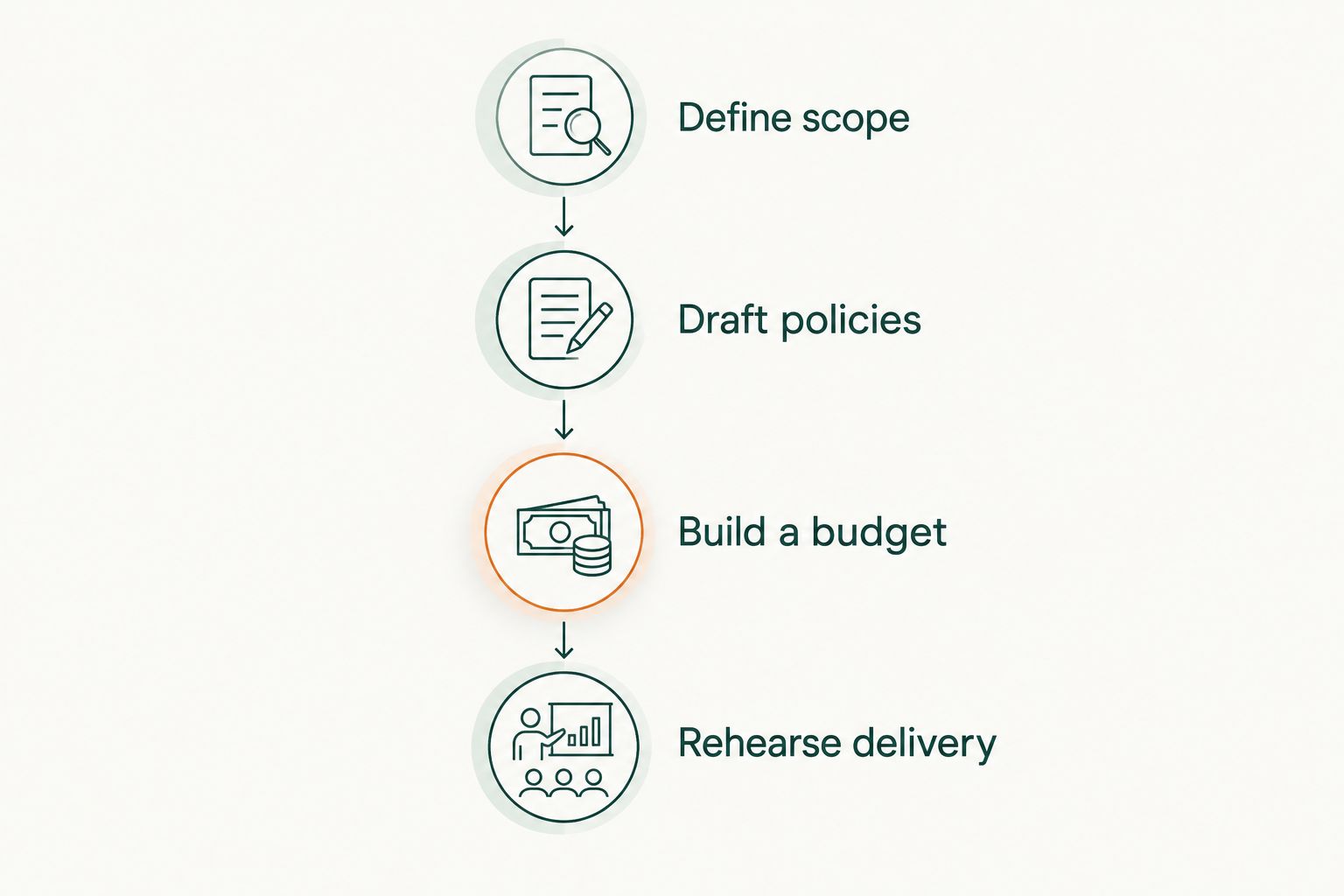
Use this sequence to assess how practical a course's business component is:
- Define scope. Write an accurate description of the teaching service your training prepares you to offer.
- Draft policies. Explain bookings, cancellations, communication, and how clients receive session information.
- Build a budget. Separate confirmed costs from expenses and requirements still awaiting verification.
- Rehearse delivery. Walk through an inquiry, a booking, a session reminder, and a follow-up message.
This sequence gives you concrete work to discuss with a tutor where feedback is offered. Ask whether business assignments receive individual comments, use model answers, or remain self-directed exercises; those are different forms of support.
Business assignments also need to stay separate from movement assessments. Understanding a cancellation policy does not demonstrate that you can observe a participant and give an appropriate cue.
When comparing assessment methods, examine written versus practical assessments as a separate enrollment question. Ask what each assessment evaluates, how feedback works, and what happens when work needs improvement.
Teach client acquisition without exaggerated promises
Client-acquisition lessons should start with an accurate offer, not a guaranteed outcome. You need to explain whom a session is intended for, what it involves, and how someone asks questions or books.
Practice writing an invitation that a prospective client can understand without knowing Pilates terminology. State the teaching format and practical arrangements; leave out unsupported claims about treating conditions, guaranteed physical changes, or your professional status.
The distinction between learning to teach and learning to run a service also explains the separate role of business coaching for yoga teachers: the business questions concern positioning, client communication, and operations rather than movement instruction. Pilates business lessons should make that same boundary clear instead of treating promotion as evidence of teaching competence.
Your marketing assignment should include a response to an unsuitable inquiry, too. If someone asks for a service outside your preparation, practice stating that limit rather than changing your offer to secure the booking.
A clear boundary is part of a credible service description. Business training should help you communicate what you do and what you do not offer with equal confidence.
Why business-training needs vary
The right emphasis depends on the teaching decisions you face, not on how many business-themed lessons appear in a syllabus. Use these factors to decide what deserves closer attention:
- Your starting point: A first-time instructor needs help translating practitioner experience into a defined teaching service.
- Your intended setting: Studio applications and independently organized classes involve different administrative decisions.
- Your teaching scope: Mat instruction and dedicated apparatus teaching require different preparation checks.
- Your study format: Self-paced online learning makes the availability and form of feedback an important enrollment question.
- Your development plans: Expanding beyond your initial preparation calls for further training decisions, not simply revised advertising.
Do not demand advanced business planning before you have defined your first teaching role. Start with the decisions you need to make now, while keeping a record of what must be checked before expanding.
Is self-paced study enough for business preparation?
Self-paced study can suit business planning because you can draft policies and budgets around your existing schedule. The trade-off is that flexibility does not tell you how much individual feedback or practical teaching observation you receive.
Teachpilates suits aspiring Pilates instructors seeking self-paced online study covering teaching foundations and business skills. Its stated curriculum includes anatomy, mat and reformer instruction, cueing, and business skills; verify the detailed assessments, access conditions, and support before enrolling.
For your 2026 decision, ask for written answers to the following questions:
- What business topics appear in the curriculum?
- Which assignments require you to apply those topics?
- What feedback is available on your work?
- What are the course-access and completion conditions?
- What teaching scope does completion support?
- Is any independent credential included, or is that a separate process?
Do not interpret an unanswered question as an included benefit. A self-paced format is a scheduling feature, not proof of employer acceptance or hands-on apparatus preparation.
FAQ
What business skills should a Pilates instructor course teach?
A Pilates instructor course should teach service planning, budgeting, client policies, communication, bookings, and accurate marketing. Look for assignments that turn those subjects into documents and decisions you can review.
How much is Teachpilates tuition?
Teachpilates tuition is $497 for its self-paced online Pilates instructor certification course. Keep that tuition separate from any operating expenses or additional preparation required for your intended teaching role.
Do I need business experience before taking Pilates instructor training?
You do not need to arrive with a finished business plan to evaluate instructor training. Ask whether the business lessons explain basic budgeting, client communication, and administration in language a first-time instructor can follow.
Will a Pilates instructor course guarantee me a job?
A Pilates instructor course does not guarantee a job or universal studio acceptance. Check your intended employer's training, assessment, and experience requirements before enrolling.
Does introductory Reformer content qualify me for every apparatus role?
Introductory Reformer content is not a substitute for dedicated hands-on apparatus qualification. Confirm the practical preparation and assessment required for the particular role you want.
Should business assignments be assessed separately from teaching?
Business assignments and teaching assessments should have distinct purposes. A budget or client policy demonstrates business planning, while practical teaching assessment examines your ability to deliver instruction.
Does a course certificate include an independent credential?
Do not assume a course certificate includes an independent credential. Ask the provider to identify the exact award and explain any separate eligibility, assessment, or application process.
One last thing
Before enrolling, write the message you would send to your first prospective client. Explain what you teach, how booking works, and where your preparation ends.
Any sentence you cannot write accurately identifies a question your training or business planning still needs to answer. Use that unfinished message as your enrollment checklist—not a promise about future earnings.