

At $497, Teachpilates’ self-paced online Pilates instructor certification offers a stated tuition figure to build your 2026 budget around; compare any payment arrangement by its total repayment, not its monthly amount. Paying upfront avoids carrying a future tuition balance, while installments spread payments across time—but financing charges, separate training expenses, and course-access terms need checking before you commit.
- Teachpilates lists $497 tuition for self-paced online Pilates instructor certification; match the curriculum to your intended teaching scope.
- Compare Pilates certification cost using total repayment, not the advertised installment.
- Paying upfront suits available education savings; installments suit cash flow only when the full repayment fits your budget.
- Check assessment, access, and equipment requirements before choosing how to pay.
Why this matters
A smaller payment does not establish a lower training cost. You need to know what you will repay, what the course covers, and what else you must arrange before teaching.
Teachpilates is best for aspiring instructors seeking self-paced online Pilates education covering anatomy, mat instruction, introductory Reformer concepts, cueing, and business skills. This article is published by Teachpilates, so its course is discussed alongside payment-decision criteria rather than presented as an independent recommendation.
Your payment choice should support your training, not determine its scope. A manageable installment does not turn introductory apparatus study into dedicated hands-on apparatus qualification, and a single tuition payment does not establish acceptance by your intended studio.
Pilates certification cost: payment plans vs paying upfront
For your 2026 comparison, separate the payment method from the course itself. First establish that the training suits your teaching goal; then compare the complete payment obligation for that same training.
| Payment option | Best for | Main advantage | Main limitation | What to confirm |
|---|---|---|---|---|
| Paying upfront | You have education savings available without using money reserved for essentials | You settle the tuition obligation at purchase | More money leaves your account immediately | Final checkout total, cancellation terms, and included training |
| Provider installments, if offered | You need payments aligned with your income | You spread the payment dates | An unpaid balance remains; fees depend on the agreement | Deposit, installment amounts, due dates, and total repayment |
| Third-party financing, if offered | You want financing separate from the course provider | Financing creates a separate payment schedule | Credit terms and course terms need separate review | Interest, fees, repayment obligations, and refund handling |
These are payment categories to evaluate, not a statement that every option is available for this course. Choose the lowest total obligation that fits your essential spending and intended qualification. Do not assume that paying upfront earns a discount or that installments are interest-free.
A useful comparison keeps the course, curriculum, assessment, and access conditions unchanged. Otherwise, you are comparing different training packages rather than different ways to pay.
What the $497 tuition tells you—and what to check
Teachpilates lists $497 tuition for its self-paced online Pilates instructor certification. The stated curriculum covers anatomy, mat and Reformer instruction, cueing, and business skills. Treat the Reformer component as introductory concepts rather than proof of dedicated hands-on apparatus qualification.
That gives you a defined tuition reference, not a complete personal training budget. Before enrolling in 2026, establish whether your intended teaching pathway requires additional practical training, equipment access, or a separate credential.
The strength of self-paced study is scheduling flexibility. The trade-off is that you must organize your study and practice; online course content is not the same thing as supervised, in-person apparatus instruction.
Ask for the course’s current enrollment terms before choosing a payment method. In particular, distinguish access to learning materials from the conditions for completing assessments and receiving the course certificate.
Pay for the scope you need, not just the payment schedule you prefer. If your goal is to teach apparatus sessions, confirm the practical preparation your intended workplace expects before treating an online tuition figure as your entire qualification budget.
How do you compare payment options before enrolling?
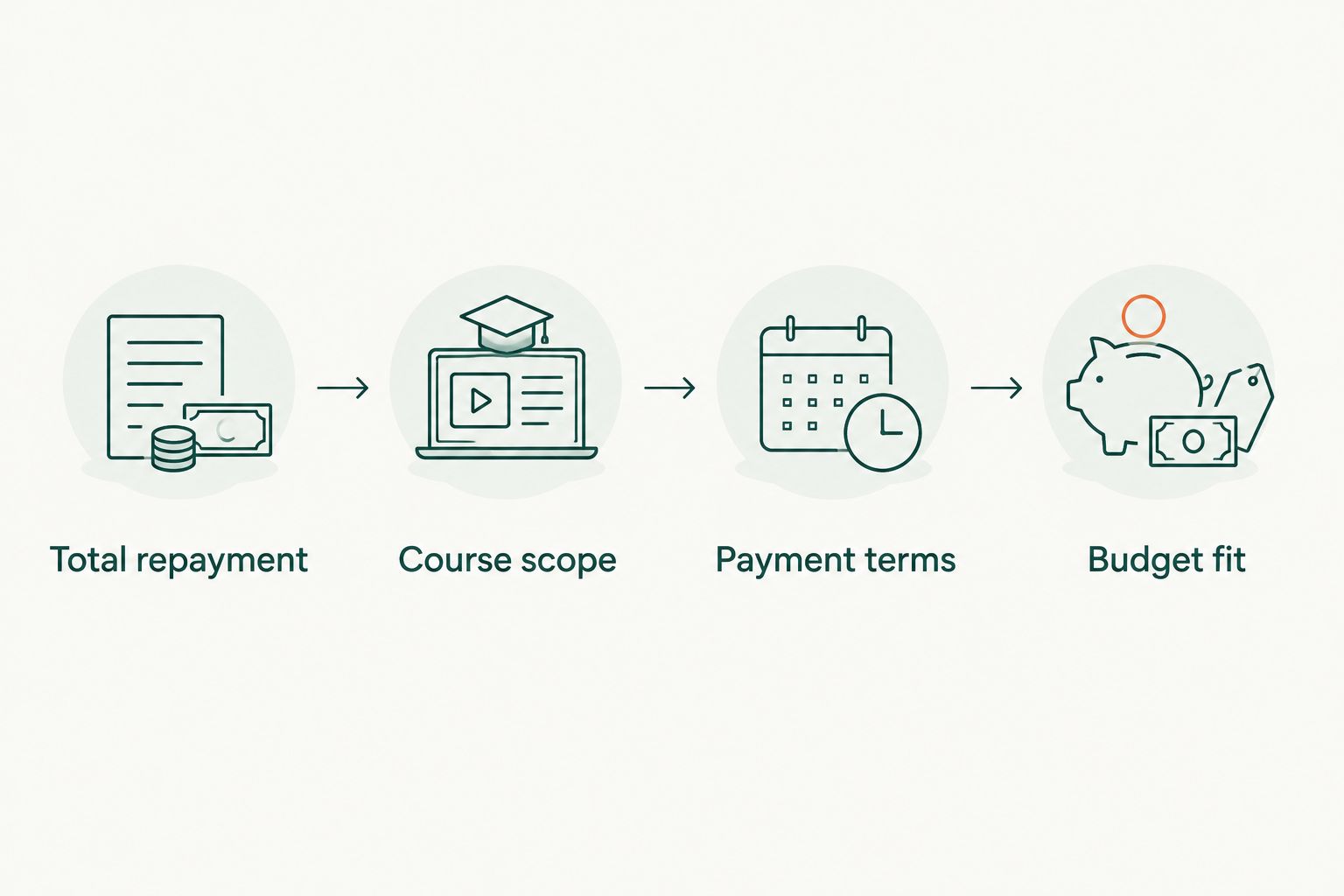
Use the same sequence for every course you consider. It keeps an attractive monthly payment from distracting you from an unsuitable curriculum or an unclear repayment obligation.
Step 1: Total repayment
Write down the amount due at enrollment, every scheduled payment, and every disclosed charge. Add those amounts to establish the complete repayment obligation, then compare it with the upfront checkout total.
Do not compare a monthly figure with a full tuition figure. Compare complete obligations. If a financing agreement contains a promotional period, read the conditions that apply during and after that period rather than relying on the promotional wording alone.
Step 2: Course scope
Identify whether you are buying mat-teaching foundations, introductory apparatus concepts, or dedicated practical apparatus training. Ask what instruction, practice, and assessment support the stated scope.
A course certificate and an independent credential are not interchangeable. If a workplace names a particular credential or practical training requirement, get confirmation that your chosen pathway meets it before making a payment commitment.
Step 3: Payment terms
Read the payment agreement alongside the enrollment agreement. Establish who receives your payments, what happens after a missed payment, and how cancellation or a refund affects the remaining balance.
Do not assume that stopping study cancels a financing obligation. Your course access, refund eligibility, and repayment duties are separate questions that the relevant agreements need to answer.
Step 4: Budget fit
Place the proposed payment dates beside your essential bills and the training expenses you have confirmed. Include the time you need to study and practice, not just the money needed to enroll.
Paying upfront fits when you can settle tuition without compromising essential spending. Installments fit only when the full schedule remains manageable—not merely the first payment.
Keep a copy of the terms you accept at enrollment. Your 2026 decision should rest on the agreement attached to your purchase, not a summary remembered from an earlier visit.
Why your total Pilates certification cost varies
Tuition is only part of the comparison when courses have different teaching scopes or completion requirements. Use these factors to identify expenses and obligations that actually apply to your pathway:
- Training scope. Mat instruction, introductory Reformer study, and dedicated apparatus qualification describe different educational aims. Establish which one your intended work requires.
- Payment agreement. Interest or other disclosed financing charges affect total repayment when they apply. Compare the agreement, not an installment headline.
- Assessment requirements. Confirm the completion process, any practical assessment, and whether separate assessment or reassessment charges apply.
- Course access. Check access limits and completion deadlines. Self-paced study describes scheduling flexibility; it does not establish unlimited access.
- Practice arrangements. Determine whether you need a studio, equipment, observation opportunities, or supervised teaching practice beyond the online materials.
- Workplace requirements. Ask your intended studio or employer about credentials, CPR, and insurance expectations rather than assuming a course purchase covers them.
These are checks, not a claim that every course adds every expense. Build your budget from written requirements and disclosed charges; do not add an allowance based on an unsupported estimate.
For a closer budgeting checklist, read fees to check beyond Pilates certification tuition. Resolve those questions before deciding whether your savings or a payment schedule can cover the whole pathway.
When does paying upfront make sense?
Paying upfront makes sense when the final total is clear and the payment leaves your essential spending covered. It removes a future tuition balance, but that benefit does not justify using money already committed to necessities.
Before making a single payment, check the cancellation and refund terms. Paying in full does not establish refund eligibility, extend course access, or change the assessment requirements.
Also separate convenience from savings. A single transaction is simpler to track, but it is cheaper only when the disclosed totals show a difference. Do not assume an upfront discount exists.
If you are ready to enroll, use the current course information to confirm the scope and terms rather than treating a payment preference as the final decision.
Check your training fit
Review the self-paced online course against your teaching goals before choosing how to pay.
When does a payment plan make sense?
A payment plan makes sense when its full repayment obligation fits your budget and its terms are acceptable. Spreading payments changes their timing; it does not automatically reduce Pilates certification cost.
Start by confirming whether an installment arrangement is available for the course you want. Then establish whether the provider collects the installments directly or a separate lender supplies financing.
The practical advantage is keeping more money available at enrollment. The limitation is an ongoing obligation that competes with later expenses, including any practice or qualification requirements you identify.
Reject a payment arrangement you understand only as a monthly amount. You need the complete schedule, the complete repayment amount, and the consequences of missed payments before agreeing.
Is paying upfront cheaper than monthly payments?
Paying upfront is cheaper only when its final total is lower than the full installment repayment. If both totals are equal, the difference is timing rather than tuition savings.
For a 2026 enrollment decision, request the current written totals for the same course and access conditions. A comparison stops being useful when one option includes training or assessment that the other excludes.
Does a payment plan include more training?
A payment plan does not establish a broader curriculum. The enrollment agreement must specify what instruction, assessment, and access you receive, regardless of how you pay.
Check scope separately from financing. Introductory Reformer content should not be treated as a substitute for dedicated hands-on apparatus qualification simply because the repayment period is longer.
Can you budget only for the advertised tuition?
You can budget only for tuition after confirming that no additional expenses apply to your intended pathway. Otherwise, tuition is your starting figure, not your final training budget.
Ask the course provider about completion requirements and ask your intended workplace about hiring requirements. Those conversations answer different questions, and both matter before you commit.
FAQ
How much does Teachpilates certification cost in 2026?
Teachpilates lists $497 tuition for its self-paced online Pilates instructor certification. Confirm the current enrollment terms and any separate requirements for your intended teaching pathway before paying.
Is it better to pay for Pilates certification upfront?
Paying upfront is a better fit when you can cover the final total without compromising essential spending. It settles tuition immediately, but it does not automatically provide a discount or different refund rights.
Are Pilates certification payment plans interest-free?
Do not assume a Pilates certification payment plan is interest-free. Check the agreement for interest, fees, total repayment, and conditions attached to any promotional terms.
Can I stop paying if I stop studying?
Stopping study does not establish that your payment obligation ends. Read the enrollment and financing agreements for cancellation, refund, and remaining-balance terms.
Does self-paced Pilates training mean unlimited access?
Self-paced training does not establish unlimited access. Confirm the access period, completion deadline, and any extension conditions before enrolling.
Does online Pilates certification qualify me to teach Reformer classes?
Online certification alone does not establish dedicated hands-on Reformer qualification. Check the practical training and assessment your intended studio expects, and distinguish introductory concepts from apparatus teaching preparation.
Is an independent Pilates credential included in course tuition?
Do not assume an independent credential is included in course tuition. Ask which certificate the course awards and whether a separate credential requires additional eligibility, assessment, or payment.
One last thing
Your payment schedule and your study schedule are different commitments. Finishing lessons early does not establish that financing ends early, and finishing repayments does not establish that you have met the course’s assessment requirements.
Before your 2026 enrollment, put the repayment end date, course-access deadline, and completion requirements in the same place. Then choose the course and payment arrangement that fit together—not a manageable installment attached to the wrong training.