

With $497 tuition and flexible self-paced study, an online Pilates certification still requires a refund check before you enroll: confirm the cancellation deadline, what starts that deadline, whether opening lessons changes eligibility, and how to submit a request. Check deductions and installment obligations separately; the tuition figure alone does not tell you what happens if you withdraw.
- Before buying online pilates certification, get the refund deadline, access restrictions, and cancellation process in writing.
- Teachpilates offers self-paced instructor training; assess its refund terms separately from its curriculum.
- Check mat teaching, introductory Reformer scope, and assessment requirements before opening course materials.
- Save the terms attached to your purchase, not just a promotional description.
Why this matters
Your enrollment decision has two parts: whether the training fits your teaching goal, and whether you accept the conditions if that decision changes. Flexible study describes how you learn. It does not establish a right to cancel, pause payments, or keep access after a refund.
At Teachpilates, the course covers anatomy, mat and reformer instruction, cueing, and business skills. This guide is published by Teachpilates to help you evaluate enrollment terms, including the terms of its own course. Use the same questions for every provider you consider in 2026.
Read the refund terms before you open the course, not after you decide it is unsuitable. Treat marketing copy, the enrollment agreement, and the refund policy as different documents with different jobs.
Which online Pilates certification refund terms should you check?
Check the rules that determine eligibility, the amount returned, and the action required from you. A statement that refunds are available is incomplete without those details. Work through the following checks before paying or accessing lessons.
1. Find the cancellation deadline and its starting event
Locate the exact cancellation period in the written terms. Then identify what starts it: payment, enrollment confirmation, account activation, course access, or another stated event. Do not assume those events happen together.
Ask how the provider measures the deadline and which time zone applies if the wording leaves either unclear. Save the answer alongside your enrollment confirmation. Your personal study start date does not replace the contractual starting event unless the terms explicitly say so.
2. Check what counts as starting the course
Find out whether signing in, playing a lesson, downloading a workbook, submitting an assessment, or attending a session affects refund eligibility. These are questions to resolve, not assumed restrictions on any particular course.
This check matters before you explore the learning platform. If you need to inspect lesson quality before deciding, request a sample or demonstration rather than assuming paid access functions as a trial. Only treat access as a trial when the provider explicitly offers one.
3. Identify deductions and excluded payments
Read whether the policy describes a full refund, a partial refund, or exclusions. Ask which payments the refund applies to and whether any stated administrative, assessment, or material charges remain payable.
For a course with $497 tuition, ask whether an eligible cancellation returns that tuition in full or follows another written calculation. This is a question about the agreement, not a claim that a particular deduction exists. You need the calculation before you can judge the financial risk.
4. Separate cancellation from installment payments
If you choose installments, check both the training agreement and the payment agreement. Ask whether withdrawing cancels future payments, changes the remaining balance, or requires a separate instruction to a payment provider.
Stopping study and stopping a payment arrangement are different actions. Do not treat an unused account as a cancellation request. Follow the stated process and obtain confirmation of what remains payable, if anything.
5. Find the required request method
Identify the channel the policy requires, such as an account form or a specified email address. Check which details you must provide and whether eligibility depends on the request being sent or received before the deadline.
Keep a copy of your request and its submission confirmation. If you speak to support, ask for a written record of the answer. A clear record connects your request to the relevant purchase and makes the next conversation more precise.
6. Check what happens after approval
Ask when access ends, how an approved refund is returned, and what processing period the provider states. Also check what happens to submitted assessments, downloaded materials, and any completion record.
Do not confuse approval with receipt of funds. Ask who handles each stage and how to follow up if the stated processing period passes. Use the provider's actual timeline rather than a timeline borrowed from another course.
Compare refund arrangements by their conditions
No single refund arrangement is best for every learner. The useful comparison is between the written conditions and how you expect to evaluate the course. The arrangements below are examples to identify in a policy, not descriptions of any named provider's current terms.
| Arrangement, if offered | Best for | Advantage | Limitation to check |
|---|---|---|---|
| Cancellation before access | Learners who finish their research before opening lessons | Gives a clear decision point before study begins | Opening materials might change eligibility |
| Time-limited refund | Learners ready to review the course promptly | Establishes a defined review period | The clock might start before your first study session |
| Progress-based refund | Learners who can track their course activity | Connects eligibility to stated usage conditions | Downloads, assessments, or lesson access might count differently |
| Deferral instead of refund | Learners who still want the course but need a later start | Can address a scheduling problem | Does not return tuition and needs its own written conditions |
Read a 2026 enrollment offer against its actual policy. A reassuring headline does not tell you which arrangement applies, and a deferral offer is not the same thing as a refund.
Why refund eligibility varies
The answer depends on the agreement attached to your purchase and your activity under that agreement. Keep these factors separate when reading the terms:
- Starting event: A payment-based deadline and an access-based deadline use different triggers. Identify the one stated in your agreement.
- Course activity: Check whether the policy distinguishes opening lessons, downloading materials, and submitting work.
- Payment structure: An installment agreement needs its own cancellation check; a course withdrawal instruction might not address it.
- Included services: Where tutoring, assessments, or physical materials are included, check whether the terms address services already supplied.
- Reason for withdrawal: Read whether the policy distinguishes a change of mind, a scheduling problem, and a complaint about course delivery.
- Purchase terms: Save the version presented when you enroll. A later website page does not document what you originally accepted.
For your 2026 purchase record, keep the policy, order confirmation, and any written clarification together. That gives you a usable reference without relying on memory.
Check teaching scope before refund terms become urgent
A refund policy cannot make the wrong training pathway right for you. Start with the work you want to do: teach mat classes, build introductory apparatus knowledge, or pursue dedicated hands-on apparatus training. Then compare that goal with the course's stated curriculum and assessments.
Teachpilates is best for aspiring Pilates instructors seeking self-paced online study of anatomy, mat instruction, cueing, and business skills. Its flexible format supports independent study, but online learning is not a substitute for every practical requirement a teaching role can involve.
The course description includes reformer instruction. For your enrollment decision, distinguish introductory Reformer concepts from a dedicated hands-on apparatus qualification. Do not assume that a curriculum reference establishes the practical training or credential a particular studio requires.
Before enrolling, ask your intended employer or studio which training, assessments, and practical experience it accepts. Use the guide to checking employer requirements for online Pilates certification to organize that conversation. No course purchase promises a job or universal studio acceptance.
Also check prerequisites, assessment format, tutor support, and access duration. Self-paced study tells you that you control your study rhythm; it does not, by itself, establish unlimited access, live feedback, or an independent credential.
Build a purchase record before you enroll
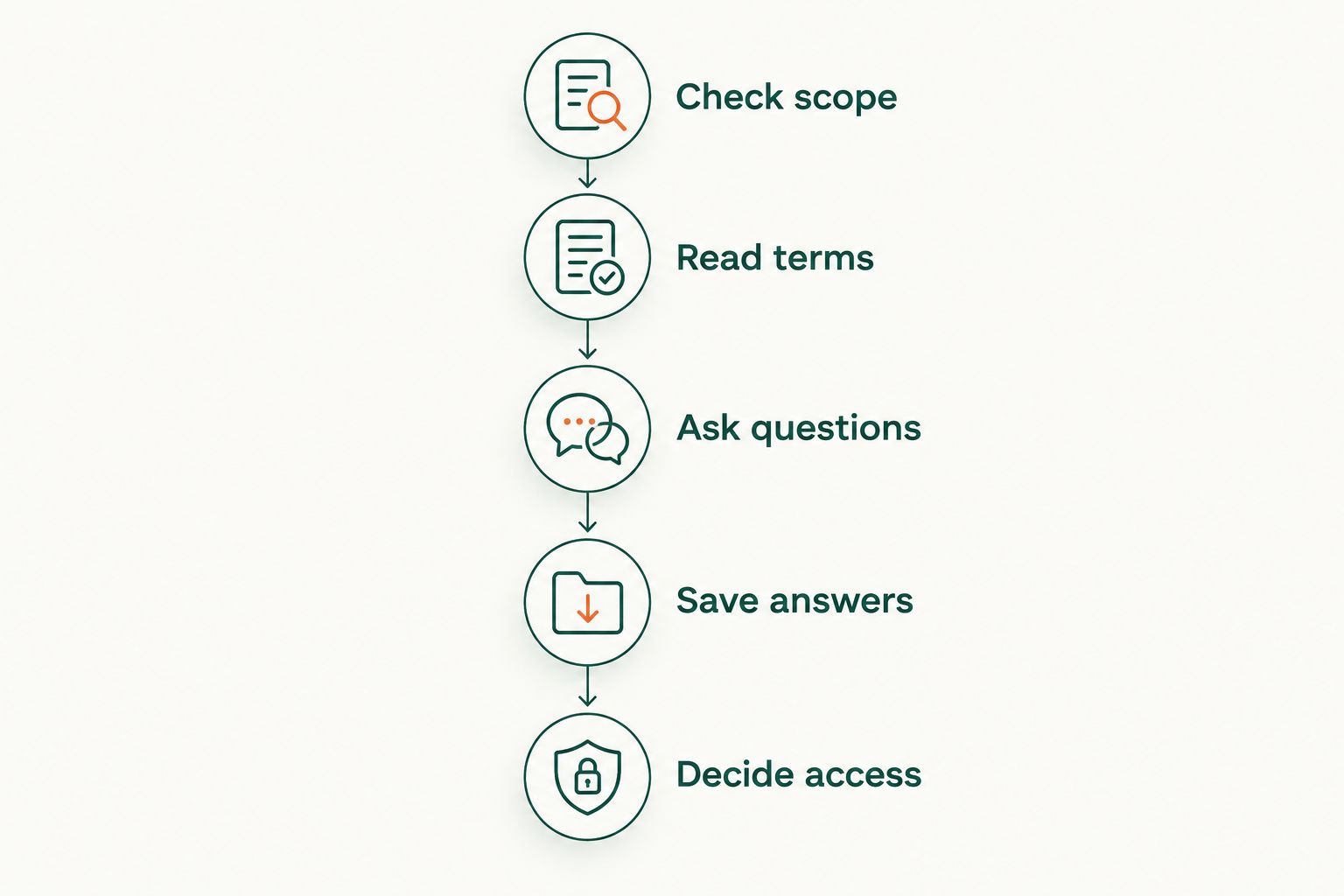
A useful purchase record is short enough to review and complete enough to answer a disagreement. Follow this sequence before you enter payment details.
- Check scope. Write down your intended teaching setting and match it to the published course coverage. List any practical training you still need to investigate.
- Read terms. Save the refund policy, enrollment conditions, and payment conditions presented at checkout. Keep the date visible in your saved record.
- Ask questions. Send unresolved questions together so the reply addresses your actual decision. Ask for written clarification rather than interpreting ambiguous wording yourself.
- Save answers. Keep the reply with your order confirmation and the terms you accepted. Include any conditions attached to an exception or alternative arrangement.
- Decide access. Confirm whether beginning study changes eligibility before you log in or download materials. Then decide whether you are ready to proceed.
This sequence separates course suitability from cancellation mechanics. You need both answers before paying, even when the curriculum looks right.
Your record does not need to be complicated. A saved document containing the relevant terms and correspondence is more useful than scattered screenshots without dates or context. Keep it accessible until any cancellation or refund issue is resolved.
What should you ask when the policy is unclear?
Ask questions that require a specific answer. Instead of asking whether the course is risk-free, ask what happens to your payment if you cancel before access, after opening lessons, or after submitting an assessment. Those scenarios expose the terms you need to understand.
Use a short message with these prompts:
- What event starts the cancellation period?
- Which course activities change refund eligibility?
- What amount is refundable under the applicable conditions?
- Does cancellation end future installment obligations?
- Where must I submit the request, and what confirmation will I receive?
- What happens to access after cancellation or refund approval?
If the response points back to wording you still cannot interpret, ask for clarification of that wording. Do not replace an unanswered question with an assumption. Enroll when you understand the conditions, not merely when you like the course outline.
Can you get a refund after opening the course?
Refund eligibility after opening an online course depends on its written terms and any applicable legal rights. Check whether access itself changes eligibility or whether the policy uses another condition, such as downloads or assessment submission. Do not assume that brief access is disregarded.
Does self-paced study mean you can cancel whenever you want?
Self-paced study describes scheduling, not cancellation rights. Check the refund deadline and access expiry separately, even if you plan to study gradually. For a 2026 enrollment, make sure the terms you save are the ones presented for that purchase.
Is a course deferral the same as a refund?
A deferral changes when you study; a refund returns an eligible payment under the applicable terms. If a provider offers deferral, check the revised access period, any conditions, and whether accepting it affects your refund request. Choose it only if you still want the training.
FAQ
What refund terms should I check before buying online Pilates certification?
Check the cancellation deadline, its starting event, access-related restrictions, deductions, and the required request method. Read installment obligations and post-cancellation access conditions separately.
Can I get my money back if I have not started the lessons?
Not starting lessons does not, by itself, establish refund eligibility. Check whether the policy measures the deadline from payment, enrollment, activation, or course access.
Does downloading a workbook affect my right to a refund?
Check the course policy before downloading a workbook because eligibility can depend on the stated access conditions. Ask the provider to clarify downloads explicitly if the wording is unclear.
Can I stop installments if I withdraw from an online Pilates course?
Withdrawal does not by itself confirm that future installments are canceled. Read the payment agreement and obtain written confirmation of any remaining obligation.
Is Teachpilates suitable if I want flexible online instructor training?
Teachpilates offers self-paced online instructor training covering anatomy, mat and reformer instruction, cueing, and business skills. Check its current terms and distinguish introductory Reformer concepts from dedicated hands-on apparatus qualification.
Does Pilates certification guarantee a studio will hire me?
Pilates certification does not guarantee employment or universal studio acceptance. Ask your intended employer about its training, assessment, and practical-experience requirements before enrolling.
Which refund policy should I save for a 2026 enrollment?
Save the refund policy and enrollment terms presented for your 2026 purchase. Keep them with your payment confirmation and any written clarification from the provider.
One last thing
The detail that deserves your closest attention is the event that starts the cancellation clock. You can know the deadline and still misunderstand it if you assume it begins with your first planned study session rather than the event stated in the agreement.
Before your 2026 enrollment, finish this sentence in your own notes: My cancellation period starts when the agreement says it starts, and these actions change my eligibility. If you cannot fill in the actual conditions, ask before opening the course. A clear answer now is more useful than a refund argument later.